


Likes
Comments
Share


@BLAZED
Follow
Week 14 (2-6 t/m 8-6)
2-6
Temperatuur: 27.1 graden (licht aan) 20.5 graden (licht uit)
Luchtvochtigheid: 55% (hoogste) 45% (laagste)
Het gaat aardig goed. En wat zijn de shots met de lamp uit en flitser op mobiel aan super mooi!
Ik ben ook verliefd geworden op haar geur, ze ruikt zo lekker zoet-zuur! 😍Ik kan niet wachten om haar te testen. Ookal ben ik bang dat ze net wat te veel THC heeft dan ik normaal rook haha, maar dat zien we nog wel.
Watergift: 1000 ml, met 0.2 ml Silica Power per liter, 0.3 ml CalMag per liter en 1 gr Calcium PowderFeeding per liter. EC: 0.6 PH: 6.3
3-6
Temperatuur: 28.8 graden (licht aan) 21.8 graden (licht uit)
Luchtvochtigheid: 56% (hoogste) 41% (laagste)
Watergift: 1000 ml, met 0.2 ml Silica Power per liter, 0.3 ml CalMag per liter en 1 gr Calcium PowderFeeding per liter. EC: 0.6 PH: 6.3
4-6
Temperatuur: 29.5 graden (licht aan) 22.7 graden (licht uit)
Luchtvochtigheid: 55% (hoogste) 42% (laagste)
Watergift: 1000 ml, met 0.2 ml Silica Power per liter, 0.3 ml CalMag per liter en 1 gr Calcium, 0.6 gr Hybrids en 0.4 gr PK+ PowderFeeding per liter. EC: 1.7 PH: 6.2
5-6
Temperatuur: 29.5 graden (licht aan) 22.4 graden (licht uit)
Luchtvochtigheid: 55% (hoogste) 44% (laagste)
Watergift: 1000 ml, met 0.2 ml Silica Power per liter, 0.3 ml CalMag per liter en 1 gr Calcium PowderFeeding per liter. EC: 0.6 PH: 6.2
6-6
Temperatuur: 29.4 graden (licht aan) 21.8 graden (licht uit)
Luchtvochtigheid: 55% (hoogste) 43% (laagste)
Ik ga vanaf nu om de dag wat PK+ meegeven aangezien ze dat nodig heeft in de bloei, 0.4gr per liter wordt er aangeraden op het schema maar ik doe voorzichtig en geef haar 0.2gr per liter.
Watergift: 1000 ml, met 0.2 ml Silica Power per liter, 0.3 ml CalMag per liter en 1 gr Calcium en 0.2 gr PK+ PowderFeeding per liter. EC: 0.7 PH: 6.3
7-6
Temperatuur: 30.1 graden (licht aan) 23.1 graden (licht uit)
Luchtvochtigheid: 56% (hoogste) 45% (laagste)
Watergift: 1000 ml, met 0.2 ml Silica Power per liter, 0.3 ml CalMag per liter en 1 gr Calcium PowderFeeding per liter. EC: 0.6 PH: 6.3
8-6
Temperatuur: 31 graden (licht aan) 23.5 graden (licht uit)
Luchtvochtigheid: 58% (hoogste) 45% (laagste)
De toppen beginnen voller te worden! Nu nog ongeveer 3 weekjes te gaan. 😁
Watergift: 1000 ml, met 0.2 ml Silica Power per liter, 0.3 ml CalMag per liter en 1 gr Calcium en 0.2 gr PK+ PowderFeeding per liter. EC: 0.7 PH: 6.2

Likes
25
Share


@Ultraviolet
Follow
ANTHOCYANIN production is primarily controlled by the Cryptochrome (CR1) Photoreceptor ( !! UV and Blue Spectrums are primary drivers in the production of the pigment that replaces chlorophyll, isn't that awesome!
1. Diverse photoreceptors in plants
Many civilizations, including the sun god of ancient Egypt, thought that the blessings of sunlight were the source of life. In fact, the survival of all life, including humans, is supported by the photosynthesis of plants that capture solar energy. Plants that perform photosynthesis have no means of transportation except for some algae. Therefore, it is necessary to monitor various changes in the external environment and respond appropriately to the place to survive. Among various environmental information, light is especially important information for plants that perform photosynthesis.
In the process of evolution, plants acquired phytochrome, which mainly receives light in the red light region, and multiple blue light receptors, including his hytropin and phototropin, in order to sense the light environment. .. In addition to these, an ultraviolet light receptor named UVR8 was recently discovered. The latest image of the molecular structure and function of these various plant photoreceptors (Fig. 1), focusing on phytochrome and phototropin.
Figure 1
Ultraviolet-visible absorption spectra of phytochrome, cryptochrome, phototropin, and UVR8. The dashed line represents each bioactive absorption spectrum.
2. Phytochrome; red-far red photoreversible molecular switch
What is phytochrome?
Phytochrome is a photochromic photoreceptor, and has two absorption types, a red light absorption type Pr (absorption maximum wavelength of about 665 nm) and a far-red light absorption type Pfr (730 nm). Reversible light conversion between the two by red light and far-red light, respectively(Fig. 1A, solid line and broken line). In general, Pfr is the active form that causes a physiological response. With some exceptions, phytochrome can be said to function as a photoreversible molecular switch. The background of the discovery is as follows. There are some types of plants that require light for germination (light seed germination). From that study, it was found that germination was induced by red light, the effect was inhibited by subsequent far-red light irradiation, and this could be repeated, and the existence of photoreceptors that reversibly photoconvert was predicted. In 1959, its existence was confirmed by the absorption spectrum measurement of the yellow sprout tissue, and it was named phytochrome. Why does the plant have a sensor to distinguish between such red light and far-red light? There is no big difference between the red and far-red light regions in the open-field spectrum of sunlight, but the proportion of red light is greatly reduced due to the absorption of chloroplasts in the shade of plants. Similar changes in light quality occur in the evening sunlight. Plants perceive this difference in light quality as the ratio of Pr and Pfr, recognize the light environment, and respond to it.
Subsequent studies have revealed that it is responsible for various photomorphogenic reactions such as photoperiodic flowering induction, shade repellent, and deyellowing (greening). Furthermore, with the introduction of the model plant Arabidopsis thaliana (At) and the development of molecular biological analysis methods, research has progressed dramatically, and his five types of phytochromes (phyA-E) are present in Arabidopsis thaliana. all right. With the progress of the genome project, Fi’s tochrome-like photoreceptors were found in cyanobacteria, a photosynthetic prokaryotes other than plants. Furthermore, in non-photosynthetic bacteria, a homologue molecule called bacteriophytochrome photoreceptor (BphP) was found in Pseudomonas aeruginosa (Pa) and radiation-resistant bacteria (Deinococcus radiodurans, Dr).
Domain structure of phytochrome molecule
Phytochrome molecule can be roughly divided into N-terminal side and C-terminal side region. PAS (Per / Arndt / Sim: blue), GAF (cGMP phosphodiesterase / adenylyl cyclase / FhlA: green), PHY (phyto-chrome: purple) 3 in the N-terminal region of plant phytochrome (Fig. 2A) There are two domains and an N-terminal extension region (NTE: dark blue), and phytochromobilin (PΦB), which is one of the ring-opening tetrapyrroles, is thioether-bonded to the system stored in GAF as a chromophore. ing. PAS is a domain involved in the interaction between signal transduction-related proteins, and PHY is a phytochrome-specific domain. There are two PASs and her histidine kinase-related (HKR) domain (red) in the C-terminal region, but the histidine essential for kinase activity is not conserved.
3. Phototropin; photosynthetic efficiency optimized blue light receptor
What is phototropin?
Charles Darwin, who is famous for his theory of evolution, wrote in his book “The power of move-ment in plants” published in 1882 that plants bend toward blue light. Approximately 100 years later, the protein nph1 (nonphoto-tropic hypocotyl 1) encoded by one of the causative genes of Arabidopsis mutants causing phototropic abnormalities was identified as a blue photoreceptor. Later, another isotype npl1 was found and renamed phototropin 1 (phot1) and 2 (phot2), respectively. In addition to phototropism, phototropin is damaged by chloroplast photolocalization (chloroplasts move through the epidermal cells of the leaves and gather on the cell surface under appropriate light intensity for photosynthesis. As a photoreceptor for reactions such as escaping to the side of cells under dangerous strong light) and stomata (reactions that open stomata to optimize the uptake of carbon dioxide, which is the rate-determining process of photosynthetic reactions). It became clear that it worked. In this way, phototropin can be said to be a blue light receptor responsible for optimizing photosynthetic efficiency.
Domain structure and LOV photoreaction of phototropin molecule
Phototropin molecule has two photoreceptive domains (LOV1 and LOV2) called LOV (Light-Oxygen-Voltage sensing) on the N-terminal side, and serine / on the C-terminal side. It is a protein kinase that forms threonine kinase (STK) (Fig. 4Aa) and whose activity is regulated by light. LOV is one molecule as a chromophore, he binds FMN (flavin mononucleotide) non-covalently. The LOV forms an α/βfold, and the FMN is located on a β-sheet consisting of five antiparallel β-strands (Fig. 4B). The FMN in the ground state LOV shows the absorption spectrum of a typical oxidized flavin protein with a triplet oscillation structure and an absorption maximum wavelength of 450 nm, and is called D450 (Fig. 1C and Fig. 4E). After being excited to the singlet excited state by blue light, the FMN shifts to the triplet excited state (L660t *) due to intersystem crossing, and then the C4 (Fig. 4C) of the isoaroxazine ring of the FMN is conserved in the vicinity. It forms a transient accretionary prism with the tain (red part in Fig. 4B Eα) (S390I). When this cysteine is replaced with alanine (C / A substitution), the addition reaction does not occur. The effect of adduct formation propagates to the protein moiety, causing kinase activation (S390II). After that, the formed cysteine-flavin adduct spontaneously dissociates and returns to the original D450 (Fig. 4E, dark regression reaction).
Phototropin kinase activity control mechanism by LOV2
Why does phototropin have two LOVs? Atphot1 was found as a protein that is rapidly autophosphorylated when irradiated with blue light.
The effect of the above C / A substitution on this self-phosphorylation reaction and phototropism was investigated, and LOV2 is the main photomolecular switch in both self-phosphorylation and phototropism. It turns out that it functions as. After that, from experiments using artificial substrates, STK has a constitutive activity, LOV2 functions as an inhibitory domain of this activity, and the inhibition is eliminated by photoreaction, while LOV1 is kinase light. It was shown to modify the photosensitivity of the activation reaction. In addition to this, LOV1 was found to act as a dimerization site from the crystal structure and his SAXS. What kind of molecular mechanism does LOV2 use to photoregulate kinase activity? The following two modules play important roles in this intramolecular signal transduction.
Figure 4
(A) Domain structure of LOV photoreceptors. a: Phototropin b: Neochrome c: FKF1 family protein d: Aureochrome (B) Crystal structure of auto barley phot1 LOV2. (C) Structure of FMN isoaroxazine ring. (D) Schematic diagram of the functional domain and module of Arabidopsis thaliana phot1. L, A’α, and Jα represent linker, A’α helix, and Jα helix, respectively. (E) LOV photoreaction. (F) Molecular structure model (mesh) of the LOV2-STK sample (black line) containing A’α of phot2 obtained based on SAXS under dark (top) and under bright (bottom). The yellow, red, and green space-filled models represent the crystal structures of LOV2-Jα, protein kinase A N-lobe, and C-robe, respectively, and black represents FMN. See the text for details.
1) Jα. LOV2 C of oat phot1-to α immediately after the terminus
Rix (Jα) is present (Fig. 4D), which interacts with the β-sheet (Fig. 4B) that forms the FMN-bound scaffold of LOV2 in the dark, but unfolds and dissociates from the β-sheet with photoreaction. It was shown by NMR that it does. According to the crystal structure of LOV2-Jα, this Jα is located on the back surface of the β sheet and mainly has a hydrophobic interaction. The formation of S390II causes twisting of the isoaroxazine ring and protonation of N5 (Fig. 4C).
As a result, the glutamine side chain present on his Iβ strand (Fig. 4B) in the β-sheet rotates to form a hydrogen bond with this protonated N5. Jα interacts with this his Iβ strand, and these changes are thought to cause the unfold-ing of Jα and dissociation from the β-sheet described above. Experiments such as amino acid substitution of Iβ strands revealed that kinases exhibit constitutive activity when this interaction is eliminated, and that Jα plays an important role in photoactivation of kinases.
2) A’α / Aβ gap.
Recently, several results have been reported showing the involvement of amino acids near the A’α helix (Fig. 4D) located upstream of the N-terminal of LOV2 in kinase photoactivation. Therefore, he investigated the role of this A’α and its neighboring amino acids in kinase photoactivation, photoreaction, and Jα structural change for Atphot1. The LOV2-STK polypeptide (Fig. 4D, underlined in black) was used as a photocontrollable kinase for kinase activity analysis. As a result, it was found that the photoactivation of the kinase was abolished when amino acid substitution was introduced into the A’α / Aβ gap between A’α and Aβ of the LOV2 core. Interestingly, he had no effect on the structural changes in Jα examined on the peptide map due to the photoreaction of LOV2 or trypsin degradation. Therefore, the A’α / Aβ gap is considered to play an important role in intramolecular signal transduction after Jα.
Structural changes detected by SAXS
Structural changes of Jα have been detected by various biophysical methods other than NMR, but structural information on samples including up to STK is reported only by his results to his SAXS. Not. The SAXS measurement of the Atphot2 LOV2-STK polypeptide showed that the radius of inertia increased from 32.4 Å to 34.8 Å, and the molecular model (Fig. 4F) obtained by the ab initio modeling software GASBOR is that of LOV2 and STK. It was shown that the N lobes and C lobes lined up in tandem, and the relative position of LOV2 with respect to STK shifted by about 13 Å under light irradiation. The difference in the molecular model between the two is considered to reflect the structural changes that occur in the Jα and A’α / Aβ gaps mentioned above.
Two phototropins with different photosensitivity
In the phototropic reaction of Arabidopsis Arabidopsis, Arabidopsis responds to a very wide range of light intensities from 10–4 to 102 μmol photon / sec / m2. At that time, phot1 functions as an optical sensor in a wide range from low light to strong light, while phot2 reacts with light stronger than 1 μmol photon / sec / m2. What is the origin of these differences? As is well known, animal photoreceptors have a high photosensitivity due to the abundance of rhodopsin and the presence of biochemical amplification mechanisms. The exact abundance of phot1 and phot2 in vivo is unknown, but interesting results have been obtained in terms of amplification.
The light intensity dependence of the photoactivation of the LOV2-STK polypeptide used in the above kinase analysis was investigated.
It was found that phot1 was about 10 times more photosensitive than phot2. On the other hand, when the photochemical reactions of both were examined, it was found that the rate of the dark return reaction of phot1 was about 10 times slower than that of phot2. This result indicates that the longer the lifetime of S390II, which is in the kinase-activated state, the higher the photosensitivity of kinase activation. This correlation was further confirmed by extending the lifespan of her S390II with amino acid substitutions. This alone cannot explain the widespread differences in photosensitivity between phot1 and phot2, but it may explain some of them. Furthermore, it is necessary to investigate in detail protein modifications such as phosphorylation and the effects of phot interacting factors on photosensitivity.
Other LOV photoreceptors Among fern plants and green algae, phytochrome ɾphotosensory module (PSM) on the N-terminal side and chimera photoreceptor with full-length phototropin on the C-terminal side, neochrome (Fig. There are types with 4Ab). It has been reported that some neochromes play a role in chloroplast photolocalization as a red light receiver. It is considered that fern plants have such a chimera photoreceptor in order to survive in a habitat such as undergrowth in a jungle where only red light reaches.
In addition to this, plants have only one LOV domain, and three proteins involved in the degradation of photomorphogenesis-related proteins, FKF1 (Flavin-binding, Kelch repeat, F-box 1, ZTL (ZEITLUPE)), LKP2 ( There are LOV Kelch Protein2) (Fig. 4Ac) and aureochrome (Fig. 4Ad), which has a bZip domain on the N-terminal side of LOV and functions as a gene transcription factor.
4. Cryptochrome and UVR8
Cryptochrome is one of the blue photoreceptors and forms a superfamily with the DNA photoreceptor photolyase. It has FAD (flavin adenine dinucle-otide) as a chromophore and tetrahydrofolic acid, which is a condensing pigment. The ground state of FAD is considered to be the oxidized type, and the radical type (broken line in Fig. 1B) generated by blue light irradiation is considered to be the signaling state. The radical type also absorbs in the green to orange light region, and may widen the wavelength region of the plant morphogenesis reaction spectrum. Cryptochrome uses blue light to control physiological functions similar to phytochrome.
It was identified as a photoreceptor from one of the causative genes of UVR8 Arabidopsis thaliana, and the chromophore is absorbed in the UVB region by a Trp triad consisting of three tryptophans (Fig. 1D). It is involved in the biosynthesis of flavonoids and anthocyanins that function as UV scavengers in plants.
Conclusion
It is thought that plants have acquired various photoreceptors necessary for their survival during a long evolutionary process. The photoreceptors that cover the existing far-red light to UVB mentioned here are considered to be some of them. More and more diverse photoreceptor genes are conserved in cyanobacteria and marine plankton. By examining these, it is thought that the understanding of plant photoreceptors will be further deepened.

Likes
7
Share


Coming along nicely in a week or so I will Super crop and scrog shortly thereafter flip to 12-12
Supercropped November 9th 2018
Sugar Black Rose clones humidity dome
Lollipoped and Topped and Scrogged
Nov. 11, 2018


Processing
Likes
1
Share


@TaZmainMan
Follow
She was not suppose to grow that long..22 weeks..but due to the issues I had with the nutrients set me back a few weeks.. a really nice strain to grow i must say..I realized that i do not have enough watts for the grow box..and this affects my yealds.. Its not the best yeald in the world but its bud i didnt have..
Really not happy with the dry weight..but its oky i understand
Only real problems i had was my Ph levels that keeps dropping but that is normal i suppose..My light coverage isnt kind of bad cause i ended up with a lot of small nugs that clearly didnt get light.. well it's all about learning..im learning as i go along..every grow gets better and better..
at least this time I'm growing a strain I'm mad about..
the 48hours darkness at the end of the ripen stage just before harvest makes a huge difference! the buds doubled in size but it will lose the density will drying..
buds are on the rack buzy drying..hence i could not give a dry weight yet.
I'm alittle gown looking at the buds almost dry and they shrunk in size and arent as big as they looked..its alittle heart breaking cause i got only a few good sized bud and the rest is just this little tiny nugs the size of my half my pinky finger nail..😞some are slightly bigger than that..and then the top nugs which was the main colons ..they are about 6 good sized buds..its okay i learned from her and its not a waste cause she did give me some buds in the end..
now the curing starts..going to cure for a month more or less will see as we go along..
Super Cheese Thank you!0
Likes
9
Share


@OS_Farmz
Follow
Aк-47 вытянулся до рекордных 96.6 см в высоту. В целом растения выглядят здоровыми, начали образовываться первые соцветия. На этой неделе начну добавлять Terpenator (3мл х литр).


Likes
1
Share

@Sundancers
Follow
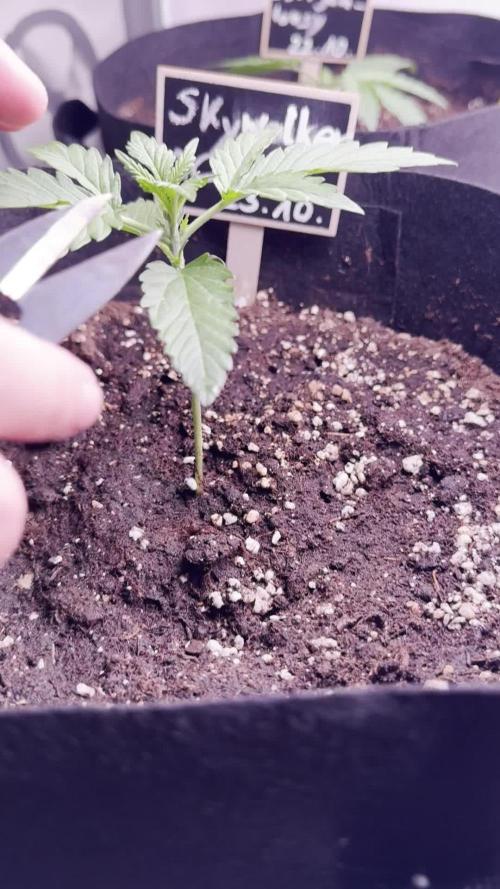
Der Skywalker ist ein kräfter Strain und wurde bereits an Tag 10 mit Topping belohnt. 😜

Likes
6
Share


@russrahl
Follow
We’re back! 💨 Finally was able to get some picks and do an update on these girls. Pushed them 11 weeks into flowering and we cut them down. Took 4 days for me to trim it all! She’s drying in my rack now so I will update the harvest info shortly. I pulled 1 of these already about a month ago that I was growing alongside my peyote cookies and it was some decent buds, not spectacular at first but after a few weeks cutting its coming along better. Ended up with about 11 oz off that one girl and we cut her at the 9 week flowering mark and she had about 2 weeks less veg time as well. So we pushed these 2 girls to the extreme the other way(partially because I just didn’t have the time to cut them…lol) and hopefully we will get some more intense highs from it. I kinda just let these girls do their own thing and really only bent them down over my screen once and tucked a little to fill the screen but other then that she was just blowing up all over and I had a hard time actually containing these 2 girls
In my 4’x8’ tent. We also got a good heat wave again that pushed my temps way up in the 10th week of flowering and these girls grew closer to my light then I wanted or could keep from happening. Lol so we got some major foxtails in the center of my tent but we still ended up with some huge buds. Cheers 💨

Likes
15
Share


@KaliWeeD
Follow
Vamos a por otra semana mas, 🔥 🔥🔥 los clones estan contando los dias para terminar de coger color


Likes
37
Share


@steadfast_grower
Follow
--------------------------------------------
Week 14 // Dec 4 - Dec 10
--------------------------------------------
- Dec 10th puts us at day 96 from seed and everything is going smoothly for the most part - but they still need to mature a bit more.
- i'm definitely seeing the difference in the phenos; one plant going yellow and another is going purple.
- Sage #2, the smaller plant, really hasn't shown me any issues and is fading out to purple and still looks great today.
- Still running beneficials and enzymes: Microbial mass every two weeks and Orca twice a week and Z9 once a week.
- Plants are eating and drinking as top off is dropping daily and PPMs dropping as a result.
- I'm still alternating Overdrive (15ml) and AN Coco Bloom (10ml) and shooting for a high target of 750ppm each dose.
- I'm giving a dose at about the 690ppm mark. The dose brings ppm back up to 750ppm. I've been doing this daily with a top-off bucket with plain RO maintaing the water level.
- I'm checking trichomes daily, just getting milky now on the calyxes (bracts). But, I'm still not seeing much amber yet and still lots of clear trichomes on the lower growth.
- Sage #3 leaves are getting pretty brittle. The RH is way too dry for a rust fungus issue and would have spread by now to the other plant (Sage #2) I'd imagine. I don't know if it was salt build-up or calmag deficiency in early flower with a combination of nute burn, but now I'm leaning toward nutrient burn and CMH light burn even though it was the bigger plant of the two. Sage #2 doesnt have any issues. Balancing the needs of two phenos in RDWC can be challenging. - I'll admit I did push the ppms for a bit of tip burn, but it is weird why the bigger plant would burn if that is the case. - Either way, the upper sugar leaves have on Sage #3 are rusty, breaking off, and brittle on the top of the flowers. I need to figure it out so I can correct it next time. Plenty of PK between overdrive and bloom, calmag really isn't needed in late flower so the deficiency shouldn't have progressed if it was a calcium or magnesium issue in the early flower.
- RH is dry enough I'm not too worried about any rot and trying to clean up any dead leaf matter when i see it.
- I'm not rushing anything for the sake of harvest, but I do need these plants need to finish up... I'm worried I may in trim jail on Christmas after a 10 day dry.
- Expecting to harvest any day, but who knows at this point could be another 10 days until mostly milky and I feel the THC content is optimal.
Thanks for checking out my diary!

Likes
4
Share


@myketb
Follow
WK2D2 - Everything is looking very good. Start giving them some 250 ppm nutrients today and they are still bathing under light CFL of about 350 ppfd.

Likes
14
Share


@ConspiracyFly
Follow
Week 10 Amnesia
Amnesia 1 (Seedstockers)
With LST
6 weeks of flowering (66 days)
It has 55 centimeters
14L
LED 25 cm
LUX 59.000
This week through carelessness I broke a branch
Amnesia 2 (Seedstockers)
Without LST
4 weeks of flowering (62 days)
It has 60 centimeters
14L
LED 20 cm
LUX 70.000
Gorilla Cookies Auto (Fast Buds)
5 Week (38 days)
It has 11 centimeters
16L
LED 56 cm
LUX 25.000
This Week - Defoliation and LST - Pre-flowering
Godzilla Cookies (Herbies)
4 Week (28 days)
It has 9 centimeters
15L
LED 60 cm
LUX 24.000
This Week - Defoliation and LST
Gorilla Glue Auto (Herbies)
1 Week (5 days)


Likes
20
Share


@Buddyman75
Follow
They were eating and growing at a fast rate. I had to Increase the water almost 50%. Happy growing
Likes
11
Share


@kauilmayel1996
Follow
Me siento muy contento con estás auto...
Fast buds sorprendiendo con unos cogollos hermosos y un olor increíble...
No hice el mejor trabajo pero estoy feliz de haber hecho esto...
estoy enamorado con las ruderalis!
Auto de Fast buds un súper 10!

Likes
21
Share


@GrowGuy97
Follow
Ladies got cut down on day 61, the gorilla girl wasn’t the biggest but she has super frosty, tight little buds should be a great smoke! The CM on the other hand had some huge buds & was probably the frostiest plant of all, she smells amazing as well🔥😋 will post a harvest update as soon as these ladies get dried & trimmed! Thanks for following & happy growing friends!🙏🏼🌱✌️🏼

Likes
10
Share


@Yolka
Follow
Sweet citrus caramel- love it :)
There is a peppermint flavor
Everything is going great. I think a little too much light - the leaves stand upright.
The back side of the leaf has begun to darken - genetics.
Likes
41
Share


@BOMbolenath
Follow
Plant is growing fast now. The hot days are back, but we are still going strong.
Likes
4
Share


@IronGrower
Follow
Since my last grow i have a problem with powdery mildew... So on veg. i just spray Sulfur and worked fine... (the smell is terrible....)
now i am in flower and found the mildew again... i try a new mixture:
dry common horsetail
1 onion
1 garlic
cook that for around 1 hour.
Then i flux it 1:5 with water.
The smell is not so bad and just for 2 days. The leaf and flower not change color or smell.
Hopefully it works! i will spray that now every week.
Update:
Flower Day 20
I start with the Top dressing on all Plants. They start to frost.
The powdery mildew spreads :'( i dont know what else i can do?! i spray again!


Processing
Likes
3
Share


@CityFarmer
Follow
Hello everyone,
The girls are finally outside in 20 gallon fabric pots. This season I have a greenhouse for them and I hope it goes good. Still have to build the first cages around them and start stretching them. 🎊🎉 finally, summer is here 🎉🎊
See you guys next week 🤞🤞🤘🤘👊👊👊
Likes
36
Share


@MadeInGermany
Follow
Info:
Unfortunately, I had to find out that my account is used for fake pages in social media.
I am only active here on growdiaries.
I am not on facebook instagram twitter etc All accounts except this one are fake.
Flowering day 43
since time change
to 12/12 h.
Hey everyone :-).
The buds keep getting bigger and tastier :-)
This week it was poured 3 times with 1.2 l each.
The tent was cleaned and everything checked and refilled.
Stay healthy 🙏🏻
You can buy this Strain at
https://www.barneysfarm.com/blue-cheese-34
Type:
Blue Cheese
☝️🏼
Genetics:
Blueberry
X
Original Cheese
👍
Vega lamp:
2 x Todogrow Led
Quantum Board 100 W
💡
Bloom Lamp :
2 x Todogrow Led
Cxb 3590 COB 3500 K 205W
💡💡☝️🏼
Soil :
Bio Bizz Coco
☝️🏼
Fertilizer:
Green House Powder Feeding
☝️🏼🌱
Water:
Osmosis water mixed with normal water (24 hours stale that the chlorine evaporates) to 0.2 EC. Add Cal / Mag to 0.4 Ec Ph with Organic Ph - to 5.5 - 5.8