


Likes
Comments
Share


@BLAZED
Follow
Week 18 (30-6 tm 5-7)
30-6
Temperatuur: 31.4 graden (licht aan) 22.5 graden (licht uit)
Luchtvochtigheid: 69% (hoogste) 50% (laagste)
Ik heb de trichomen bekeken en heb besloten haar nog een dagje langer laten staan.
Watergift: Geen.
1-7
Vandaag heb ik de trichomen opnieuw bekeken en die zien er goed uit! Veel cloudy en best wel wat amber.
Ik hou echt van deze trichome foto's, echt mind blowing hoe dat er uit ziet!
Dus vandaag gaat de schaar er in!
2-7
Ik heb besloten om een wet trim te doen zodat als ze droog is ze gelijk in de cure pot kan.
Geloof het of niet, maar ik ben wel 12 uur lang bezig geweest om alles te knippen 😅
Op 1-7 ben ik in de middag begonnen en in de vroege ochtend van 2-7 was ik klaar.
Het natte gewicht van de buds is 283 gram, en het natte gewicht van de trim is 61 gram.
Ik ben nu al super tevreden met het gewicht! Dit is meer dan het dubbele aan gewicht vergeleken met mijn eerste grow.
De buds zien er ook echt mooi uit. Ik schat dat het tussen de 50 en 75 gram droog gaat zijn. Ik ben benieuwd, nu een paar dagen drogen!
Droogtent:
Temperatuur: 23.4 graden (hoogste) 21.2 graden (laagste)
Luchtvochtigheid: 59% (hoogste) 42% (laagste)
3-7
Droogtent:
Temperatuur: 23.2 graden (hoogste) 21.5 graden (laagste)
Luchtvochtigheid: 50% (hoogste) 41% (laagste)
4-7
Droogtent:
Temperatuur: 23.1 graden (hoogste) 22.1 graden (laagste)
Luchtvochtigheid: 53% (hoogste) 46% (laagste)
5-7
Na 3 dagen is ze droog genoeg om te curen. Wel heb ik iets te lang gewacht want de LV in de jar geeft nu 57% aan.
Ik hoop dat dit over een dag wat om hoog gaat. Nu een paar weken curen en dan kom ik met de rook verslag 😁
Ik zal binnenkort ook even berekenen wat de gram per watt is, aangezien ik de lamp niet de gehele grow op 100% had staan.
Het droge gewicht van de buds is precies 75 gram, en het droge gewicht van de trim is 19 gram.
Samen maakt dat 94 gram! (De trim gebruik ik om een CBD cake of bubble hasj te maken)
Ik wil iedereen bedanken voor het volgen van dit avontuur! Tot de volgende keer!


Likes
29
Share


@TonyTrichomes
Follow
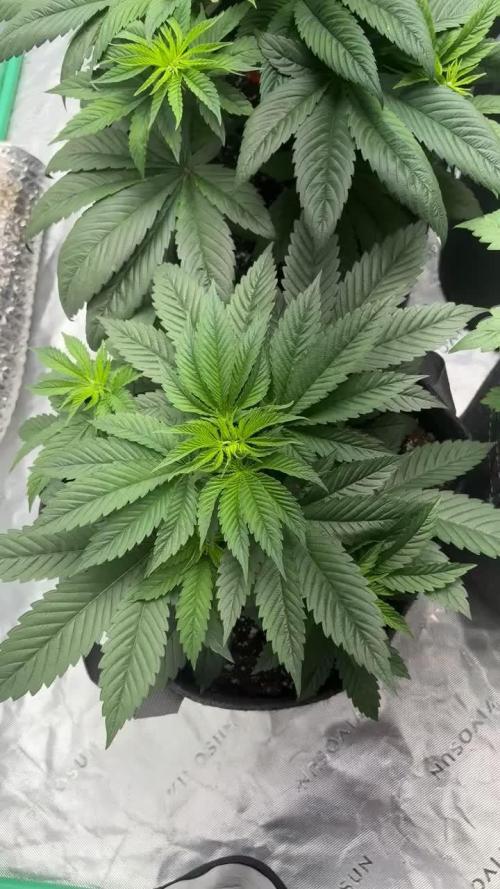
Not an overly impressive strain and I would say she was not that hard to grow. If I even grew this one again I would let it go naturally with some LST. Wanted more grape flavours but they don't really come through in the smoke. There's a bit of a sharp fruity smell that's sort of piney with a hint of fuel at the end. The smoke is not too flavourful in my opinion but that just means I didn't grow it well. Super tight nugs so be careful with humidity as stated above. Also she's a bit of a light feeder so be careful with your nutes. As you can see I burnt her tips and over fed her a lot. Not a bad yield though! I've only really smoked the lowers on this one so far so that gave me a bit of a racey high, just slightly racey. I would accredit that to the lowers not being mature enough at chop. The plant is super dense and since I mainlined it the lowers didn't receive enough light. I tried to let the lowers mature more but the plant stopped maturing when I chopped the tops, this caused stress and the plant just shut down basically. Not sure if I would grow Blimburn's GDP again until I grow the real GDP.



Likes
2
Share


@DrKushlife
Follow
Yaaay week 2 is finally here!!! I hope everyone is happy and well
So not much changed since last week except I have misted the leafs with regular PHd water
I have also put 2 companion chilli plants in with the gorilla now to detour any pests that might visit
I've now upped her watering amount to 500 ml per feed every 3 days
I've also now stopped using formulex
Every few days I mist the leafs with regular water
Well that's the end of week 2 in the veg phase.. See you all in week 3.. Happy growing 💪😎🙏

Likes
5
Share


@Dunk_Junk
Follow
Still going through flowering.
She has stayed short and stocky throughout since week 3/4 actually. About that time I remember watering her with nutrients that must have been too acidic. I'm pretty sure I omitted add ph up. 😭 The damage was done, growth all but stopped. As she is an auto flower there is no time to 'save' her and grow a big plant, so we will go to the end with what we've got.
Likes
8
Share


@sellem
Follow
24/03 watered AGAIN after 2 days with 1.5L 5.9 PH 1.5 EC, 5ml/L of Terra Bloom.
So far im really happy with plagron. Just one bottle for grow and one for bloom and the plants look healthy and show no signs of deficencies. really happy with the product. Moreso than biobizz, where i used Grow, bloom, calmag, activera and topmax and still fought deficencies here and there.
I also am conflicted about the trellis net. I like what it does but i think my tent is too full with plants or too small to really enjoy it growing-wise. I cant move the plants and its hard to reach them during watering. So i removed it again. its an on/off relationship with us :D
I also did some more defoliation, PROMISE ITS THE LAST TIME. i took out the plants of the tent for it to better reach the insides of them and made some nice videos of their progress so far.
ALSO: Tent smells really good and overwhelming when i open it! sadly, it escapes pretty fast so ill put "normal" smell on here. but its decent!
Watered again on
27/03, 1.5l 5ml/L Terra Bloom 1ml/L Green Sensation, 5.8 PH 1.7 EC
29/03, 1.5l 5ml/L Terra Bloom 1ml/L Green Sensation, 5.7 PH 1.7 EC
Likes
3
Share


@Mr_nugs_lover_David
Follow
Anotheer amaazing Black cherry punch pheno, beautiful colas, they looks just like rockets, so fat dense and sticky colas man. So in love with this black cherry punch, same sweet aroma, very fruity and sweet just like her sisters. I'm very happy with how this strain has performed in my garden. All my plants are 100%organic grown. She's been grown with florganics FLO Living soil, guanokalong organic dry amendments and Silicium flash by biotabs which contains bug shit and helps to keep a good microbial activity in your soil, it also contains silica, Flo living soil is full of life too man, I'm getting top clean aromas, very clean medicine for myself. It's such a pleasure to work with what I love the most. My cannabis 🤞💚😋🍪 peace everybody!!

Likes
5
Share

@Jungle_James_Grows
Follow
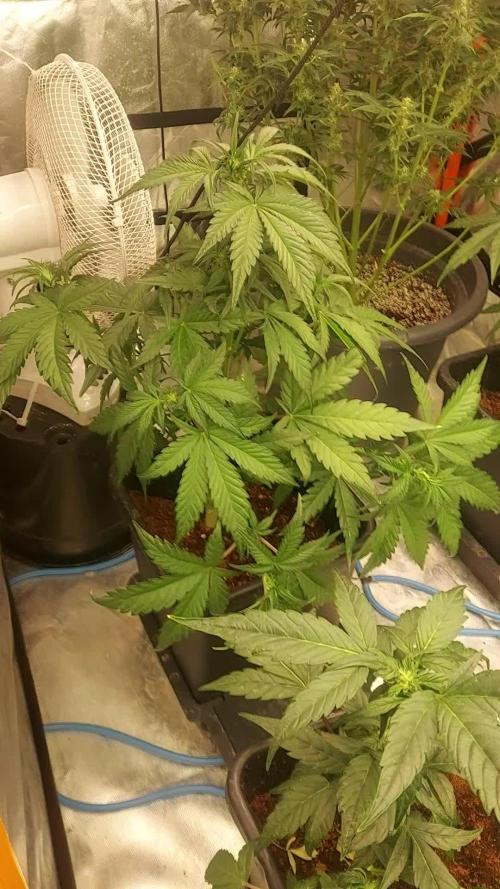
They're looking lovely, there is a variety of phenos, some are big and bushy and others are long and lanky. Went in today at took all the larf off the bottom and did some bending and tucking
Likes
7
Share


@MadeInGermany
Follow
Hey everyone 🤗.
This week they both continued to develop very well.
Flowering day 42
Today the tent was cleaned, the humidifier refilled and the plants sprayed with Canna Cure :-).
Flowering day 43
The plant was watered today with 1.2 L 🙂.
They were also checked for their health and pests 👍.
Everything looks great 🙏🏻.
Flowering day 44
Again the tent was cleaned and fresh osmosis water was filled into canisters.
Flowering day 45
Today 1.5 l per pot was poured so that some drainage comes out again.
therefor two days are not poured 😋.
Flowering day 46
The tent was cleaned, the humidifier was filled, the plant was checked for vitality and the entire electronics were checked for functionality.
Flowering day 47
Today she was sprayed again with Canna Cure and checked.
Flowering day 48
We got to the last day of this week and 1.2 L were poured again and the tent was cleaned 👍.
I hope you have a lot of fun with the new update, and let it grow 🍀🙏🏻
You can buy this Strain at
https://thecaliconnection.com/original-sour-diesel.html
You can buy this Nutrients at
https://greenbuzzliquids.com/
Type:
Original Sour Diesel ( Clone )
☝️🏼
Genetics:
Fem seeds- Original Sour Diesel to Original Sour Diesel BX3 RVSD Male
Reg seeds- Original Sour Diesel x Original Sour Diesel BX3 Male
👍
Vega lamp:
2 x Todogrow Led
Quantum Board 100 W
💡
Bloom Lamp :
2 x Todogrow Led
Cxb 3590 COB 3500 K 205W
💡💡☝️🏼
Soil :
Canna Coco Professional +
☝️🏼
Fertilizer:
Green Buzz Liquids :
Organic Grow Liquid
Organic Bloom Liquid
Organic more PK
More Roots
Fast Buds
Humic Acid Plus
Growzyme Big Fruits
Clean Fruits
Cal / Mag
Organic Ph - Pulver
☝️🏼🌱
Water:
Osmosis water mixed with normal water (24 hours stale that the chlorine evaporates) to 0.2 - 0.4 EC. Add Cal / Mag 2 ml per l water every 2 waterings . Ph with Organic Ph - Pulver to 5.8 .

Likes
99
Share


@BudXs
Follow
The girls are looking healthy and happy, except the one that had its head torn off. It will be fine though. Ive been plucking off some fan leaves and even intermediary sun leaves to open up bud sites.
Autos are starting to cluster, looks like they will shoot pistils any day now. The photos are looking great, variances in each strain, so Im on the lookout for the structure I like, and making notes daily.
Happy growing to all


Likes
13
Share


@greenAF
Follow
Lights Main: 40% Lower 100%
Feed: Listed Above then ec/ph adjusted
D91
Nothing much new, still and ugly duckling but the part that counts is looking good, and there's a lot of it lol. Buds are starting to fill and there coming from everywhere. Its a shame i had issues here and there, she could have looked so much better but all that counts is what in the jar at the end, Pretty much all the issues are feed related, I already ordered jacks for the next run, im done trying to decipher the fox farm matrix.
D93
I stretched her out some more today, a lot of new fast growth 😁😁😁
===============================================================================================
Weekly Power Usage:
C02 Controller: 0.03 kWh
Lower Circulation Fan: 1.83 kWh
Upper Circulation Fan: 1.04 kWh
Inline Exhaust: 1.12 kWh
Inline Intake: 3.69 kWh
Dehumidifier: 14.5 kWh
Lights Main: 17.0 kWh
Lights Lower: 1.99 kWh
Total 41.20 kWh
===============================================================================================


Likes
5
Share


@prebiancagrower
Follow
So, I start the harvest last week, but didn't get time to post here, first were the top bud, and this week I got the rest of the plant, it is a good strategy as the lower buds could develop a little more!
Amazing growth! I am very happy with the wield, it was my 3 growth at all and my first LST! Great results!
Thank you all for the support! Now I will stop for 3 months, going to Africa for a little bit! :-)


Likes
36
Share


@nonick123
Follow
Día 108 (16/09) Tras el flush las plantas muestran tímidamente nuevos pistilos blancos! 😍
Hoy no es necesario regar!
Día 109 (17/09) Me he encontrado a OnionOG #1 y a Purple Punsh completamente sedientas! Con las hojas caídas!
Riego con 1,25 litros de H2O a cada una de ellas (el resto no necesitan riego)
Día 110 (18/09) Riego con 500 ml H2O
Las plantas con el bloqueo empiezan a mostrar nuevos pistilos, sobre todo en las partes inferiores
Día 111 (19/09) Riego con 250 / 500 ml H2O
Se vuelven a formar pistilos blancos en todas las plantas que han sufrido el bloqueo! 😍💥
OnionOG #1 va como un cohete formando y apilando flores 💪 🚀 😍
Día 112 (20/09) Día lluvioso. Riego ligero 250 ml H2O
Día 113 (21/09) Otro día lluvioso. Riego ligero con 250 ml
Día 114 (22/09) Detecto algunas moscas blancas apoderándose de las plantas y decido hacer una aplicación foliar de piretrinas (Spruzit a 15 ml / l)
Riego con 1 Litro de Té Floración de Lurpe Solutions. Preparación: 24 horas con bomba de aire (oxigenación) con ingredientes:
Healthy Harvest 8 ml/L + Insect Frass 16 ml/L + Kelp Hidrolizado 0,3 g/L
💦Nutrients by Lurpe Solutions - www.lurpenaturalsolutions.com
🌱Substrate PRO-MIX HP BACILLUS + MYCORRHIZAE - www.pthorticulture.com/en/products/pro-mix-hp-biostimulant-plus-mycorrhizae


Likes
2
Share


@Little
Follow
Hola a todos!
Comienza la semana 4 de crecimiento para las AK.
Están todas creciendo mas o menos al mismo ritmo, menos la que sufrió quemaduras, que está más lenta que el resto.
Seguramente que esta semana o al principio de la siguiente realizaré la poda apical, depende un poco de la "enana".
Hay una planta que tiene los bordes de las hojas de color más claro, casi amarillo. ¿Qué puede ser? Si alguien lo sabe, le agradezco su ayuda!
Likes
47
Share


@GWSD82
Follow
Another week down, time seems to be flying by.
Can we just take a second to talk about the smell. OMG the fucking smell. Intense, bursting with orange, it's like I'm being waterboarded with Sunny D! Every time I open the tent, the smell literally jumps out, kicks me in the nuts, throws me in the corner and then runs wild all over the house. It's more of a feeling than a smell - You know when you arrive in a hot climate from a cool one and you step off the plane to that wall of heat? It's like that, but on your nose :)
Nothing dramatic to report this week. Just beginning to ease off slightly on N levels. The week's schedule:
MegaCrop: 4.75g / gallon
Bud Explosion: 2g / gallon
Calmag: 0.5ml / liter
E.C: 2.1
PH: 6
Not really much to do other than light defoliation just to keep the air flowing. Buds are getting nice and fat and she seems healthy, I can pretty much be hands off from here on out.
Catch you all again in a week!
