Likes
Comments
Share
Likes
2
Share
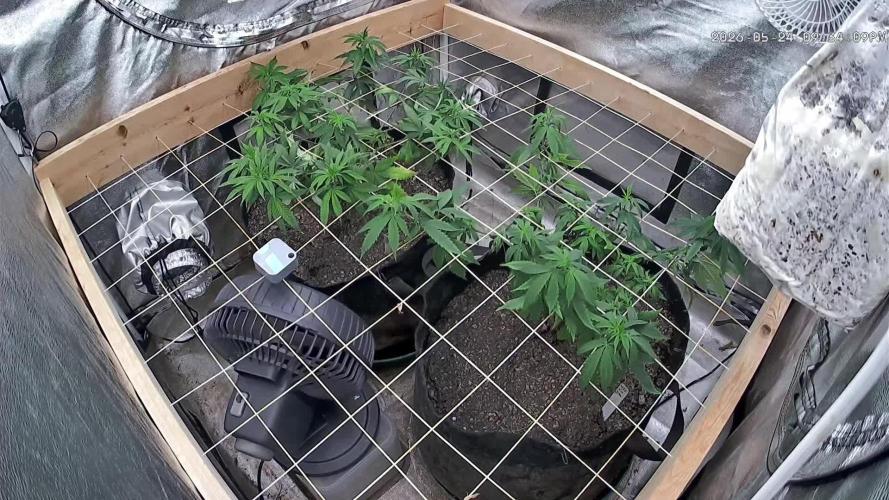
Germinated 2 seeds had 50% success [still hoping the other pops up] chocolope #1 doing very well. They are in a 2'×2'×4' grow tent which they will spend rest of their lives as I'm trying my hands at cannabonsai. [Pretty calming] Lights are lowered close to dome to reduce stretch. Let me know what u think
Likes
6
Share
I’m getting behind, the feed is not accurate. But yeah small signs of potassium deficiency and possibly phosphorus deficiency? I think she just needs time to get established in her new pot of super soil. Will mostly just feed plain water.
Likes
12
Share
Week 3, Day 15 of Veg. Looking good and healthy so far. When they reach 6" I should have enough nodes to start LST.
Likes
8
Share
Flowering week 6 ---> Indoor plant: This is the last week of flowering. The flowers are ready to be harvest.💪 I watering the plant only with 4lt of water (pH 6.5). I removed the yellowing leaves. I will wait after all the soil il totaly dry before harvesting. Temperature grow box---> 22-26 °C Umidity grow box ---> 45 - 55 % Outdoor plants: They are in full bloom ready for the harvest😍. This week I watering the plants only with water.
Likes
35
Share
It was a roller coaster ride guys but I started with four harvested I earlier got two ounce quick dry wasent flushed properly but these ones hav been there a some nice buds here n a hopefully will get a decent seed harvest stoned @chedderbob112 s2340420 don’t hav dry weight bud av went for fullness plant
Likes
8
Share
I just moved the mimosa inside a little growbox i bought 40x40x120 with a mes hydro 600. Let’s see!
Likes
152
Share
@EBxAH
Follow
Well week 15 and 5th week of flower started yesterday, 9/12. I did a little more defoliation over the weekend, maybe cut 20 leaves altogether. Everything is still looking good. Temps are good, rh is good, airflow is definitely good. And judging by the frosty trichs that are showing I'd say everything is right on schedule. Starting to get more smell. That's about it for now. Happy growing everyone ✌️🍀✌️
Likes
2
Share
Topped once, turned off IR @ nights, slowed vertical growth back down, and took off both of the very lowest internodes on each plant. Eisenia fetida Stratiolaelaps scimitus Armadillidium vulgare Red wigglers (Eisenia fetida) are highly beneficial. They are considered an ideal choice for "no-till" or container-based organic growing because they live in the upper layers of soil, feeding on organic mulch rather than the plant's root system. Red wigglers accelerate the breakdown of organic amendments and produce high-quality, nutrient-dense worm castings directly in the root zone. Clover is another exceptional component of an organic rhizosphere, offering a sustainable, self-sustaining alternative to synthetic nitrogen fertilizers produced via the energy-intensive Haber-Bosch process. By forming a symbiotic relationship with Rhizobia bacteria, clover converts atmospheric nitrogen N2 into ammonium NH4, providing a steady, slow-release nutrient source that enhances soil health and reduces environmental impacts. Red clover offers superior nitrogen fixation and biomass production compared to white or yellow clover, making it the premier choice for maximum soil vitality, particularly for improving soil structure and providing a high-volume nitrogen credit for subsequent crops. If it is fully functional and efficient soil, the rhizophagy cycle is superior long-term than any synthetic delivery when it comes to preventing deficiencies, not because it's "better," per se. The medium will require a very high CEC to make it to harvest without re-fertilization. The rhizosphere acts as a dynamic, interactive exchange where plants and soil microbes trade resources based on immediate needs. When a plant lacks a specific nutrient, it changes its physiology and releases specialized chemical cocktails—root exudates—into the surrounding soil. These exudates, which include sugars, amino acids, and organic acids, serve as a "shopping list" to attract specific microorganisms, which in turn return higher levels of desired nutrients. There is nothing in comparison when using synthetic delivery, which can cause plants to stop producing exudates, effectively "starving" the beneficial soil life, over time turning the soil barren and void of microbial life. Responsible use, applying the right amount at the right time, can minimize these negative effects. Relying solely on synthetic fertilizers without replenishing organic matter is what typically leads to exhausted soil. The use of synthetic fertilizers can utilize the Cation Exchange Capacity (CEC) of the soil, but without a robust rhizosphere and active microorganisms, the efficiency of this process is significantly reduced. This makes synthetic growing more difficult to prevent deficiencies overall compared to an efficient organic living soil with a robust rhizophagy cycle, as there is no "one size, fits all" when it comes to different nutrient profiles of strains/genetics, making it trickier to "guess" and prevent creeping deficiencies. CEC does not contribute towards EC. Add more CEC using biochar, problem solved. If you keep pH between 6.3 and 6.7, hydrogen is exudated to cycle the medium's CEC for its needs. Keeping the pH between 6.3 and 6.7 creates an environment where plants release H+ to displace positively charged nutrients (like Ca2+, Mg2+, K+ held on soil particles or within artificial media this cycle through nutrients via the medium's Cation Exchange Capacity (CEC) Microorganisms generate a stable potential of approximately 0.5 V EC. The rhizosphere creates its own food, similarly to chelation, using 1000's of varying combinations to create its own food. Start to finish, just add water. Eventually, more materials will need to be added at the beginning of each new grow, but very attainable to go from seed to harvest without ever fertilizing. ATP is important when it comes to biomass accumulation. Cellular root respiration and cellular respiration are essentially the same biological process, the breakdown of glucose to create usable energy (ATP) in the presence of oxygen, just taking place in different parts of the plant. Synthetic (salt-based) grows have significantly lower levels of total rhizosphere respiration, often referred to as root-zone activity, compared to organic living soil grows. While the plant roots themselves may respire in both systems, the surrounding soil ecosystem in a living soil setup is vastly more active, teeming with bacteria, fungi, and beneficial microorganisms. 2 pools of ATP, it won't double in growth buuuut, but improving root respiration by ensuring high oxygen in the soil is crucial. Good aeration ensures roots can fully utilize glucose to generate the ATP necessary for nutrient uptake, leading to healthier and more productive plants, even if growth isn't exactly doubled. The ATP created using root respiration is dedicated to rootzone growth; the ATP created using regular cellular respiration in a synthetic system would have to dedicate a lot of ATP to the roots when there is little or no root respiration. It's true that there is less of an initial ATP cost in breakdown when nutrients are already in their final form (synthetic), but you lose a solid chunk of ATP when the entire plant is reliant on cellular respiration alone; a large portion of ATP is dedicated to root zones for "forced" nutrient uptake rather than traded. Making it overall less efficient, even if the initial cost of breakdown is higher. Not sure if I butchered that but one can hope It makes sense. Oxygen is of critical importance when growing in living soil compared to synthetic soil because it supports the metabolic needs of the microbial, fungal, and insect ecosystem, rather than just the root respiration required by the plant itself. While synthetic grows can survive in lower-oxygen environments with precise mineral feeding, living soil systems rely on aerobic microbes to decompose organic matter (microbial mineralization) to create plant-available nutrients, which is an oxygen-intensive process. While a specific fair percentage is difficult to guess, my experience points to a massive, compound difference between the two methods and the amount of oxygen required. All the ATP spared is used on more biomass, not only that, but the extra root respiration can achieve a much higher CO2 compensation point naturally than you could with synthetic and atmospheric CO2 alone. As a plant grows faster and increases in size, its demand for nutrients to support that growth increases, requiring a higher rate of nutrient uptake. As plants enter phases of rapid vegetative/floral growth, their metabolic demand for nutrients increases exponentially. Without a robust buffer zone—whether in the soil (cation exchange capacity) or in a hydroponic reservoir—deficiencies will occur rapidly because the instantaneous demand for specific nutrients can quickly exceed the rate of supply. A growing body of evidence suggests that organic living soil provides superior long-term soil health and environmental benefits compared to synthetic fertilizers, which are often criticized for promoting a cycle of dependency and degradation. While synthetic fertilizers offer short-term convenience and high yields, they often come at the expense of long-term soil health, sustainability, and increased corporate control over growers/ farmers. Organic living soil, while slower and requiring more care to establish, creates a sustainable, resilient, and, ultimately, more fertile environment. We don't really grow; we facilitate energy conversions, and energy is just numbers. Because the universe works the same way today as it did yesterday, there is a single, fundamental mathematical quantity that remains constant. We call this quantity energy. You cannot put "energy" under a microscope. You observe matter and forces (like heat, motion, or light), but energy is just a scalar number calculated to help predict how these things will change and interact. When an object falls, or when a battery powers your phone, matter shifts and changes form. Through it all, the universe ensures the "total score" of the numbers remains exactly the same. Once all water is removed, approximately 95% to 97% of a plant’s dry matter consists of carbon, oxygen, and hydrogen. These three elements form the structural backbone of all plants. NPK & all the rest 3-5%. Indigenous Amazonians created, or at least significantly enhanced, the fertile, dark soil known as Terra Preta de Índio (Portuguese for "Indian Black Earth") by incorporating biochar and other organic materials into the soil. This anthropogenic (human-made) soil technique, which dates back roughly 2,500 to 8,000 years, allowed ancient civilizations to flourish in regions with naturally poor, acidic, and nutrient-poor tropical soils.
Likes
14
Share
So far it looks like I have control of the nute burn looking at the fan leave not burning/changing anymore. Started finish but started at 5pm and my led goes off at 6pm. I kept flushing till 6:20om but stopped due to the fear of the ladies herming, revegging, or anything that would cause my ladies to start off week 7 on a slow/bad start. Defoiling a little but mostly real bad burned fan leave because I believe your ladies will continue to try and repair them which pulls energy from bud developement. Flushed on 6/1/22 and ended on 6/2/22 all 3 ladies ppm is under 200 so I can make sure they have enough to ripen and fatten up. On week 8, I will do a ice flush and then 2-3 days of darkness while they freeze. Checked trichomes on 6-5-22 and some show maybe 10-20% on some colas. Will harvest all 3 on 6-12-22 probably in the morning which I seen and heard it is better because at a certain time in the day marijuana plants let out moisture and you want to keep as much of that as possible.n
Likes
1
Share
Great week, all is going well. I'm glad that I keep these in my basement where it stays nice cool 25°C during this year's heatwave. I'll reduce some of the nutrients from next week on. Power buds in late flowering stage doesn't really do anything.
Likes
21
Share
Salutations amis cultivateurs 🍁🌿 Aujourd'hui on débute la 5 semaines de floraison 🗓️ La Candy Cream et magnifique, je lui donne 2 litres de nutriments tous les 2 jours, aucun problème de carence. Je ne les pas taillé et préparer comme les autres . Le résultat ce vois 😋💥 On voit maintenant des belle banane ce formé, odeur et incroyable ❤️🍁 Merci Kannabia variétés fantastiques 💥 Merci xpertnutrients impressionnant 💥
Likes
2
Share
@jahredi
Follow
Starting a second seed of this Wedding Cake strain from Lifted, a rec grower. The first seed has some interesting mutations going on that I did not see in any of the four plants last year. Hopefully this one comes out strong and uniform. If it does, I’ll likely clone it and hit the clone with some colloidal silver to reload. I have 9 seeds left, but it would be nice to have some extras. I really scored with these seeds. I put a few photos of a plant from the same seed stock. As you can see, the plant is very robust. I also found it very durable, pest and weather resistant. It also provides high yields. The research I’ve done says that Lifted’s Wedding Cake strain comes from a clone of the Seed Junky strain, which I believe to be the original strain. Whether the seeds I found in my rec store purchase are from cross pollination, genetics or stress, I’m not sure. However, given that I popped 4 seeds last year and had four females, I feel pretty confident that the seeds are from stress or genetics. So they would be feminized. No topping, just some serious LST. This year, I plan to top the stronger of the two and FIM the other.
Likes
Comments
Share
Likes
6
Share
@Hoodoo
Follow
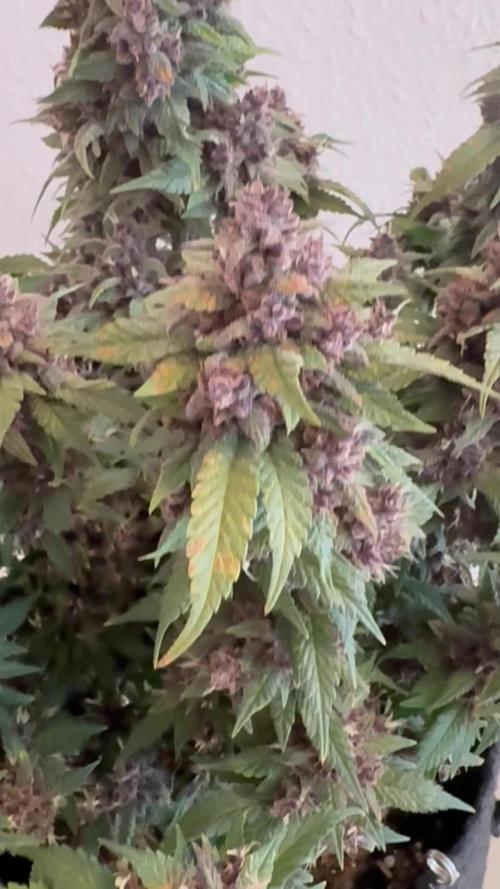
The first picture day 44! Well, we've finally got the purple colours coming in very strongly! Even the fan leaves are turning purple. The progression of the pigment looks like a pathogen has taken over but it's just the cool genetics of this plant. Smell is increasing, they have a very sweet odor so far when crushing the flowers. Still nowhere near harvest but the buds and calyxes are starting to stack. Very exciting that I got this one to grow!
Likes
31
Share
Well today is day 84 and she's just about done.. I flushed her with 3 gallons of water twice in the last week and now I'm just feeding water to a little runoff for another day or two.. I want to point out that this plant smells exactly like blueberry Pop-Tarts.. that is not an exaggeration it is literally the same smell.. I really really hope that that doesn't go away and stays throughout the cure.. hopefully this weather cools down so I can dry it at an appropriate temperature and not lose these precious terpenes that smell so good.. this is my second fast buds grow the first was kosher cake and that was awesome I tried the Afghan Kush but I ended up getting rid of her because of too many mutations and I didn't have the room for plant that wasn't going to grow right.. so two out of three so far have been great I know this flower is going to be awesome.. hope everyone is doing well and happy growing ✌️😎
Processing
Likes
20
Share
@Cinderman
Follow
Same nutes, I'm keeding usually but 1/3 than usage even less.. sweet smell start raising stronger.
Likes
2
Share
Week 2 for the solo Afghani went smooth. Looked a little slow to develop her first proper set of leaves, but the root development should help speed up her progression. Still feeding off the slow release 444 and is now regularly drinking about 2oz of water every other day. I also spritz the bottom of the outer cup to keep moisture levels high for stretching roots. She's about 36" from the light. Hoping to get a little stretch to make training easier. Added a couple new pics to get the week caught up. Stay tuned, week 3 starts training.