Likes
Comments
Share


@KeemBboomin
Follow
Once again these girls don’t really need much just watering when dry but other than that we are on cruise mode. I have been checking trichomes for about a week now and man is she almost there I should be giving them lights out with in another week or two can’t wait
Likes
41
Share


@MadeInGermany
Follow
Hey guys .
A wonderful week goes by with a super growth :-).
After I topped it for the first time last week, it recovered very quickly and showed great growth.
I don't think I will use topping again on the lady because I should slowly blossom with a few other women :-)
think it will be ready in the next 7-14 days for Flowering 👍.
This week it was poured 3 times with 1 l each time
(for nutrients, see table above).
The tent was cleaned and the health of all women was checked :-).
After the photos she was sprayed again with neem oil so that the last little tripse disappeared.
Even if you can't see any more trips I will spray it one last time next week to make sure :-).
I wish you all a happy new year 2022 ☺️.
Stay healthy 🙏🏻
👇🏼👇🏼👇🏼👇🏼👇🏼👇🏼👇🏼👇🏼👇🏼👇🏼👇🏼👇🏼
You can buy this Nutrients at :
https://greenbuzzliquids.com/en/shop/
With the discount code: Made_in_Germany you get a discount of 15% on all products from an order value of 100 euros.
👇🏼👇🏼👇🏼👇🏼👇🏼👇🏼👇🏼👇🏼👇🏼👇🏼👇🏼👇🏼
You can buy this strain at :
https://www.exoticseed.eu/
Water 💧 💧💧
Osmosis water mixed with normal water (24 hours stale that the chlorine evaporates) to 0.2 EC. Add Cal / Mag to 0.4 Ec Ph with Organic Ph - to 5.8 - 6.4
MadeInGermany

Likes
6
Share


@CeGrow
Follow
week 9
day 61:
the buds are growing well, first leaves turn yellow, I cutted some leaves
height: 76 cm
nutrition:
day 61: 0,5 litre water + 1,5 ml mairol blütenwunder
day 62: 0,5 litre water + 1,5 ml mairol blütenwunder

Likes
12
Share


@CheeRz
Follow
The year is almost over and I think we can look back on a very successful 2024. Happy new year 🎇🎆 and lets have a great 2025 🚀💚with big and juciy crops

Likes
7
Share


@100Trillion
Follow
Second week of flower went well. The plant has over double the size at this point and we have early signs buds forming within the second week. Continuing to keep the light about 12 to 14 in above the canopy as the plant stretches. Plants are getting really bushy will prepare for a day 21 leaf strip to clear out the canopy and to allow for air flow while dropping humidity. Will also try to implement a second scrog for support.Currently The single seed Sent from khalifa for grow Contest is tallest pheno in the tent and healthiest looking that pheno will show on the top right in any of the disclosed pictures and videos.

Likes
14
Share


@CanarianGrow92
Follow
Banana Jelly has a very nice bushy shape, she responds good to LST and doesn't stretch a lot when turned into flowering.
Good resistance as we performed some HST and even during flowering defoliations, no sign of stress or delays in growth.
The bid smell is almost like nuts, fresh almonds with a sweet but slightly gassy background, a true gem to explore. We will definitely repeat this one!!!
Likes
Comments
Share

@Hundreds
Follow
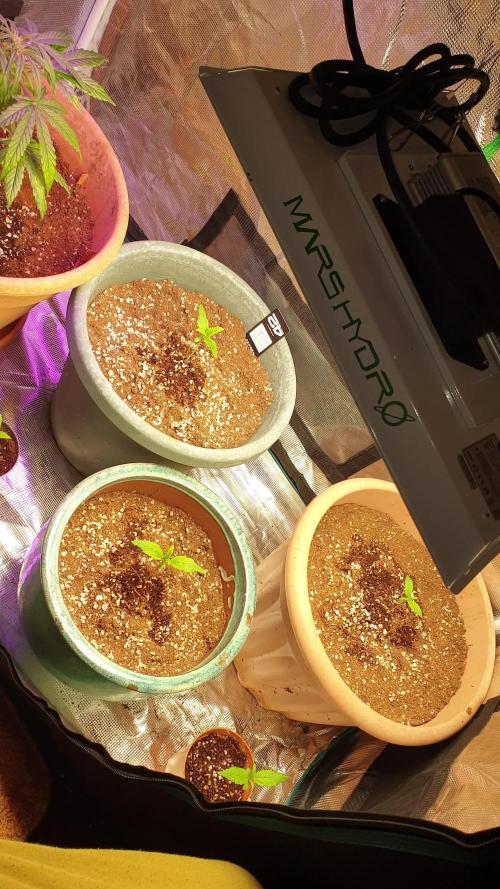
All good was draping a little but just needed water and Nutrients so I watered and fed them

Likes
58
Share


@biggreens420
Follow
Growth has finally picked up a bit with this girl she's bushing like crazy and noticed over the last few days she is using more feed/water now and is producing a lot of budding sites did some defoliation and tucked a few branches stripped a bit of waste materials from under the canopy to give extra energy to the tops happy week so far.... 09/12 a little problem went to find my trellis had come of the clips pulling my canopy into one big ball sorted it and put a pic up of the day after so no major problems or snapped branches luckily thanks for reading happy growing

Likes
6
Share


@GoldenWeedGrower
Follow
Legend
Timestamp: 📅
EC - pH: ⚗️
Temp - Hum: 🌡️
Water: 🌊
Food: 🍗
pH Correction: 💧
Actions: 💼
Thoughts: 🧠
Events: 🚀
Media: 🎬
D: DAY, G: GERMINATION, V: VEGETATIVE, B: BLOOMING, R: RIPENING, D: DRYING, C: CURING
______________
📅 D57/B20 - 11/06/24
⚗️ EC: 1.0 pH: 6.1
🌡️ T: 25°C H: 70%
🌊
🍗
💧
💼
🧠
🚀
🎬 1 TL video
______________
📅 D58/B21 - 12/06/24
⚗️ EC: 1.0 pH: 6.4
🌡️ T: 25°C H: 80%
🌊 8 L
🍗 Calmag - Bloom A-B
💧
💼
🧠
🚀
🎬 1 TL video
______________
📅 D59/B22 - 13/06/24
⚗️ EC: 1.2 pH: 6.6
🌡️ T: 25°C H: 70%
🌊
🍗
💧
💼
🧠
🚀
🎬 1 TL video
______________
📅 D60/B23 - 14/06/24
⚗️ EC: 1.0 pH: 5.8
🌡️ T: 25°C H: 70%
🌊 15 L
🍗 Calmag - Bloom A-B - B52 - Big Bud - Bud Candy
💧
💼 Spinosad and pH-
🧠
🚀
🎬 1 TL video
______________
📅 D61/B24 - 15/06/24
⚗️ EC: 1.0 pH: 5.8
🌡️ T: 25°C H: 70%
🌊
🍗
💧
💼
🧠
🚀
🎬 1 TL video
______________
📅 D62/B25 - 16/06/24
⚗️ EC: 1.0 pH: 5.5
🌡️ T: 26°C H: 80%
🌊
🍗
💧
💼
🧠
🚀
🎬 1 TL video
______________
📅 D63/B26 - 17/06/24
⚗️ EC: 1.0 pH: 5.2
🌡️ T: 26°C H: 80%
🌊
🍗
💧
💼
🧠
🚀
🎬 1 TL video

Likes
10
Share


@BodyByVio
Follow
This week I top all 8 Green Poison ( 4dwc and 4 coco ) clones. They look healthy and happy and few days later I already start to low stress training (LST) them.

Likes
60
Share


@MrSpooky882
Follow
The week was nothing unusual, I fertilized today and see them growing very well 😍
Next week I will defoliate and thin out again and remove what is in the shade and will not wear anything ... otherwise I am very, very satisfied with the growth of the plants😁😏😊
Likes
4
Share


@The_Projexx
Follow
Welcome to week 8 of flower!! Things are really starting to get heavy and loaded in frost! I will be checking the trichomes this week to see what plants are nearing the end and which ones will still need a bit more time to mature and finish. To say the least Im very excited to get to the finish line with these ladies!
Huge shout outs go to @MarsHydroLED and Hidden Vault Genetics for their dedication on making stellar gear that making growing extra fun and really easy.
Huge HUGE shout outs go to all my followers and to the people who stop into the diary alike to show their support! Keep on inspiring to grow!
-The Projexx
Day#50F Some of the ladies are still putting on some mass!
Day#51F Pictures N/A. Macmelonz and Banana Smoothie #1 will deff need more time to finish then the rest of the ladies in this room!
Day#52F Started removing some leaves from the bottom , I will be looking to continue this until harvest day.
Day#53F I knew I should have installed the second net, Some of the flowers are leaning right over now haha. Going to get some stakes to add into the buckets for some support.
Day#54F Checked the trichomes looking like 6 of the 8 plants will be starting their flush while Macmelonz and Banana Smoothie #1 will continue to feed for a bit longer before starting to flush.
Day#55F Really digging trichome production on Creamy Cereal #2 , she's got a wild Lucky Charms aroma to her that's quite unique.
Likes
5
Share


Likes
5
Share

@Growfather1
Follow
Hello everyone,
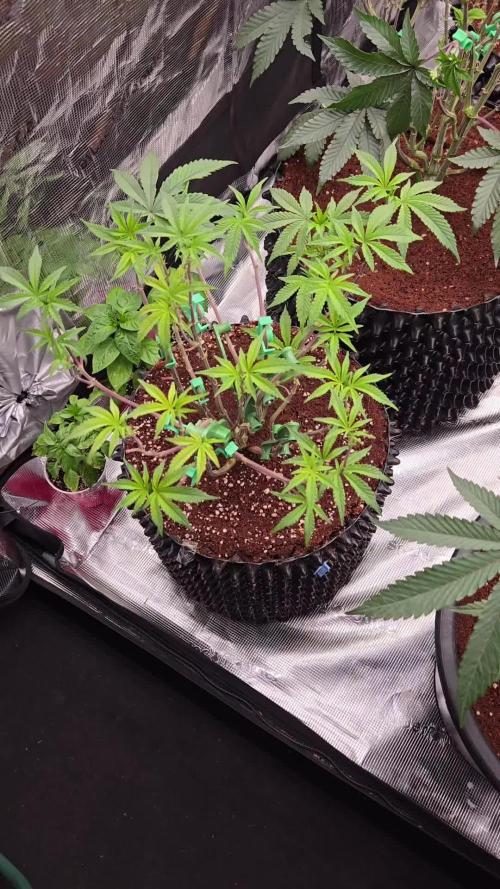
The 3 plants are okay a little nutrient deficiency because the ph meter was 0.3 ph to high.
The plants are almost ready for flipping to flower 7 days more in veg is enough.
Thanks for stopping by and have a nice day.
Best regards,
Growfather

Likes
44
Share


Likes
68
Share


@KingSalomonsWeed
Follow
Oh ja. Durchgebrochen. Voll, juckt sie nicht. Sehen gut aus, Sonst. Na ja meine Meinung. Die Pineapple riecht nach pineapple. Klar steht drauf. Die Lsd? Ahm da wird es schwierig. Alle Kräuter des waldes. Fruchtig, süß, honig, und jetzt... KNOBLAUCH.... BÄRLAUCH., IM ernst. Nachdem die ganzen süßen gerüche verflogen sind, bleibt ein geruch von knoblauch ( ganz leicht, aber knoblauch) zurück. Verrückt, ganz verrückt, habe es durch zweite nase bestätigen lassen. Wie geil. Barneys Farm. Wow.
Ich möchte mich erstmal bedanken für dieses nette Growdiaries. Ich dacht erst hier wäre es nur kommerziell. Ist aber nicht so. Danke dafür. Dewegen erzähl ich mal über meinen grünen Daumen.
Den gibt es gar nicht. Alles ging früher bei mir ein. Kakteen sukulenten, ficus Benjamin, hamster, hamster? Ja nicht nur einmal n Hamster.... Also, wie kommts das ich diesen grow großkriege?! Ok eigentlich easy, nimm dir was gutes. Greenception gc4 125 watt verbrauch (übrigens 120 watt Lichtleistung 5 für die zu lauten lüfter) homebox q60 (max 2 pflanzen, bedeutet, eigenverbrauch, komme ich zwar ins jailhouse für, weil strafe zahlen ok, no prob, aber beim Versuch des mitnehmens meines nicht verseuchten leckeren gesunden, knallenden, für mich bestimmten weeds, ( dafür, und das wird häslich) gibt es richtig shelte.
Und damit das nicht passiert habe ich selbstverständlich ein paar regeln befolgt. 1 bleibe in den schatten(was ich zwar mit beitritt zu Growdiaries abgelegt habe, allerdings habe ich es satt verseuchtes weed zu rauchen, und bin dafür LEGALIZE IT.. Und im Bekanntenkreis no speak no tell no sell.
2. Nimm dir ne bombenfeste genetik, mit bitte bitte Ruderalis( macht sie viel sehr viel stabiler) übergib das alles mir, mache 9 wochen lang die Augen zu und staune. Als ich mit meinem ersten zu Kollegen kamen und wir zusammen rauchten. Bekam ich direkt die Anerkennung die beste connection seid 2 - 3 jahren zu haben. King!
King with crown. Den 2 ten grow habe ich innerhalb 30 min gegrillt. Den 3.... Na ja ich sage mal so, zu früh geerntet und mit zuviel Dünger versaut. Aber nicht gekillt. Und jetzt mit
Barneys Farm. Mann ich bin glücklich. Sie Leben, und sehen jetzt schon toll aus. Klar haben sie gelitten. Bin ja ich. Aber grins, wenn ich killer aller pflanzen, sowas hinzaubere, dann kann das wirklich jeder. Meinen Respekt dafür das die pflanzen so stabil sind, besonders, wenn man bedenkt wie sie duften. Denn das ist aussergewöhnlich gut.
Tag 64. Jetzt ist beginn der Woche 9 seid Kontakt mit Wasser. Ich schreibe halt sehr gerne, wie man sieht.
Aus diesem Grund, mal eben in die Runde meine Frage. Nervt es euch?
Dieses hmm hmm rumgeschriebsel, weitläufige Erzählungen wie eine einzelne Welle die durch den Ozean gleitet?
Ja? Mir egal! Sativa... 😛 Aber echt mal bei Indica, macht man kaum noch was... Was auch nicht schlecht ist. Muhahaha. Und das schlimmste? Die 9 te Woche ist erst zwei Tage alt. 2. . .
😛 Ich springe aus dem Fenster. Nein mache ich nicht. Ist eh Erdgeschoss... Und es Regnet.
Trichome Check on L. S. D. 80%milky 20% clear. Expect the little ones. The popcorn buds re from L. S. D. Suddenly they where there. Maybe the same @pineapple express. Except they getting bigger and new phylaxien re everywhere.... And @theL.s.d again, the christalls are @ another color shining. Like blue diamonds... And i cant catch this on my photos.
PS. Not Garlic, Moschus is the smell.

Likes
2
Share

@Illumi7
Follow
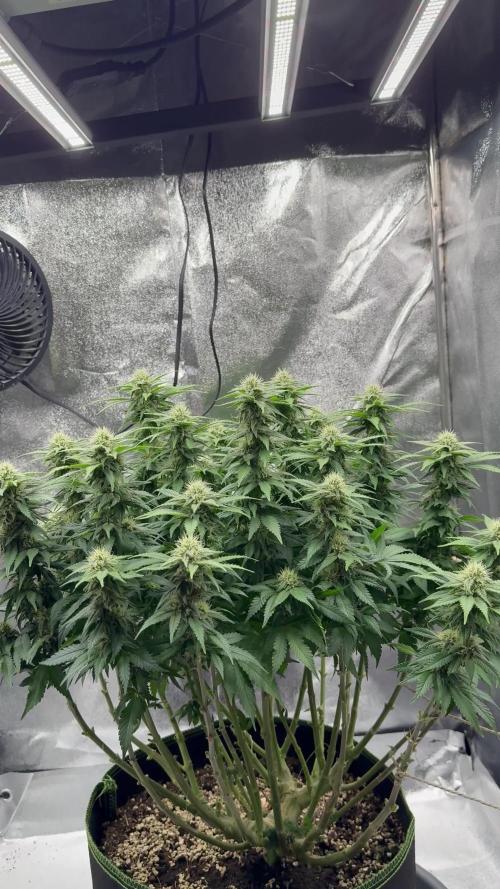
Also Blüte Woche 5 ist jetzt schon angebrochen und es wird so langsam richtig frostig

Likes
27
Share


@RDWCGrowing
Follow
3/4/2023
Week 3- Day 1 of Veg (Day 31 overall)
Water Change out Day
36 Gallons in
CalMag = .5Mil/Gal = 18Mil
FloraMicro = 4.2Mil/Gal = 151Mil
FloraGrow = 3.8Mil/Gal = 137Mil
FloraBloom = 3.0Mil/Gal = 108Mil
PH DOWN = 1.72Mil/Gal = 62Mil
PPM = 546
PH = 5.88
This Grow has definitely been an interesting grow I have been playing with Over or Under since the beginning and it all started with me drowning the plants by adding too much water. I will have to make sure I watch that on all my future grows. I prayerful that this week will get me fully back on track, in my previous grows using my chart, I haven't had any issues during this week, so again prayerful that this is the week I am back on point.
3/5/2023
Week 3- Day 2 of Veg (Day 32 overall)
ROOT ROT!!!
I guess from when I drowned it I caused a lurking issue that really showed it's head today. The roots were looking not slightly bleached but looking black. I cut out what looked dead and I had to run to the local Hydro shop to pick up some items to see if I can fix it and strengthen the plants.
I picked up Mammoth Silica, ORCA, and ROOT Drip.
I completely drained the system and started it over today as well.
38 Gallons In
Mammoth Silica = .5Mil/Gal = 19Mil
CalMag= .5Mil/Gal = 19Mil
Root Drip = 1Mil/Gal = 38Mil
FloraMicro = 4.2Mil/Gal = 160Mil
FloraGro = 3.8Mil/Gal = 144Mil
FloraBloom = 3.0Mil/Gal = 114Mil
Orca = .5Mil/Gal = 19Mil
PH Down 60 Mil = PH 5.83
I also had to run by Staples I realized the paper I was using wasn't the right brightness and Lbs for the Photon App. What I needed to have 22Lbs 98 Bright. I recently saw a comparison of the different weight papers against a several hundred dollar Apage PPFD detector and with the right paper it was almost exact readings. With that my PPFD 355.
3/6/2023
Week 3- Day 3 of Veg (Day 33 overall)
Still alive!! #2 and #3 are still alive and it looks like no further damage to any of the leaves.
#2 needed 1 node topped. I will keep monitoring day to day.
3/7/2023
Week 3- Day 3 of Veg (Day 34 overall)
Well Both appear to be doing all right. I cut off the offensive leaves from #3 nothing new on shown on the leaves. I actually needed to top 1 node on #2. PH is stable, Temps are stable.. I will be changing out the water and Nutes on Saturday not waiting the 2 weeks.
3/8/2023
Week 3- Day 4 of Veg (Day 35 overall)
Well Both appear to be doing all right. I actually needed to top 1 node on #3 and 2 on #2. PH is stable, Temps are stable.. I will be changing out the water and Nutes on Saturday not waiting the 2 weeks. I think the additives are truly making a difference I think I will be adding them to all my grows from here on out.
3/9/2023
Week 3- Day 5 of Veg (Day 36 overall)
Both still appear to be on the mend Still some dark brown on a small part of the roots and I don't know if those are just dead but it doesn't look like it is spreading and I see a bunch of new roots forming. Nothing new on the leaves at all. So I think the trio that I added is helping. The plants also seem to be in raised happy position going towards the light. I still plan to change the water on Saturday and go from there.
3/10/2023
Week 3- Day 6 of Veg (Day 37 overall)
Moved the light up to 41 1/2" so 3' 4 1/2" away from the top of the Plants.
PPFD= 363
Power on my Light =62.5
Water Temp is holding steady=70.3
PPM= 534
PH= 5.92
Tent Temp= 72.5
Humidity= 50-60% I have 2 humidifiers running on INK Bird controllers monitoring it 24/7.
I will be changing out the water tomorrow even though I could let it go an extra week but I am still concerned that the Root Rot is clearing up and I don't want to risk it coming back. I want fresh Nutes/ water in the tanks.
I topped 2 nodes on #3
I topped 3 Nodes on #2
I also cleaned out some of the bottom third portion that isn't getting much light and not much growth at all.
#2: 8 1/2" tall, 18" Wide
#3: 7 1/2" Tall, 15" Wide

Likes
4
Share

@SmokingTiki
Follow
This week was a bit less sunny than the last one but still hot and sunny. It also rained but hopefully it remained quite dry so I think I shouldn't get some mold 👌We're reaching the theoretical growing duration given by FastBuds. I will give them one more week, maybe two, but the harvest is approaching 😎