


Likes
Comments
Share


@GMSgrows
Follow
What was it like this week? It was irritating. This site is sucking. Upload a vid that takes so long to upload to just have the save sign spin and spin. Then have to reupload. Your admin sucks the bag.

Likes
70
Share


@Mrs_Larimar
Follow
2021-10-30
The Chiquita Banana is my Queen.
I am in LOOOOVE
shes sooo ....
she smells nicely deep like oranges, mandarine and some kushlike smells
and some crazy frostiness is going on
here are some Codes
Lights:
https://viparspectra.eu/discount/M.Larimar
And for the Fertilisers:
https://greenbuzzliquids.com/en/shop/
Code: mrs_larimar
Thanks @Theia for this awsome Seed

Likes
44
Share


@The_Good_Twin
Follow
11 Sep 2021
Today starts week 2 of the flowering stage and week 10 of life for my lovely Ladies. I did some massive defoliation and pruning the other day and all three of my babies are looking amazing afterwards!! Absolutely beautiful! I have a short video log (I’m not cool enough to call it a vlog), and a few pictures to upload to start this week.
I must admit that I really thought I may have overdone the defoliation and pruning, but so far it’s turning out exactly as I had hoped. There are budlets forming at every node, and all three plants are looking healthy and strong.
I decided to look at my feed chart and to count backwards from the date that they should be ready for harvest and to arrange their feeding schedule. I made a plan where I can provide a good steady level of nutrients in the proper stage of growth, and schedule time for the flush to be done by the time harvest time arrives.
So today I started the Mid-Bloom stage 4 of my Flora-Trio 6 part feeding chart. I’m still giving half the nutrient level until I know there are no issues, then I will adjust to full strength if necessary. At 50% strength each plant was given: CALiMAGic 2ml, FloraMicro 2.4ml, FloraGro 2ml, FloraBloom 4.2ml, Floralicious Plus 1ml, and Liquid KoolBloom 1ml mixed into a gallon of water. The initial pH for all three gallons was 6.3. I wanted to adjust them up, so I added 1.2ml of pH UP to each gallon which adjusted them as follows: C1 - 6.7, and C2/C3 were both adjusted to 6.6.
I still don’t have a replacement TDS meter, so only pH was measured in the runoff. Runoff pH was as follows: C1 - 5.9, C2 - 6.1, and C3 - 5.8. The runoff levels of C1 and C3 are still lower than id like, but still manageable.
As I mentioned several times above; my plants are looking great, and I plan to keep growing them as they are until this method needs to be adjusted or changed. I’m just letting them grow wild. Granted, I’m trying my best for them to grow the way I want, but I’m not using a support net at all (yet). I say (yet), because once the buds start to bulk up, they may need support to stand upright. If that day comes, I’ll use the net. Time will tell.
The temperature in the tent was 82F, and the humidity was 45%. So far my trio is growing beautifully! Enjoy everyone! I am!!
14 Sep 2021
I ended up using only about half of each gallon the other day, so today I gave the rest of each gallon to the perspective plant it belonged to. None of the plants had any real runoff from the amount given today, so I’ll probably start feeding every two days instead of every 3-4. It happens with each grow. The trick is to identify how much they need, and how often. It seems to change with every plant.
So as I stated above; each plant received about 1/2 gallon of water and nutrients that was prepared a few days ago. Each plant received CALiMAGic 2ml, FloraMicro 2.4ml, FloraGro 2ml, FloraBloom 4.2ml, Floralicious Plus 1ml, and Liquid KoolBloom 1ml.
The pH going in was: C1 - 6.7, C2/C3 - 6.6. As I said above, there wasn’t enough runoff to measure, so I don’t have runoff data today.
The temperature in the tent was 84F, and humidity was 57%. I measured each plant and adjusted the lights according to their growth. C1 is now 23 inches tall, C2/C3 are both 23.5 inches tall. I adjusted the lights to all be 15 inches over each plant. Light spill off is still awesome for all three plants, and each one of my lovely ladies is looking absolutely amazing!
15 Sep 2021
My plants are doing AWESOME!! I looked in on them a little earlier today and just sat in my floor and looked at them. They are doing amazing! Absolutely beautiful!!
I have used a support (scrog) net for each of my grows so far; till this one. At least so far that is. I may end up putting it in to support the branches once they are loaded with bud, but for right now I have just let them grow as they naturally want too.
Of course there are some exceptions to that last statement. At the end of my first week of flower I decided to defoliate and prune them down. I did so much defoliation and pruning that I thought I may have hurt my girls, but nope! They have responded even better than I had hoped.
I trimmed off all of the lowest branches that weren’t already long enough to get full light exposure, as well as most of the small intermediate branches growing off of more established branches. The result… every node growing on every branch is developing buds! All of them are getting full light exposure, and ventilation from the fans inside the grow room.
These three are looking better than any of my previous plants thus far. I am very pleased with how they’re doing!
I’m feeding again today because what I gave them yesterday just didn’t seem sufficient. None of them had any runoff to measure; so I’m going to make sure that they do as well as possible!
I’m sticking with the mid-bloom stage 4 of my Flora-Trio 6 part feeding chart at 50% of recommended levels. My plants are doing great at 50% strength so far, so if it isn’t broken, don’t fix it! No deficiencies have been seen, so I’ll keep on keeping on that.
Each plant received a mixture of a gallon of water with the following nutrients: CALiMAGic 2ml, FloraMicro 2.4ml, FloraGro 2ml, FloraBloom 4.2ml, Floralicious Plus 1ml, and Liquid KoolBloom 1ml.
C1 and C2 didn’t take the whole gallon, but about 3/4 of it. C3 took the whole gallon, but that may be because it is in a bigger pot.
The initial pH of each was: C1 - 6.4, C2 - 6.5, and C3 - 6.3. I added pH UP to each as follows: C1 - 2ml, which adjusted to a final pH of 6.7. C2 - 1ml, which adjusted to 6.9, and C3 - 1.5ml, which adjusted to 6.6.
I still haven’t gotten another TDS meter, so no TDS data to report. Runoff for all three plants was lower than I expected. C1 was 5.8, and C2/C3 were 5.7. I really expected them to be near 6.2 or thereabouts, but nope. I’m going to have to keep an eye on that.
The humidity today was 65%, which is pretty good. The temperature in the tent was 84F. It was over 90F outside today, so hot outside = hot in the tent. 🤷♂️
They’re still looking great! Happy growing everyone!

Likes
69
Share


@nonick123
Follow
Día 73 (12/08) Riego 500 ml H2O pH 6,55
Todas las plantas muestras las preflores hembras! (excepto LemonPaya)
Día 74 (13/08) Riego 250 ml H2O pH 6,55 . Están muy bien hidratadas
Pequeños ajustes de LST
Día 75 (14/08) Hoy día de lluvias torrenciales
Riego 250 ml H2O pH 6,55
Día 76 (15/08) Detecto mosca blanca en varias plantas. Aplico Spruzit a 10 ml/l ahora que aún no estamos en floración
Riego 500 ml H2O pH 6,55
Día 77 (16/08) Riego 500 ml H2O pH 6,55
La mosca blanca ha desaparecido completamente
Día 78 (17/08) No riego. Mañana a primera hora aplico Top Dress y riego profundo
Va a empezar la floración!
Día 79 (18/08) Alimentemos el suelo con Top Dress! 💥 Aplicamos 4 g/L sustrato de Tasty Flowers TD by Lurpe Solutions.
Total = 84 gramos / maceta
Riego con 1 Litro H2O pH 6,5 con 25 ml/L de Humus de Lombriz Liquido
Aplicación foliar Kelp hidrolizado de Lurpe Solutions a 0,25 ml/l
💦Nutrients by Lurpe Solutions - www.lurpenaturalsolutions.com
🌱Substrate PRO-MIX HP BACILLUS + MYCORRHIZAE - www.pthorticulture.com/en/products/pro-mix-hp-biostimulant-plus-mycorrhizae

Likes
12
Share

@n1mbu5
Follow
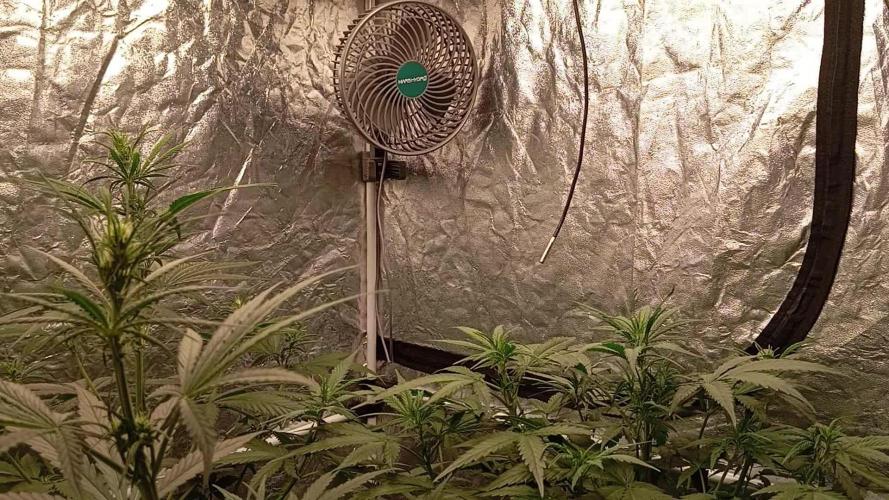
Ok guys been flowering since 05.07
Just moved into the big tent and installed AC infinity autopots
They are getting big!
Was playing around with time lapse and caught one of my girls moving to adjust growth for position in the new tent thought it was pretty cool
I am going to be getting a quality cam for doing professional time lapses soon I'm so excited😍
Likes
3
Share


@WeedM8
Follow
Hello m8 welcome to this journey with me in this diary will have very interesting strains hope u find something useful
O.G. Kush Titanium
- [ ] 1st week Veg: germinated in substrate lighting very close so it jets medium high humidity after the 3rd day they started sprouting
- [ ] 2nd week Veg: this week my ventilator broke down and as the temperature stayed very warm nothing developed much
- [ ] 3rd week Veg:fortunately this week i had fixed the ventilation and the temperature has go down a bit allowing the little plants to develop and reinforce
- [ ] 4th week:very good developments in this week I already started feeding a bit two times but i didn’t have to…once was enough
- [ ] 5th week Veg:this week they were very strong green i only had to water them good and keep the ventilators going no stop .They have good hight already ,but as i have to strains together. I want to transplant them when the hight of the other one have stretched… I’m thinking to transplant next week if not the next one
- [ ] 6th week Veg: this week it went great fortunatly i dont have pests that eat my buds i’ve givven a fed once the substrate is very rich already the plants streached very well i will transplant today so be ready m8 i cant wait to show you the progress
- [ ] 1st week Fl:they started stretching and looking very healthy just transplanted
- [ ] 2nd week Fl this week I’ve been away i had a friend taking care of them they stretching very well i hope that she starts putting energy into the flo
- [ ] 3rd week Fl:they are streaching very well ..getting the light very well
- [ ] 4th week Fl:there we aree guys the good stage is heree good high hope dosent effect de prod
- [ ] 5th week Fl:pumping very good this week a lot of changes started already being frosty
- [ ] 6th week Fl:this diaries its not daily updated this week its going’s so great we are close to harvest between next week and the other one . Ill harvest them at diffrent time just because they are not all at the same point of flowi
- [ ] 7th week Fl: im so satisfied from the way that this is going they didnt had any particular stress just that its 29 degrees during light and its going good so farr I haven’t constantly fed like on the peach g and pcr i hope for better taste at the end


Likes
3
Share


@Trinidad
Follow
02.07.25. Day 46
These ladies have gone out of control. Not much time. Had to make airport runs. Family staying over at my house. I have been trying to keep things as discreet as possible so I have them locked up in the loft with highs of 34°C or 93°F. I changed out reservoir today with 3 liters of water in each pot.

Likes
7
Share


Likes
8
Share


@Squaregrouper
Follow
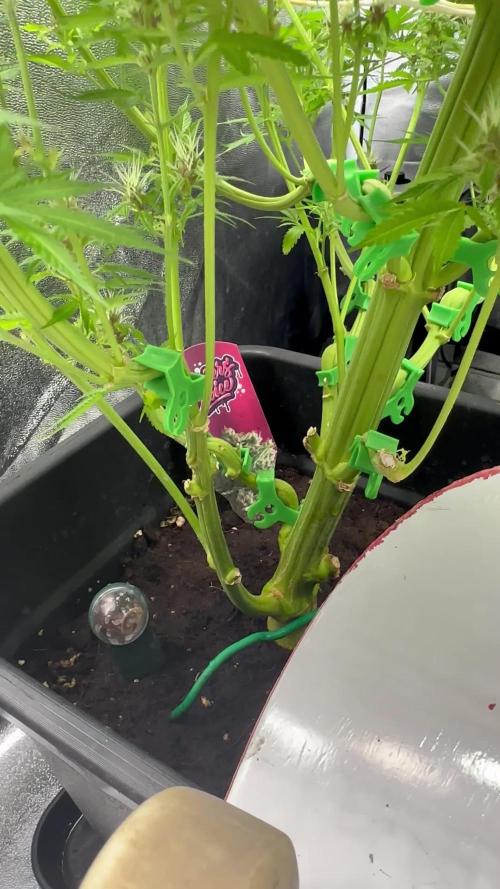
The three triple cheese plants are growing at the same rate at the exact same height... They are all from three separate seeds I grew these from seeds they are not clones... But I must know that triple cheese has a problem with cloning.? I finally got three clones to root outdoors but to be fair I did not dedicate a lot of time on getting clones.


Processing
Likes
8
Share


@GrownwithLED
Follow
The two surviving Barbarian (=AK-47 x Barbara Bud) plants develop well after they were planted in soil. The first pot is very small (0,25 l) and only a little watering is necessary now. As you can see in the pics the roots grow VERY WELL with the Voodoo Juice from Advanced Nutrients.
Likes
10
Share





Likes
11
Share


@Neetly
Follow
Week 0 Day 1
Alrighty my first grow ever but I’ve done my research through growweedeasy.com. And I’ve decided to go with 70/30 mix of coco coir and pelucite into 5 gallon fabric pots dosed with Cal Mag; and I’m planning on feeding it with FloraTrio next week.
Week 0 Day 2
They split around hour 19! Gonna wait for it to grow a little more then transfer into rapid rooter that came with the kit. Just Transferred into the rooter and keeping it warm on top of my pc, hoping to see some sort of sprouting by day 3/4 and good weather to transfer these babies over. So far, I’m just keeping the ziplok bag moist with 5.5-6.5 pH balanced water.
Week 0 Day 3
Transferred the rooters into the final pot for the rest of their growth, these puppies are fast growers ! pH is a consistent 6.0, and I’m keeping them in my garage since it’s 60F outside. Hoping for warmer weather, at least when she sprouts her first couple of leaves.
Week 0 Day 4
Just transferred the pots outside, hoping to get those sprouts some fresh sunlight. And hoping the good weather holds up. I think I should be able to start the coco coir nutrient schedule tomorrow. Going to base it off this schedule, Week 1
( https://www.growweedeasy.com/wp-content/uploads/2014/12/coco-coir-flora-series-schedule.pdf )
Week 0 Day 5
Growth has been good so far, unfortunately it seems like one of the super lemon haze girlies didn’t make it :( i’ve started to feed them the nutrients from the seedling section of the schedule. Keeping an eye out for any changes.
Week 0 Day 6
Spotted a couple of aphids, gonna look into natural insecticides/ordering ladybugs as a natural predator.

Likes
7
Share


@Oldwied
Follow
After four days of darkness it is time for harvest.
Day 113
Flower day 66
Christmas harvest
After I divided the plant in two, it was hung up and dried at 19°C for 8 days. It was then dry trimmed.
Cream Caramel = 73g buds + 22g trimm
Likes
4
Share


@Hommero75
Follow
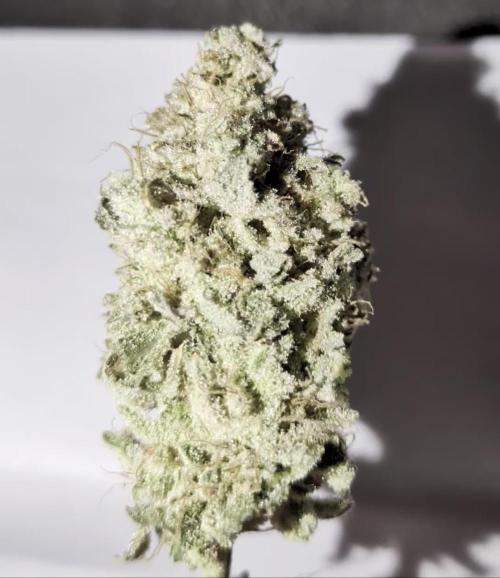
The Banana Purple Punch great strain with a super Sweet and Berries aroma.
I had bad issues in the beginning with the development and the grow of the plant. I amost gave up on the seed but she bounced back. She got cut today and put to dry. Give a 10 to the Banana Purple Punch

