The Grow Awards 2026 🏆
Likes
Comments
Share
@MrGrow
Follow
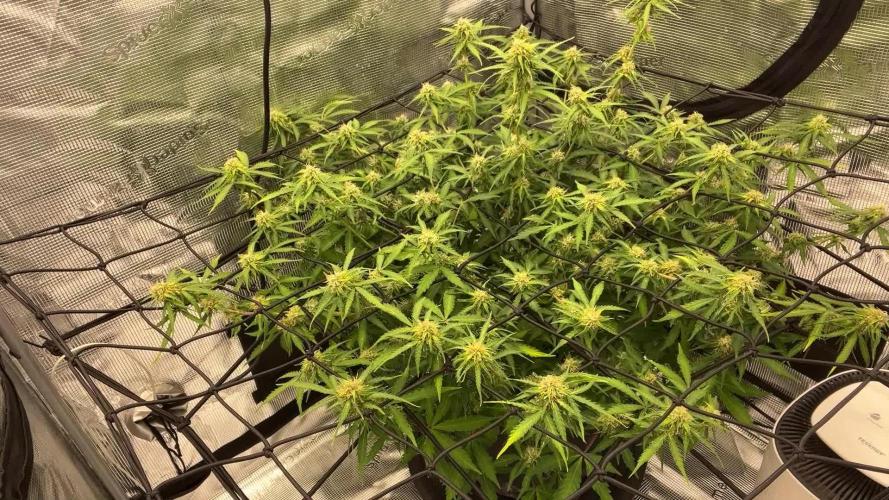
10.06.2023 RACCOLTO_RED HOT COOKIES Sweet Seeds 🌱 142 giorni dal seme 🌼 70 giorni fioritura ⚖️ 2895 grammi non secchi totale di 4 piante Tutto è andato per il meglio in questa corsa. Le 4 piante di Red hot cookies si sono dimostrate veramente forti. Colori stupendi a fine fioritura, non rossi come speravo, profumo di terra, dolcezza e aspro mescolati con note di gas, un profilo terpenico molto interessante. Lo scrog effettuato da me, non credo abbia dato il massimo potenziale di queste piante, con il tempo migliorerò anche questo aspetto, ma spero di stare su 1 hg a pianta di media. Aggiornamento a breve con peso a secco, foto dei fiori ripuliti e rapporto sulla potenza di questa varietà. Ringrazio tutti quelli che sono passati a vedere il mio diario, a tutti i like i commenti e ai consigli.. un grande love a tutta la community di growdiaries 💚🙏
Likes
80
Share
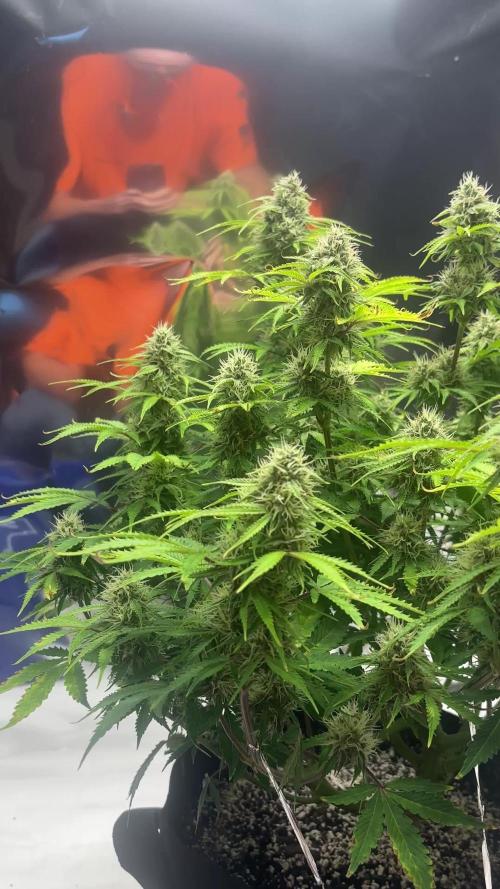
May 1st. breeders Information says, 10-12 Weeks of Flower iam very courious, how they go on Atm the 2 Phenos developing a lot of Flowermass The shorter/ denser Pheno has fistsized Buds, starting to get denser The other Pheno is still stacling up, and then budding around, very funny They smell fantastic,,, very courious how this Legend ary Strain goes on Stay tuneD!!!
Likes
63
Share
@Wastent91
Follow
Eccoci qua all ultima settimana di questa esperienza grandiosa! La mia prima volta in coltura DWC per me è stato fenomenale! Sono uscite due ragazze stupende! La papaya sherbert è davvero quella uscita meglio con dei bei fiori compatti e pieni di resina! L unica cosa negativa è che devo aver sbagliato qualcosa, anche se nn so cosa, dato che i fiori sono rimasti piccoli, numerosi ma molto piccoli rispetto alle coltivazioni fatte in precedenza.. Xo davvero a livello terpenico queste due piante sono spettacolari! Il loro odore penetra tutta la mia abitazione, uscendo anche fuori sopratutto la mattina presto, nonostante il filtro a carboni, in tutto il mio giardino si sente odore di frutta "molto speziata" in inverno, quindi quando tutti gli altri odori sono assenti, apparte l odore della combustione della legna della stufa... L unuca cosa che mi protegge dai miei vicini che potrebbero sospettare che di fianco a loro succede qualcosa di strano! 😂Grazie a tutti voi che mi avete seguito fino ad ora, vi terrò aggiornati per l. Imminente raccolta, ora ho cambiato l acqua per l ultima volta e ho messo acqua normale con il finale clean di Terra Aquatica, che nel giro di 3 max 4 giorni dovrebbe pulire a dovere la ragazza da tutti i nutrienti in eccesso, speriamo esca Dell ottima erba, con una combustione ottimale e un fumo pulito! Un abbraccio e buone fumate 420 a tutti! 🤞🍀💪😸🌱🌿🌲🧑‍🌾❄️❄️❄️😽💨💣💥💚💚💚
Likes
5
Share
Harvest day 68 since time switch to 12 / 12 h Hey guys :-) Finally it's time 💚 The lady is done the large leaves have been removed and hung upside down to dry in the dark drying room. You can now stay there for 13-15 days at a temperature of 18-20 degrees and 55-62% humidity. After 13-15 days it is neatly trimmed by hand and placed in jars with boveda packs 62. After 4 weeks Boveda 58% come in and are ready for testing ;-). After everything has been cut cleanly, the last update comes with the smoke report and the finished pictures. Let's get to the plant 💚. First of all I would like to compliment Green House for this genetics. Unfortunately, the rating system at Growdiaries is a bit strange because I have to give the stars before the Smoke Report and in the end it might have led to more stars in terms of taste. The growth was great from start to finish. She had no problems at all and also had no problems with animals 👍. I'm amazed at the great smell the beautiful buds give off😀. Of course I cut cuttings and if the taste is as good as the smell it will be grown again ☺️. A final report comes with the Smoke Report. Until then, I would like to say thank you to the whole Green House team and wish you all the best fun with the diary 💚🙏🏻 Have fun and stay healthy 💚🙏🏻 👇🏼👇🏼👇🏼👇🏼👇🏼👇🏼👇🏼👇🏼👇🏼👇🏼👇🏼👇🏼 ‘Powered by GreenHouse Feeding’ Copy the link for 10% off all Nutrients 👇🏼 http://shop.greenhousefeeding.com/ affiliate/madelngermany_passiongrower/ 👇🏼👇🏼👇🏼👇🏼👇🏼👇🏼👇🏼👇🏼👇🏼👇🏼👇🏼👇🏼 Water 💧 💧💧 Osmosis water mixed with normal water (24 hours stale that the chlorine evaporates) to 0.2 EC. Add Cal / Mag to 0.4 Ec Ph with Organic Ph - to 5.8 - 6.5 MadeInGermany
Likes
46
Share
@Jloux
Follow
11 mars Tous va bien ! Juste la "Lemon Garlic Og" qui montre signes de un peu trop d'engrais sur le bout des feuilles.(pourtant j'ai arrêté l'engrais bloom en mineral pour le passé en organic) Sinon elles vont bien ! Elles sont un peu fine, ça manque de volume (je vais remédier à ça en ajoutant du "PK" d'ici 1 a 2 semaines). J'ai posté 2 vidéos et des photos de chaques variétés. Sinon j'ai pas grand choses à dire. Ca brille-brille, ça sent bon ! C'est sur la bonne voie pour une jolie floraison !
Likes
40
Share
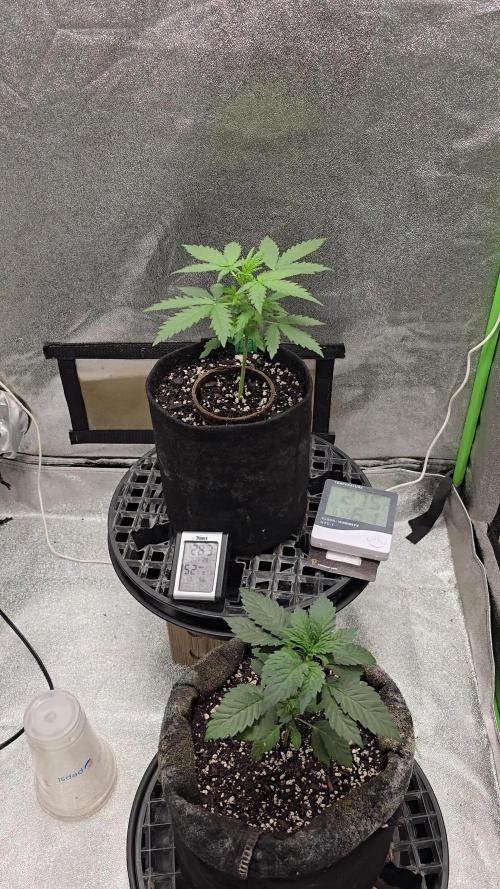
Day 43 purpling petioles is back. Root zone ph tests are perfect 5.9 6.0. She is fed at only 650 ppm on constant drip feed. Anything higher and was seeing some tip burn. May try low low low dose pk boost. I've read up on adding at 1/8 strength and feed middle 3 weeks can help. Think I'm going to give it a shot next reservoir change. Day 44 res change. Implemented Canna PK boost at 10% strength. Filled res with 2 gal. Will monitor plants signals. A couple bottom leaves yellowed and died. Not concerned as the leaves where well below canopy and low light conditions. Day 45 .75 gal consumed. All is well Day 46 she drank another 3/4 gal last night. Maintenance flush completed. Adjusted fan to above canopy and while doing so my hand inadvertently brushed against a bud and she smells of pure lemon candy at the moment. Stunning. Day 47 another 3/4 gal gone and the top of the coco had a few dry splotches. She's out drinking my feeder. I may have to add a second carrot to the pot. Day 48 she drank a gal last night. I think I finally got her flowering nutes dialed back in. Initial runoff ppm coming out same as going in. Overall appearance strong and healthy. Added 3 gal to res. Day 49 checked her at lights on and she was bone dry. Somehow got an air bubble in the drip line. Immediately drenched her. she looks fine. Fingers crossed. Added some pics/vids of some propagators that I'm playing around with. No MJ yet, but its spring and planting my herbs and veggies.
Processing
Likes
4
Share
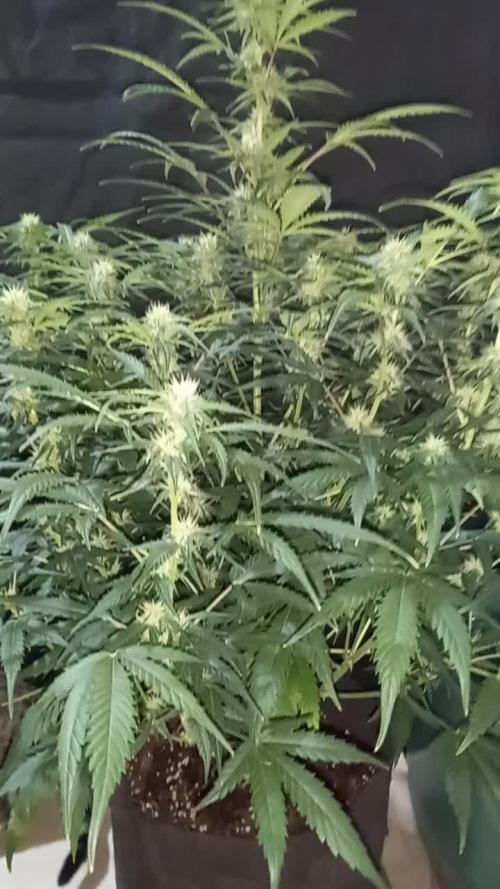
DAY 34 of flower🌸🌼 TALL PHENO BEST PHENO BY FAR
Likes
3
Share
@MrPipi
Follow
Mr. Pipi defoliated a bit after the topdress last week. just some old leafs here and there, not much. And Frost is building up, terps are coming. Mr.Pipi is happy :) AND the colors BOI oh BOI. thats what Mr.Pipi dreamt of. Day 46: Heights : Frank 47cm , Pedro 44cm and Lance 34cm.
Likes
2
Share
@GRow_M8s
Follow
Leave's edges have turned yellow and it was fed with a good amount of 6.5 ph water to give her a break. Watered for second time this week with just 6.5 ph water.
Processing
Likes
11
Share
happy day my friends, because little space I decided to put two of the three in bloom, the 3 girls I want to grow it again for a while. Today the first day of flowering 12/12, they are beautiful full they will make many buds
Likes
12
Share
Overall great experience. Felt that these auto were real easy to grow, with not many issues to fix.
Processing
Likes
26
Share
82.5 grams she taste so good ... thanks for all the love everyone
Likes
3
Share
So we have both auto flowers germinated and we're going to do a diary for each strain. Whichever one does best we'll enter into the competition for Divine seeds. I'm using Promix soil and BAS Craft Blend for the nutrients and we just gave them some Alfalfa Ferment from Growing Organic as well. That should give these ladies a nice little boost. This one just broke the soil, barely so she's a little farther behind the others but now by much. It's Big Demon vS Overdose. Let's see who takes the 👑.
Likes
27
Share
Hi Growmies Another week of flowering behind us and 3 weeks to the finish post and fruity highs They have all been productive in the flowering this week with plenty of nice fluffy pistils springing up daily now. They are also producing a very sweet smell when I open the tent too. A nice fruity terp indeed. They have been performing excellent from seed and with no concerns at all for their genetics, it is all about what the new additions to my feeding schedule can do. So far the results do seem to support the flower production claim with lots of fresh sites throughout the canopy, thankfully they have also not created wide spacing between the flower sets either so could hopefully become long chunky colas. Using the viparspectra and it's great specs for just the 3 plants has also been a new thing for me to try instead of the crammed in 6 plants. No issues to report around bugs or deficiency still and with the dehumidifier on the case , hopefully no mould spores will show up either. Until next time , be lucky and keep it green
Likes
6
Share
She in middle of week one flowering recieved a heavy pruning , also adjusted her lst. She started to stretch now hopefully she stretches up a foot more :) all in the end even though one made it I'm still glad :) will order more down the line for sure. Sometimes people we hit or miss with seeds!
Likes
5
Share
@Ninjabuds
Follow
The rainbow Saltz has a very unique set of leaves it doesn’t have the traditional looking leaves that 80% of plants have I think when this plant flowers it’s gonna wrap around the stem This week was smooth sailing I topped all the plants
Likes
3
Share
Caught up... things are going well, Bruce stretched like crazy and has evened up its canopy to the others idk if it's that big bud in it or what. Lilac has looked a solid week and half ahead of the others since flower, she looks wicked though, trichromes are starting to build. I've done my last training, I usually go hard on thinning but I'm trying to be conservative and only uncover buds under leaves. Still same feeding routine.. looking forward to the finish line but know this is an important time with terms and trichromes beginning to resonate... I sick at this guy's but I want to get better at chronicling my grows.. so hourly I will improve in the process of Journaling.
Likes
18
Share
Green light is radiation with wavelengths between 520 and 560 nm and it affects photosynthesis, plant height, and flowering. Plants reflect green light and this is why they appear green to our eyes. As a result, some growers think that plants don’t use green wavelengths, but they actually do! In fact, only around 5 – 10% of green light is reflected from leaves and the rest (90 – 95 %) is absorbed or transmitted to lower leaves [1]. Green wavelengths get used in photosynthesis. Chlorophyll pigments absorb small amounts of green wavelengths. Light that doesn’t get absorbed is transmitted to leaves that are shaded out from direct light. This means that leaves at the bottom of the canopy get more green light than leaves at the top. A high proportion of green wavelengths compared to other colors tells lower leaves that they are being shaded out, so they are able to react accordingly. Lower leaves may react by opening or closing their stomata or growing longer stems that help the leaves reach brighter light [1, 2, 3]. When it comes to growing cannabis, many cultivators are interested in the quality of light used for the flowering stage. In many plants, flowering is regulated by two main photoreceptors: cryptochrome and phytochrome. Both photoreceptors primarily respond to blue light but can also respond to green, although to a lesser extent. Green can accelerate the start of flowering in several species (although cannabis has yet to be tested) [1, 4, 5]. However, once flowering has begun, it’s important to provide plants with a “full spectrum” light that has high amounts of blue and red light, and moderate amounts of green, in order for photosynthesis to be optimized. Green light mediates seed germination in some species. Seeds use green wavelengths to decide whether the environment is good for germination. Shade environments are enriched in green relative to red and blue light, so a plant can tell if it is shady or sunny. A seed that senses a shaded environment may stay dormant to avoid poor growing conditions [1]. Some examples of plant species where researchers have documented this response are: ryegrass (a grass that grows in tufts) and Chondrilla (a plant related to dandelion) [1, 6]. Although green wavelengths generally tell plants NOT to germinate, there are some exceptions! Surprisingly, green wavelengths can stimulate seed germination in some species like Aeschynomene, Tephrosia, Solidago, Cyrtopodium, and Atriplex [1, 6, 7]. Of course, light is not the only factor affecting seed germination – it’s a combination of many factors, such as soil moisture, soil type, temperature, photoperiod, and light quality. When combined with red and blue light, green can really enhance plant growth [1, 8]. However, too much green light (more than 50% of the total light) can actually reduce plant growth [8]. Based on the most current research, the ideal ratio of green, red, and blue light is thought to be around 1:2:1 for green:blue:red [9]. When choosing a horticultural light, choose one that has high amounts of blue and red light and moderate amounts of green and other colors of light. Not many studies can be found about the effect of green light on cannabis growth or metabolism. However, if one reads carefully, there are clues and data available even from the very early papers. Mahlberg and Hemphill (1983) used colored filters in their study to alter the sunlight spectrum and study green light among others. They concluded that the green filter, which makes the environment green by cutting other wavelengths out, reduced the THC concentration significantly compared to the daylight control treatment. It has been demonstrated that green color can reduce secondary metabolite activity with other species as well. For example, the addition of green to a light spectrum decreases anthocyanin concentration in lettuce (Zhang and Folta 2012). If green light only reverses the biosynthesis of some secondary metabolites, then why put green light into a growth spectrum at all? Well, there are a couple of good reasons. One is that green penetrates leaf layers effectively. Conversely red and blue light is almost completely absorbed by the first leaf layer. Green travels through the first, second, and even third layers effectively (Figure 2). Lower leaf layers can utilize green light in photosynthesis and therefore produce yields as well. Even though a green light-specific photoreceptor has not yet been found, it is known that green light has effects independent from the cryptochrome but then again, also cryptochrome-dependent ones, just like blue light. It is known that green light in low light intensity conditions can enhance far red stimulating secondary metabolite production in microgreens and then again, counteracts the production of these compounds in high-intensity light conditions (Kim et al. 2004). In many cases, green light promoted physiological changes in plants that are opposite to the actions of blue light. In the study by Kim et al. blue light-induced anthocyanin accumulation was inhibited by green light. In another study it has been found that blue light promotes stomatal opening whereas green light promotes stomatal closure (Frechilla et al. 2000). Blue light inhibits the early stem elongation in the seedling stage whereas green light promotes it (Folta 2004). Also, blue light results in flowering induction, and green light inhibits it (Banerjee et al., 2007). As you can see, green light works very closely with blue light, and therefore not only the amount of these two wavelengths separately is important but also the ratio (Blue: Green) between these two in the designed spectrum. Furthermore, green light has been found to affect the elongation of petioles and upward leaf reorientation with the model plant Arabidopsis thaliana both of which are a sign of shade avoidance symptoms (Zhang et al. 2011) and also gene expression in the same plant (Dhingra et al. 2006). As mentioned before, green light produces shade avoidance symptoms which are quite intuitive if you consider the natural conditions where the plants grow. Not all the green light is reflected from the highest canopy leaves in nature but a lot of it (50-90%) has been estimated to penetrate the upper leaves at the plant level ((Terashima et al., 2009; Nishio, 2000). For the plant growing in the understory of the forest green light is a signal for the plant of being in the shade of a bigger plant. Then again, the plants growing under unobstructed sunlight can take advantage of the green photons that can more easily penetrate the upper leaves than the red and blue photons. From the photosynthetic pigments in higher plants, chlorophyll is crucial for plant growth. Dissolved chlorophyll and absorb maximally in the red (λ600–700 nm) and blue (λ400–500 nm) regions of the spectrum and not as easily in the green (λ500–600 nm) regions. Up to 80% of all green light is thought to be transmitted through the chloroplast (Terashima et al., 2009) and this allows more green photons to pass deeper into the leaf mesophyll layer than red and blue photons. When the green light is scattered in the vertical leaf profile its journey is lengthened and therefore photons have a higher chance of hitting and being absorbed by chloroplasts on their passage through the leaf to the lower leaves of the plant. Photons of PPFD (photosynthetic photon flux density) are captured by chlorophyll causing an excitation of an electron to enter a higher energy state in which the energy is immediately passed on to the neighboring chlorophyll molecule by resonance transfer or released to the electron transport chain (PSII and PSI). Despite the low extinction coefficient of chlorophyll in the green 500–600 nm region it needs to be noted that the absorbance can be significant if the pigment (chlorophyll) concentration in the leaf is high enough. The research available clearly shows that plants use green wavelengths to promote higher biomass and yield (photosynthetic activity), and that it is a crucial signal for long-term developmental and short-term dynamic acclimation (Blue:Green ratio) to the environment. It should not be dismissed but studied more because it brings more opportunities to control plant gene expression and physiology in plant production. REFERENCES Banerjee R., Schleicher E., Meier S. Viana R. M., Pokorny R., Ahmad M., Bittl R., Batschauer. 2007. The signaling state of Arabidopsis cryptochrome 2 contains flavin semiquinone. The Journal of Biological Chemistry 282, 14916–14922. Dhingra, A., Bies, D. H., Lehner, K. R., and Folta, K. M. 2006. Green light adjusts the plastic transcriptome during early photomorphogenic development. Plant Physiol. 142, 1256-1266. Folta, K. M. 2004. Green light stimulates early stem elongation, antagonizing light-mediated growth inhibition. Plant Physiol. 135, 1407-1416. Frechilla, S., Talbott, L. D., Bogomolmi, R. A., and Zeiger, E. 2000. Reversal of blue light -stimulated stomatal opening by green light. Plant Cell Physiol. 41, 171-176. Kim, H.H., Goins, G. D., Wheeler, R. M., and Sager, J. C. 2004.Green-light supplementation for enhanced lettuce growth under red- and blue-light emitting diodes. HortScience 39, 1617-1622. Nishio, J.N. 2000. Why are higher plants green? Evolution of the higher plant photosynthetic pigment complement. Plant Cell and Environment 23, 539–548. Terashima I., Fujita T., Inoue T., Chow W.S., Oguchi R. 2009. Green light drives leaf photosynthesis more efficiently than red light in strong white light: revisiting the enigmatic question of why leaves are green. Plant & Cell Physiology 50, 684–697. Zhang, T., Maruhnich, S. A., and Folta, K. M. 2011. Green light induces shade avoidance symptoms. Plant Physiol. 157, 1528-156. Wang, Y. & Folta, K. M. Contributions of green light to plant growth and development. Am. J. Bot. 100, 70–78 (2013). Zhang, T. & Folta, K. M. Green light signaling and adaptive response. Plant Signal. Behav. 7, 75–78 (2012). Johkan, M. et al. Blue light-emitting diode light irradiation of seedlings improves seedling quality and growth after transplanting in red leaf lettuce. HortScience 45, 1809–1814 (2010). Kasajima, S., et al. Effect of Light Quality on Developmental Rate of Wheat under Continuous Light at a Constant Temperature. Plant Prod. Sci. 10, 286–291 (2007). Banerjee, R. et al. The signaling state of Arabidopsis cryptochrome 2 contains flavin semiquinone. J. Biol. Chem. 282, 14916–14922 (2007). Goggin, D. E. & Steadman, K. J. Blue and green are frequently seen: responses of seeds to short- and mid-wavelength light. Seed Sci. Res. 22, 27–35 (2012). Mandák, B. & Pyšek, P. The effects of light quality, nitrate concentration and presence of bracteoles on germination of different fruit types in the heterocarpous Atriplex sagittata. J. Ecol. 89, 149–158 (2001). Darko, E. et al. Photosynthesis under artificial light: the shift in primary and secondary metabolism. Philos. Trans. R. Soc. B Biol. Sci. 369 (2014). Lu, N. et al. Effects of Supplemental Lighting with Light-Emitting Diodes (LEDs) on Tomato Yield and Quality of Single-Truss Tomato Plants Grown at High Planting Density. Environ. Control Biol. 50, 63–74 (2012).