


Likes
Comments
Share


@Chumpkilla
Follow
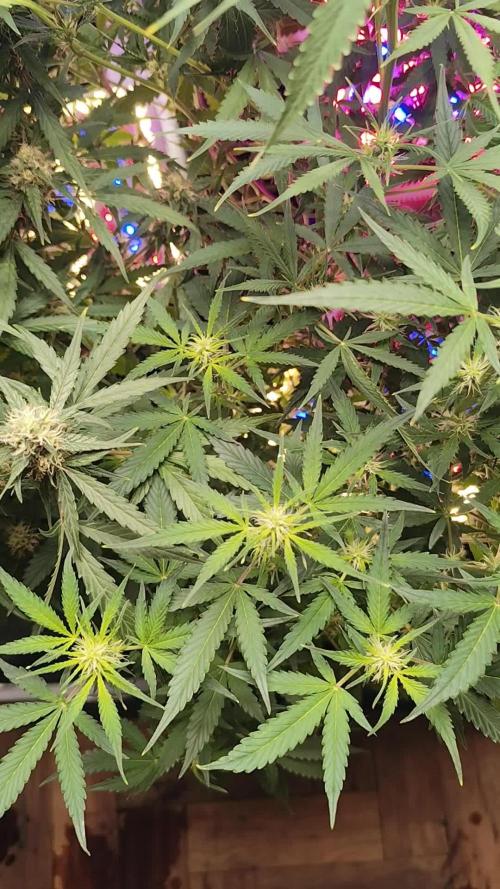
7/30/23 - Day 48 - OK, so last I posted, I have been waiting to see how tall she grows. She does not seem to be stopping her growth I'm going to try some super cropping. I've never done this before, but it honestly does not seem like a bad thing. Hurt the plant a little, and the response should be more THC. The reason for hurting the plant is so that you can bend the plant as you need it. She's sleeping now, but when she wakes up, ill take a look and possibly start to super crop.
Currently, I am working on implementing the auto water feature of the LEAF Grow system, which is quite convenient to set up. All it requires is to hook it up to a standard hose outlet, saving you time and effort. By using Reverse Osmosis (RO) water instead of tap water, I can ensure a controlled and optimal environment for my plants. Tap water contains various additives like copper, zinc, and chlorine, which can't be measured precisely and might affect plant growth.
In a successful grow operation, every aspect needs careful control, and water is of utmost importance. RO water, with its near-zero ppm, ensures that there are no unwanted additives, offering the best conditions for plant development. Although RO water is not produced under pressure, I've found a suitable solution to address this concern.
To achieve the required pressure for the LEAF unit, which is rated for 30 - 80 PSI, I've researched and discovered that a sump pump would work perfectly in this setup. This pump adds the necessary 30 PSI to the water line as it is drawn from the inlet, eliminating the need to pressurize a bottle or container, thus avoiding potential hazards associated with excessive pressure.
I'll be documenting my progress with pictures as I set up this system, and I can't wait to witness the auto water feature in action, saving me from the hassle of manually adding water.
Super Crop: I did about half of the plant in a Super Crop today. Meaning I damaged the branches enough to bend them. The plant will work overtime to fix them, but also, the Resin and THC will be surging through the plant in a rush to be more defensive against what it more than likely a predator eating it. I did my best to make the branches pliable. I think I did a good job. I was so scared that I was going to snap them.... and I did; on a couple, they split up the side. So I grabbed my duct tape and added a bandaid. I have been worried sick about how she would handle all the destruction.
After about 3 hrs, I saw that all the Super Cropped branches were already reaching back up. This is a great sign that the plant is doing well and that all the branches I was sure were to fall off are thriving. Again I think this box is magic. The topping didn't stunt any growth, trimming a 3-gallon bucket full of leaves 1st week into flower didn't stunt any growth, and Super Cropping 2 weeks into flowering seems to be thriving. I'm going to get to experiment with this LEAF box on all kinds of strains. The possibilities are endless. Just one theory I want to try, Purple. I want to grow a strain known for its purple, and I want to grow it a few times, each time growing it colder and colder to document and show how cold might affect the purple color like we have all read and heard about. These are the kinds of things that I think about and why I choose LEAF.
Ill be back to update tomorrow morning.
8/1/23 - Day 50 - I updated some of the pictures. Flowering is going well. Every day the water is less, and the buds are bigger! I scoped out some of the buds already. Now we just wait. i have a water change coming up in a few days. As always ill add some more pics as we go along.
If you are looking for this experience, check out https://www.getleaf.co/

Likes
25
Share


@Sators
Follow
Mixed biobizz all mix with extra eggshells, palm tree ash, extra worms casting and fish blood and bones.

Likes
4
Share


@Lazuli
Follow
So this was my third tropicana, so far all different phenos, this was the biggest yielder of them

Likes
11
Share


@TheThiccBud
Follow
sooooo... I have now harvested the plants and they looks so pretty 😍😌 I'm really proud of myself to have produced such THICC BUDS!!! 😅😍 and the smell is so awsome 😵 this strain is a 11 from 10 👌 a realy big Thanks to Royal Queen Seeds for this 2 awsome strains 💪 A detailed rating comes after drying with a detailed score board 😄


Likes
6
Share


@Ksouth1
Follow
Last week went well. She is growing steadily and I can't wait to get her outside. She is going to be great once she can spread her roots in the ground. I took a few clones to attempt to keep this strain around since it was my only seed. Can't wait for the fall. She had some leaves removed and I did some lst and supercropping to even out the canopy further. She was topped on every branch to double the amount of tops. I will update as she progresses. Until next time happy growing to everyone!

Likes
12
Share


@OGbros
Follow
the roots broke the plastic basket😱
Very strong genetic, very recommended👽

Likes
2
Share


@EtnoGrow
Follow
everything is going very well, the girls have developed, we have found a hermaphrodite, what a surprise my colleague got when he found one with eggs, what a scare! I saw a video of a Mexican whose technique consists of breaking the male balls and letting the flower clean and do it every day as soon as new shoots come out, there comes a time when they no longer grow and only the female hairs follow, I will see that That's how it goes, if I can, when I visit the indoor, a photo of the hermaphrodite will be taken, only one of the girls, I don't know if she got stressed or what happened, the others continue to flower normally, big beautiful females, I'm amazed, how many showed my first crop, I see it great what do you think friends
Likes
10
Share


@Stacy_smokez
Follow
Going well did some defoliating and going to do some more also added to my grows as well deffiecies still present need a ph pen to check everything may switch nutrients next grow as well

Likes
21
Share


@BushDoctor740
Follow
Day 70 Well I think I will give them another week and harvest.Showing lots of trichomes that are mostly cloudy so I’ll let them go a bit longer.The tallest girl is at 40 inches and suffered some fox tailing I’m gonna say from when I pounded them with light for a week or so 😆.Even though she fox tailed and will not have the most dense buds she smells super strong and loaded with trichomes.Of the 5 Runtz the shortest has the chunkiest most dense buds.The other 3 were very big producers and took the LST great branching out forming tons of colas.Ill try to let them dry out this week and place in the dark for a day or so before chopping.Unfortunately in my area we have heavy rains all week humidity may become a problem so I will add a dehumidifier soon.


Likes
2
Share

@Growingbuds
Follow
So.... We start week 9 - 9-30 to 10/6 so far so good , one of them more slow but with nice structure, I m gone love to see development of lastest one , keep feeding them in my attempt to harvest nice and fat buds, let's see.,( smells very good)

Likes
28
Share


@No_Clout
Follow
Hopefully will be starting flush next week seeing how it is, gonna do a two week flush, yes it is coco but I want a proper flush this time round so o can get that thick white ash we all know and love instead of some nasty dark gray/Black.


Likes
11
Share


@Lushbloomz
Follow
After a comeback, the train is in the station! Even though I broke the main stem, she was an easy grow. I just basically let her do her with great results. Buds are thick and dense. Time for the drying and curing.
Likes
27
Share


@420DeepGrow
Follow
Gracias al equipo de Zamnesia Marshydro XpertNutrients y Trolmaster sin ellos esto no sería posible.
💐🍜 Cosmic Noodles:
Orgullosa descendiente de Alien OG y Rollercoaster Haze, la Cosmic Noodles ofrece cosechas excelentes y una experiencia de fumar fragante. Esta variedad es muy potente, tiene un 25% de THC y produce efectos intensos y duraderos. Edificante y relajante, fumar Cosmic Noodles catalizará un colocón cerebral energizante que luego disminuirá hasta convertirse en un relajante colocón corporal.
Aquí se pueden detectar las influencias de ambas cepas parentales y las flores son notablemente cítricas, con la lima en primer plano. También disfrutarás de notas especiadas y terrosas con delicados matices florales.
🌻🚀 Consigue aqui tus semillas:
https://www.zamnesia.com/10777-zamnesia-seeds-cosmic-noodles.html
Código Descuento 20%: ZAMMIGD2023
💡TS-3000 + TS-1000: se usaran dos de las lámparas de la serie TS de Marshydro, para cubrir todas las necesidades de las plantas durante el ciclo de cultivo, uso las dos lámparas en floracion para llegar a toda la carpa de 1.50 x 1.50 x 1.80.
https://marshydro.eu/products/mars-hydro-ts-3000-led-grow-light/
🏠 : Marshydro 1.50 x 1.50 x 1.80, carpa 100% estanca con ventanas laterales para llegar a todos los lugares durante el grow
https://marshydro.eu/products/diy-150x150x200cm-grow-tent-kit
🌬️💨 Marshydro 6inch + filtro carbon para evitar olores indeseables.
https://marshydro.eu/products/ifresh-smart-6inch-filter-kits/
💻 Trolmaster Tent-X TCS-1 como controlador de luz, optimiza tu cultivo con la última tecnología del mercado, desde donde puedes controlar todos los parametros.
https://www.trolmaster.com/Products/Details/TCS-1
🍣🍦🌴 Xpert Nutrients es una empresa especializada en la producción y comercialización de fertilizantes líquidos y tierras, que garantizan excelentes cosechas y un crecimiento activo para sus plantas durante todas las fases de cultivo.
Consigue aqui tus Nutrientes:
https://xpertnutrients.com/es/shop/
📆 Semana 4:
Aparecieron un monton de erizos esta semana, el temporal ha hecho algo de mella en la carpa al bajar las temperaturas aunque todo sigue correcto.
Continuamos con las dosis de nutrientes recomendadas por el fabricante.
Likes
4
Share


@PatriciaGant
Follow
Dane, We all should help one another.
Human beings are like that.
We should live by each other’s happiness - not by each other’s misery.
We don’t want to hate and despise one another, share the Joint.
And mother earth is rich and can provide for everyone.
We can Grow enough Happiness, In this paradise, there is room for everyone.
We only exist to bring joy into the world and The way of life can be free and beautiful,
but we have lost the way.
Grow High and Give the world A smile.
At the end we own nothing more then all our memories, lets make them amazing for everyone,
nothing to lose only everything to win.
for those who come after, right.
A last kiss goodby, a second one, softer and long as a sign, that you are woth it.
That Everyone worth, who loved and given.
Enought Hippie Talk, now have a nice day and an even better grow, thx for watching by.
((From Seed 🌱
week report:


