


Likes
Comments
Share


@PoppaJoe
Follow
So after further review I found that the Big Bang is an auto that REQUIRES a dark period throughout its flowering stage and doesn’t do well under 24 hours of light🤦♂️🏾She lost almost every leaf she had but her branches are still strong and she’s trying to survive. I’m not too worried about it, I can always give it another run. As far as the crystal candy I’m contemplating on cutting a single branch now while the terpenes are cloudy and then cutting the rest when Amber just to experience the difference in high first hand.






Likes
65
Share


@MadeInGermany
Follow
Flowering day 52
since time change
to 12 / 12 h
Hey guys :-)
All ladies look very healthy and delicious :-)
We're slowly getting closer to the end.
This week it was poured 3 times with 1.2 l each (sewing materials see table above)
At the next watering there is a very light rinse with Clean Fruits so that the last nutrients can be slowly used up.
The trichomes are now checked every day.
I'm looking for my microscope with an app so I can take pictures of it 👍.
I wish you a lot of fun with the update and stay healthy 💚🙏🏻
👇🏼👇🏼👇🏼👇🏼👇🏼👇🏼👇🏼👇🏼👇🏼👇🏼👇🏼👇🏼
You can buy this Nutrients at :
https://greenbuzzliquids.com/en/shop/
With the discount code: Made_in_Germany you get a discount of 15% on all products from an order value of 100 euros.
👇🏼👇🏼👇🏼👇🏼👇🏼👇🏼👇🏼👇🏼👇🏼👇🏼👇🏼👇🏼
You can buy this strain at :
https://www.barneysfarm.com/dr-grinspoon-5
Water 💧 💧💧
Osmosis water mixed with normal water (24 hours stale that the chlorine evaporates) to 0.2 EC. Add Cal / Mag to 0.4 Ec Ph with Organic Ph - to 5.8 - 6.5
MadeInGermany

Likes
12
Share

@H0BBYGAERTNER
Follow
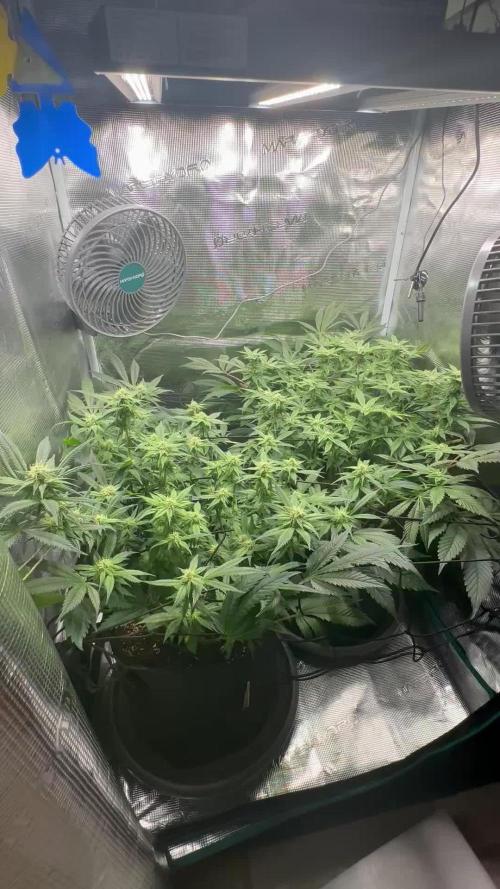
WEEK #15 — FIRST SIGNS OF FROST
Most „Standard“ Week so far, i guess. A Little grow, a little leaves removed (that shadowed other Branches), Water Water — same same all week.
The only new thing: A Little smell. Slush Mint cake very fresh and fruity (had the Impression of a light menthol Impression in the air a few times). Skywalker like lemon-soapy Style. Looking forward to how it will develop individually.
The Look: another clear difference is the appearance. SMC is very flat (like really flat), very dense, but mostly with distance between buds. Skywalker rather normal, but also dense. Both have „breakout“ Kolas, canopy rather uneven, so light Distribution not that great. Well, LED aint the sun, hu?
BUT: The underdog, Mint Cake, has the most frostied leaves, covered in trichomes. From shaft to the tip, ALL of them, what makes them appear light green, although the leaves are rather dark. Hope this will develop Even further, very impressive so far.
First few pistills turning brown already, However according to Dutch Passion, bloom is 8-9 weeks for SMC and 9-10 Weeks for Skywalker *Haze* on average. This should mean like half is already over. ☺️
Bonus: CUTE - SMC as well as Skywalker have slight purple tips (🍆) respectively tiny dark/ purple leaves. Fingers crossed i have a purple pheno!
Temperatures are hot at the Moment, humidity dry. Both Translate to very good conditions in the tent.
Guess thats it for this week, stay tuned.
Edit: For nutrients, i still have some calmag and phosphor around from my beginnimgs. They dont seem necessary at the Moment, but — so i assume — will Not harm the plants either, at least in a very light concentration.

Likes
5
Share


@cr0baron
Follow
I've started flushing.
Harvest time predictions:
Afghan Kush - I reckon some time this week maybe Friday
Northern Lights - I reckon Tuesday in a week exactly
Gushers - Some time between next Tuesday and next Friday
Crack and THe Beanstalk - Some time between next Friday and next Tuesday

Likes
11
Share


@Lahuertade_Bototo
Follow
🌱🌱🌱Continuamos este cultivo, con esta hermosa cepa de FastBuds, Girl Scout Cookies Auto, en las ultimas semanas de Floración .🌱🌱🌱
👨🍳👨🌾🏻 Nutrición y Bitácora 👨🌾🏻👨🍳
-Día 50. Se riega con una solución nutritiva NPK de 1.5 Litros con Plagron Alga Bloom (2.6 ml), Plagron Sugar Royal (0.75 ml) y Plagron Green Sensation (0.75 ml).
-Día 51. Se riega con 3 litros de una solución nutritiva NPK de Plagron Alga Bloom (6 ml) Plagron Sugar Royal (1.5 ml) y Plagron Green Sensation (1.5 ml).
-Día 52. Se deja secar el sustrato, ya se aprecian unas colas gordas llenas de flores y resina, tricomas ámbar comienzan a verse, estamos prontos a la cosecha, quizás por el día 60-70.
-Día 53. Se riega con 3 litros de una solución nutritiva NPK de Plagron Alga Bloom (6 ml) Plagron Sugar Royal (1.5 ml) y Plagron Green Sensation (1.5 ml). A los aromas dulces y diesel, se le suma un fuerte olor picante y terroso, cada vez un aroma mas complejo.
-Día 54. El engorde de flores no para 💪
-Día 55. Se riega con una solución nutritiva NPK de 3 Litros con Plagron Alga Bloom (6 ml), Plagron Sugar Royal (1.5 ml) y Plagron Green Sensation (1.5 ml).
-Día 56. Ultima semana con riego NPK, de ahora en adelante se regara con agua + enzimas .
🚀Equipamiento🚀
Indoor de 60x60x159 cm y una iluminación BlackCob F320, se activa solo 1 modulo (160w) a 45 cm del canopy por el resto del cultivo. Intractor de 135mm, extractor de 135mm, filtro de carbón, ventilador "oscilofan", ventilador "clip fan", este ultimo ventilador se ajusta en la parte baja de la carpa para mejorar la circulación de aire bajo el canopy, 2 termohigrometros y una malla SCROG de kanovi a 15 cm de la maceta.
Acompáñenme para ver los resultados de este hermoso desafío, un saludo cultivadores 🔥🔥🔥


Likes
24
Share

@BunnyBud
Follow
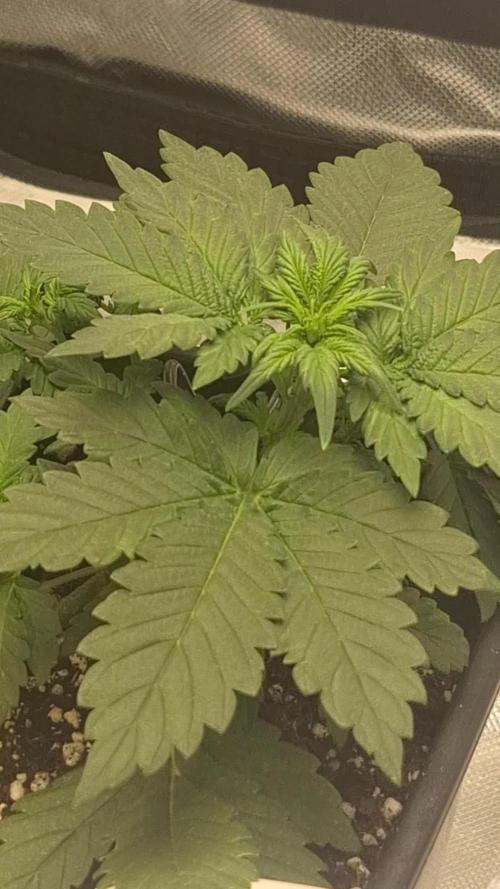
31 Aug. I start the third week of my autoflower. The plant is growing well, but I noticed small yellow spots on the leaf tips, which seem like a mild calcium deficiency. This is probably due to the fact that so far I have been giving water with a slightly low pH, around 6, while the ideal range would be 6.5–7.
At the beginning, to lower the ppm of the tap water (which was around 211 ppm), I mixed it with demineralized water. This brought the ppm down to about 109–140, making it harder for the plant to absorb the available calcium. Additionally, the soil I am using, Biobizz Light Mix, is lightly fertilized but does not contain enough calcium to correct this small initial deficiency.
For this week, I will not add any fertilizers. I simply want to raise the pH to 6.5 and use water with higher ppm, so the plant can better absorb the nutrients already present in the soil.
The lamp is positioned about 35–36 cm from the plant and so far there are no burn issues. Temperatures range between 25 and 30 °C depending on the day, while humidity in the room stays between 40–60%. The humidifier is always on because I keep the window open, but the dehumidifier is not being used, as it is not necessary at the moment.
I also have a new oscillating fan arriving to replace the current fixed one, and I’m waiting for a regulable extractor (90–145 m³/h), which will allow me to control the air perfectly during winter if needed.
This week my main goals are:
Increase the water ppm without overdoing it
Adjust the pH to 6.5
Keep observing the plant without adding any fertilizers
Everything else seems fine and growth is regular. With these corrections, I expect the new leaves to grow healthy and free of spots.
==UPDATE 31/08==
To control the calcium deficiency, I will administer an eggshell solution until I reach 300 ppm (I will boil some eggshells and administer the solution in tap water).
==Update 4 Sept==
By mistake, I adjusted the pH twice, once to 7 and once to 8, and obviously the plant immediately showed symptoms of incorrect pH. At the next watering, I'll give Biobizz Grow with a little Biobizz Bloom since the plant has entered pre-flowering. I'll adjust everything to a pH of 6-7 and a ppm of 450-500.
Likes
2
Share


@CannaIGrow
Follow
This plant is growing well, I transplanted them this week into 3 gallon pots from 1 gallon pots. Structure on this plant is pretty nice and visually pleasing to the eye lol.
Likes
2
Share


@Aleks555
Follow
Our beauty is now 4 weeks old and continues to grow strong and healthy. She has already surpassed 18 cm in height, showing excellent progress. The light schedule remains 12/12, and we continue to monitor her response to these conditions.
The daytime temperature stays steady at 28°C, nighttime at 21°C, with humidity maintained at 65%. We are consistently feeding her with Xpert Nutrients fertilizers, ensuring she gets all the necessary elements for active growth. Additionally, we are continuing the use of CO2, which, based on our observations, has a positive impact on development.
A huge thank you to Xpert Nutrients for their high-quality fertilizers, helping our plants grow strong and healthy!


Likes
19
Share


@Master_weeda
Follow
Plus 10 centimètres !
Jour70 arrosage avec 2 litres d'eau ph6. 3
Jour72 arrosage avec 2 litres d'eau ph6. 3
Jour75 arrosage avec 2 litres d'eau ph6. 3

Likes
27
Share


@Kirsten
Follow
Hulkberry has continued to develop big fat buds, which are becoming frosty!
The leaf situation is not looking pretty. I had taken down my Northern Lights, which was really large, and decided to rearrange the tent. I noticed that the worst leaves were all on the side of the plant closest to the lights.
She has much more space now and hopefully will manage to finish out nicely.
She is still feeding heavily and needs to be watered several litres a day or so.
Here is what I fed her this week:
10.6.25:
The plant was watered with 6ltrs of dechlorinated water PH'd to 6.2.
I added per 6.5 litres;
♡ 7ml Ecothrive Trace
♡ 1/4 TSP Sea K(elp)
PPM: 605
PH: 6.2
I decided to feed each plant separately and mix it up in the 2l jug.
12.6.25:
I watered with 4L of dechlorinated water PH'd to 6.4 and containing the following nutrients per 6.5 litres;
♡ 7ml Ecothrive Trace
♡ 1/2 Tsp Ecothrive Biosys
PH: 6.4
PPM: 890
14.6.25:
I watered with 6L of dechlorinated water PH'd to 6.4 and containing the following nutrients per 6.5 litres;
♡ 7ml Ecothrive Trace
♡ 1Tsp Mega Crop Part A by Greenleaf Nutrients
PH: 6.4
PPM: 890
15.6.25
I gave 5l of dechlorinated water PH'd to 6.2 with the following nutrients;
♡ 12ml Ecothrive Flourish
PPM: 463
PH: 6.2
17.6.25:
I watered with 4.5L of dechlorinated water PH'd to 6.3 and containing the following nutrients per 6.5 litres;
♡ 1Tsp Ecothrive Biosys
PH: 6.3.
PPM: 436
Thanks for following along 😊🍃✌️💚🤞


Processing
Likes
Comments
Share


Likes
8
Share

@RockoCalenberg
Follow
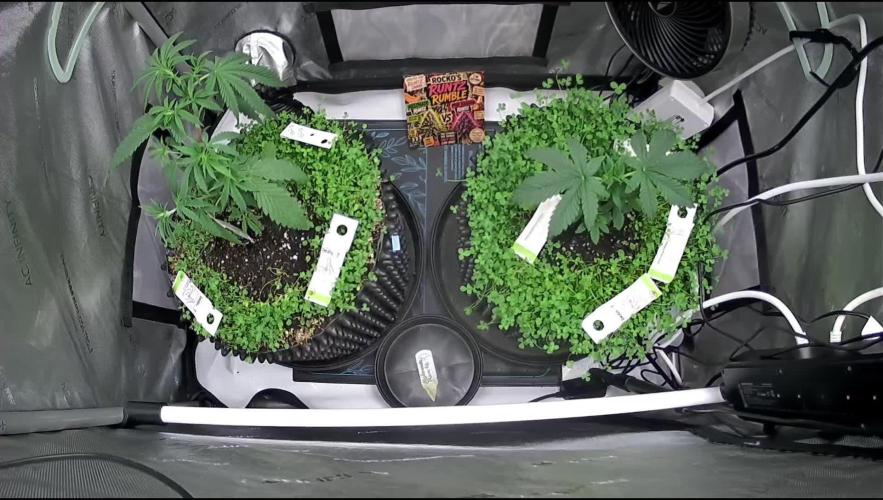
Rocko’s Runtz Rumble Tag 49
– die letzte Runde Vegi ? 🌱🥊
Eine weitere Woche ist rum – und mittlerweile sieht es ganz danach aus, als hätten die drei genug Vegi bekommen.
Nach dem deutlichen Schub der vergangenen Woche haben sie ihre Fläche weiter ausgefüllt und stehen insgesamt gesund und munter da. Deshalb werde ich wahrscheinlich schon morgen oder übermorgen auf 12/12 umstellen. Viel länger möchte ich ihnen jedenfalls nicht mehr geben.
✂️ Training
Auch diese Woche ging es hauptsächlich mit LST und Clips weiter. Ziel war weniger, noch großartig etwas am grundsätzlichen Aufbau zu verändern, sondern die vorhandenen Triebe möglichst sinnvoll über die Fläche zu verteilen und die letzten größeren Höhenunterschiede auszugleichen.
Jetzt dürfen sie langsam zeigen, was sie aus dieser Ausgangslage machen.
🍈 Melonade Runtz
Melonade bleibt dabei diejenige, die etwas mehr Aufmerksamkeit verlangt. Sie wächst weiterhin ordentlich, zeigt aber nach wie vor ihre helleren bzw. gelblichen Spitzen und teilweise etwas verdrehten Neuwuchs.
Bislang scheint sie das allerdings nicht großartig auszubremsen. Insgesamt entwickelt sie sich weiter gut – nur eben mit etwas mehr Drama als die anderen beiden. 😄
🍌 Pink Banana Runtz
Bei Pinky gibt es momentan erfreulich wenig zu berichten – und das ist durchaus positiv gemeint.
Sie wächst zuverlässig weiter, bleibt gesund und macht beim Training keine Probleme. Ihr dichter Aufbau hat sich weiter gefüllt und sie wirkt bereit für den nächsten Schritt.
💙 Blue Zushi – Wildcard
Auch die Wildcard marschiert weiter. Blue Zushi macht nach wie vor einen sehr kräftigen und unkomplizierten Eindruck und hält trotz ihres kleineren Topfes problemlos mit.
Auch hier wurde die Verteilung der Triebe noch etwas nachgebessert. Ansonsten gibt es aktuell wenig Grund, ihr großartig dazwischenzufunken.
🔴 Far Red 730 nm
Das Far Red bleibt vorerst Bestandteil des Setups. Nach den ersten vorsichtigen Tests der vergangenen Woche läuft es weiterhin nur gezielt und kurz rund um das Ende des Lichtzyklus.
🌿 Nächster Halt: 12/12
Damit dürfte die Vegi ziemlich genau dort angekommen sein, wo ich sie haben wollte. Die drei haben ihre Plätze gefunden, das Training steht und die Fläche ist ordentlich gefüllt.
Wenn nichts dazwischenkommt, fällt der Startschuss für die Blüte in wenigen Tagen.
Dann beginnt der eigentliche Rumble. 🥊🌿
Am Ende zählt nur, welche Runtz am härtesten rumbled.🌱💚✌️
Likes
10
Share


@GanjaFarmer101
Follow
Will update over time - have another three on the go at various stages.
Processing
Likes
2
Share


@Greenbean15
Follow
Lollipopped the monster crop clones in the tent; defoliated everything a bit. Everyone seems to be moving alone nicely.
Everything is showing pistils except the two bagseeds in the middle of the tent. Smells great in the closet.
Between the two tents I have a 2x7’ area with three Sunraise lights running. I’m hoping to have a better harvest than last time. Last grow I only used the 2x4 tent with three plants and two lights yielded about 2 ounces per plant. I nute burned the hell out of them last time and I’ve been feeding about 1/4 the amount I was last grow.
These plants seem much healthier and are much larger than my last grow. I have also become more comfortable with defoliation than I was previously. This time I am focusing on larger, denser buds.
The plant in the solo cup is a Pineapple Express clone. It has not rooted but the stalk has turned white and it hasn’t been needing much humidity anymore. It is almost rooted; I have been spraying it with colloidal silver to try and Hermie it. If I can get it to Hermie I can separate it before the pollen sacs burst and selectively breed branches on my other plants to make feminized seeds.
**growdairies is messing up; I cannot change the temperatures on substrate, night air or day air. Average temp for all is about 75 degrees Fahrenheit.

Likes
Comments
Share

@Kannisho
Follow
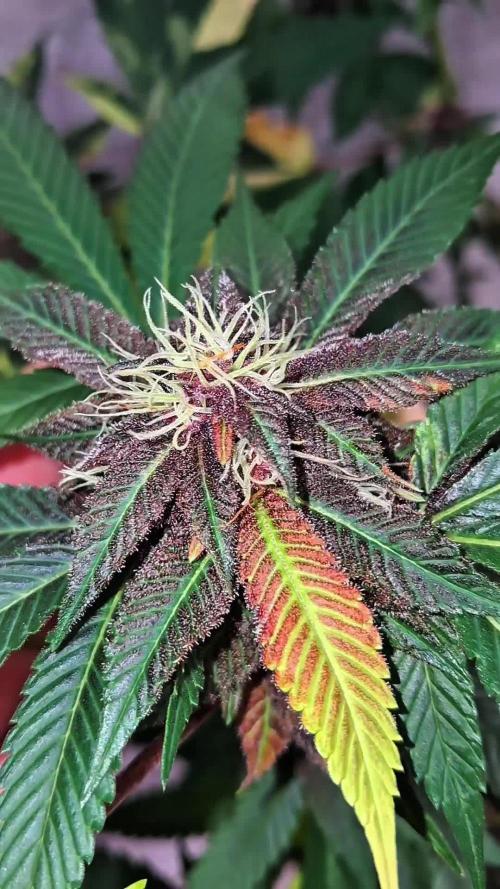
Estamos trabajando con microorganismos que nos ayudan a tener una mejor simbiosis entre la nutrición y la masa radicular, para obtener un excelente resultado en cada etapa del ciclo de cultivo.
Likes
17
Share

@RakonGrow
Follow
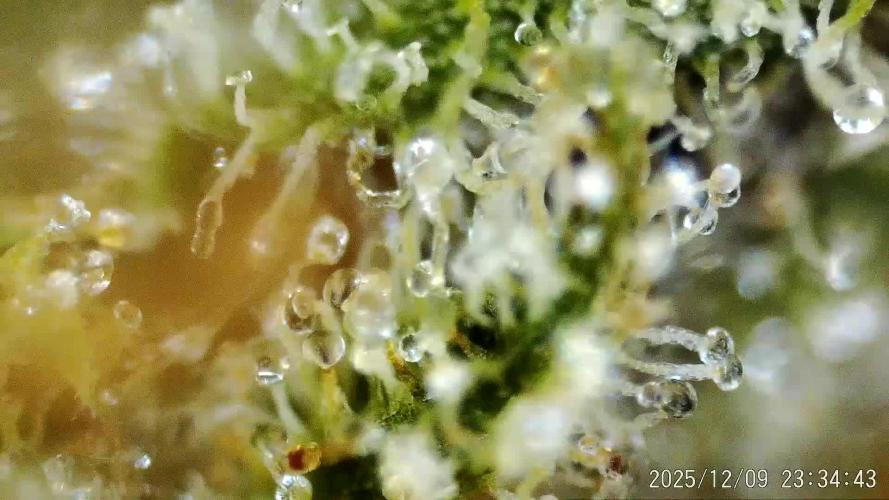
Harter ritt diese Dame , alles viel zu schwer das es gleich umknickte beim defolieren .
Hab mal ein getrockneten Bud aus der mitte genommen und Trichom analyse (Videos und Bilder) gemacht . ja viel klar wenig milchig und einige rot . Ergo , zuviel Licht an der Spitze (abstand zum licht viel zu gering) und im Boden zu kalt ist keine gute Kombination .