




Likes
16
Share

@MrWeeedWorld
Follow
🍋🍒 Lemon Cherry Cookies Auto – Woche 14 | Der letzte Tag 🌿✂️
Und damit schließt sich heute auch bei meiner Lemon Cherry Cookies Outdoor der Kreis.
Woche 14 – und gleichzeitig ihr letzter Tag unter freiem Himmel. 🍋🍒🌿
Heute wird geerntet. ✂️
Wenn ich mir die Pflanzen jetzt noch einmal in Ruhe ansehe, bin ich vor allem davon begeistert, wie unterschiedlich sich die einzelnen Blüten entwickelt haben.
Von kräftig grünen und frostigen Buds bis hin zu wunderschönen dunkelvioletten Blüten ist wirklich alles dabei. Gerade diese Purple-Töne zusammen mit der sichtbaren Trichombedeckung machen einige der Buds für mich zu den absoluten Hinguckern dieses Outdoor-Grows. 💜❄️
Auch der gesamte Aufbau der Pflanzen gefällt mir unglaublich gut.
Die langen Haupttriebe mit ihren vielen einzelnen Blütenständen geben ihnen diesen unverwechselbaren, natürlichen Outdoor-Look. Keine perfekt kontrollierte Indoor-Umgebung, keine künstlich perfekte Form – sondern Pflanzen, die sich ihren Weg unter Sonne, Wind und Wetter selbst gesucht haben.
Und genau das erzählt man ihnen heute auch ein bisschen an. 🌞🌧️🌿
Die Lemon Cherry Cookies mussten während ihrer Reise mit den Bedingungen klarkommen, die ihnen die Natur gegeben hat. Trotzdem stehen sie heute hier mit einer ganzen Menge wunderschöner, harziger Blüten.
Auf den Nahaufnahmen wird erst richtig sichtbar, wie viel sich in den letzten Wochen getan hat.
Die Sugar Leaves sind teilweise deutlich mit Trichomen überzogen, viele Pistillen haben sich bereits orange bis braun verfärbt und zwischen den grünen Buds tauchen immer wieder diese wunderschönen dunklen Farbtöne auf.
Genau für solche Details liebe ich Outdoor-Growing.
Jede Blüte sieht ein kleines bisschen anders aus und jede Pflanze erzählt am Ende ihre eigene Geschichte.
Besonders schön finde ich, dass einige Blüten trotz der fortgeschrittenen Reife noch richtig kräftig grün wirken, während andere bereits diesen dunklen, fast beerigen Look angenommen haben. 🍒💜
Damit endet heute nach 14 Wochen auch dieses Kapitel.
Es wird nichts mehr gepusht und nichts mehr verändert.
Heute dürfen die Lemon Cherry Cookies einfach noch einmal für ihre letzten Bilder vor der Kamera stehen…
…und danach kommt die Schere. ✂️😄
Was am Ende trocken auf der Waage landet, werden wir später sehen. Aber wie schon bei der Apricot ist der Ertrag für mich nur ein Teil dieser ganzen Reise.
Vom kleinen Sämling über die ersten Outdoor-Wochen bis zu diesen harzigen, teilweise violetten Blüten durfte ich ihre komplette Entwicklung dokumentieren.
Und genau das macht so einen Grow für mich besonders. ❤️
Lemon Cherry Cookies Outdoor – Woche 14
🍋🍒 Letzter Tag
🌿 14 Wochen Outdoor
❄️ Schöne Harz- und Trichombedeckung
💜 Wunderschöne violette Phänotypen
🌱 Unterschiedliche Blütenstrukturen
🌞 Unter echtem Sonnenlicht gewachsen
🌧️ Wind und Wetter überstanden
✂️ Heute ist Erntetag
Noch ein letztes Fotoshooting.
Noch einmal die Buds im Sonnenlicht betrachten.
Und dann heißt es:
Danke, Lemon Cherry Cookies. 🍋🍒❤️
Du hast deine Geschichte erzählt.
✂️ HEUTE FÄLLT DER VORHANG – HARVEST DAY! 🏁🌿
Das nächste Update gehört nicht mehr der Pflanze…
sondern ihren Buds. 😁🍋🍒
--------------------------------------------------------------------------------------------------------------------------------------------------------------------
🍋🍒 Lemon Cherry Cookies Auto – Week 14 | The Final Day 🌿✂️
And today, another outdoor journey comes to an end.
Week 14 – and the final day outside for my Lemon Cherry Cookies. 🍋🍒🌿
Today is harvest day. ✂️
Taking one last look at these plants, one thing I really love is how differently the individual flowers have developed.
There is everything from vibrant green, frosty buds to absolutely beautiful dark purple flowers. Especially combined with the visible trichome coverage, those purple expressions have become some of my favorite flowers of this entire outdoor grow. 💜❄️
I also really enjoy the overall structure of these plants.
The long main branches covered with individual flower sites give them that unmistakable natural outdoor appearance. No perfectly controlled indoor environment and no artificially perfect structure – just plants finding their own way under real sunlight, wind and changing weather.
And today they proudly show the story of that journey. 🌞🌧️🌿
The Lemon Cherry Cookies had to deal with whatever nature decided to throw at them throughout the season.
Yet here they are after 14 weeks, carrying a beautiful collection of resin-covered flowers.
The close-up shots really show how much has happened during these final weeks.
Many of the sugar leaves are covered in visible trichomes, a large number of pistils have turned orange and brown, and between all those green flowers there are these gorgeous dark purple expressions appearing again and again.
These little differences are exactly why I love outdoor growing.
Every flower looks slightly different and every plant finishes the season with its own character.
I especially love the contrast between the flowers that have remained bright and green and those that have developed that deep, almost berry-like purple appearance. 🍒💜
And with that, after 14 weeks, this chapter comes to an end.
There is nothing left to push and nothing left to change.
Today the Lemon Cherry Cookies get one final photoshoot…
…and then the scissors come out. ✂️😄
We'll find out later what eventually ends up on the scale after drying, but just like with my Apricot grow, the final weight is only one part of this journey for me.
From tiny seedlings through their first outdoor weeks and all the way to these resin-covered, partially purple flowers, I was able to document their entire development.
And that's what makes a grow like this special to me. ❤️
Lemon Cherry Cookies Outdoor – Week 14
🍋🍒 Final day
🌿 14 weeks outdoors
❄️ Beautiful resin & trichome coverage
💜 Gorgeous purple expressions
🌱 Different flower structures
🌞 Grown under real sunlight
🌧️ Survived wind and weather
✂️ Harvest day is TODAY
One final photoshoot.
One final look at the flowers under natural light.
And then it's time to say:
Thank you, Lemon Cherry Cookies. 🍋🍒❤️
Your story has been told.
✂️ THE CURTAIN FALLS TODAY – HARVEST DAY! 🏁🌿
The next update won't belong to the plants anymore…
it will belong to their buds. 😁🍋🍒

Likes
23
Share


@Piorkeed
Follow
Tenth week of flowering started.
I went out a week and at my return I discovered that the #2 is sick. The plant doesn't drink anymore and a lot of branches are falling down with limp leaves. I think that the missing defoliation, the height and the poor ventilation caused that. At the moment I removed her from the tent moving her out to the balcony.
I did a huge defoliation to the #1 and a massive LST in order to low the height of buds that reached the lamp that is at its maximum height.
So far I gave to the plant only water.
I think that the cause of plant disease is the high humidity level (at least 90%...). Tomorrow I will buy a dehumidifier hoping that this will help the remaining plant.
D63: changed the water into the pot. Added 15 ml grow, 30ml micro and 40ml bloom. [email protected] EC 1.2
D64: after the defoliation the plant seems to be healthy. The humidity into the tent is still high, tomorrow I will install the dehumidifier.
D65: I've put a dehumidifier into the tent, I've added 3 liters of tap water to the pot; the plant is drinking a lot so I think that she is fine. The plants produces a lot of fat buds, so I've checked the trichomes for the first time, they are clear for the majority.
D67: added 5 liters of tap water to the pot. The plant is drinking a lot


Likes
31
Share


@DudeGrowsWeed
Follow
I cut down the 2nd half of my Green Crack plant today. Did a wet trim this time. Will post the harvest report after she's dried and cured. So far the buds seem loose and airy overall. Probably stressed her out a little too much with the topping, HST and then the LED burn. I'm still pretty happy with the results so far 😃
Root sone looks more developed than the last harvest (Blue Mammoth). I guess Recharge is working 👍
Likes
6
Share

@sunshinegroww
Follow
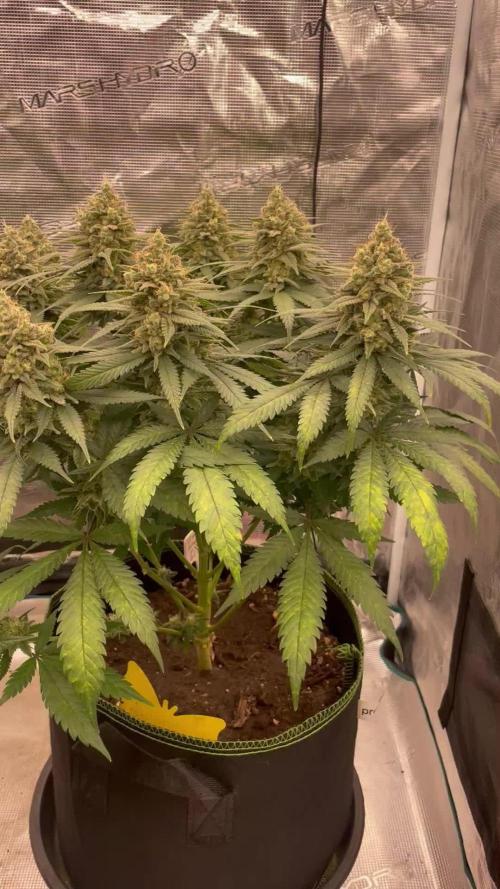
She is lovely super super super frosty almost white especially lower buds ,super sticky dense buds smells like wow berries sweet flowers super fresh ,another week and she goes into mode flush and yeah can’t wait for this one ☝️

Likes
35
Share


@Kirsten
Follow
16.6.25:
Today is Harvest Day!
Well this has certainly been a fun one! Really pleased with how she turned out, when I cut her down, it was actually heavy. I'll be interested to see what we yielded here!
I did take all of the fan leaves off and some of the sugar leaves too. Just to make the trimming easier, and also help prevent mould during the drying process.
The trichomes were very hard for me to tell, but they have quite a lot of amber. So I may have grown some sleeping potion. We will soon find out I guess! 😅
I decided to leave the plant longer than I usually would, I did this to see the difference in effects.
This is a low THC strain, so in theory shouldn't produce a couch lock effect. So if it does, it will give me a better idea of the harvest windows.
Some of you helped choose this strain to grow, so if you've followed along, I hope you enjoyed this journey. Thank you, it was a great choice
Will update when I've finished drying, and then the smoke report!
😊💚✌️🌱👌🍃
Likes
132
Share


@Grow4Releaf
Follow
** Mar 27th/28th few bud shots added, checking the trichomes on the purple were getting cloudy so shes moving along. Shouldnt be long for her!***
**Mar 26th- added a few more photos , purple plant is getting close, she's on a water only diet till harvest ***
*25th- Added a few photos using a phone app, gonna try this till the computer is back up ***
Everything going well so far still, still Trying to get my computer and Adobe program up and running right but gonna get some more photos during the week.
So far the purple one is moving well starting to thickin up, and the other jusy stopped getting length and hopefully will bulk a bit.
Buds are crazy dense. Can't wait to show a good video of them once closer to Harvast.
The SMELL is intense off the purple one already. I can't wait !!
It's been ALOT of fun growing out these runtz can't wait to see how the smoke is!! Getting closer tho, got another week before I'll check out some lower buds trichomes then see their progression.
Can't wait tho. Should have my camera and laptop up this week , hopefully.
But besides that's I hope ur all doing well !!
Till next update, thanks for checking this one out !!

Likes
6
Share


@CeGrow
Follow
begining week 7
day 44: flowers more, but bad wheather :(
end of week 7
still bad wheather :(
flower turned a little bit bigger, but not much
and I have some fleas now :( (see video)
I picked them manually
hope they dont increase
day 48 nutrition: 0,4 litre water+ 0,8 ml Mairol Blütenwunder
day 49: nutrition 0,5 litre water + 1,5 ml Mairol Blütenwunder
Likes
11
Share


@Sauce_XL
Follow
3.9.2024: Start of week 8. Day 50 from seed, 46 from sprout. Nothing doing today, plant is healthy and getting fatter by the day. Plucked a few leaves but thats it.
3.10.2024: Day 51. Fed 1/4 strength fox farm trio mixed w/ calmag into over a gal of 6.5ph water. Gave roughly 3 liters of the solution. Runoff ppm is finally under 1000. Might increase nutes to 1/2 strength moving forward. I'm no pro when it comes to taking pictures so its hard for me to get clear, detailed shots of the nugs.
3.11.2024: Day 52, 48 from sprout. Moving along nicely. Some nice purple hues here and there. Still very "hairy."
3.12.2024: Day 53. Fed 1/4 strength, roughly 96oz at 6.4ph. I broke the feed/water/feed schedule and fed twice in a row. Also did some lite defoliation on the bottom fan leaves that weren't getting light.
3.13.2024: Day 54 from seed. Plant is doing its thing.
3.14.2024: Day 55. Fed again at 1/4 strength, 96oz at 6.6ph. Runoff ppm was 880.
3.15.2024: Day 56 from seed, 52 from sprout.

Likes
91
Share


@CANNASIM
Follow
Expecting a awesome top shelf smoke from this girl, smell is mid way, a lot less than other strains, so it make a good option to stealth, but not the best. Superb strain, will update on the effects after dry and fully cured, high is supposed to be mild and functional, this is my first medical strain with high CBD, super curious.
---WET WEIGHT---
421G
---DRY WEIGHT---
95G just flowers000
---UPDATE 2 . After harvest---
-A -Jaring
After drying till the stems almost snap, in a rack, I separed the flowers, weighted and jared for cure.
-B-Vape report.
Vaped with a Davinci IQ, about .5 from the uncurred buds, from 350f to 430f max temp.
Since the begging of the session you feel this is a special strain, taste is 5/5 vapor production is insane 5/5, and the effect as discribed by RQS, a stress killer that allows you to funcione normally, think it as a mild relaxant, is what i was looking for so super satisfyed!
As you increase the vaping temps you feel the effects stronger, basically is a good body sensation and head tranquility, no paranoia, no confusion, no psychoactive stone. The side effects i feel is the classic dry mouth, not too strong though.
-C-Joint smoke.
Nice and smooth it hits with a mild sensation, very relaxing, no couch lock, mental trip or anything, i’m certain is similar to canna-tonic some how, very enjoyable, sweet taste tones of citrus earthy and woody.
-D-Bong hit.
Not a fan of bongs, i feel vaping gives a better overall experience, though for the sake of the diary, i did a bong hit to check, filled a full bowl and hitted mutiple times, the smoke is smooth, no harshness, though is a bit more intense than smoking a joint.
---UPDATE 3 . Final—
Well guys, this concludes my diary, with this final update.
After two weeks cure, i feel is already cured for the most part, one more week and all the cruise part will be done, after that it continues but slowly. It was fun to grow, and top shelf smoke. Note that is not a recreative smoke, is functional and enjoyable, i feel that if you have a super strong strain you can dilute in to this one and have a more controlled high. Smoking, vaping in multiple temperatures and i could still function, work, speak on the phone and think clear.
Looking for a Stress Killer, high in CBD, that will melt your stress and concerns so you can go on with your duties and enjoy a nice smoke, give this strain a go, and let me know so i can follow your diary and know your opinion.
Cheers everyone and thanks for those who contributed to the diary in any manner, or passed by. Happy growing always. 00
Likes
5
Share


@H0BBYGAERTNER
Follow
Harvest Part One, Day 93: First harvest of the Main colas, as a lot of the trichomes turned brown. An awful lot of work to trim wet, but wanted to get rid of all the dryed leaves.
A comment on another diary said leaves turned yellow because of possible lockout. Well, i cant deny it, but i have no experience at all with it. In hindsight i should have used a lot more fertilizer during the vegi phase, i guess, because this monster turned out to be super hungry (if that makes sense).
Density after removing the leaves is ok i think. Expected a bit more to be honest. Massive headbuds still though. However, kinda „raw“ on the inside as you can see by the color and general appearance. So wondering if it was to early still.
Alright, half of the plant cut down, and placed in dryferm bags (compare to dryaging but tailored to Cannabis), as i have mentioned before. Still in the process, after like 7 days half of the weight gone already. A Bit more to go i think.
I think i will post another update with the bottom part of the plant and for sure one with the finished product.
So far very surprising strain in a positive way, still very delicate smell (i get the „doughy“ and in a sense creamy part of dutch Passions Description, its very subtile though and not much else, almost citrusy tea like), great yield, grows somewhat easy but probably isnt easy to maintain and doesnt like errors in handling.
All in all im very happy and cant wait to try the First Buds.
So far 7.5/10 — very decent. Let‘s see how it performs. Might change the evaluation then. And sorry, might totally be wrong about everything.
Let me know your opinion, criticism, etc., please!



Likes
20
Share


@JohnnyCash420
Follow
Day 56
alle 3 Pflanzen haben die letzte regnerische Woche sehr gut überstanden.
Apple Fritter ist 72cm hoch und bildet schöne Buds.
Runtz F1 ist 60cm hoch und hinkt ein wenig hinterher.
GG#4 ist immer noch in der Wachstumsphase und scheint ein Monster zu werden. Der Stamm ist sehr dick im Vergleich zu den anderen zwei.
Zusätzlich gieße ich die Babys seit 2 Tagen mit Canna Terra Flores.
Ich bin sehr zufrieden mit der Wachstumsphase und Übergang in die Blütephase.
Ohne Lampe zu dieser Jahreszeit ein gutes Ergebnis wie ich finde.


Likes
Comments
Share


Likes
12
Share

@carlitospiratahaze
Follow
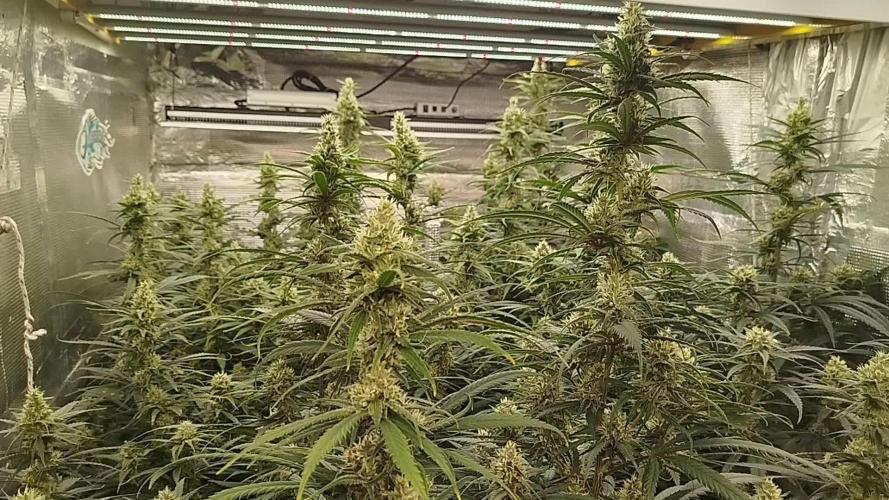
Seguimos otra semana más de avance de este rincón de amnesias!
Todo se ve en orden alguna que otra saturada de abono otras perfectas y otras un poco estresadas,por qué las mantuve cerca del foco pensando que al ser pequeños y de 100 w necesitarían estar más cerca pero de todo eso equivocado.. en el siguiente ya sabemos.
Estamos ya con 58 días de floración y estimo que estaré con ella hasta el día 78.
Está vez la dejaré madurar al punto de conseguir el mejor sabor posible y un efecto relajante nada paranoico.
Seguimos metiendo abonos esta semana pero vamos a combinar un riego libre de solo agua y azúcares.
Likes
25
Share


@Silverback_Guerilla
Follow
9/10:
Coming along nicely...the big Amnesiac is the biggest seedling in the garden.
9/11:
I waited to long to transplant them and they have root problems to some degree or another...too wet for too long.
I transplanted all but the smaller Amnesiac and Lemon Cream Kush into 3 gallon pots, and those two went into 2.30 gallon pots. About 50% brownish roots on all but the smaller ones. 😕
I powdered the planting holes with myco, tricho, and other goodness.
I added two Mars Hydro 150w lights, and a 60w 6500k LED panel light since they are all spread out now. The average CCT is still a little over 4800k, even though the Mars are a little warmer color temp than the Viparspectras.
9/12:
Between the root problems and the transplant, they looked horrible, so I sprayed them with BoomBoom Spray today and will do a good root drench tomorrow with BushDoctor Boomerang.
They looked better by the end of day, but still have a ways to go to get back on track.
9/17:
I fed them boomerang only twice this week, and also fed them kangaroots yesterday. They are all looking strong, and branching well. The big Amnesiac is impressive. Great structure and amazing vigor.
The LCK is finally starting to look like she belongs in the same crop.
I'll prolly flip to 13/11 with emerson effect in the next couple of days.

Likes
27
Share


@LockDownGrow
Follow
Ok so I'm going too only feed pH water from here on out too force the plants too use up all that's in the soil , I am hoping I can carry them on now for the next 2 weeks like this before they are ripe ,
Likes
18
Share


@CanarianGrow92
Follow
Week 7 for the Caramel 🍯 from Ganja farmers 👨🌾
Awesome results for now, the buds are looking great and getting bigger every week, more and more trichomes are visible.
Not much left so we continue with water for now.
A slight excess of nutrients is visible but nothing to worry about as we are flushing now anyway
Likes
15
Share


@SouthernOnions
Follow
Height growth has stopped completely on plants 2, 3, and 4. Plant 1 is now at 22inches and most main tops breaching the trellis. Picked up some Full Tilt from FloraFlex to start throwing at them this week as they begin flush and start to finish out. Still running 3 grams per gallon(0.6 tsp per gallon or about 1 tbls per 5 gallons) of the B1&B2 from FloraFlex. This week I will begin cranking the tsw2000 from 75% slowly to 100% over the week and try to finish these girls out under the full 310 watts. Today I put it at 80% resulting in the highest tops on plant 4 around 500-550PPFD while the tops on 2 and 3 are receiving about 350 and plant 2 is receiving about 250. Will continue to increase the intensity and monitor their response. Hopefully in the next week or so we will start to see some color change and perhaps that runt will show us what she's been hiding. See ya in week 10!
