





Likes
7
Share

@CannaArchive
Follow
This week was definitely the most stressful one so far.😅
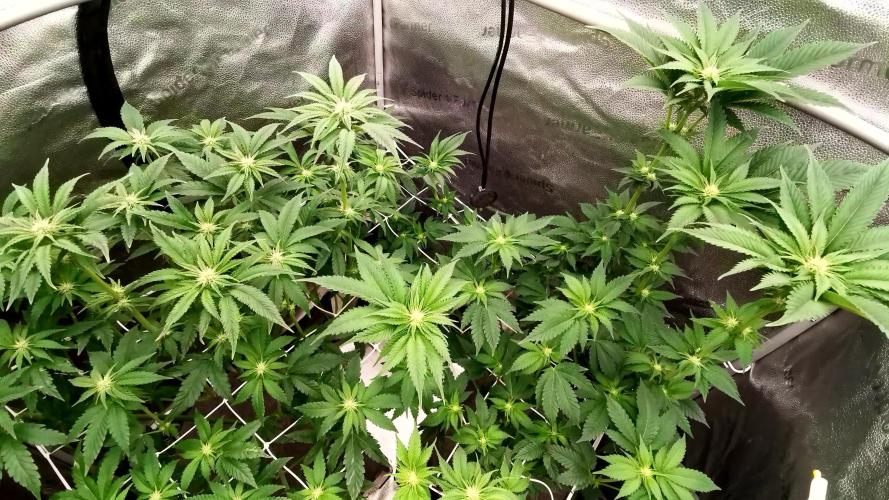
Candy Hustle #1 showed a few hermaphrodite flowers early in the week. Instead of removing the entire plant immediately, I decided to inspect her thoroughly every single day and carefully remove every pollen sac I could find. It was a lot of work throughout the week, but fortunately the effort seems to have paid off. 💪 Since then I haven't found any new sacs, although she will remain under close observation. If she starts producing them again, I'm fully prepared to remove the plant. 👀
The funny thing is that this same plant has become the most interesting phenotype in the tent. 🌱 The main cola is developing much wider than her sister and is showing some unusual growth that almost resembles a polyploid or fasciated expression. It's too early to know if that's really the case, but she definitely stands out from the rest. 🤞
Candy Hustle #2 continues to perform exactly as expected. Healthy growth, great structure and absolutely no signs of stress. 💚
Because the heatwave is still affecting the climate, temperatures stayed around 28°C with 55% RH, which is much easier to manage than the previous week. Light intensity has now been increased to roughly 1000 PPFD (60% power) and both plants are responding very well. ☀️
Both Candy Hustles were lollipopped this week to improve airflow through the canopy. 🍃
I also removed a few additional lower branches on #1 while inspecting for pollen sacs. Air circulation is much better now, which gives me a bit more confidence considering the higher temperatures.
Feeding was kept simple this week:
💧 1× Bio PK
🚰 RO water + CalMag every 2–3 days
Another thing I noticed is how quickly the resin production has increased. ✨
Even at only week three the sugar leaves are already becoming noticeably frosty, especially on Candy Hustle #1. I'm really curious to see how both phenotypes compare later in flower. ❄️
Overall, despite the herm issue, I'm happy with how the week ended. 🙏 Hopefully #1 has left the hermaphrodite flowers behind and can now focus entirely on stacking buds. 🌸
🌡️ Environment
🌡️ Temperature: 28°C
💧 Humidity: 55% RH
💡 Light: ~1000 PPFD (60%)
🥤 Feeding: 1× Bio PK, otherwise RO water + CalMag every 2–3 days
✂️ Lollipopping completed for both plants to improve airflow
👀 Candy Hustle #1 remains under daily observation



Processing
Likes
22
Share


@CenturionGrower
Follow
Plants came back out of their 36 hours of darkness and were a little droopy, so I made the decision to put them outside for the first day of light. Unfortunately they suffered from wind burn so I brought them back to the tent. Foliar fed the plants daily at 400PPM.
Likes
30
Share


@FatnastyzBudz
Follow
Chopped this lady on her 70th day!
Branches all were bent from being heavy!
Loved this strain very much. Super excited about the soon to come smoke!
This stinky sweet stuff
Started the dry, trimmed the buds and set em up. Temp 68F ( the best I can) and RH 62-65%
Flipped every 12 hrs.
Another in the books for me! I really enjoy the LST grows, very easy!
Now to figure how to make the buds FATTER!!
TYVM for the follows, likes and support through this grow. 😍
Looked forward to many more and hanging with you then!
MUCH LOVE!😍👊💪🙏
Likes
2
Share

@DogDoctorOfficial
Follow
🌸 Week 9 – Opening the Door for the Flowers
Blueberry Muffin has always had an interesting personality in this tent.
She's not the tallest plant.
She's not the largest plant.
But she's been quietly building herself into a compact flowering machine.
And that's exactly why I decided that a little selective defoliation was appropriate this week.
We're not trying to strip her.
We're not trying to make her naked.
We're simply opening some space.
A few leaves here.
A little overlap there.
Removing foliage that is no longer helping the structure we're trying to maintain.
The goal is simple:
More breathing room.
Better light movement.
Better airflow.
Less unnecessary congestion.
And when you have twelve different plants sharing the same room, sometimes opening one plant slightly also helps the environment around her.
That's the beauty of working with the whole garden rather than looking at each plant in isolation.
✂️ Defoliation – It's About Purpose, Not Punishment
I've talked about this before, but this week is a perfect opportunity to repeat it.
Defoliation isn't about removing leaves because leaves are somehow "bad."
They're not.
Healthy leaves are incredibly valuable.
They're photosynthetic organs.
They're producing the energy the plant uses to grow and develop.
So when I remove a leaf, I want to have a reason.
Maybe it's heavily overlapping another leaf.
Maybe it's sitting inside an increasingly congested section of the canopy.
Maybe it's shading a developing flower while contributing relatively little to the structure.
Maybe removing it creates a much better pathway for air.
And sometimes...
it's simply part of cleaning the plant.
That's the approach we're taking with Blueberry Muffin.
Selective. Intentional. Moderate.
We're not trying to win a defoliation competition.
We're trying to create a healthier, more manageable flowering plant.
💨 Airflow Becomes More Important as Flowers Develop
This is where the timing becomes particularly interesting.
As the plant gets deeper into flower, the canopy naturally becomes more complicated.
Flowers get larger.
Leaves overlap.
Branches carry more biomass.
And spaces that were wide open earlier in the grow can gradually become pockets of dense vegetation.
That's not automatically a problem.
But it's something worth managing.
One of the reasons I wanted to open Blueberry Muffin a little more this week was simply to maintain air movement through the plant.
Good airflow doesn't mean blasting the flowers with a hurricane.
It means avoiding stagnant pockets of humid air trapped inside dense vegetation.
And as we move further into flowering, that's increasingly important.
Because nobody wants to discover a problem after flowers have already become dense.
Prevention is much easier than trying to fix a problem later.
💧 Helping the Room Breathe
There's another interesting side effect to opening the canopy.
The plants are collectively producing and moving a lot of moisture through transpiration.
When twelve plants are sharing a relatively enclosed environment, the canopy itself becomes a major part of the room's microclimate.
Opening congested areas gives moving air more pathways through the plants.
That can help reduce pockets of trapped humidity around the foliage.
And when the canopy breathes better, the whole room benefits.
Again, this isn't about expecting defoliation to magically control room humidity.
The ventilation system is still doing the heavy lifting.
But good canopy management can make the environment easier to manage.
And that's exactly what we're looking for.
💡 Every Photon Has Somewhere to Go
Blueberry Muffin is also at an interesting size.
She's approximately 75 cm tall.
That's not a huge plant.
And because she's relatively compact, I want to make sure the available light isn't unnecessarily intercepted by layers of foliage sitting on top of other foliage.
Yes, she has support from the under-canopy and inner-canopy lighting strategy.
And that's fantastic.
But additional lighting doesn't mean we should deliberately create unnecessary barriers between the light and the flowers.
If we can open a section naturally and allow more photons to travel through the canopy, why not?
We're not trying to expose every square centimetre of the plant.
We're simply making the canopy a little more efficient.
Sometimes the best lighting upgrade is simply...
removing something that doesn't need to be in the way.
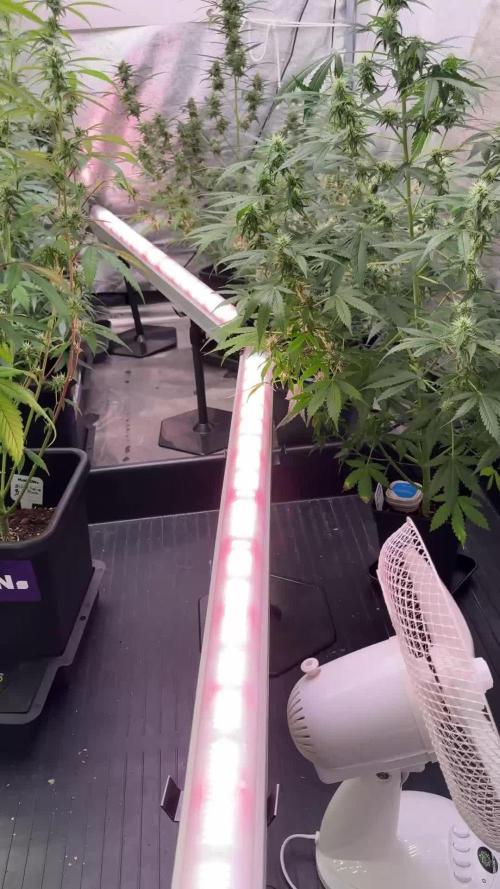
🌸 The Flowers Are Taking Over Now
And this is where the photographs become particularly exciting.
The flowers are becoming increasingly obvious throughout the plant.
The white pistils are still doing a lot of the visual talking, but the individual flowering sites are gaining structure and substance.
She's moving away from that early-flower appearance where everything is basically a collection of little pistil-covered points.
Now we're beginning to see the plant building actual floral mass.
The branches are carrying their flowers with confidence.
The canopy has become more compact.
And the whole plant feels like she's entering another chapter.
This is the stage where I stop being interested in how much she's going to stretch...
and become much more interested in how much she's going to stack.
? The Blueberry Muffin Personality
One thing I really appreciate about this phenotype is how different she looks when compared with some of the other genetics in the tent.
She's not trying to dominate.
She isn't the tallest.
She doesn't have the most dramatic structure.
But she's developing her own little architecture.
And that's what this entire 8×8 Adventure is about.
Twelve genetics.
One room.
One general environment.
And twelve completely different answers.
Blueberry Muffin's answer seems to be:
"Give me some time."
And now she's starting to show us why.
💚 Nutrition – Staying the Course
There's no reason to reinvent the feeding programme this week.
We're keeping nutrition essentially unchanged.
Current feeding remains:
Terra Bloom — 2.2 ml/L
Pure Zym — 1 ml/L
Power Buds — 1 ml/L
Sugar Royal — 1 ml/L
pH Plus / Lemon Kick — as required
The plant continues receiving the same flowering nutrition rather than reacting to every small visual change with another adjustment.
That's important.
We made a structural intervention this week.
We don't need to simultaneously start changing everything else.
One change at a time makes the plant much easier to read.
🌡️ The Room Has Changed
And this week we do have a small but interesting environmental change.
The daytime temperature remains around:
29°C
But the night temperature is now approximately:
26°C
Last week we were around 25.6°C, so the difference isn't dramatic, but the overall night temperature is slightly warmer.
That means our day/night temperature differential is now smaller.
We're also sitting around:
RH: 60%
Solution temperature: 25°C
Root-zone/substrate temperature: 25°C
CO₂: ~693 ppm
Light schedule: 12/12
Watering: ~1.3 L per plant / 24h
Container: 15 L
And I actually like observing these little changes.
The room doesn't have to remain frozen in time.
What matters is understanding what changed and watching how the plants respond.
At this stage, with flowers getting denser, keeping the canopy open and maintaining good air movement becomes even more valuable.
🌙 Day vs Night – The Difference Matters
One of the things I enjoy about documenting these numbers is that they tell us more than a single temperature reading.
We're running approximately:
29°C during the day → 26°C at night.
That's only about a 3°C difference.
Earlier in the run, the difference was a little larger.
As the room changes, so does the relationship between temperature, humidity, transpiration and plant development.
And this is why I don't like looking at temperature or humidity as isolated numbers.
The plant doesn't experience "29°C."
It experiences:
temperature + humidity + light + airflow + root-zone conditions + CO₂ + time of day.
Everything interacts.
And right now, I'm happy with what the room is showing us.
We're watching it.
We're measuring it.
And we're adjusting when necessary rather than reacting to every little fluctuation.
🔬 One More Reason I Like This Defoliation
There's something else happening here that I think is easy to overlook.
Cleaning the plant isn't only about what remains.
It's also about what we can see afterward.
Once some of the unnecessary foliage is removed, I can see the flowering structure much more clearly.
I can see which branches are developing strongly.
I can see where flowers are stacking.
I can see where the canopy remains dense.
And I can see what might need attention later.
In other words...
defoliation also improves observation.
And for this project, observation is half the fun.
🔮 Looking Ahead
From here, I want to keep things relatively simple.
No unnecessary training.
No dramatic interventions.
No chasing numbers just because they're numbers.
We'll continue watching the flowers develop, monitoring the canopy and paying attention to how she responds to the cleanup.
The next stage should increasingly be about:
🌸 flower stacking
🌸 calyx development
🌸 increasing resin production
🌸 increasing flower density
🌸 maintaining airflow
🌸 keeping the environment stable
The framework is already there.
Now we're entering the part of the journey where patience becomes more important than intervention.
We've done our job.
Now...
let Blueberry Muffin do hers.
💭 Final Thoughts – Making Space for What's Coming
I think this week is a really good example of how I like to grow.
We didn't defoliate because someone told us:
"Week 9 means defoliation."
We did it because the plant changed.
She's becoming more compact.
She's developing more flowers.
The canopy is getting denser.
She isn't a particularly tall plant, so making the available photons work efficiently matters.
And with twelve plants sharing the same room, keeping air moving through the garden matters too.
So we opened her up.
Not dramatically.
Not aggressively.
Just enough.
And now she looks cleaner, more open and easier to read.
That's what I wanted.
Not a naked plant.
A better-organised plant.
And honestly...
she looks fantastic.
Blueberry Muffin may not have started this journey as the plant that immediately grabbed everyone's attention.
But she's slowly becoming one of those phenotypes where you look back at the earlier photographs and think:
"Oh... now I see what she was doing."
She's been building toward this.
And now she's starting to show it.
?🌸🔥
🙏 Thank You
A huge thank you once again to Zamnesia for giving us the opportunity to explore these genetics, Plagron for supporting the garden throughout the journey, Future of Grow for providing the light that powers this experiment, Lumiflora for bringing additional light into the inner and lower canopy, TrolMaster for helping maintain environmental stability, and of course everyone following this 8×8 Adventure on GrowDiaries.
Every week gives us another little lesson.
Sometimes it's about nutrition.
Sometimes it's about environment.
Sometimes it's about genetics.
And sometimes...
it's simply about knowing when to take a few leaves away and give the plant a little more room to breathe.
Blueberry Muffin is entering another chapter now.
The canopy is open.
The flowers are developing.
The room is stable.
And there's still plenty of story left to write.
Until next week...
Growers Love and happy growing! 🌱💚?


Likes
42
Share


@AutoCrazy
Follow
I can’t believe how big this plant is!! She is really bursting into flowering. There are already trichomes showing at the little bud sites which is incredible. Sweet seeds genetics always seem to bring the frost!!
I can’t recommend these genetics enough! She’s the biggest Fast Photoperiod I’ve ever grown!! I bet she will push over the 1lb mark!
She’s super resistant to mould/mildew and bugs. She can take the heat like a champ and down pours don’t affect her at all!! I have been spraying her with OMRI fungicide which I’m sure has helped. Like I always say, a little prevention goes a long way! Although I also believe strong stable genetics help!!
I can’t wait to see what another week brings!!
Bravo sweet seeds you nailed it with these genetics!! 🔥🔥🔥
😎🍿🍻🌱

Likes
27
Share


@TheCannaProphet
Follow
~ FASTBUDS TESTER #2205 ~
Well friends, here we go on another 'canna-venture' together!
The grow room has had a complete remodel and some upgrades done to it including brand spanking new 4x8 and 4x4 tents and a Trolmaster Hydro X controller along with a new Control Panel.
This tester strain is one of six tester strains that FastBuds has graciously provided me with and I'm looking forward to seeing what this girl has to offer when she's grown to her full potential!
One drawback of 'testers' is I have little to no information on it other than its number and that it's an autoflower... 🤪 But, it's ALWAYS a blast growing them for me because not knowing a lot allows me to just concentrate on the essentials: Light, Environment, Water, Nutrients and possibly a bit of LST... not complicated, just basics like keeping a constant temperature and RH in the tent at a level that gives a good VPD, watering when almost dry and maintaining proper light levels according to their stage of growth.
____________________________________________________________________________________________________________________________________________________________________________________________________________________________________________________________________________________________________________________________________________________________________________________________________________________________________________________
~THE SETUP~
~Initially seeds were lightly scuffed, then soaked for 3 hours in 78℉ distilled water after which they were transferred to moist paper towels laid out in a Jiffy Pellet plastic starter tray with lid. Underneath the tray was placed a Mars Hydro Heat Mat with Controller that was set to 78℉ where they stayed until their tap roots emerged.
~Planted into Jiffy Peat Pellets that were hydrated with distilled water warmed to 78℉ with a 7.0 ph.
~Once roots emerge from the Jiffy Pellet they're transferred to their fabric pots.
~Grown 100% organic in a 4g Gronest fabric pot and a 3g fabric pot by Wraxly filled with Mother Earth 70/30 Coco/Perlite medium and initially amended with Dr. Earth 4-4-4 / Earthworm Castings / Dr. Earth Flower Girl 3-9-4 and Coast of Maine Stonington Blend Organic Plant Food 5-2-4.
~19/5 light cycle for the entire run with supplemental UVA added during flower. Lights are controlled by a Trolmaster Hydro X controller set for a 15min Sunrise/Sunset simulation.
~Top dressing every 3-4 weeks with slow release dry amendments and Earthworm castings.
~Straight water ph'd @ 6.2-6.8 when needed and bi-weekly Compost Tea's.
____________________________________________________________________________________________________________________________________________________________________________________________________________________________________________________________________________________________________________________________________________________________________________________________________________________________________________________
Weekly Updates:
12/1- I soaked both seeds for 3 hours in 78℉ distilled water after which they were transferred to moist paper towels laid out in a Jiffy Pellet plastic starter tray with lid. Underneath the tray was placed a Vivosun Heat Mat with Controller that was set to 78℉ where they stayed until their tap roots emerged which usually takes roughly 24 hours. These seeds however didn't follow the rules and took their fine time to pop out their tap roots.
12/3- Today their tap roots were about 1/4 to 3/8" so at 11 am I transferred them into Jiffy Peat Pellets that were hydrated with distilled water warmed to 78℉ with a 7.0 ph using a tine off of a plastic fork as a 'mini trowel' to make a hole in the pellet and to gently cover the tap root, leaving only the seed head slightly exposed. This method accomplishes most of the initial work the seed has to do by eliminating having to orientate itself, push it's root down and head up. By 10pm the #1 seed had her cotyledon leaves opened ...waiting on the #2. 🧐
I was concerned that one of the seeds may fail as she took so long to germinate so I soaked two more as an insurance policy. Naturally, BOTH of the second set of seeds popped their tap roots within 24 hours. One of the first round seeds failed to germinate which left me with three viable seeds, one in a pellet already and two showing tap roots. I planted both of the second round seeds into the same peat pellet that I had previously soaked.
12/5- Well this is Day ONE for the #1 FBT #2205 and I anticipate seeing one or both of the second round poking their heads out real soon! I'll keep them in the covered/heated Jiffy tray until I see their roots beginning to emerge from the peat pellet, then I'll transfer them gently into their respective fabric pots. The #1 will be going into the 4g Gronest pot from FastBuds and the #2 will reside in a 3g pot by Wraxly, which I'm trying out for the first time.
12/7- Yesterday I checked the #1 tester and she had roots starting to emerge from her pellet so tomorrow I'll transfer her into her 4g Gronest pot.
The second round seeds finally made an appearance and I decided to yank the smaller of the two keeping me from having to stress them when I separated them.... this will be Day One for the #2! She looks really healthy and I'm confident that she should be ready to transfer into her fabric pot in the next couple of days!
😎💚 Thank you for checking out my passion in life! Please visit as often as you wish and I hope you enjoy this journey as much as I know I will! Grow Strong! 💪😎🤙
Likes
10
Share
@DogDoctorOfficial
Follow
Grow Update — GMO Cookies
Week 6 from seed | 12/12 from seed
Marked as: Week 1 Flower
Quick recap for anyone just joining
This is a 12/12 from seed run, meaning plants have been grown under a flowering light schedule from day one. Because of that, development doesn’t follow the classic “veg → flip → flower” timeline. Instead, plants express themselves at their own pace, and structure, stretch, and flowering signals appear more organically.
Now, in week 6 from seed, there’s no doubt anymore: this GMO Cookies is in flower.
⸻
Current environment (stable & shared across the room)
• Temperature: ~27.5 °C
• Humidity: ~65%
• CO₂: ~900 ppm
• PPFD: ~600–850
• Smaller plants: ~600–700
• Taller plants: up to ~800–850
Light intensity is intentionally staggered. Plants are allowed to grow into the photons naturally, rather than forcing a flat PPFD across different genetics and sizes. This helps maintain balance and reduces stress during stretch.
⸻
Root zone & watering
• pH: 6.5
• EC: 2.4
• Root / reservoir temperature: ~17 °C
Slightly on the cold side, acknowledged. Still within a manageable range, and plants are responding well.
⸻
Nutrition — why the switch happened
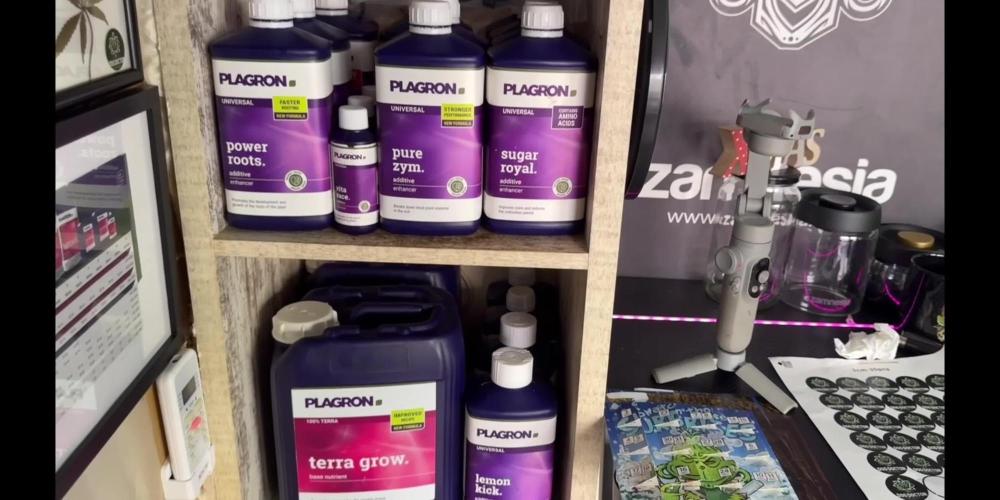
• Switched from Plagron Terra Grow → Terra Bloom
• Following the Plagron feeding schedule
• This was the only intentional change
As plants clearly entered flower, nitrogen-forward feeding (Terra Grow) was no longer appropriate. The switch to Terra Bloom reflects what the plant is now asking for:
👉 support for stretch, branching, and early flower development.
The feeding schedule is being adapted slightly to match uptake speed and plant response, rather than followed blindly. Observation first, bottles second.
⸻
Training & plant behavior
Low stress training is ongoing:
• Leaf bending
• Gentle positioning
• No aggressive topping or hard stress
The response has been excellent.
This GMO Cookies is:
• Stretching evenly
• Branching beautifully
• Forming compact, bushy structures
What you see now are little green bushes, with multiple tops forming naturally. Those “little balls” and dense branching patterns are exactly what we want at this stage — it means the plant is distributing energy well and preparing multiple flowering sites.
Color is strong, healthy green, with no signs of active stress.
⸻
What this means
• Training is working
• Environment is dialed
• Nutrition is aligned with the plant’s phase
• The plant is confident enough to push structure and flower at the same time
This is the kind of growth that doesn’t happen by force — it happens when conditions allow it.
⸻
What to expect next week
• Continued stretch
• Clearer flower formation at branch tips
• More defined structure as internodes space out
What not to expect
• Instant bud stacking
• A frozen structure (she’s still moving)
• Identical behavior to other genetics in the room
Each plant runs its own race.
⸻
Final thoughts & thanks
This 8x8 has been a real roller coaster — emotionally, visually, and educationally — and this GMO Cookies is no exception. Watching her respond, adapt, and thrive has been a pleasure.
Huge thanks to:
• The OGs
• The newcomers
• The lovers and the haters
• The sponsors
• The platform
• And the community that makes these diaries worth writing
It’s truly an honor to share these grows openly.
Week 6 from seed.
Week 1 flower.
We move forward 🌱
FOR DISCOUNT CODES AND MORE JUST FOLLOW THE LINK https://website.beacons.ai/dogdoctorofficial
📲 Don’t forget to Subscribe and follow me on Instagram and YouTube @DogDoctorOfficial for exclusive content, real-time updates, and behind-the-scenes magic. We’ve got so much more coming, including transplanting and all the amazing techniques that go along with it. You won’t want to miss it.GrowDiaries Journal: https://growdiaries.com/grower/dogdoctorofficial
Instagram: https://www.instagram.com/dogdoctorofficial/
YouTube: https://www.youtube.com/@dogdoctorofficial
⸻
Explore the Gear that Powers My Grow
If you’re curious about the tech I’m using, check out these links:
🔆 Lighting & Environmental Control
• Future of Grow — Advanced LED lighting technology
https://www.futureofgrow.com/
DISCOUNT CODE: DOG20
• Lumiflora — Under-canopy LED lighting
https://lumiflorade.com/
• TrollMaster — Environmental controllers and automation gear (past collaboration)
⸻
Genetics
• Zamnesia Seeds — Genetics used in this project
https://www.zamnesia.com/
⸻
🌱 Soil, Substrates, Boosters & Root Support
• Plagron — Substrates, bio mixes, and supportive products
https://plagron.com/en/
⸻
🎒 Storage, Curing & Preservation
• Grove Bags — Curing and storage solutions
https://grovebags.com/
⸻
📸 Photography Equipment & Tools
(Not sponsors, but part of my creative toolkit)
• Sony A6700
• Sony full-frame macro lens + few more
• Stacking photography workflow - learning
• iPhone (for behind-the-scenes shots)
We’ve got much more coming as we move through the grow cycles. Trust me, you won’t want to miss the next steps, let’s push the boundaries of indoor horticulture together!
As always, this is shared for educational purposes, aiming to spread understanding and appreciation for this plant. Let’s celebrate it responsibly and continue to learn and grow together.
With true love comes happiness. Always believe in yourself, and always do things expecting nothing and with an open heart. Be a giver, and the universe will give back in ways you could never imagine.
💚 Growers love to all 💚
📸 P.S. – The Eye Behind the Lens
All photos in this diary (for now — except for the ones showing the camera, which I took with an iPhone) are taken with a Sony A6700 paired with a Sony full-frame macro lens and a few more.
Photography is part of the story — it’s how we share the fine textures, the glow, and the quiet details that words can’t always capture.
I’ve also started experimenting with photo stacking — a technique where multiple images, each taken at a slightly different focus point, are layered together to create one perfectly sharp image from front to back.
It’s not digital enhancement or AI; it’s pure photography — a way to reveal the plant’s beauty in microscopic depth, from trichome to petal.
You’ll even see a few shots of "ghost me" capturing the shots — camera, lens, setup — because every grow deserves not just to be cultivated, but documented like art.
FOR DISCOUNT CODES AND MORE JUST FOLLOW THE LINK https://website.beacons.ai/dogdoctorofficial
NEW DISCORD - Official Server Invite Link : https://discord.gg/ksjAkA5T74

Likes
Comments
Share

@KushHunter
Follow
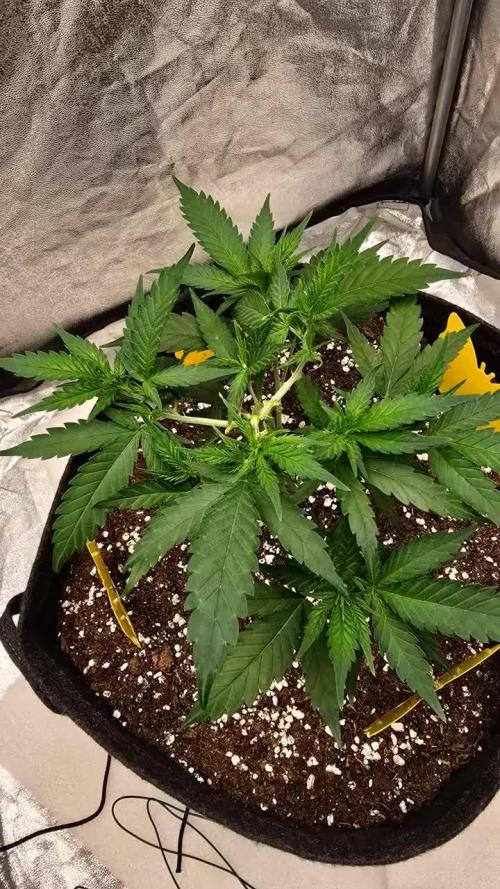
das 1 mal Dünger in der 7 Vegi Woche... Lampe läuft weiterhin auf 60% leistung. Ca 600 PPFD jetzt ende der Woche Lichtzyklus auf 12/12 gestellt.
Processing
Likes
24
Share


@GrowGuy97
Follow
Day 21 - Ladies are looking nice & healthy! Everything seems to be going great, one is still growing a little slow but all in all extremely happy with this grow so far! Thanks for following & happy growing friends!✌️🏼🌱
Day 22 - They are really starting to take off now😍😍
Day 23 - not sure if it’s the pheno type or the nutrient but the plant that is getting the Technaflora Nutrients is starting to get a little bigger🤷♂️🏼
Day 24 - Babies are really starting to take off😍😍 got my New420GuySeed gear in today as well👍🏼🙏🏼
Day 25 - Starting to really grow now, the smaller of the 3 I starting mainlining today to do another comparison at harvest time!
Day 26 - Another good day of growth! Thank you for following & happy growing friends!🌱✌️🏼
Day 27 - End of the week & these ladies just keep looking better & better😍


Likes
8
Share


@Mo_Powers
Follow
we are entering the 6th week. slowly the little one is growing towards the sun. i did a first topping and started with LST. maybe it was too early with the topping? we will see. the sun is shining more again and the temperatures are slowly rising.
Processing
Likes
7
Share


@Canadian_Bud
Follow
31-08-2019
Another glorious week with the new system, getting the RO water is less a challenge than the Soil or CoCo with previous grows and soo much better than feedings of 2 or more gallons every other day. She seems to be coming out of the shock mode as some stems are changing back to green from deep purple. Some new growth has started to appear so that's a good sign 😎
Nutrition will be doubled on the next Nutrition Change out in 7 days. So far! All variables are under control. I like the fact I can turn the tap and check accurately and adjust if needed unlike soil unless you are using a soil kit all the time.
I have notice a few drips coming out of the unit but not much to be concerned with. Pump work 15 min intervals pumping Nutritional spray. 2 different Air flows 1) in solution with air stone and 2) open wand spray inside directed at the roots to provide additional oxygen.

Likes
8
Share

@MaxWax
Follow
The ladies are looking great and the scents are amazing. The bud on the Runtz #1 looks insane, can't wait to see how it turns out. I'll check the trichomes under the microscope later, but I'm guessing the first one needs about 2 more weeks. Have a good one🏼

Likes
10
Share

@AestheticGenetix
Follow
Everything is great with these genetics.
Great breeder. 100% of 11 seeds have made it to maturity.
I have culled 2 males.
I have 1 that has insane structure compared to its siblings. The only one with side branching was a male. I haven't culled it yet but I probably should asap


Likes
3
Share


@Poohboomin
Follow
As you can see we're still going strong let me know if you have any tips or
Likes
126
Share


@nonick123
Follow
Día 27 (12/02) Sigo con los ajustes de LST, pero voy a empezar a dejar que la planta se empiece a estirar
Día 28 (13/02) Hago una ligera defoliación (2 hojas por planta) para mejorar la luz sobre las ramas laterales que están creciendo verticalmente
Día 30 (15/02). Riego 1 Litro H20 + Wholly Base 1,5 ml/l + Solid Green 1 ml/l + Rise Up 1,25 ml/l de Gen1:11
TDS 880 PPMs - pH 6,6 (ajuste con pH+ para subirlo desde 6,2 y buscar mejor biodisponibilidad del Calcio)
DÍA 32 (17/02) Ajustes de LST. La planta no para de crecer 😍
Mañana pasamos a 12/12 y que empiece el proceso de floración!
💦Nutrients by Gen1:11 - www.genoneeleven.com
🌱Substrate PRO-MIX HP BACILLUS + MYCORRHIZAE - www.pthorticulture.com/en/products/pro-mix-hp-biostimulant-plus-mycorrhizae
️Controlled by TrolMaster TCS-1 Tent-X System Main Controller - https://www.trolmaster.com/Products/Details/TCS-1