Likes
Comments
Share


Likes
7
Share


@RivenWaters
Follow
Getting close to harvest, maybe one or two weeks more. I had some powdery mildew starting on one plant so I cut those out, drying them now.

Likes
12
Share


@Mule420
Follow
Added the epsom salt and calcium supplement to fix my yellowing problem and so far it’s turning it for the better!!! 😂

Likes
10
Share


@therealgrowmie
Follow
The day of harvest has arrived!
Even though it always feels like a big day - at least for growing, lol - there isn’t actually much to be done. I always hang the plants as a whole and only trim enough to make sure there are no air pockets during the drying process.
I know it might spark some controversy, but I dry by VPD, which also lets me adjust the humidity according to the temperature.
Each plant came in at around 200g wet weight, which is rather small - but honestly, if the quality is high, I don’t mind. I have to admit though, they are very small 😜.
The smell is as expected: like you put your head in cookie dough!
Until next time!

Likes
10
Share


@Brick_Bazuha
Follow
Прошла ещё неделя, всё в норме цветочки очень плотные но не сильно большие размером, зато очень много, как раз под размер моего гриндера пока оставшегося из рабочих😂 трихомы мутнеют, думаю на следующей недели пойдёт уже янтарь и буду харвить)

Likes
2
Share


@SolitudeCorners
Follow
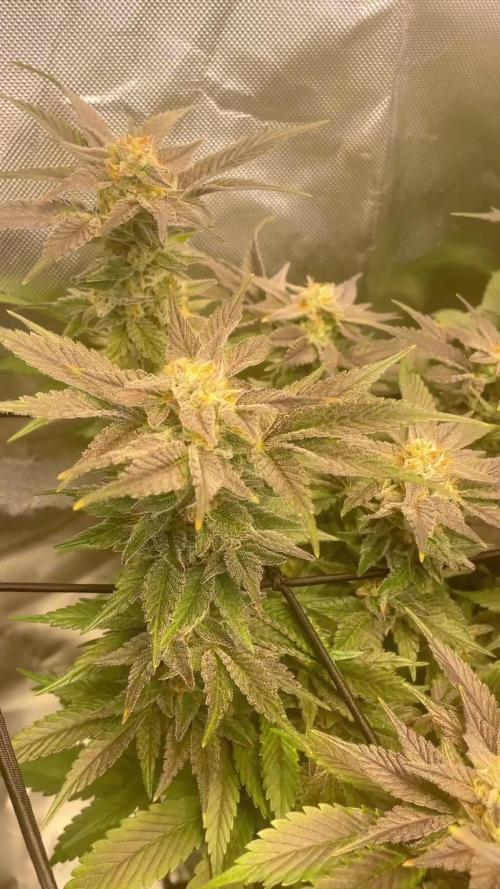
We’re deep into Week 8, and Blue Banana Cream is stacking up beautifully. Trichomes are looking frosty, covering the buds in a thick, sticky layer—definitely a strain that’s going to shine post-cure.
The aroma has intensified compared to earlier weeks, now pushing out a stronger creamy, fruity scent with a slight gas undertone. Every time I open the tent, it hits harder. The buds are swelling up nicely, transitioning from airy to more mid-compact density. Pistils are still mostly white, meaning it’s got a bit more time before it fully ripens.
One thing I’ve noticed—the branches are starting to lean from the weight, so some light support might be needed to prevent them from bending too much in the final stretch. I’m keeping temps at 18-20°C and humidity around 55-60% to ensure a proper finish.
With harvest around the corner, it’s just about watching those trichomes shift from clear to cloudy/amber and letting this one reach its peak.
Likes
22
Share

@Brotanical
Follow
🌱(BT 40) 🌱Es sind verschiedene phenos zum Vorschein gekommen aber sie entwickeln sich bisher super 👍
Es gibt keine großen Veränderungen in den zusätzen☕ es geht weiter mit @Hesi_Official Dünger und die rlf Passt auch wieder wie gewünscht mit der ich zwischenzeitlich etwas zu kämpfen hatte aber das ließ sich gut gegensteuern mit der Infrarotmatte 👍
AKF von @VIVOSUN lässt Geruch durch ohne Ende auch bei 50% rlf 😄schon der zweite nagelneue 150mm akf ✅ bis vor zwei Wochen war noch alles top
Links die XS 1500 pro mit 36 cm Abstand und 85% Leistung derzeit✅
Rechts die M100 Pro von Wizard of Bloom mit 31cm Abstand und 100% Leistung ✅
Mir persönlich gefällt Spektrum und Vitalität sowie Performance unter der M100 etwas besser der Wuchs ist bedeutend kompakter und die Blüten gehen fast bis zur Erde das ist echt Wahnsinn 👍✅☣️
Die Research Reihe von @SensiSeeds läuft bisher ohne große Probleme und es ist eine Freude zuzusehen 😁


Likes
7
Share

@GERGrowDesigns
Follow
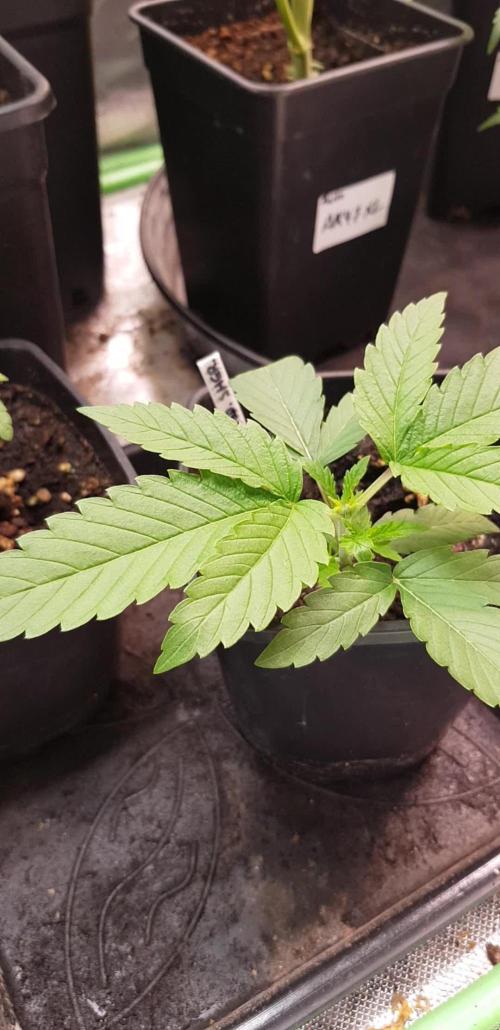
Welcome to Veg Week 3 of Fast Buds Papaya Sherbet
I'm excited to share my grow journey with you from my
FastBuds Project . It's going to be an incredible ride, full of learning, growing, and connecting with fellow growers from all around the world!
For this Project , I’ve chosen the Feminized Photo strain Papaya Sherbet :
Here’s what I’m working with:
• 🌱 Tent: 120x60x80
• 🧑🌾 Breeder Company: Fast buds
• 💧 Humidity Range: 60
• ⏳ Flowering Time: 58 Days
• Strain Info: 30%THC
• 🌡️ Temperature: 26
• 🍵 Pot Size: 0.5l
• Nutrient Brand: Narcos
• ⚡ Lights : 600W x 2
A huge thank you to Fast Buds for allowing me to try my Best with this amazing collection from Automatic and Photo Strains they managed to Sponsore . Big thanks for supporting the grower community worldwide! Your genetics and passion speak for themselves!
I would truly appreciate every bit of feedback, help, questions, or discussions – and of course, your likes and interactions mean the world to me as I try to stand out in this exciting competition!
Let’s grow together – and don’t forget to stop by again to see the latest updates!
Happy growing!
Stay lifted and stay curious!
Peace & Buds!

Likes
1
Share

@ChubbyBudBros
Follow
-
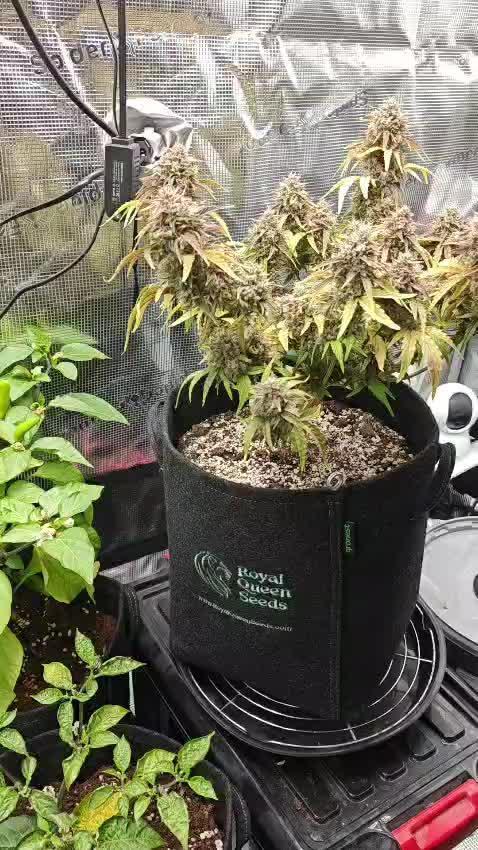
Day 71
I increased the height from the lamp a bit further trying to get about 600-700 ppfd across the canopy, just to help her finish and prevent trichomes from degrading into CBD too fast. Hopefully She will be ready to cut down this week.
Day 72
Still seeing a lot of clear trichomes, think we gonna be waiting for a while still. 😅 There's quite a few white pistils node still as well, which makes me believe she is still not done swelling.
Likes
5
Share


@ganzigunnu
Follow
this is week 3 and I fed them only two times. the pots are still wet from the initial watering. I will introduce Bio Heaven this week.

Likes
6
Share


@eldruida_lamota
Follow
Que pasa familia, vamos con la sexta y última semana de crecimiento de estas Papaya sherbet feminizadas de fastbuds.
Vamos al lío, de las 3 plantas, me quede con 2 por espacio, siempre pongo alguna semilla de más por si no abriese alguna por no perder ese hueco del indoor.
También se trasplantaron a su maceta definitiva, en este caso de 7 litros, que el mismo trasplante provocó un shock, que también fue solucionado inmediatamente.
El ph se controla en 6.2 , la temperatura la tenemos entre 20/22 grados y la humedad ronda el 50%.
Hasta aquí todo, Buenos humos 💨💨💨
Likes
11
Share


@SonomaSungrown
Follow
Skipped a week in my journal last week, as I was traveling.
Had my neighbor water my plants.
Came back and everything was looking great with the Lion Claw.
I WAS having some minor early deficiencies with my photoperiod plants though... so I decided to go ahead and give everything a solid feeding of Foop Bloom 1, 2 and Sweetener.
Also top dressed the Lion Claw and mulched with rice straw to help with the soil drying out a bit too quickly.
She's a big plant for being in a 5-gallon pot.
I have a sneaking suspicion that my neighbor didn't water them quite enough while I was gone.
Will probably continue with the Foop feedings... probably once per week. Don't want to overdo it.
8/4 LIGHTLY sprayed with gravenstein apple FFJ and OHN.
8/6 LIGHTLY sprayed base soil area with neem oil / castile soap mixture.
Likes
6
Share


@mEluv420
Follow
Starting of from an sexy seed - root is out, and ready to get smashed (gently) into the hot n' warm soil. The early days of this lil' baby girl will begin now. SOOOO excited x to the d.
Likes
260
Share


@SlowpokeFuegobud
Follow
🐒 🍌 🌴🐒 🍌 🌴🐒 🍌 🌴🐒 🍌 🌴🐒 🍌 🌴🐒 🍌 🌴🐒 🍌 🌴
Welcome to week number 15!! ✨
Meanwhile I found out that Monkey Butt is actually a thing! 😬
DAY 105
Chop chop 🎉 💀 🙏
Thanks, my growmies for visiting and reading and commenting, I love reading your comments! Mwah! 😘
Thank you, @Kannabia, for sponsoring this grow, aaaaand for the amazing gift pack! 😍 I hope to make you proud! 🧡
Special shouts out to my fantastic sponsor @GreenBuzzNutrients! Thank you for trusting me with your awesome products, I'm a longtime fan! 💚 🙏 Green + juicy growmie hugs to my Greenbuzzers!! 😘 Get a generous discount code for their products in my set up section ⬇️ !!
Grower Love everybody!!!11 💚 💚💚💚💚💚💚💚
Wishes do come true, they just take a lot of time sometimes.. ✨
__________________________________________________________________
https://www.kannabia.com/en/feminized-cannabis-seeds/monkey-grease
Monkey Grease
Its own personality
At Kannabia Seeds we have put all our effort into bringing out our own feminized Monkey Grease, a cross between Monkey Grease x White Widow, focusing above all on giving it its own personality in flavor and aroma (frankly unmistakable) and, of course, in Highly demanded characteristics, such as high resistance to diseases and pests, and adaptability to all types of growing conditions, making it close and easy to grow to the widest possible range of growers. The result is a really powerful and versatile indica-sativa marijuana seed, with a powerful relaxing effect, ideal for those moments when you want to disconnect from the madding crowd.
Cultivation of Monkey Grease
Which cultivation method would be most appropriate for this variety? Good question… and one that is easy to answer. Its versatility and adaptability make it a true all-rounder, with remarkably uniform results, whether you choose SOG, SCROG, hydroponics or guerrilla growing. Moreover, we invite you to experiment and play, varying the techniques from moment to moment, and to draw your own conclusions. We are convinced that in all cases, apart from minor variations, the results will always be optimal, giving remarkable yields and in a short time.
Attention should be paid to its high bud production, which can be fat, dense and heavy, although its sturdy branches are able to bear heavy loads without major problems. If you are a fan of extractions, our Monkey Grease is also optimal, given its high production of caramelised resin.
If it is already amazingly productive indoors, this variety excels on its own merits outdoors, where it can easily reach 200 cm in height, and can reach between 700 and 800 grams per plant.
It is therefore an easy and grateful plant, which demands little from its gardeners, making do with simple basic care, and with little or no propensity to develop diseases or mildew, or to attract pests (despite its striking aroma!).
Taste and effect of Monkey Grease
Our Monkey Grease stands out first and foremost because of its powerful, strong smell, which is hard to camouflage. A penetrating aroma that unfolds, in a balanced way, on the palate in the form of a wide range of spicy and sweet flavours, reminiscent of wild honey, nougat and cinnamon, and distant notes of milk chocolate. A delicious treat to be savoured calmly, without haste, as a preamble to its pleasant effect: extremely relaxing and narcotic, powerful, ideal for meditation and moments of introspection and meditation.
Don’t be in a hurry with Monkey Grease. It can be your perfect ally to treat those stress and anxiety problems, but for that you must let yourself go, surrender to its charms, especially if you are inexperienced.
________________________________________________________
Setup:
140x70x200 cm Spiderfarmer tent
2x Monkey 16W fans (not oscillating)
1x box fan 50W oscillating (on lowest level)
LED
Full Spectrum 320W AGLEX AGL-320W-MA
5,6 kg
foldable, dimmable
864 pieces Samsung LH301H
864umol/s
2,7umol/J
full spectrum white + RED 660nm + IR 740nm
wavelength range 380-780nm
covering 3x4ft
Green Buzz Nutrients https://greenbuzzliquids.com/
❗ Use code GD42025 for generous 25% discount (for orders of minimum 75€) 💚
Plagron Growmix
Can Lite Filter 125/ 400cm³/h
PrimaKlima exhaust EC 125-400/240 cm³/h
tab water pH 8 - EC 0,25 with Calmag to 0,5
Advanced Hydroponics pH minus Grow + Bloom to pH 6.2 💧
🐒 🍌 🌴🐒 🍌 🌴🐒 🍌 🌴🐒 🍌 🌴🐒 🍌 🌴🐒 🍌 🌴🐒 🍌 🌴

Likes
6
Share


@Plantinator
Follow
I feed her with full strength of nutes in every 4 days. The leaves are much healthier, so this is the way to go.
The smell is lacking which is weird, but hopefully the end product will be fine.
Likes
2
Share


@Home_Grower
Follow
Día 51 de Floración: Agregamos otra lámpara de Sodio HPS de 70W colocando las dos lámparas en pantallas águilas. Continuamos los 3 riegos semanales intercalando con agua.
Día 57 de Floración: Comenzó el engorde de las flores y ya se puede ver tranquilamente el cambio de color de las hojas. 😍

Likes
18
Share


@Ginger_gnome
Follow
Well this is a switch. The plant that was small has caught up to the bigger one and the bigger one is slowly getting better. Was having a issue with my tank temperature and luckily both plants seem to have avoided any issues. They both do have a bit of purple in the stems but it seems to be fading so I'm hoping that there issues are sorted out lol.
Today is the last day of veg and the first day of flower is to come. If it goes a full 8 to 9 weeks I'll be looking at a March harvest. If that's the case I might be able to squeeze in a quick auto flower grow before the family summer vacation lol. The temperature has been getting warmer outside and the night time temperature hasn't been to bad. The humidity has been stay around 50% all week and thats were id like to keep it but we're expecting a lot of rain over the next few weeks so we'll see how well that works. I picked up 2 more temperature hydrometer meters with probes for the room. And with all the fans the air movement in the room has been great. Humidity and temperature is the same in every corner of the 8x9 room.
I switched the lights from 24/0 to 18/6 this last week to get them ready for the approaching 12/12 light schedule. And because that is tomorrow I lowered the lights down so that tomorrow I just have to turn the lights up.
I also emptied my tank and refilled it with the nutrients for flower so that the treys can empty a bit before I add all the new nutrients. I filled all the trays before I turned it all off so they would have enough for the night.
Well that's all for now, happy growing and happy new years!!! Keep it growing!!!

Processing
Likes
97
Share


@DudeGrowsWeed
Follow
Week 2 and the girls are looking more yellow and funky than I like. I'm pretty sure my soil is just way too hot. I tried flushing it through, but that just seemed to lead to general overwatering issues. I'm planning on transplanting to larger pots with more neutral soil this weekend and hope that will help straighten things out.