


Likes
Comments
Share


@AsNoriu
Follow
Day 58 since seed touched soil.
Sponsored grow
MARS HYDRO TSL2000: 300W, Flower 2'x4', Veg 3'x5'
It's recommended for beginners.
Low-budget & high-efficiency.
Think its more than for beginners ;)))
Plants coped well with small distance, stretch is over, flowers start tu bulk up, some buds will be really nice.
Today raised light to max, so now they have 15 cm quile healthy distance ;)))
Last top up was too powerful with Nitrogen, i see signs of overdose.
Bomb thinnest, smallest, from heat and wind damage has brown pistils here and there , but is stacked !!! Got light signs of nitrogen toxicity. Did small clearing, but she needs more ;)
Day 60. Some more to cut off
Happy Growing !!!

Likes
6
Share


@jackh3rrer
Follow
Everything still looking fine. Moved them to 5 Gallon fabric bags. Let’s start vegging!

Likes
43
Share


@TheCannaProphet
Follow
~ FastBuds PAPAYA SHERBET Photoperiod~
Well here we go on another journey together through 'Canna-land' and this one's kinda special... forget that, it's VERY special because this is FastBuds newest surprise for the community, a FEMINIZED PHOTOPERIOD STRAIN!🤯
I was fortunate enough to score these seeds, of which only 1000 were available and can't wait to see what this strain can do! This Papaya Sherbet, according to FastBuds, is a hybrid with a 9-10 weeks flowering period. For a more detailed and accurate description of this strain the following from FastBuds says it best:
"Combining the massive stature of Papaya (Oni Selection) with the strength and resilience of one of our best keeper cuts (Sunset Sherbet), this strain develops into a big, expansive bush adorned with numerous bud sites that later transform into a generous harvest of medium-sized buds. Papaya Sherbet flowers deliver a signature flavor of premium cannabis with subtle citrus undertones that emerge upon inhaling. During growth, her aroma makes for a sweet yet pleasantly bitter fragrance, giving you an idea of what the smoke will taste like. Notably stress-resistant, Papaya Sherbet is a great choice for growers working in challenging environments. She is very forgiving and rebounds quickly from any adversity, allowing growers the freedom to experiment with confidence that she will take everything like a champion she is. This strain embodies resilience, flavor, and abundant yields in every grow cycle."
Sounds like an epic strain and I personally cannot wait for this lady to strut her stuff!😍
________________________________________________________________________________________________________________________________________________________________________________________________________________________________________________________________________________________________________________________
The Setup:
This is going to be an outdoor grow, but I have started the Papaya Sherbet photoperiod indoors as our weather is still a bit too chilly to put a newly sprouted seedling outside (nighttime temp's dipping regularly into the 40's℉).
The plan is simple... let her grow inside under a 19/5 light schedule until the nighttime temperatures are in the mid 50's℉, which shouldn't be long. After which, she'll be moved outside and transplanted into the soil which I have already setup and inoculated with beneficial microbes from BioTabs and slow release dry amendments from Gaia Green. Once she's established herself outside she'll be given periodic top dressings of Gaia Green 4-4-4 and 2-8-4 along with worm castings and Compost Tea's. Her grow area is approx. 5'x5' and I have posts and a trellis net set up already for when she gets bigger to aid in training her. Let the fun begin!🤪💚
________________________________________________________________________________________________________________________________________________________________________________________________________________________________________________________________________________________________________________________
Weekly Updates:
8/11- Here we go into the FIRST WEEK of flower for the FastBuds Papaya Sherbet photoperiod! She finally finished her preflower stretch, ending up at a nosebleed height of 90" tall! It was such a great sight to look at her yesterday and see little flowers beginning to form. She's going to be a beautiful plant!
8/13- Our weather has cooled off after last weeks tropical system passed and it's nice to have a much needed break from the heat and humidity!
I am continuing to water daily with 5-8 gallons of well water from the garden hose. I also went ahead and removed two small branches that were at the very bottom of the Papaya Sherbet that would only take away nutrients from more beneficial areas of the plant.
8/15- Today, I top dressed the Papaya Sherbet with 3 cups of Gaia Green 2-8-4 Power Bloom which I watered in with well water from the hose. I then applied 1/2 gallon of a nutrient mix I made up in 2 1/2g of well water consisting of: 1/4 cup Neptune's Harvest Seaweed(kelp) plant food and 2 1/2 tsp. of Plantonics Amino Bliss.
8/17- There goes the first full week of flower for this incredibly stunning Papaya Sherbet photoperiod from FastBuds and I can not wait to see her transformation as this lady progresses through flowering!
Thank you for checking out my diary, your positive comments and support make it all worthwhile! 💚Growers Love!💚😎🙏

Processing
Likes
1
Share


@Mr_nugs_lover_David
Follow
This wedding cake is looking as healthy as her sister however she's in a bigger pot 25 liters. Let's see if she does as good as her sister,she's enjoying life right I don't think I'll have any type of issue,she's being fed 100% organically,with lactobacillus liquid made by me,liquid bat guano,and she has in her soil florians living organics and more bat guano and seaweed,mycorrizae,humic and fulvic acids,beneficial bacteria and fungus. She's gonna be a wonderful plant at the end I'm sure. Stay tuned guys! 💚🌱✌️

Likes
17
Share


@DutchGlobalCitizen
Follow
With the plants entering their final stages, inspections were increased significantly.
The Wall of Green canopy had developed exactly as hoped. Dense flowers, large colas and a surprisingly uniform wall of bloom were visible across nearly the entire setup. While these characteristics were highly encouraging, they also increased the need for caution under tropical conditions.
During these final inspections, a small number of suspicious spots were identified. Nothing dramatic, but enough to raise concerns about potential quality loss if flowering was extended further. At this stage, the Wall of Green concept had already demonstrated what it needed to demonstrate. The question was no longer how much additional weight could be added, but how much quality could be preserved.
The decision was therefore made to harvest.
The final wet harvest weight came in at approximately 5.4 kilograms.
One thing that became immediately obvious during harvest...
Production was distributed across virtually the entire wall.
There were very few unproductive or empty areas within the canopy.
Multiple productive stems emerged from nearly every planting pocket.
Yield was not concentrated in a small number of exceptional plants but spread across the system.
Large numbers of medium-to-large colas were visible throughout the wall.
Flower production extended along much of the main stem length rather than being limited to the top cola.
After defoliation, surprisingly little space appeared wasted on excessive side branching or non-productive growth.
One of the biggest surprises was how much flower mass became visible after harvest preparation. The actual distribution of buds along the stems proved more impressive than many individual cola photographs had suggested during flowering.
A second unexpected observation was simply how comfortable the harvest process turned out to be. The vertical layout placed most of the work at a convenient height. With relatively few side branches and most production occurring directly on the main stems, trimming and harvest preparation involved far less bending and awkward positioning than I am accustomed to.
Acknowledgements
This run also benefited from some products that deserve mention.
Plagron Lightmix proved to be an excellent substrate throughout the grow. Given the limited root volume available to each clone, substrate performance was particularly important. The plants established quickly, maintained vigor and showed little sign of stress despite the unconventional setup. While many factors contributed to the outcome, Lightmix may well have been one of the key ingredients behind the success of this Wall of Green experiment.
Bio Nova X-Cel was used during the early stages to support root development in the clones. It fit seamlessly into the feeding program and helped the young plants establish quickly, providing a solid foundation for the cycle that followed.
Plagron Alga Bloom formed the backbone of the flowering nutrition program. Easy to use, reliable and consistent throughout bloom, it allowed the plants to perform without unnecessary complexity.
Godfather OG itself also deserves some recognition.
Throughout this project the focus was often on the Wall of Green methodology rather than the cultivar. Nevertheless, Godfather OG consistently displayed strong vigor, excellent cloning consistency, heavy resin production and a remarkably uniform growth pattern. Under tropical outdoor conditions, it proved itself to be a dependable and highly productive variety.
Final Thoughts
The harvest is complete, but the evaluation is not.
The final conclusions regarding dry yield, canopy efficiency, root development, plant density and the overall performance of the Wall of Green system will be reserved for the Final Dry Weight Update.
Only after drying, weighing and examining the root zone will it be possible to determine what this experiment truly achieved.
For now, the scissors are down, the flowers are hanging, and the waiting begins.
Final Dry Weight Update: Coming Soon.

Likes
62
Share


@HinduGod
Follow
WOW LOOK AT DAT!!!! DA PLANT IS NEAR DA END!!! I MADE AN ORANGE PEEL TEA WITH WORM CASTINGS TO GIVE IT A LITTLE BOOST!!!! DAT PLANT IS USING ITS RESERVES IN DA LARGER FAN LEAVES DAT IS VERY VERY GOOD!!!! SUN GOD AND RAIN GOD HAVE BEEN WORKING VERY VERY GOOD TOGETHER!!!! HARVEST IS VERY VERY SOON!!!!!😎
PLEASE COME AGAIN!!!!!
Likes
240
Share


@mcflow
Follow
Yielded way more than i thought! Great strain, i planted the seedlings in their final pot right away and it worked like a charm! Had a little problem with gnats but the nematodes i used made that problem go away really fast. The smell of the buds are awsome, im looking forward to smoking some

Likes
1
Share


@WeedSherpa_420
Follow
Blacked out all windows in the shed and moved Moby Dick plants here from greenhouse to ensure flowering as they are now in darkness for 13 hours uninterrupted. Growing very well for 7 week old. Ran into some nitrogen deficiency problems as these Phenos are very nutrient demanding but still no problems. Will keep in flower for 4 weeks and bobs your uncle
Likes
26
Share


@donutgrower
Follow
Big week! I got my new EarthBoxes and a bunch of goodies. I picked up the Probiotic Farmer's Alliance kit from BuildASoil, so I also got some EM-1, Kashi Blend, dolomite lime and Malibu compost. Alongside that I picked up Colorado Worm Compost (vermicompost), Gnarley Barley (malted barley, corn and hemp) and Craft Blend (aprox 3-5-2 organic mix). Unfortunately there was a bag of soil missing, so I ended up using my own mix though I am somewhat scared of it being too clay-heavy for the SIP. I inoculated with EM-1 and began fermenting a batch of activated EM-1 to make the bottle last longer.
It looks about a week from LST, after that I hope to set up a two-tier SCROG setup and begin growing the bushes. I will begin spraying AEM-1/EM-FPE/EM-5 alternatively once a week for IPM, I will try to avoid using neem this round (unless I find this approach lacking). I also brewed a batch of EM-FPE with aloe that smells incredible, I can't wait to give it a go.


Likes
5
Share


@Naujas
Follow
84 days!!!! I came back after a 12-day vacation, and immediately rushed to cross it:) it's a pity that I didn't see her last 12 days, I only got a few photos while I was away :) but that's the point:) The girl coped with nature's challenges really well, there were cold, rainy, windy days that she endured, but there were also very hot days +35° C during which she warmed herself on the northern balcony where the sun shines for a maximum of 5 hours under ideal conditions:) but the result makes me very satisfied and happy, a cool strain :) good luck to everyone, the update will be after the harvest dries out:).

Likes
2
Share


@midau
Follow
We are now on day 15 of veggie growing. The 5 that were first in the final pots have developed well. The other 4 that came later are a bit behind but that will definitely change. In 14 days the plants will be switched to flowering. I am excited.

Likes
42
Share


@Ginger_gnome
Follow
Holy crap can you say rocket ship hahaha. Thing grew over 10" I 7 days. I've only got 6" of grow space left before my light is completely maxed out soooo yea fingers crossed lol. She's got tones of buds growing all over and is looking amazing. She has filled this tent out better then my last few grows in this tent.
The temp has been holding around 25 to 26.5 light on the last week and humidity has been jumping back and forth between 50% and 60%.
I've jumped up to a gal of water a day plus a extra 500ml every other day for run off. My run off gas been between 50 and 100 above my input so that's good.
Plants looking happy so I'm happy
Well that's all
Happy growing everyone!!!!

Likes
29
Share


@Cheeba_Inu
Follow
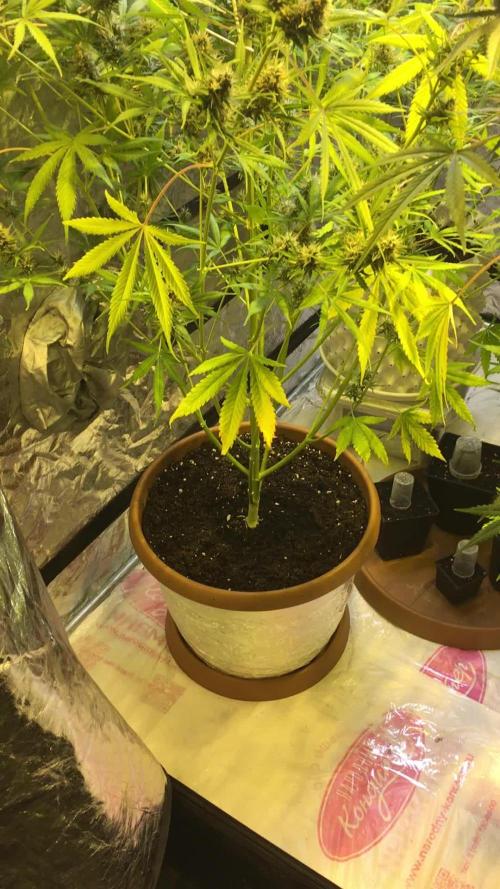
As of day 43 (November 13), the NYC Diesel has stopped stretching and is putting on weight throughout the buds. It is an important time for the plant, as the flowering is going to be critical for quality and yield, but it is also a little boring not having anything to do besides watch, water, and wait.
It's doing well with the nutrients so I am upping the phosphorus/potassium it is getting, and I am going to try to slightly lower the cal/mag to help reduce the nitrogen. I am continuing with the Armor Si as an extra potassium boost as well. I try my best not to overfeed, as I find the auto flowers with my lighting setup are sensitive to more agressive feeding schedules.
Day 46: did a small defoliation, will probably be the last.
Thanks for reading!



Likes
70
Share


@IstrGrow
Follow
The weather in my country suddenly got warmer unexpectedly. That's why I'm having problems with the temperature. Still, it seems to be going well for now.
I watered on the 51st day. I will do it again today and with full fertilizer.
Likes
6
Share


@Juannabico
Follow
Hoy finaliza este hermoso proceso de cultivo, que por descuido y falta de medidas tenemos una cosecha polinizada que dará origen a un curuze entre la Jack Orange de Gea seeds y una Runtz de Mr.Q seeds; se observa unos cogollos no tan compactos ni gordos, asumo que esto se debe a la falta de estimulantes para el crecimiento de los cogollos y la polinizacion de la planta feminizada, que gasto sus energías en la formación de semillas y no en engordar cogollos.
La planta entra a secado en oscuridad en un habiente controlado, para proceder a retirar las semillas y utilizar el material vegetal ya seco y rico en tricomas en la extracción de rosin.
En el corte de la planta en su estado ya maduro, obtuvimos una planta de 55 cm de altura, con aroma fuerte, colores vivos, con cogollos llenos de tricomas

Likes
15
Share


@Happy_Rakosnicek
Follow
I got new lighting from VIPARSPECTRA and type XS1000 and I added another dose of nutrients according to the table, but I only used 0.5l of water.
Likes
6
Share


@GoldenWeedGrower
Follow
Legend
Timestamp: 📅
EC - pH: ⚗️
Temp - Hum: 🌡️
Water: 🌊
Food: 🍗
pH Correction: 💧
Actions: 💼
Thoughts: 🧠
Events: 🚀
Media: 🎬
D: DAY, G: GERMINATION, V: VEGETATIVE, B: BLOOMING, R: RIPENING, D: DRYING, C: CURING
______________
📅 D50/B13 - 04/06/24
⚗️ EC: 1.0 pH: 6.0
🌡️ T: 24°C H: 60%
🌊
🍗
💧
💼
🧠
🚀
🎬 1 TL video
______________
📅 D51/B14 - 05/06/24
⚗️ EC: 1.0 pH: 6.0
🌡️ T: 25°C H: 60%
🌊 15L
🍗 CalMag, Bloom A-B, Bud Candy, B-52, Big Bud
💧
💼
🧠
🚀
🎬 1 TL video
______________
📅 D52/B15 - 06/06/24
⚗️ EC: 1.0 pH: 6.0
🌡️ T: 25°C H: 60%
🌊
🍗
💧
💼
🧠
🚀
🎬 1 TL video
______________
📅 D53/B16 - 07/06/24
⚗️ EC: 1.0 pH: 6.1
🌡️ T: 25°C H: 80%
🌊 4L
🍗 CalMag, Bloom A-B, Bud Candy, B-52, Big Bud
💧 pH-
💼 Added pH- in order to keep the water on the lower side for a while
🧠
🚀
🎬 1 TL video
______________
📅 D54/B17 - 08/06/24
⚗️ EC: 1.0 pH: 6.1
🌡️ T: 25°C H: 80%
🌊
🍗
💧
💼
🧠
🚀
🎬 1 TL video
______________
📅 D55/B18 - 09/06/24
⚗️ EC: 1.0 pH: 6.1
🌡️ T: 25°C H: 70%
🌊15L
🍗 CalMag, Bloom A-B, Big Bud
💧
💼
🧠
🚀
🎬 1 TL video
______________
📅 D56/B19 - 10/06/24
⚗️ EC: 1.0 pH: 6.1
🌡️ T: 25°C H: 70%
🌊
🍗
💼
🧠
🚀
🎬 1 TL video

Likes
26
Share


@GroloCup
Follow
Another solid week of this lady just vegging along. MegaCrop is fueling her growth and she's really guzzling down the water, nearly 16 oz every 18 hrs. If there was a mini hydro category in this grow off I'd decimate all 🤣... Stay tuned I'd say we'll be seeing pistils within a few days, then the fun begins!!

Likes
19
Share


@420DeepGrow
Follow
Gracias al equipo de Royal Queen Seeds, Marshydro, XpertNutrients y Trolmaster, sin ellos esto no seria posible.
💐🍁 Gelato #44:
Los criadores de Tyson 2.0 criaron Gelato 44 a partir de cepas finas. Al cruzar la Sunset Sherbet y la Thin Mint Girl Scout Cookies, crearon un híbrido de dominancia índica que asesta fuertes golpes en el cuerpo y la cabeza.
Su contenido de THC del 22% crea sinergia con terpenos colocantes para ablandar los músculos
Mantenla hidratada y con una dieta constante y pasará por la fase de floración en unas ocho semanas. Las plantas de interior alcanzan una altura máxima de 120 cm y producen 400-450 g/m², mientras que sus homólogas de exterior alcanzan los 180 cm y producen hasta 600 g por planta.
🚀 Consigue aqui tus semillas:
https://www.royalqueenseeds.es/rqs-semillas-cannabis-tyson/664-dynamite-diesel.html
💡TS-3000 + TS-1000: se usaran dos de las lámparas de la serie TS de Marshydro, para cubrir todas las necesidades de las plantas durante el ciclo de cultivo, uso las dos lámparas en floracion para llegar a toda la carpa de 1.50 x 1.50 x 1.80.
https://marshydro.eu/products/mars-hydro-ts-3000-led-grow-light/
🏠 : Marshydro 1.50 x 1.50 x 1.80, carpa 100% estanca con ventanas laterales para llegar a todos los lugares durante el grow
https://marshydro.eu/products/diy-150x150x200cm-grow-tent-kit
🌬️💨 Marshydro 6inch + filtro carbon para evitar olores indeseables.
https://marshydro.eu/products/ifresh-smart-6inch-filter-kits/
💻 Trolmaster Tent-X TCS-1 como controlador de luz, optimiza tu cultivo con la última tecnología del mercado, desde donde puedes controlar todos los parametros.
https://www.trolmaster.com/Products/Details/TCS-1
🍣🍦🌴 Xpert Nutrients es una empresa especializada en la producción y comercialización de fertilizantes líquidos y tierras, que garantizan excelentes cosechas y un crecimiento activo para sus plantas durante todas las fases de cultivo.
Consigue aqui tus Nutrientes:
https://xpertnutrients.com/es/shop/
📆 Semana 7:
Ha sido una semana algo complicada, tormentas, frio y lluvia han ralentizado el crecimiento, espero que pronto lleguen dias soleados, continuo con 1/3 nutrientes recomendados en cada riego.