The Grow Awards 2026 🏆
Likes
11
Share
Mise en route des graines pour ce test Jour 1 : mise en pot 24/09/24 13graines ont germer Recette du living soil pour 10l 5litre terreau compost équin bovin ovin végétal 5litre terreau intérieur 500gr biochar 900gr lombric 50gr luzerne 5gr micro granulée it45 5gr pollen d’abeille 5gr levure de bière 50gr tourteau karanja 10gr bactérie soluble 200 zeolith chabasit 10gr Levures Saccharomyces Cerevisiae 2gr Endomycorhizes RHIZOPHAGUS IRREGULARIS 2gr Bacillus IT35 Amyloliquefaciens Il est actuellement en maturation depuis 2semaine j’attends que les graines germes et développe bien leur racines Ensuite je rempoterai dans des pots de 300/400ml que je garderais pour une végétation de 3/4/5 semaines le temps que je récolte ce qui a dans la tente Ça s’annonce beau ! Le terreau Terralba ou terre 4 composts est un terreau naturel exceptionnel. Il s'utilise tel quel en extérieur pour stimuler la vie de vos sols, planches de cultures, grands pots... Augmente le stock d'humus dans le sol, la rétention d'eau et d'air. De la germination à la récolte. Sans risque de brûlure. Ce terreau universel peur s'utiliser dans tous les cycles de cultures extérieures. Nous vous conseillons un mélange à 50/50 avec notre terreau Horticole INNT pour une base de culture durable et réutilisable en intérieur. Composition : composts équin, bovin, ovin et végétal maturés 24 mois minimum. Composition : 1% (N) total 0,7% (P205) 0,9% (K20) 0,5% (MgO) 3,6 (CaO) 24% de MO C/N : 11 PH : 8 Le terreau Terralba est un terreau universel exceptionnel. Ce terreau innovant très drainant avec innovation fibre de mousse et fibre textile recyclées est comparable à un substrat de type fibre de coco. Il est aussi enrichi en compost. Il peut servir de la germination jusqu'à la récolte. Nous vous conseillons un mélange à 50/50 avec notre terreau 4Xcomposts EXT&INT pour une base de culture durable et réutilisable. Écologique, restructurant, la terreau enrichie et aère le sol durablement - notamment les sols argileux - tout en lui redonnant jeunesse ! Composition : • 1,2% (N) total • 0,4% (P205) • 0,8% (K20) • 49% de MO • C/N : 22,4 • PH : 7,3 Le charbon végétal actif est capable d’absorber jusqu’à cinq fois son poids propre en eau ainsi que les éléments nutritifs qui s’y trouvent. Il joue ainsi le rôle de catalyseur et d'amplificateur pour les fertilisants traditionnels, qu'ils soient d'origine organique ou minérale. Ce pourquoi il est idéal pour activer un sol et pour les thés de compost oxygénés. Le charbon végétal améliore la diffusion et la disponibilité des éléments nutritifs dans le sol et offre des conditions propices au développement des micro-organismes. Le Biochar peut être introduit dans une grande variété de sols. Il est particulièrement efficace dans les sols pauvres, difficiles et acides. Pour faire agir rapidement et efficacement sa capacité d’amendement, le charbon végétal est enrichi et biologiquement activé avec des micro-organismes. Le Biochar se comporte ainsi comme un structurateur et un activateur dans le but de valoriser les sols. Composition : • Charbon végétal actif 31% • Matière organique 33% • Matière sèche 75% • C/N : 17 • PH : 7,2 • Azote (N) : 2,1 % dont 1,2 % azote organique • Phosphore (P205) : 0,74% • Potassium (K20) : 1,18% • Calcium (Ca) : 6,8% • Magnésium (MgO) : 0,65% Le lombricompost apporte à la plante des éléments nutritifs tels que l'azote, le phosphore et le potassium, qui sont essentiels à sa croissance. En outre, il contient de nombreux oligo-éléments et micro-organismes qui peuvent être bénéfiques pour la plante. Le lombricompost a également une forte capacité de rétention d'eau et peut améliorer la structure du sol, ce qui peut être bénéfique pour les plantes. En utilisant du lombricompost, vous pouvez ainsi favoriser la croissance de vos plantes de manière naturelle et écologique. Le lombricompost est un fertilisant, amendement organique à la formule haut de gamme. Totalement naturel, il résulte de la digestion de fumier bovin et équin par des vers de terre. Les lombrics transforment ces déchets en un compost riche en nutriments et en micro-organismes bénéfiques pour les plantes. Le lombricompost présente une texture fine et friable, regorgeant de nutriments essentiels tels que l’azote, le phosphore, le potassium et d’autres micro-organismes bénéfiques pour les plantes. Son utilisation améliore la qualité du sol, favorise la croissance des plantes et contribue à la conservation de l’environnement en réduisant les déchets organiques. Le lombricompost est donc une source naturelle de nutriments et de matière organique pour les plantes, et peut être utilisé comme engrais ou comme amendement du sol. Il surpasse ainsi le compost, grâce au travail du lombric (E. Foetida) qui transforme le fumier en un super compost ! 10kg de fumier sont nécessaire pour obtenir 1kg de lombricompost. Composition : • Matière sèche 65,3% • Matière organique 48,7% • Ph 7,9 CE 5,98dS/m • Azote (N) 2,4% dont NO3 0,28% • Phosphore (P205) 3,2% • Potasse (K2O) 3,8% • Acides Humiques 6,2% • Acides Fulviques 0,9% • C/N 11,8 La luzerne fait un excellent paillis, c'est un inoculum de bactéries et de champignons ! Elle contient des niveaux élevés de protéines. Elle fournit de nombreux minéraux importants, dont l'azote, le potassium, le calcium, le fer, l’acide folique, etc. Elle stimule la croissance saine des racines et elle contient des hormones naturelles qui aident à prévenir les maladies des racines. Idéal pour les thés de compost oxygénés (TCO) Protéines : 16%. Naturellement riche en protéines, minéraux, vitamines, enzymes et acides aminés. Micro granules it45 Amendement calcaire, dolomie et gypse avec préparation microbienne à base de Bacillus Amyloliquefaciens IT45 et Saccharomyces cerevisiae LYCC6420 Formulation : micro granulés (1 – 1,6 mm) à base de rhizobactéries favorisant la croissance des plantes qui se multiplient et colonisent rapidement la zone des racines, et de levures Saccharomyces cerevisiae souche LYCC ayant un effet probiotique. Les PGPR produisent des enzymes qui solubilisent le phosphore à partir de complexes inorganiques et organiques dans le sol et stimulent la croissance des racines efficaces augmentant ainsi la zone d'interception des éléments nutritifs. Les levures LYCC permettent une occupation de la rhizosphère par une flore bénéfique. Composition : • Matière sèche : 96,8% • Matière organique : 91,5% • N total : 6,6% dont N soluble dans l'eau 0,17% • P total : 2% • K total : 1,7% Micro-granulés : • Oxyde de calcium (CaO) total : 30% • Oxyde de magnesium (MgO) total : 7% • Anhydride sulfurique (SO3) : 13% Le pollen d’abeille est l'ingrédient de base de la fabrication du miel par les abeilles. Riche en vitamines et minéraux, il est qualifié « d'aliment parfait », y compris pour les plantes ! La levure de bière est une matière vivante qui permet un meilleur fermentation pour les thés de compost oxygénés notamment conseillé pour accompagner les croissances ou apporter un gros coup de pousse pendant la floraisons. La levure de bière stimule la vie des sols également à l'arrosage direct en apportant tout aussi bien que dans le TCO sa population l'espèce micro-bactérienne positive pour votre sols ainsi que des oligo-éléments et diverse vitamines. Composition : • 2,8% (N) total dont 1% (Norg), • 2,3% (P205) • 1,6% (K20) • 35% de MO • C/N : 8. PH : 8,4. Le tourteau de Karanja est un complexe absorbant (argilo humique) qui renforce et stimule la vie microbienne du sol. Riche en éléments fertilisants, il permet une assimilation lente et progressive de l'Azote et donc une régularité de l'apport. Composition : • 4,3% (N-Azote) • 5,2% (P205-Phosphore) • 2% (K2O-Potasse) Matières Organiques : 67,3% Carbone Organique : 33,7% Les bactéries solubles sont utiles pour enrichir les sols, activer le processus de compostage et favoriser la création d'humus. Avec plus de 55 éléments nutritifs, ce produit concentre un mélange de vie microbienne bénéfique à tous types de sols. Véritable concentré de matières végétales et minérales, et d'une sélection de végétaux naturels compostés, nos bactéries solubles permettent une libération immédiate des nutriments. • 2,8% (N) total dont 1% (Norg), • 2,3% (P205) • 1,6% (K20) • 35% de MO • C/N : 8. PH : 8,4. Une zéolithe se comporte comme une « Super Argile » perméable qui retient l’Azote et les éléments minéraux nutritifs au voisinage des racines et les relâche lentement en fonction des besoins de la plante. Cela se traduit par une croissance constante mais rapide du végétal. La zéolithe permet de réduire à la fois le nombre d’arrosages et la consommation en fertilisants car ces derniers sont moins soumis aux effets du lessivage et de l’évaporation. Améliore durablement la fertilité foncière des sols. Peut s’utiliser en mélange à tous types de substrats. Récolte les surplus d’eau et réagit à la chaleur en suintant. Diffuse lentement les éléments minéraux nutritifs et l’azote retenus dans l’eau (évite l’acidification des sols. Riche en oligo-éléments, permet un développement racinaire soutenu. Retiens les pollutions des sols (nitrate, mercure). Se mélange à tous types de substrats et toutes les cultures. Idéal bonsaïs, plantes arides Accroit la capacité d’échange globale du « complexe argilo-humique ». Agit comme anti-mottant. Allège les sols lourds et bloquants trop argileux en améliorant le drainage et le ressuyage en surface. Volume poral de 47%. Améliore la structure des sols en s’opposant à l’acidification de ceux-ci par son effet tampon et par le retard de la nitrification de l’azote ammoniacal. Apporte des oligo-éléments. Augmente la résistance au piétinement. Diminue la fréquence des rempotages. Empêche le pourrissement des racines. Favorise la ramification. Modère le développement des mousses. Permet des économies d’eaux et d’engrais. Résiste au dessèchement et diminue la formation de « feutres ». Retient l’eau sans changement de volume. Sert de support aux microorganismes, ce qui contribue à la dégradation des déchets de coupes. Les zéolithes sont des roches cristallines, présentant des capacités d'adsorption particulièrement importantes vis à vis des polluants que l'on rencontre dans l'eau et dans certains liquides, ainsi que dans l'air et les gaz. Elles sont extrêmement poreuses comme les charbons activés et elles peuvent être chargées électriquement pour opérer comme des échangeurs d'ions. La zéolithe est un produit naturel qui respecte notre environnement. Utilisé dans le milieu industriel depuis de longues années déjà, ce minerai aux propriétés filtrantes particulières commence à se vulgariser dans le domaine de la piscine privée, de l'aquariophilie, des bassins d'agrément, de la récupération des eaux de pluie, ou encore de la culture des bonsaïs et autres plantations diverses par exemple... 4 points techniques majeurs : - Grâce à leur propriété hydrophile, les zéolithes peuvent adsorber l'eau jusqu'à 30% de leur poids total et sans aucune variation de volume : pas de gonflement en présence d'eau ni de craquement en cas de déshydratation comme certaines argiles. Les zéolithes sont d'ailleurs de puissants agents anti-mottant (anti-agglomérant). Cette propriété est très appréciée dans le cas des terrains de golf et autres aires de jeux. - Les zéolithes ne captent pas l'eau de façon irréversible, elles se comportent comme une réserve au voisinage des racines. Celles-ci peuvent capter l'eau en fonction de leur besoin. Les zéolithes permettent ainsi de réduire les besoins d'arrosage jusqu'à 35 %. - Une zéolithe se comporte comme une "Zone de Stockage" qui retient l'azote et les éléments minéraux nutritifs au voisinage des racines et les relâche lentement en fonction des besoins de la plante. Cela se traduit par une croissance harmonieuse mais rapide du végétal. - La capacité d'adsorption et l'énorme rapport surface/volume des zéolithes, vont permettre à la fois la rétention de la solution du sol et une bonne oxygénation au voisinage du système racinaire. Les zéolithes favorisent donc l'organisation biologique des sols en contribuant au développement de la micropopulation. L'apport en nutriments (N, P, K) est réduit de 20 à 25 %. Ces derniers, adsorbés par la zéolithe, sont beaucoup moins sensibles au lessivage et à l'évaporation. Composition minéralogique : Chabasite 70 % Phillipsite 2 % Feldspath 5 % Augite 3 % Illite - Mica 2% Analyse atomique: Sio2 52 % AL2o3 17 % CaO 5,7 % K2O 6,1 % MgO 2 %, Na2O 0,6 % Fe2O3 3,6 % Cerevisiae Souche LYCC 6420 STIMULE LA VIE DU SOL PAR DÉCOMPOSITION 100% naturel, sans OGM et sans additifs, il a une action rapide qui permet la libération d'éléments nutritifs et la stabilisation des agrégats. Conséquences ? Les besoins de la plante sont synchronisés, meilleur rendement et qualité à la clé ! • Stimule les population de micro-organismes « décomposeurs » : +32% de population 24 heures après apport • Libère les éléments nutritifs fixés sur la matière organique : 40 à 50 U d’N, 5 à 15 U de P, 15 à 30 U de S libérées 1 à 3 mois après apport • Améliore la structure du sol : stabilisation des agrégats • Réduction de la fertilisation minérale et préservation de l’environnement Sous forme de poudre mouillable. Il contient des spores du champignon mycorhizien Rhizophagus Irregularis MUCL57891 avec des levures inactivées spécifiques. 2000 spores/gramme d’endomycorhize Rhizophagus Irregularis MUCL57891 et Saccharomyces Cerevisiae LYC6420 inactivée. Se connecte efficacement au système racinaire et forme un vaste réseau souterrain de filaments, qui agissent comme des extensions pour atteindre les nutriments et l’eau au-delà de la rhizosphère La bactérie Bacillus Amyloliquefaciens se fixe dans la rhizosphère en se nourrissant des exsudats racinaires. En contrepartie, elle stimule la croissance racinaire en sécrétant des métabolites de croissance et solubilise le phosphore en sécrétant des phytases (enzymes). Effet probiotique consistant en l’utilisation de micro-organismes bénéfiques pour la nutrition et la santé des plantes.
Likes
48
Share
Aug 24: cool and rainy lately but will warm up again in a couple days. Gorilla Cookies looks really good and is flowering nicely. Very nice strain. Added some soluble seaweed to the water mostly for the K. Don’t take flash pics of photoperiods unless you’re immediately using a 730 nm light to put them into dark mode. Using the far red light like this is known as phyto-forcing and it’s like getting an extra two hours of darkness making a 26 h day. This far north I think it moves flowering up by 3-4 weeks so obviously a huge trick. Easy and cheap if you have daily access at dusk. Aug 26: it’s been a couple of weeks but I figured it was time for a lazy compost tea. I watered with it slightly diluted and the plants look almost immediately greener and more vigorous…amazing actually. 👍👍 Aug 27: this is definitely the fastest flowering of the four. Hopefully it stays sunny for a few more weeks. Thinned out the understory a bit as there were some small branches and bud sites that were not going to do anything. Check out the birds sounds on the first video. The magpies thought I was too close to their nest in the tree or something…they’re usually not quite that annoying. Aug 29: this is a great strain, and the manifold is working its magic.
Likes
4
Share
🌈 LSD — Week 5 Veg Report 8×8 Tent | 12/12 From Seed & Short Veg Comparison 👋 Quick Welcome Welcome to everyone joining us now — and thank you for being here. This diary documents LSD genetics grown under a shared environment, with different early-life strategies (short veg vs 12/12 from seed), allowing us to observe how structure, vigor, and timing express themselves under identical conditions. ⸻ 🌱 Overall Status — Week 5 All LSDs are doing beautifully — not as a figure of speech, but in structure, color, and behavior. • Strong vertical growth • Active lateral branching • Clear phenotypic differences depending on early light exposure • Early signs of pre-flower expression, which is fully expected at this stage There is no panic, no rush — just plants doing plant things. ⸻ Plant-by-Plant Observations 🌿 LSD #1 — Former Autopot Plant (Short Veg) • Initially placed in autopots • Showed early nutrient demand stress (“hangry” expression) • Removed from autopots and transitioned to regular feeding • Recovery is excellent: • Purple stems fading • Leaf color returning to healthy green • Strong upward momentum Structure & Behavior • 9–11 visible branches • Lower branches aggressively reaching upward • Clear sativa-leaning dominance in structure • Responds quickly to nutritional correction → a demanding but expressive genotype This plant tells us clearly: “Feed me, and I will perform.” ⸻ 🌿 LSD #2 — 12/12 From Seed • No autopot exposure • No nutrient issues observed • Grew entirely under 12/12 from seed Structure • 7–8 nodes • More compact internodal spacing • Heavy lateral branching • Balanced, controlled architecture Roots clearly prioritized first, followed by steady vertical growth — classic 12/12-from-seed behavior. ⸻ 🌿 LSD #3 — 12/12 From Seed (More Compact Expression) • Also 12/12 from seed • Even tighter internodal spacing than LSD #2 • Similar node count • Excellent symmetry and branch development This one reinforces the pattern: 12/12-from-seed LSDs are stacking nodes tightly while still branching hard. ⸻ 🔍 Key Insight — 12/12 From Seed Behavior This run is revealing something important: • These LSDs are vegging, structuring, and initiating pre-flower simultaneously • Behavior closely resembles autoflowers, despite being photoperiods • The same pattern is visible in the autoflowers sharing the room This suggests: • Time efficiency without sacrificing structure • Reduced “waiting” between phases • Early architectural decisions locked in sooner This is not a flaw — it’s a different rhythm. ⸻ 🌸 Pre-Flower Signals — What to Expect ✔️ Expect • Continued vertical stretch • Ongoing lateral branch expansion • Gradual, overlapping transition into flower • Plants “deciding” their final shape soon ❌ Don’t Expect • A sharp, sudden flip • A clean separation between veg and flower • Uniform behavior across all phenotypes These plants are layering growth stages, not switching them. ⸻ 🧠 Closing Thoughts This week confirms something important: When conditions are stable, plants don’t rush — they express. The differences we’re seeing are not problems. They are information. And we’re doing exactly what a good steward does: • observing • adapting • and letting the plants teach first Week 5 Veg/pre-flower | 8×8 Tent | Master Conditions 🌍 External Environment (Context) • Outside temperature: ~5 °C • Outside RH: 92–96% (very high humidity) • Strong seasonal pressure influencing internal stability ⸻ 🌡️ Internal Tent Conditions • Tent temperature: ~21.8 °C (noted drop due to cold external temps) • Tent RH: ~58% → Very good considering outside conditions ⸻ 💨 Airflow & Circulation • Primary airflow: Bottom → top → wall return • Pattern: Full-room vortex circulation • Additional fans: Central airflow to break blind spots and mix layers • Goal: No stagnant pockets, uniform VPD across canopy ⸻ 💧 Water Source & Rationale • Water: Dehumidifier water + rainwater • Base EC: force • Systems designed to support plant intelligence, not override it FOR DISCOUNT CODES AND MORE JUST FOLLOW THE LINK https://website.beacons.ai/dogdoctorofficial 📲 Don’t forget to Subscribe and follow me on Instagram and YouTube @DogDoctorOfficial for exclusive content, real-time updates, and behind-the-scenes magic. We’ve got so much more coming, including transplanting and all the amazing techniques that go along with it. You won’t want to miss it.GrowDiaries Journal: https://growdiaries.com/grower/dogdoctorofficial Instagram: https://www.instagram.com/dogdoctorofficial/ YouTube: https://www.youtube.com/@dogdoctorofficial ⸻ Explore the Gear that Powers My Grow If you’re curious about the tech I’m using, check out these links: 🔆 Lighting & Environmental Control • Future of Grow — Advanced LED lighting technology https://www.futureofgrow.com/ DISCOUNT CODE: DOG20 • Lumiflora — Under-canopy LED lighting https://lumiflorade.com/ • TrollMaster — Environmental controllers and automation gear (past collaboration) ⸻ Genetics • Zamnesia Seeds — Genetics used in this project https://www.zamnesia.com/ ⸻ 🌱 Soil, Substrates, Boosters & Root Support • Plagron — Substrates, bio mixes, and supportive products https://plagron.com/en/ ⸻ 🎒 Storage, Curing & Preservation • Grove Bags — Curing and storage solutions https://grovebags.com/ ⸻ 📸 Photography Equipment & Tools (Not sponsors, but part of my creative toolkit) • Sony A6700 • Sony full-frame macro lens + few more • Stacking photography workflow - learning • iPhone (for behind-the-scenes shots) We’ve got much more coming as we move through the grow cycles. Trust me, you won’t want to miss the next steps, let’s push the boundaries of indoor horticulture together! As always, this is shared for educational purposes, aiming to spread understanding and appreciation for this plant. Let’s celebrate it responsibly and continue to learn and grow together. With true love comes happiness. Always believe in yourself, and always do things expecting nothing and with an open heart. Be a giver, and the universe will give back in ways you could never imagine. 💚 Growers love to all 💚 📸 P.S. – The Eye Behind the Lens All photos in this diary (for now — except for the ones showing the camera, which I took with an iPhone) are taken with a Sony A6700 paired with a Sony full-frame macro lens and a few more. Photography is part of the story — it’s how we share the fine textures, the glow, and the quiet details that words can’t always capture. I’ve also started experimenting with photo stacking — a technique where multiple images, each taken at a slightly different focus point, are layered together to create one perfectly sharp image from front to back. It’s not digital enhancement or AI; it’s pure photography — a way to reveal the plant’s beauty in microscopic depth, from trichome to petal. You’ll even see a few shots of "ghost me" capturing the shots — camera, lens, setup — because every grow deserves not just to be cultivated, but documented like art. FOR DISCOUNT CODES AND MORE JUST FOLLOW THE LINK https://website.beacons.ai/dogdoctorofficial NEW DISCORD - Official Server Invite Link : https://discord.gg/ksjAkA5T74
Likes
27
Share
She’s coming along nicely this girl, only wish that I kept her branches tied Down as she’s grown into a bush 🌳 need more light penetrating her! Happy growing 👊
Likes
26
Share
@darb35
Follow
Day 36 - 1L water + calmag (ph 6.5)(60 cm) Day 37 - 1L water with half dose according to biobizz schedule (ph 6.5 runoff at 7.2)(64 cm) Day 38 - 1.3L water (ph 6.4)(68 cm) Day 39 - 1L water with half dose according to biobizz schedule (ph 6.5)(70 cm) Day 40 - 1L water (ph 6.5)(75 cm) Day 41 - 1.3L water with half dose according to biobizz schedule (ph 6.3)(80 cm) Day 42 - 660 ml water with calmag (ph 6.4)(82 cm) 2nd week of flower, looking really healthy after the heavy trim, hopefully the 9L pots keeps them small(ish) They are getting 1L every morning, but could probably go for more, but pots wont hold more than 1L Hope it's a sign they are healthy 🌱 This time I notice calmag def early into flower, will add some almost every watering
Likes
17
Share
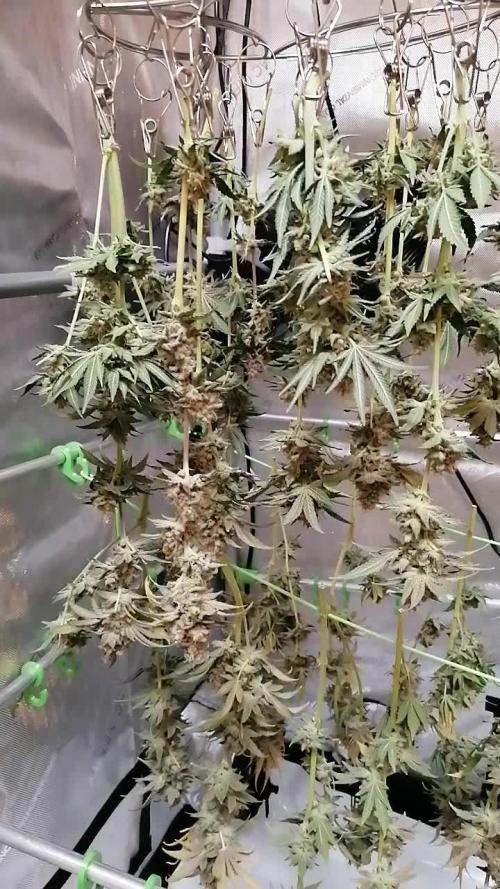
Can't wait to blazeeee Feeding💪 10/17 Water30L+Cleanse80ml+calmag@190ppm Ph6.3 Ebb 10.42/11.32/12.26/13 Clone 11.35/12.21/13.05/14 Average runoff ec1.5 Keeper 300ml per pot 10/18 Water26L+Flawless90ml+calmag@300ppm Ph6.3 Ebb 11.38/12.24/13.17 Average runoff ec1.2 ph6.5 Clone 12.38/13.56/15.20/16.10 Average runoff ec1.5 ppm750 10/19 Water26L+Cleanse80ml+calmag@200ppm Ph6.3 Ebb 11.12/11.48/12.24 Average runoff ec1.4 Clone 11.50/12.12/12.37/13.37/14.40 Average runoff ec1.3 ph6.6 10/20 Water30L+Cleanse30ml+Calmag@190ppm Ph6.4 Ebb11.42/12.22/13.20/14 Clone 12.40/13.20/14.20/14.45/15.15 Average runoff 1.2ec ph6.4-6.7 10/22 last light day 10/23 2 Pm Cut and hang Plan 21day at 23temp 55rh
Likes
17
Share
@olli0420
Follow
The roots look super healthy. I'm happy because I didn't use quality soil for germination 😬 I guess it worked because I used like 90% perlite and 10% poor quality soil which worked great for new little roots. So much so that they wanted to be repotted after 2 weeks😁 after the repot they looked very much happy 💚 I repotted with biobizz light mix soil and a lot of perlite,as much perlite as soil cause I'm afraid of root rot and it just works for me🖤 also I still haven't given any nutrients cause they don't seem to want them yet.
Likes
88
Share
Fatto leggera defogliazione giorno 45.Tra qualche giorno giro a 12/12 👍🖐️
Likes
76
Share
@Canna96
Follow
This week went good, she is still stretching and up to 36 inches tall. I switched over to flower nutrients and defoliated a handful of leaves. Just going to sit back and let her stack flowers. This is my first ever manifold so I am interested to see if this method can increase yield and/or decrease trim time. I should know here in a few weeks. Thanks for stopping by and blaze on!
Likes
5
Share
03/01 - Day 57 All the girls have their pistils changing colors, buds growing by the day, (B) has has very sweet aromas coming out, & (C) is more earthy and peppery. Still losing some fan leaves here and there on (A) & (D) from the Cal/Mag & Phosphorus defiance but nothing like 2 weeks ago. 03/05 - Day 61 Enjoying the process and maintaining the environment. Buds on (B), (C), & (D) are starting to get heavy. Maybe some foxtails starting on (C)??
Processing
Likes
13
Share
@GrowGuy97
Follow
Flower day 17 - All the ladies are looking great, starting to see a lot of bud sights & the smell is definitely getting stronger everyday I open the tent! Thanks for following & happy growing friends!🌱✌️🏼 Flower day 19- Got a bigger dehumidifier because I was having problems on days I would water the humidity would go through the roof at night so to prevent mold I bought a bigger dehumidifier but now it is throwing off so much heat the tent is pushing 90 degrees F at some points throughout the day so I’m not exactly sure how to fix the issue! Will definitely not be running so many plants in the next run for the 5x5! Hopefully things get better!😅😅
Likes
57
Share
Ladies and gentlemen, welcome to the grand finale of my Medusa F1 journey! Week 10 has arrived, and it's a spectacle of colors that even the most talented painters would envy. The buds on my Medusa are a visual feast, showcasing a symphony of pinks, purples, reds, and greens. It's like stepping into a surreal world of botanical beauty. As we approach the harvest, it's time to bid farewell to additional nutrients. Just like saving room for dessert after a sumptuous meal, we're allowing the plant to focus all its energy on maturing those magnificent buds. It's the VIP treatment, giving them the undivided attention they deserve. Now, let's talk trichomes, those tiny resinous wonders that hold the key to potency. I've become a trichome connoisseur, inspecting them daily with a fascination that could rival an alien investigator. These shimmering crystals are like a galaxy of diamonds, reflecting the culmination of our hard work and dedication. A special shoutout goes to Royal Queen Seeds for blessing us with the Medusa F1 genetics. They've truly crafted a masterpiece, and I'm honored to have been a part of this growing adventure. Thank you, Royal Queen Seeds, for making our dreams come true. As we approach the final curtain call, I invite you all to savor the beauty of cannabis cultivation. Embrace the vibrant colors, relish the trichome spectacle, and celebrate the magic of nature's artistry. As always thank you all for stopping by and for supporting me on this journey, i am super passion about growing and fell blessed to have you all with me on this new journey <3 <3 <3 Genetics - RQS MEDUSA F1 Ligth - LUMATEK ZEUS 465 COMPACT PRO 
Food - APTUS HOLLAND 
 
All info and full product details can be find in can find @ https://www.royalqueenseeds.com 

https://aptus-holland.com/
 
https://autopot.co.uk/ 

https://lumatek-lighting.com/ With true love comes happiness <3<3<3 Always believe in your self and always do things expecting nothing and with an open heart , be a giver and the universe will give back to you in ways you could not even imagine so <3<3<3 <3 <3 <3 Growers love to you all <3 <3 <3 Medusa F1 Medusa is a true F1 hybrid created from pure, inbred cannabis lines. She boasts uniform grow traits, mouthwatering aromas and flavours, and plenty of potency. If you're looking to bring stable, elongated plants into your room, tent, or garden, look no further. Mouthwatering Aromas, High Potency, and Mid-Size Plants Though she won't turn you to stone like the mythical goddess after which she's named, Medusa F1 is bound to get you plenty stoned in her own special way. Combining genetics from inbred lines deriving from Sugar Magnolia, a thick and sweet indica, and American Beauty, a fast, fruity hybrid loved for its well-balanced, positive high, the result is an autoflowering F1 variety that produces fresh flavours, a unique cannabinoid profile, and large yields. A very aromatic cultivar with a vibrant concentration of terpenes bearing notes of fresh mint alongside an upfront peppery kick, backed up by hints of fresh fruit, berries, and tangy fuel. Her thick, frosty flowers consistently produce high levels of THC and CBG, as well as high concentrations of myrcene, ocimene, farnesene, and caryophyllene. As a result, Medusa F1 has strong effects that relax and stone the body from head to toe (brought on by particularly high concentrations of myrcene and farnesene) while motivating the mind with an uplifting, creative, and motivating kick (thanks to high concentrations of ocimene). Medusa F1 seeds produce elongated autoflowering plants with long, strong branches and well-spaced internodes. Plants regularly grow up to 80–85cm tall and boast a fast flowering time of just 42–45 days (72 days from germination to harvest). Thanks to her genetics, Medusa F1 produces plenty of thick flowers with big, swollen calyxes that make for very easy trimming. Medusa F1 is very stable, handling stress and unfavourable growing conditions with ease, though she is somewhat susceptible to Botrytis, so make sure to keep tabs on the humidity in your grow room/garden
Likes
27
Share
I’m overjoyed with the phenos this strain is producing, strong vibrant purples with some serious flavour profiles! Scent Profiles we have: Candy Lemon Sherbet 🍬🍋 Sweet & Piney Diesel 🍭🌲⛽️ Sweet & Tangy Tropical Punch 🏝️🥊 Alongside this, these beauties are the frostiest and the most insanely dense koala looking nugs I’ve ever produced!
Likes
1
Share
Día de corte para la gran berta... No hice ningún flush por qué quiero probar la diferencia entre flush y no flush Quedan algunos cogollos abajo que falta formarse
Likes
5
Share
@Nemessis
Follow
Calmag enter this week, the fruit are more big. Next week im gonna enter the PK from Aptus. One of my plants has a magnesium deficiency I think, I hope that with the calmag it will be fine. The smells are already magnificent, the Glookie looks like a packet of candy! The fruits will start to grow nicely by the weekend with the high PK intake