


Likes
Comments
Share


@Roberts
Follow
Purple Ryder auto is growing great under the Medic Grow Mini Sun-2, in the Agrogardens nutrition. She has a great canopy full of budding sites. She is starting to develop a aroma as well. Everything is looking really good, and she is ready for another week. Thank you Medic Grow, Agrogardens, and Doctors choice. 🤜🏻🤛🏻🌱🌱🌱
Thank you grow diaries community for the 👇likes👇, follows, comments, and subscriptions on my YouTube channel👇. ❄️🌱🍻
Happy Growing 🌱🌱🌱
https://youtube.com/channel/UCAhN7yRzWLpcaRHhMIQ7X4g

Likes
28
Share


@TheHighentist
Follow
Start of week 5...
Looking back at the first few weeks of veg, i never imagined that they would thrive this good in week 5 already!
(Look back at week 1+2 for horror pictures)
Whole of week 4 i worked on my climate control automation.
I will keep the set up for atleast a week.
👽👉26/9
Big LST day. I got new supplies to manage the rest of the ladies properly.
Topped another one ( 5/6 is topped)
Cut just a couple of leaves. The crusty ones that did not receive light and the ones casting shadows over my lovely budsights.
👽👉27/9 Waterday* and recovery
2ml/L Bio heaven + fish mix / 6.4 PH 1.68 ECLetting them recover
Humidity a bit higher during night because of watering, turned the temp up to match the VPD.
👽👉28/9 They look content, humidity a bit higher during night because of watering.
👽👉29/9 I am happy how you thrive, but they need some pruning/defoliation as soon as they have recovered from the stress training.
👽👉30/9 Did some defoliation, decided to flip to flower after their recovery.
👽👉1/10 They had a case of empty humidifier, resulting in high vpd for 7hours.
Water day*
2.1xml/L Bio heaven + fish mix / 6.2 PH 1.75 EC
👽👉2/10 They look great, healthy and happy! Climate is back on point
Likes
3
Share


@Weedzoks
Follow
Welcome everyone
Here is the diaries of a friend, this is his first culture.
He chose for this session five Hulkberry from Royal Queen Seeds, a BubbleGum offered by Zamnesia, as well as a Big Bang Auto from GreenHouseSeeds.
All these ladies are under HPS 600W, 150cm square area.
Here we go!


Likes
19
Share


@JeyGanesha
Follow
Gente questa weddin cake auto,della korngarden mi sta stupendo giorni per giorno.lei che è nata con 3 cotiledoni ed in più l'ho anche travasato,(cosa che non faccio mai con le auto) sta venendo su bene💪😜vedremo a fine ciclo


Processing
Likes
13
Share


@Trailblazers_Farm
Follow
Week Two:
The seedlings received their first and second feedings of Innovating Plant Products. Along with one just a plain watering. (Feed / Feed / Water).
The first feeding was on 5/21 of 900 ppm of the veg nutrient line. The pH was 6.3
The second feeding was on 5/24 of 700 ppm of the veg nutrient line. The was 6.4 After assessing the first feeding it was felt the PPM was a bit high for their first feeding. We could have easily done this in reverse order.
On 5/26 the plants were given just plain water to finish out their week.
One of the seedlings appeared to be a bit deformed and has since been tossed. This one seed didn't germinate well, but we thought we would give it go. Assessing the seedling we simply opted to pull it.


Likes
2
Share


@TowersD
Follow
In the beggining of week 4 of flower the phenos are showing differences.
Nanaz x BBC are way toller that the Headbands.
Also, Nanaz x BBC #2 has no pistils but it is a female plant. I have that happened before when I grew the Banana Butter Cups S1

Likes
10
Share


@HideAndFly420
Follow
Day 64 my baby is going really well by now, she s been running fast until now and I think that’s enough with fertiliser. From today o start my flush, I will give today my last dose of regulator and from next irrigation just on controlled water until the end of maturation, I want this baby to eat everything .
day 65 started flushing. ph controlled water at 6.0 i think 20 more days at max before m
Day 68 First check with micro today. The baby looks already milky and amber on the top buds but the rest of the plant is still transparent. I’ll wait at least until this weekend for a re check maybe I’ll cut her in two rounds. As I be been watching a lot with micro I noticed so many dust and other stuff on the buds so I think I’ll wash her in water.
Today watered ph 6.
Let’s see!
🌱🔥🌱🔥🌱🔥🔥
Likes
3
Share


@Green_Dream
Follow
It's been a pretty good week. I did quite a big defoliation, as things were getting crowded. She has a nice flowery smell!
I switched to a more flowering dominant feeding, I decreased the Nitrogen and pumped up the phosphorus and potassium.
I will soon do a flush, as it looks like the nuts are starting to accumulate at the roots.


Likes
6
Share


@IamCy
Follow
Week 3. This is where the fun begins. The smell is amazing.
The stretch is crazy and the stems are stiff like bamboo. There's no loss in terps. They're actually getting a lot stronger!!
Likes
18
Share


@Stonyways
Follow
2/11/21 time to flush
HAPPY GROWING!
2/13/21. lol this grow may finish in another month, straight water and chill.
I bought the carbon filter earlier in the grow and I know it's helping BUT the KUSH scent is seeping out of the many pinholes in this mars tent and now I am in the candle business ...I have a AC INFINITY T6 ordered but I am thinking of holding back until a more reliable tent is here.
Enjoy the weekend!
Plants coming along..
Likes
12
Share


@Donbehzad
Follow
I tried defoliating two days ago but just the leaves that are underneath and started to bend toward the soil, 1-2 leaves per plant not that serious defoliating because its an autoflower and I won’t stress it to much. I did another defoliating an hour ago, 1 leaf per plant again just those trap inside the bottom part. Low stress training still on going but no new tie, i’ll try to leave it like that until the end i’ll just tuck the leaves blocking the developing pistils.
I noticed that out of 3 plants, 1 is taller and bushier than the rest. Looks like the other two stunned their growth or just slow in growth. Seriously I don’t have an idea same nutrient and care are given to all plants.
I feed them twice a week every 3-4 days, no negative reactions or whatnot. Nutrients adjusted in this week. Same temperature and humidity level as last week, keeping an eye daily to adjust if its not in desire level.

Likes
42
Share


@Ukfarmer420
Follow
Hi guys entering week 7 veg on the scrog grow of strawberry chemdawg og and blackberry moonrocks under the marshydro sp3000.
There very small considering there on week 7 🤔 but now i realised that my light has been on 25% 🤣🤣🤣 now its on 50% until nov 1st when I flip it.


Likes
Comments
Share

@BruWeed
Follow
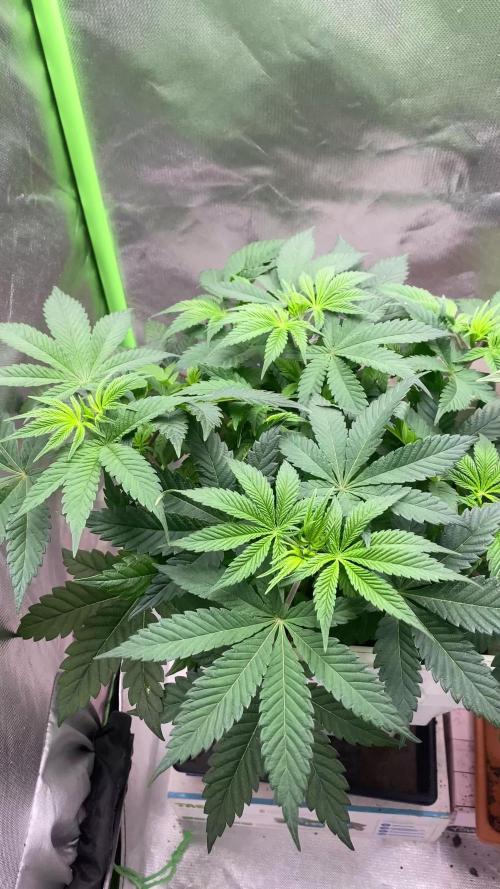
02/05 - Comienza su quinta semana en etapa de crecimiento y última.
Se encuentra hermosa, las chalas estan todas perfectas sin ningún problema.
La proxima semana ya entra en floración.
El corte apical me ayudo mucho para que no crezca tanto en altura.
Por el momento viene todo bien, sin ningún problema.
En estos dias estaré publicando mas imagenes de como viene.
Podes seguirme en Instagram como @bruweed_


Likes
10
Share


@HanfHueter
Follow
Blüten werden inzwischen sehr Harzig und der Duft nimmt zu.
Dem Giesswasser wird täglich 1:10 Jauche zugegen. Zu dem jedes zweite Gießen Pro Sugar von Grow Pro ein Kohlenhydrat Blütedünger(von der Mary Jane ein Tester). Zu dem gibt es ein bis zweimal in der Woche Seafeed Xtra von envii.
Die ersten Blätter haben sich unten entfernt daher gebe ich gerade wieder Stickstoff zu den Pflanzen. Auch wenn es nur noch diese Woche war danach nur noch Blütedünger.
Zu dem habe ich Basilikum gepflanzt, Dill, Ringelblume und Koriander gesäat am Anfang der Woche und zum Ende noch Lupine und Rot Klee.
Likes
4
Share


@The_Projexx
Follow
Welcome to week 5 of flower for this lovely project! The ladies should start to put on some serious weight over the coming weeks as I've noticed most plants are done their stretch now (except macmelonz). We got lots of crazy smells coming from these plants some are harder to tell then others but some are extremely pleasing smelling already. Banana Smoothie is really putting off that banana cream smell accompanied by berries as an undertone. Creamy Cereal Crunch smells like Fruit loops and milk , its very unique and very pleasing if your into cereal anyways haha. Over all excited to see what this week will bring!
Huge shout out to @MarsHydroLED for making such cool lights and tents that really make growing a breeze.
Huge shout out to all my followers and people who stop into the diary alike , keep on inspiring to grow!
-The Projexx
Day#29F Ladies are starting to display some bulking up.
Day#30F Pictures N/A. Plants seem to be stretching a bit more but concentrating on bulking up flowers. Some really nice smells coming out.
Day#31F Macmelonz is still stretching along but stacking hard and the rest are starting to put on noticeable weight.
Day#32F Ladies are grooving along nicely, going to look to trim up some of the middle allow for more air flow to the plants.
Day#33F Banana Smoothie #1 and #4 are really starting to put out Banana Cream aromas its quite intense now.
Day#34F The canopy deff needs a light defoliation. Going to defoliate slowly but surely over the coming weeks.
Day#35F Pictures N/A. Ladies are really thirsty going to be upping the water next feed. Flowers are bulking like crazy!
Recap: Things have gone really well this week, everyone's bulking like crazy and macmelonz who stretching out is still stacking like crazy. Lots of interesting and exciting aromas from the plants, I hope they taste as good as they smell! Over all very pleased with the performance of the plants its going to be exciting to watch them grow over the coming weeks!
Likes
25
Share


@Rob691
Follow
D-37 : Done the third topping, but I broke one of the branch of the most healthy Desfran :( I'm very sad about that so I will try to do a fourth topping to have the good amount of flowers. The others are going well !
D-43 : Everything still ok ! The LST is almost over, and I think I'll turn to flowering mode winthin 10 days max.
