The Grow Awards 2026 🏆
Likes
Comments
Share
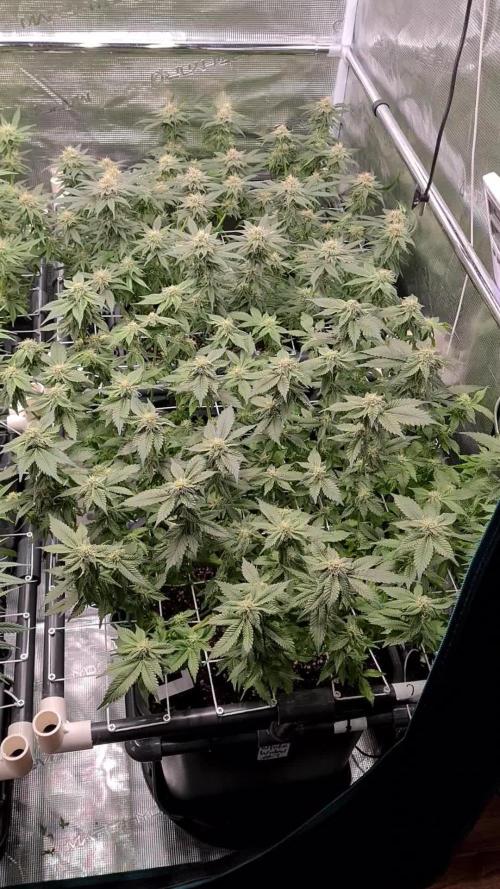
Vegetation: To keep temperature and moisture on optimal levels at around 23°C / 65% I'm using two mechanical timers. - 24/7 on: Fans and water pumps (+Ventilation after 3.11.) - Timer 1: Lights and Humidifier 18h on / 6h off - Timer 2 (BROKEN 3.11.): Ventilation 18h (15min on / 15min off) / 6h off NOTES: Everything looks good and the roots have appeared from almost every (11/13) rock-wool cube. From now on I'll mostly water the plants from bottom by adding the wanted amount of nutrient solution on a plate, and then placing the plant on top of for ~15seconds This week I'm also starting to prepare the hydroponic systems (2x NFT-GT90, and 1x EBB-flow I think) and stronger nutrient solution since my plants are becoming ready to be transferred. Spreader-mat is the base of my plants when I have transferred them in to the hydroponic systems. DO NOT place more than one layer of the spreader-mat as it is not meant to be used like that! As you're cutting the mat for NFT's, be aware to have some extra for your peace to reach nutrient solution below the tray. That way you won't get noise from water dropping when systems are turned on. Day 15 (1.11.) Day 16 (2.11.) First watering with a bit stronger nutrient-solution (~ EC 0,6 / pH 5,9) than before, starting with 50ml/plant and watering once from above. Slowly increasing EC to 0,8. I cleaned and assembled 2 out of 3 hydroponic-systems which I'm going to use. I'll do the same also to the last system, but it currently has my plants on top of it so I'm going to do it later. I want to make sure that my plants have built healthy and big enough root system before transplanting to hydroponics. I'm waiting for the rock-wool cubes to be bursting of roots so they won't drown on their first day in hydro. Also, as the plants are bigger before the transplant, I'm able to fill my nutrient-solution tanks full with correct strength nutrient-solution for Mid-Vegetation from the start, therefore no need for that much adjusting later on. Day 17 (3.11.) I noticed my other timer which controls the lights had stopped working... The lights were on when they shouldn't have been, I noticed it an hour after they were supposed to turn off. I think I caught up to it early, but it may have been on for maximum of 2 days straight. No worries there since on vegetation-phase the plants don't necessarily need any sleep (Even though you should avoid quick changes like that!). Roots have appeared from the bottom of every cube and plants are looking pretty healthy. I think they are almost ready for hydroponics. Day 18 (4.11.) Few plants are showing symptoms of nutrient deficiences or some sort of sickness, not certain what exactly. I'll be keeping an eye on it. I'll be transferring in to hydroponic systems in maybe a week, so I don't want to stress my plants more than what's necessary. Increased my solution strength to 0,9 EC with a bit more Cal-Mag than before, and watered the plants for 50-150ml each plant depending on weight and size. I'll be slowly increasing the strength by around 50% during upcoming week. Thanks for tips! Day 19 (5.11.) Day 20 (6.11.) Plants are recovering well from deficiences and I just transferred all of them to hydroponics. I don't have the water pumps on for 24/7 just yet, at this point I water them a couple times a day by keeping the pumps on for somewhere around 15min at a time. Lights are now set to 60% and I also added a tower fan to circulate the air and shake the plants. Day 21 (7.11.) Lights are now set to 70% since the Led's and plants are spreaded wider in the tent than before. Distance to plants stays the same at 75cm.
Likes
4
Share
19/09/2025 19:15 Very good climate this week,finally buds are bumping and showing some frostyness Almost at the 12/12 light cycle now,days will be soon shorter and croptober Is near Pic #1 and #2 Coco Milk and Coco fresh before defoliation and Lollipopping Pic #3 video #2 and#3 Coco Milk 62 days from seed Heavy defoliation on this one pretty impressive,there Is a lot of leaves,but i wanted to do from the start because this time i didn't top like i use to Buds have already a good flavour not so strong but sure It will be Pic #4 video #4 Coco fresh 50 days from seed Defoliated less because It was dark,next time i will cut the rest but not as much as the Coco Milk Flowers now forming but they are very small,i think this could be the last plant to harvest Video #1 Apricot auto 58 days from seed Buds now stacking this could be one of the fastest autoflower but also the one with the lower yield since the very first one Smell Is just like rotten fruit,awesome At the end there Is what i left of the gorilla z,those buds seems to flower Forever Video #5 21/09/2025 gorilla z joint While the gorilla z and the frostbanger are still hanging in the dark at 20°C 48%rh,the bud i took more than a week ago Is fully crisp and ready to be tested Nice smoke not so flavourful but clean,ash looks pretty clean too,i hope with a proper cure It will be Better High is not so strong on the body initially,only after some minutes tou can fell the body slowly relax Next week it will be probably rainy as hell,maybe i will be back at the end of September
Likes
20
Share
@MrWolfe
Follow
So this round I just lollipopped and didn’t strip the top at all, with better veg next round it’ll work better but I’m having issues with some plants not quite trellised how I’d like. Everything smells great, BCS,BD and WM are getting fat and PKB is frosty and tight. Watering is more of a chore than I’d like I think I’m just going to use some 5s for the next round . Thanks for following along I hope your buds are fat and frosty.
Processing
Likes
68
Share
hello some news on vegetation day 22, start the bio grow, and bend the four Lateral head, and crap when i bend a stem has cracked but she is not cut I straighten them with a piece of iron she can go back. 😀👍
Likes
29
Share
Feed Was MAde EC = 1.2 and ph'd to 6.2. Temp 21c .......... Put Into 12/12 flower :)
Likes
9
Share
@AlphaNoob
Follow
Pistils changing color no idea how longs left now but would assume Atleast 2 weeks
Likes
8
Share
🌿 Week 11 – Harvest! (Day 77) Harvest time for my Tropicana Cookies Auto — 77 days from seed to chop. Instead of giving her 24–48 hours of darkness, I decided to harvest right in the middle of her light cycle to preserve maximum THC and terpene content while the resin was at its peak. Trichomes were mostly cloudy with a few amber — exactly where I wanted them. The buds came out dense and sticky with a deep citrus aroma and colorful hues. Final wet weight: 300g, expecting around 60–75g dry after a slow cure. She’s currently drying on mesh racks in a dark, ventilated space with ~21°C and 55–60% RH. I’ll jar her up once the stems snap clean. This was a compact but resin-heavy pheno — rich in terpenes and easy to grow. Really happy with how she turned out. Thanks for following the grow — time to cure and enjoy the results! 🔥🌱
Likes
25
Share
ANTHOCYANIN production is primarily controlled by the Cryptochrome (CR1) Photoreceptor ( !! UV and Blue Spectrums are primary drivers in the production of the pigment that replaces chlorophyll, isn't that awesome! 1. Diverse photoreceptors in plants Many civilizations, including the sun god of ancient Egypt, thought that the blessings of sunlight were the source of life. In fact, the survival of all life, including humans, is supported by the photosynthesis of plants that capture solar energy. Plants that perform photosynthesis have no means of transportation except for some algae. Therefore, it is necessary to monitor various changes in the external environment and respond appropriately to the place to survive. Among various environmental information, light is especially important information for plants that perform photosynthesis. In the process of evolution, plants acquired phytochrome, which mainly receives light in the red light region, and multiple blue light receptors, including his hytropin and phototropin, in order to sense the light environment. .. In addition to these, an ultraviolet light receptor named UVR8 was recently discovered. The latest image of the molecular structure and function of these various plant photoreceptors (Fig. 1), focusing on phytochrome and phototropin. Figure 1 Ultraviolet-visible absorption spectra of phytochrome, cryptochrome, phototropin, and UVR8. The dashed line represents each bioactive absorption spectrum. 2. Phytochrome; red-far red photoreversible molecular switch What is phytochrome? Phytochrome is a photochromic photoreceptor, and has two absorption types, a red light absorption type Pr (absorption maximum wavelength of about 665 nm) and a far-red light absorption type Pfr (730 nm). Reversible light conversion between the two by red light and far-red light, respectively(Fig. 1A, solid line and broken line). In general, Pfr is the active form that causes a physiological response. With some exceptions, phytochrome can be said to function as a photoreversible molecular switch. The background of the discovery is as follows. There are some types of plants that require light for germination (light seed germination). From that study, it was found that germination was induced by red light, the effect was inhibited by subsequent far-red light irradiation, and this could be repeated, and the existence of photoreceptors that reversibly photoconvert was predicted. In 1959, its existence was confirmed by the absorption spectrum measurement of the yellow sprout tissue, and it was named phytochrome. Why does the plant have a sensor to distinguish between such red light and far-red light? There is no big difference between the red and far-red light regions in the open-field spectrum of sunlight, but the proportion of red light is greatly reduced due to the absorption of chloroplasts in the shade of plants. Similar changes in light quality occur in the evening sunlight. Plants perceive this difference in light quality as the ratio of Pr and Pfr, recognize the light environment, and respond to it. Subsequent studies have revealed that it is responsible for various photomorphogenic reactions such as photoperiodic flowering induction, shade repellent, and deyellowing (greening). Furthermore, with the introduction of the model plant Arabidopsis thaliana (At) and the development of molecular biological analysis methods, research has progressed dramatically, and his five types of phytochromes (phyA-E) are present in Arabidopsis thaliana. all right. With the progress of the genome project, Fi’s tochrome-like photoreceptors were found in cyanobacteria, a photosynthetic prokaryotes other than plants. Furthermore, in non-photosynthetic bacteria, a homologue molecule called bacteriophytochrome photoreceptor (BphP) was found in Pseudomonas aeruginosa (Pa) and radiation-resistant bacteria (Deinococcus radiodurans, Dr). Domain structure of phytochrome molecule Phytochrome molecule can be roughly divided into N-terminal side and C-terminal side region. PAS (Per / Arndt / Sim: blue), GAF (cGMP phosphodiesterase / adenylyl cyclase / FhlA: green), PHY (phyto-chrome: purple) 3 in the N-terminal region of plant phytochrome (Fig. 2A) There are two domains and an N-terminal extension region (NTE: dark blue), and phytochromobilin (PΦB), which is one of the ring-opening tetrapyrroles, is thioether-bonded to the system stored in GAF as a chromophore. ing. PAS is a domain involved in the interaction between signal transduction-related proteins, and PHY is a phytochrome-specific domain. There are two PASs and her histidine kinase-related (HKR) domain (red) in the C-terminal region, but the histidine essential for kinase activity is not conserved. 3. Phototropin; photosynthetic efficiency optimized blue light receptor What is phototropin? Charles Darwin, who is famous for his theory of evolution, wrote in his book “The power of move-ment in plants” published in 1882 that plants bend toward blue light. Approximately 100 years later, the protein nph1 (nonphoto-tropic hypocotyl 1) encoded by one of the causative genes of Arabidopsis mutants causing phototropic abnormalities was identified as a blue photoreceptor. Later, another isotype npl1 was found and renamed phototropin 1 (phot1) and 2 (phot2), respectively. In addition to phototropism, phototropin is damaged by chloroplast photolocalization (chloroplasts move through the epidermal cells of the leaves and gather on the cell surface under appropriate light intensity for photosynthesis. As a photoreceptor for reactions such as escaping to the side of cells under dangerous strong light) and stomata (reactions that open stomata to optimize the uptake of carbon dioxide, which is the rate-determining process of photosynthetic reactions). It became clear that it worked. In this way, phototropin can be said to be a blue light receptor responsible for optimizing photosynthetic efficiency. Domain structure and LOV photoreaction of phototropin molecule Phototropin molecule has two photoreceptive domains (LOV1 and LOV2) called LOV (Light-Oxygen-Voltage sensing) on the N-terminal side, and serine / on the C-terminal side. It is a protein kinase that forms threonine kinase (STK) (Fig. 4Aa) and whose activity is regulated by light. LOV is one molecule as a chromophore, he binds FMN (flavin mononucleotide) non-covalently. The LOV forms an α/βfold, and the FMN is located on a β-sheet consisting of five antiparallel β-strands (Fig. 4B). The FMN in the ground state LOV shows the absorption spectrum of a typical oxidized flavin protein with a triplet oscillation structure and an absorption maximum wavelength of 450 nm, and is called D450 (Fig. 1C and Fig. 4E). After being excited to the singlet excited state by blue light, the FMN shifts to the triplet excited state (L660t *) due to intersystem crossing, and then the C4 (Fig. 4C) of the isoaroxazine ring of the FMN is conserved in the vicinity. It forms a transient accretionary prism with the tain (red part in Fig. 4B Eα) (S390I). When this cysteine is replaced with alanine (C / A substitution), the addition reaction does not occur. The effect of adduct formation propagates to the protein moiety, causing kinase activation (S390II). After that, the formed cysteine-flavin adduct spontaneously dissociates and returns to the original D450 (Fig. 4E, dark regression reaction). Phototropin kinase activity control mechanism by LOV2 Why does phototropin have two LOVs? Atphot1 was found as a protein that is rapidly autophosphorylated when irradiated with blue light. The effect of the above C / A substitution on this self-phosphorylation reaction and phototropism was investigated, and LOV2 is the main photomolecular switch in both self-phosphorylation and phototropism. It turns out that it functions as. After that, from experiments using artificial substrates, STK has a constitutive activity, LOV2 functions as an inhibitory domain of this activity, and the inhibition is eliminated by photoreaction, while LOV1 is kinase light. It was shown to modify the photosensitivity of the activation reaction. In addition to this, LOV1 was found to act as a dimerization site from the crystal structure and his SAXS. What kind of molecular mechanism does LOV2 use to photoregulate kinase activity? The following two modules play important roles in this intramolecular signal transduction. Figure 4 (A) Domain structure of LOV photoreceptors. a: Phototropin b: Neochrome c: FKF1 family protein d: Aureochrome (B) Crystal structure of auto barley phot1 LOV2. (C) Structure of FMN isoaroxazine ring. (D) Schematic diagram of the functional domain and module of Arabidopsis thaliana phot1. L, A’α, and Jα represent linker, A’α helix, and Jα helix, respectively. (E) LOV photoreaction. (F) Molecular structure model (mesh) of the LOV2-STK sample (black line) containing A’α of phot2 obtained based on SAXS under dark (top) and under bright (bottom). The yellow, red, and green space-filled models represent the crystal structures of LOV2-Jα, protein kinase A N-lobe, and C-robe, respectively, and black represents FMN. See the text for details. 1) Jα. LOV2 C of oat phot1-to α immediately after the terminus Rix (Jα) is present (Fig. 4D), which interacts with the β-sheet (Fig. 4B) that forms the FMN-bound scaffold of LOV2 in the dark, but unfolds and dissociates from the β-sheet with photoreaction. It was shown by NMR that it does. According to the crystal structure of LOV2-Jα, this Jα is located on the back surface of the β sheet and mainly has a hydrophobic interaction. The formation of S390II causes twisting of the isoaroxazine ring and protonation of N5 (Fig. 4C). As a result, the glutamine side chain present on his Iβ strand (Fig. 4B) in the β-sheet rotates to form a hydrogen bond with this protonated N5. Jα interacts with this his Iβ strand, and these changes are thought to cause the unfold-ing of Jα and dissociation from the β-sheet described above. Experiments such as amino acid substitution of Iβ strands revealed that kinases exhibit constitutive activity when this interaction is eliminated, and that Jα plays an important role in photoactivation of kinases. 2) A’α / Aβ gap. Recently, several results have been reported showing the involvement of amino acids near the A’α helix (Fig. 4D) located upstream of the N-terminal of LOV2 in kinase photoactivation. Therefore, he investigated the role of this A’α and its neighboring amino acids in kinase photoactivation, photoreaction, and Jα structural change for Atphot1. The LOV2-STK polypeptide (Fig. 4D, underlined in black) was used as a photocontrollable kinase for kinase activity analysis. As a result, it was found that the photoactivation of the kinase was abolished when amino acid substitution was introduced into the A’α / Aβ gap between A’α and Aβ of the LOV2 core. Interestingly, he had no effect on the structural changes in Jα examined on the peptide map due to the photoreaction of LOV2 or trypsin degradation. Therefore, the A’α / Aβ gap is considered to play an important role in intramolecular signal transduction after Jα. Structural changes detected by SAXS Structural changes of Jα have been detected by various biophysical methods other than NMR, but structural information on samples including up to STK is reported only by his results to his SAXS. Not. The SAXS measurement of the Atphot2 LOV2-STK polypeptide showed that the radius of inertia increased from 32.4 Å to 34.8 Å, and the molecular model (Fig. 4F) obtained by the ab initio modeling software GASBOR is that of LOV2 and STK. It was shown that the N lobes and C lobes lined up in tandem, and the relative position of LOV2 with respect to STK shifted by about 13 Å under light irradiation. The difference in the molecular model between the two is considered to reflect the structural changes that occur in the Jα and A’α / Aβ gaps mentioned above. Two phototropins with different photosensitivity In the phototropic reaction of Arabidopsis Arabidopsis, Arabidopsis responds to a very wide range of light intensities from 10–4 to 102 μmol photon / sec / m2. At that time, phot1 functions as an optical sensor in a wide range from low light to strong light, while phot2 reacts with light stronger than 1 μmol photon / sec / m2. What is the origin of these differences? As is well known, animal photoreceptors have a high photosensitivity due to the abundance of rhodopsin and the presence of biochemical amplification mechanisms. The exact abundance of phot1 and phot2 in vivo is unknown, but interesting results have been obtained in terms of amplification. The light intensity dependence of the photoactivation of the LOV2-STK polypeptide used in the above kinase analysis was investigated. It was found that phot1 was about 10 times more photosensitive than phot2. On the other hand, when the photochemical reactions of both were examined, it was found that the rate of the dark return reaction of phot1 was about 10 times slower than that of phot2. This result indicates that the longer the lifetime of S390II, which is in the kinase-activated state, the higher the photosensitivity of kinase activation. This correlation was further confirmed by extending the lifespan of her S390II with amino acid substitutions. This alone cannot explain the widespread differences in photosensitivity between phot1 and phot2, but it may explain some of them. Furthermore, it is necessary to investigate in detail protein modifications such as phosphorylation and the effects of phot interacting factors on photosensitivity. Other LOV photoreceptors Among fern plants and green algae, phytochrome ɾphotosensory module (PSM) on the N-terminal side and chimera photoreceptor with full-length phototropin on the C-terminal side, neochrome (Fig. There are types with 4Ab). It has been reported that some neochromes play a role in chloroplast photolocalization as a red light receiver. It is considered that fern plants have such a chimera photoreceptor in order to survive in a habitat such as undergrowth in a jungle where only red light reaches. In addition to this, plants have only one LOV domain, and three proteins involved in the degradation of photomorphogenesis-related proteins, FKF1 (Flavin-binding, Kelch repeat, F-box 1, ZTL (ZEITLUPE)), LKP2 ( There are LOV Kelch Protein2) (Fig. 4Ac) and aureochrome (Fig. 4Ad), which has a bZip domain on the N-terminal side of LOV and functions as a gene transcription factor. 4. Cryptochrome and UVR8 Cryptochrome is one of the blue photoreceptors and forms a superfamily with the DNA photoreceptor photolyase. It has FAD (flavin adenine dinucle-otide) as a chromophore and tetrahydrofolic acid, which is a condensing pigment. The ground state of FAD is considered to be the oxidized type, and the radical type (broken line in Fig. 1B) generated by blue light irradiation is considered to be the signaling state. The radical type also absorbs in the green to orange light region, and may widen the wavelength region of the plant morphogenesis reaction spectrum. Cryptochrome uses blue light to control physiological functions similar to phytochrome. It was identified as a photoreceptor from one of the causative genes of UVR8 Arabidopsis thaliana, and the chromophore is absorbed in the UVB region by a Trp triad consisting of three tryptophans (Fig. 1D). It is involved in the biosynthesis of flavonoids and anthocyanins that function as UV scavengers in plants. Conclusion It is thought that plants have acquired various photoreceptors necessary for their survival during a long evolutionary process. The photoreceptors that cover the existing far-red light to UVB mentioned here are considered to be some of them. More and more diverse photoreceptor genes are conserved in cyanobacteria and marine plankton. By examining these, it is thought that the understanding of plant photoreceptors will be further deepened.
Likes
36
Share
Day 42 - Nutes mixed and fed - Have a bug to remove - awaiting Petratools Fogger - Preflower is happening now - Vibe: 😅 Day 44 - Ladies looking a bit droopy and sad - Nutes given - Most likely week 1 of flower for Gorilla Cookies and Wiz Stash Remix - Vibe: 🍃😩🤞🏽🙏🏽 Day 46 - After advice provided from @GrowingGrannie & Others, I watered with purpose - The really sad Gorilla Cookies took the most water, and was in fact dried out - Did not see praying for at least 24hrs, but did eventually see praying in the top portion - As well as lifting of the lower leaves from a curled position to a straighter position - Vibe: 😰 - Readings -- Lights 24/0 - Level 9 -- Temp: 70 (ideal) | 66.9 (avg) -- Humidity: 55% | 53.4% -- VPD: 0.8 | 1.03 kPa - Vibe: 😳 "Persistence and resilience only come from having been given the chance to work though difficult problems." — Gever Tulley
Likes
23
Share
Esta semana más de lo mismo aunque aún no ha terminado...jeje, le tuve que quitar el poso de café xq se le puso una pelusilla un tanto sospechosa(y mejor prevenir que curar ☝️)voy a hacerle un té de hummus, al volver el último fin de semana la he visto con los colores ligeramente más claros en algunas hojas(no sé si falta de nitrógeno o si es un problema de Ph)🤔, estoy planteandome poner mas luz y poner ventilación,🧐 al final de esta semana además quizá empiece a oler a ortiga en la habitación (ojalá 🎃☝️🕺) 🙌👌Quiero que crezca como la levadura!!!!🌵😋
Likes
18
Share
@Chubbs
Follow
Weekly update on these absolutely gorgeous girls. I was gone for the beginning of the week and came back today and I swear the flowers have doubled in size. They're smelling super strong and gassy. The flowers are dense as rocks so I hope with the summer heats they'll stay that way and not become airy. All in all Happy Growing.
Likes
23
Share
She’s getting frosty and dank 👃🍪🍊🍓🍰🍌🍒🍇🍭👃 Day 29 almost half way , happy with all the phenos so far all frosty so many terps .. started feed the canna nutrients plants canna pk1314 .. 2 flush’s Got the remo plants all most on the proper Ec again
Likes
7
Share
Bud looks beautiful, smells like a combo of grape, skunk and a hit of fresh mellons. After drying for 10 days I trimmed her up. Very strong grape smell, dense, sugary rock hard buds. Definitely plan on growing again.
Likes
14
Share
Week 1: Transition to Flowering Welcome to the fifth weekly update of our cannabis cultivation journey in Germany! As we transition from the vegetative stage to the flowering stage, our strains—Pulp Friction, Cookies Haze, Eleven Roses, Poddy Mouth, Critical Lemon Kush, and OG Kush—are ready for the next phase of their growth. Before entering the flowering stage, we took a few important steps to prepare the plants for optimal flowering. Key Developments: 1. Pre-Flowering Preparation: - The plants were defoliated to remove excess leaves and improve light penetration and airflow. - Each plant was repositioned to ensure they have ample space and light exposure. 2. Growing Medium and Setup: - The plants are grown in a mix of living soil, coco coir, perlite, and clay pebbles. - The soil mix includes mycorrhizal fungi cultures to support healthy root development. 3. Watering and Nutrient System: - The plants are watered from the bottom using an AutoPot system, which provides a consistent supply of nutrient solution. - The pots are equipped with air domes connected to an air pump, delivering oxygen directly to the roots to enhance growth. Steps Taken: 1. Defoliation and Positioning: - Carefully removed excess fan leaves to improve light distribution and airflow within the canopy. - Repositioned the plants to ensure each one has enough space to grow and receive adequate light. 2. Watering and Nutrient Management: - Set up the AutoPot system to supply a balanced nutrient solution to the plants. - Ensured the nutrient solution is appropriate for the flowering stage, with a focus on supporting bud development. 3. Air Domes and Oxygenation: - Connected the air domes to an air pump to deliver oxygen to the root zone. - Monitored the air pump to ensure consistent oxygen flow to the roots. Next Steps: - Monitor the plants closely for signs of flowering and adjust the light cycle to 12 hours on and 12 hours off to initiate and support flowering. - Continue to observe the plants for any signs of nutrient deficiencies or excesses and adjust the feeding regimen as needed. - Ensure the AutoPot system and air domes are functioning properly to maintain optimal hydration and oxygenation. Stay tuned for next week’s update, where we’ll discuss the progress of the first week of flowering and any adjustments made to the care routine. Feel free to ask any questions or share your own experiences in the comments below!
Likes
10
Share
@Prop207
Follow
15 cm 15 sb 30 PBPB K2 clones going into flower next week. K3 clones clipped 3-13-21. Last run for Khalifa
Likes
101
Share
@WhiteEdge
Follow
26.03.2024 Continue into week 4 Update firmware on TrolMaster Tent-X (3.6) Replace all filters, remove and clean drain buckets and tubing. Mix new batch with 56ml AN connoisseur AB + 4.5g Big Bud Powder + 7.5ml Silica - total 30l @ 1.34EC. NPK Ratio is 1-2-3 , Cal/Mg ratio is 4-1.5 Target EC for this week is 1.2 start and end week with 1.3. Checking plants will determine timing of strength Donne one pass off long misting (3min) with diluted solution @ 0.84@C Set new misting time @ 60s ON time Finally have time for managing canopy, pull down taller branches and position all tops to fit under screen without touching. Try ro spread them evenly across the net, top per square of net Defoliating all girls, remove all fan leaves and prune lots of smaller branches from middle. Lot of foliage is removed! After stripping humidity drop significantly (41%) , need to install humidifier again to keep RH @ 50-52% Set dehumidifier thermostat to work @ 50% RH. Reduced light intensity for this day, let girls recover from stress PAR map 1150max/650min PPFD, VPD -1.2-1.3, DRH 50-54%, NRH 45-49%, NT-20-21c, DT-24/25.5c, Leaf temperature 22-23c, Light distance 45-55cm, CO2 700+ppm HLG Scorpion Diablo @ 65-75% - 45-55cm distance 60s ON time 20min OFF time @ Day Time 60s Off time 30min OFF time @ Night Time NT-Nutrient Tank - PH -5.90-, EC -1.32, Temp-20-21 27-28.03.2024 All girl looking great after defoliation,) Clean benches and floor in box Replace all filters Set dehumidifier thermostat to work @ 47% during night times, 50% @ day. Humidifier is also connected and set @ 49% Day and 45% @ night, if needed Inkbird humidity controller stop executing's automation for day/night settings. Start manually to change day/night values for now Next several days, until weekend, temperatures outside will be high , 29c max. Hope it will not raise temperature in box to much. Light is set on TrolMaster Tent-X controller to dimmed at 28c AC Infinity fans are set to AUTO mode with height temp set at 26c and high RH set at 54% Top up tank with 25ml AN connoisseur AB + 4.5g Big Bud Powder + 7.5ml Silica - total 75l @ 1.34EC PAR map 1180max/650min PPFD, VPD -1.2-1.3, DRH 50-52%, NRH 45-48%, NT-21-22c, DT-24/25.5c, Leaf temperature 22-23c, Light distance 45-55cm, CO2 700+ppm HLG Scorpion Diablo @ 80% - 45-55cm distance 60s ON time 20min OFF time @ Day Time 60s Off time 30min OFF time @ Night Time NT-Nutrient Tank - PH -5.95-, EC -1.24, Temp-21-22 29-30.03.2024 Refilled the tanks with 20l of fresh mixture. 25ml AN connoisseur A+B + 3g Big Bud Powder + 7.5ml Silica - total 20l @ 1.21EC Refilling is done in two passes, one time before light up, and second time early in morning, two houres before night time. This give additional nutrient cooling without running water chillier. Refill soulution is @ 18c Checking EC and PH 2-3 times a day. The electroconductivity values are around 1.24EC. I maintain the strength until it drops or rises. For now, I’ve caught the perfect strength, the liquid is almost static with very small oscillations in electroconductivity and PH. Replaced all filters in the system, replaced on washing… Every other day is enough, during daily cleaning there is no dirt on the filters. The girls are handling the environment well, leaves are raised as they should be, they seem like very happy plants. Formation and enlargement of flowers can be noticed with the naked eye. The wave of warm weather continues all this week. Expected temperatures for the next seven days range from 25-29c. Need to pay attention to that Raise light 10cm, top of canopy now is around 50-55cm PAR map 1180max/650min PPFD, VPD -1.2-1.3, DRH 50-52%, NRH 45-48%, NT-21-22c, DT-24/25.5c, Leaf temperature 22-23c, Light distance 45-55cm, CO2 700+ppm HLG Scorpion Diablo @ 80% - 50-55cm distance 60s ON time 20min OFF time @ Day Time 60s Off time 30min OFF time @ Night Time NT-Nutrient Tank - PH -5.95-, EC -1.24, Temp-21-22 31.03.2024 Girls totally recovered from defoliation. Almost all gig leaves grow again on all girls. Purple Lemonade is going to be a biggest in height in this grow . They already around 85+cm with SCROG branches. Tropical condition continue. Temperatures going from 26-29c, night temperatures still colder and stay around 16c Outside temperatures affected water temp in nutrient tank, will se if i need for a water chiller or i will cool with adding cooler nutrient solution. Lower wattage on light , set Diablo @ 75% Replaced all filters in the system, replaced on washing… Refilled the tanks with 15l of fresh mixture. 25ml AN connoisseur A+B + 3g Big Bud Powder + 7.5ml Silica - total 15l @ 1.21EC PAR map 1180max/680min PPFD, VPD -1.2-1.3, DRH 48-52%, NRH 42-48%, NT-22c, DT-25/25.5c, Leaf temperature 22-23c, Light distance 50-55cm, CO2 700+ppm HLG Scorpion Diablo @ 80% - 50-55cm distance 60s ON time 20min OFF time @ Day Time 60s Off time 30min OFF time @ Night Time NT-Nutrient Tank - PH -5.95-, EC -1.21, Temp-22-24 01 04.2024 Outdoor Climate: It’s hotter outside. I’ve set the Diablo at 73% to maintain temperatures in the box within the 25-26°C range. Humidity: After defoliation, the humidity is low, which is great! The dehumidifier hardly worked this week. Misting Routine: I start the day with a 3-minute misting session; this will be the routine for now. Nutrient Solution Temperature: I’m keeping the nutrient solution temperature between 20-23°C. I refill the tank twice a day to cool down the solution. Light Parameters: PAR Map: Maximum PPFD is 1080, minimum PPFD is 650. VPD: Ranges from -1.2 to -1.3. Daytime Temperature (DT): 25-26°C. Nighttime Temperature (NT): 22°C. Leaf Temperature: 22-23°C. Light Distance: 50-55 cm from the plants. CO2 Levels: 700+ ppm. HLG Scorpion Diablo: Set at 73%, positioned at a 50-55 cm distance. Lighting Schedule: Daytime: ON for 60 seconds, followed by 20 minutes OFF. Nighttime: OFF for 60 seconds, followed by 30 minutes OFF. Nutrient Tank (NT): pH: Maintained between 5.9 and 6.1. EC: 1.18. Temperature: 20-23°C. Week 4 off Flowering in Summary 120 litter off RO water, 210ml+210ml AN connoisseur A+B, 18g Big Bud Powder, 45ml Growth Technology Liquid Silica 70kW electricity in total for light, Pumps and AC Infinity Fans. 63kW for Light + 2kW Dehumidification + AC Infinity ventilation Week start @ 1.31EC, nutrient strength., keep strength @ 1.24 till the end of the week Girls look superb all time, Purple Lemonade is going to be tallest from all three stains. Nice bud formation also. PH was stabile and move from 5.90 min to 6.2 max. Light distance for this week - 50-55cm from tallest top , PPFD levels around 1100 in center, trough whole week. Lowest reading 680 @ corner Temperature are from 23c at start off day to 26c max at some points. AC Infinity T6 extracting fan program in AUTO to kick in @ 26c Night temps around 21-23c, dehumidifier work less this week. Outside humidity is low this week Water temperatures in middle off week start to rise, refilling solution is cooled to bring temp back from 23-24 to 20c Defoliate girls on first day off this week, pruning off smaller branches, lots off foliage is removed After defoliation humidity drop immediately in box. Need to bring back humidifier for couple of days. RH was low trough whole week Day RH is moved from 45% to 50% max, at night times drop to 40-45% Next week outside temperatures continue above average for this time of the year. Continue in next week, starting probably with one more light defoliation, bigger fan leaves only
Likes
14
Share
Day 29 of flower and I couldn’t be happier with the way she’s coming together. The real magic should start this week and she should start to fill out. Everything is stating to connect and I pulled some branches apart to make sure there was ample light and air to every part. So far my favorite auto to date.
Likes
4
Share
@deseed_uy
Follow
Muy conforme como se comportó la genetica con el super ciclo, engordaron mucho mas de lo que esperaba. Ahora solo queda esperar para probar semejante delicia