


Likes
Comments
Share


@PapaNugs
Follow
Another strong week here. The blumats are working well at this point so the girls get adequate water intake. They continue to develop and the fade has now started. Will be looking to chop some of them next week.

Likes
9
Share


@TiRobotProds
Follow
Parfait elle se comporte bien les bourgeons gonfles énormément. Une odeur fruité se dégage de la tente.Les engrais bio RQS organic sont excellents elles font un super travail sans excès ni de carence. Rajout de guano au dessus du terreau pour l'explosion floral ☠️☠️ a bientôt pour plus d'informations.


Likes
Comments
Share


@8_SafeMode
Follow
The weather is very important in making flowers💪🏽Then will report again💚

Likes
15
Share

@Naujas
Follow
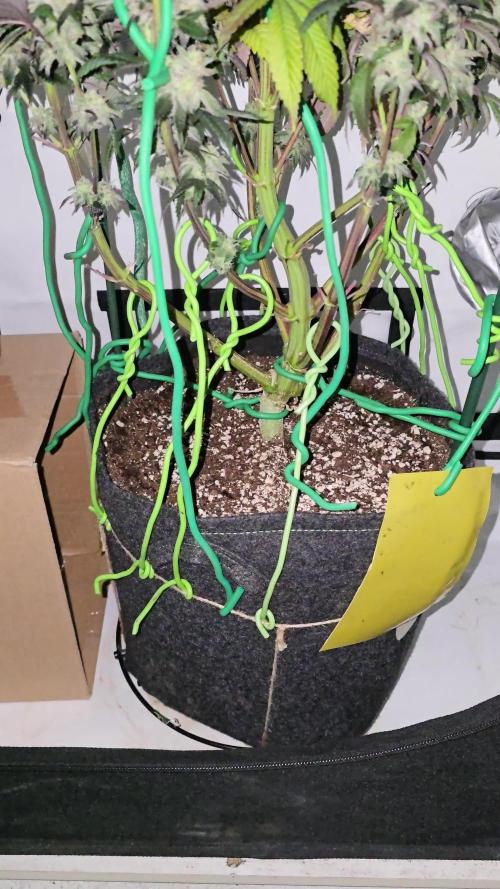
Day 112!!! The girl looks amazing, I started giving the girl clean 6.3 ph water without any nutrients "washing" her smell is very strong, I can smell her from afar:) I think next week could be the harvest week:) good luck to everyone;)

Likes
8
Share


@GrownwithLED
Follow
This was the last week of flowering and therefore I stopped giving any nutrients for a good FLUSH. This is very important in order to avoid a harsh smoke later when the plants are dried, because any nutrients left in the plant will burn your throat and the weed will hurt while you smoke it. Both Barbarian (=AK-47 x Barbara Bud) plants have developed well and carry hefty top buds on each side branch and also the main cola. The lower regions also carry buds, but those are a little more fluffy and not so big and dense as the top buds. Every bud is COVERED IN TRICHOMES and the plants glisten in the light, they are FROSTY AS HELL! The plants have a STRONG AROMA now, which is sweet and peachy with hints of sandalwood. They smell ABSOLUTELY DELICIOUS and I cant wait to try the dried end-product. All in all I can only recommend this strain, its not the biggest yielder, but definitely delivers connoisseur grade weed. Hats off to Mat from House of the Great Gardener in Canada, he has made another GREAT cross and I hope he will release this variety soon! 👍😍😎
Likes
14
Share

@Salokin
Follow
Week 4 Flower | GMO × Triangle Mints BX
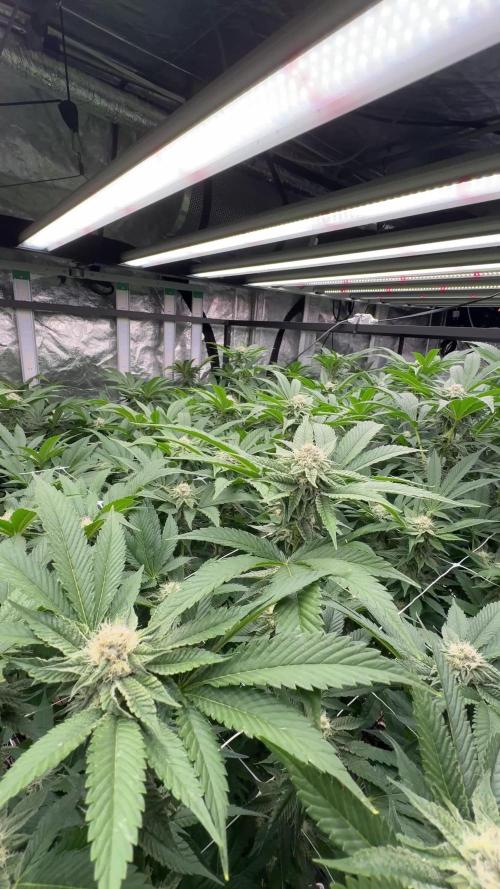
Week 11 overall, and the room is shifting into a different gear. The buds are stacking, the structure is locked in, and the bud sites are developing exactly as expected from this genetics.
Defoliation this week was light — a few leaves here and there, nothing structural. The canopy management work from the previous weeks is paying off and the plants are doing the rest themselves.
This week marked the introduction of Super Microbes BoostX into the feed programme, applied every two weeks with the water cycle. It brings a broad microbial consortium — multiple Bacillus strains, Lactobacillus spp., Rhodopseudomonas palustris, Saccharomyces cerevisiae, Glomus intraradices, amino acids and vitamins. RootX was already applied at transplant, delivering mycorrhiza (Glomus intraradices), Trichoderma harzianum, 13 strains of Bacillus spp., humic acids, amino acids and vitamins directly to the root zone where it matters most. A living root zone is a productive root zone.
Plants now at 110cm, lamp sitting at 30cm distance — dialled in to push maximum photon delivery into the tops. Running 3.3L per plant per 24h, pH holding steady at 6.2, EC stepped up to 1.9 mS/cm. Humidity down to 60%, day temp holding at 27°C, nights at 23°C.
Nutrient stack: Canna CalMag Agent 1.1 ml/l, CANNA Aqua Flores A+B at 4.6 ml/l each, CANNA PK 13/14 increased to 0.46 ml/l in line with the escalating demand, Aptus Regulator 0.1 ml/l, Green Planet Rezin 1 ml/l. Feed rotation stays the same — two full feeds, third is 50/50 osmosis and tap, pH’d, carrying only CalMag.
Next update Sunday. Stay tuned.
Likes
9
Share


@Love2Bud_UK
Follow
Have not been disappointed by this strain, from start to finish! Blown away by her resilience. Very smelly girl, literally has my mouth watering 🤤 Nugs are really solid and dense, they have been the best I've grown so far. RQS have done an excellent job 🤯🤯

Processing
Likes
3
Share


@Ogbangbang2981
Follow
this week was a lil challenging, had to get out of LST due to the fact that I broke a branch and that just tripped me off and I took off all my ties , apart from that i started giving her bloom products because I noticed a few hairs. I started applying tiresias mist to one of my branches so I can get pollen sacks to produce my own fem seeds, as I plan on crossing my fortune cookies autoflower with my ak48 autoflower and creating a new strain called "DRAKO" AUTOFLOWER well till next update . O.G. Bang Bang !! out.....

Likes
86
Share


@CANNASIM
Follow
------GENERAL COMMENT------
Everything going well, the AK47 is much more vigorous than the BB, let's consider that she was more stressed.
So i'm putting up the week timelapse, is a pain to do it but i found the result very interesting will try to put up one weekly. This week was a busy one, opted to a defoliation to be able to even the bud spots introducing a cage, and doing some LST, training to the cage to make a more flat pre flower spots in that way the flowering will be easier to control. So the plants grew in hight but was trained to be more bushy.
We have a week to go or something about that then i will switch to 12-12.
------GG.AK47 COMMENT------
Vigorous growth, she was trained to even the canopy, with many bud spots.

Likes
65
Share


@MadeInGermany
Follow
Flowering day 87
since time change
to 12/12 h.
Hey guys :-)
The Grinspoon blooms and blooms 😂
She keeps getting new pistils but the trichomes are starting to turn milky :-) .
I think it can be harvested in the next 14-20 days 👍.
Would even be a faster phenotype this time :-)
The last one had 136 days.
Was poured 3 times with 1 l each (groundwater see description at the bottom)
Everything was made clean.
Fresh osmosis water is applied and the plants are sprayed and checked.
Stay healthy 💚🙏🏻
👇🏼👇🏼👇🏼👇🏼👇🏼👇🏼👇🏼👇🏼👇🏼👇🏼👇🏼👇🏼
You can buy this Nutrients at :
https://greenbuzzliquids.com/en/shop/
With the discount code: Made_in_Germany you get a discount of 15% on all products from an order value of 100 euros.
👇🏼👇🏼👇🏼👇🏼👇🏼👇🏼👇🏼👇🏼👇🏼👇🏼👇🏼👇🏼
You can buy this strain at :
https://www.barneysfarm.com/dr-grinspoon-5
Water 💧 💧💧
Osmosis water mixed with normal water (24 hours stale that the chlorine evaporates) to 0.2 EC. Add Cal / Mag to 0.4 Ec Ph with Organic Ph - to 5.8 - 6.5
MadeInGermany

Likes
65
Share


@DudeGrowsWeed
Follow
This girl is getting close, buds are fat, crystals are sparkling, hairs are orange and leaves are yellowing all over. Gave her Recharge only this week. As soon as I start seeing some amber trichs, she's coming down. Oh, did I mention she STINKS! 😄


Likes
12
Share


@K8420
Follow
Noticed some Mg deficiency on plant 1. Just started creeping in. Haven't seen any signs on plant 2 but I fed them both some epsom salts just in case. Other than that, the girls are doing well. Growing very bushy though, will do some experimenting with the light intensity to try to get them to stretch a bit.

Likes
11
Share


@Chubbs
Follow
420Fastbuds
FBT2309
Germination Week
Time has come yet to start another amazing Tester strain from 420Fastbuds FBT2309. Started germination on 2/7 by soaking the seed in just water for 48hrs then planting it directly in the soil (Roots Organic 707) in a 3gal fabric pot. I spray the top soil with my gallon sprayer keeping it moist for the next week. After 48hrs in the soil we have sprouts that emerged that appear to be healthy and happy. All in all Happy Growing
Likes
2
Share


@SecretC8keSociety
Follow
Let say I don’t even know where to begin or how to say this but it more of a challenge w/ the fans leave. I’m like dang but of course got to keep the girls manicure and clean for they can strive to their full potential. I may have or may have not stress the girls out by cutting too many fans leaf off. Regardless I hope they don’t hermies on me . If did no sweat 😅 still will run this back . I only see em at the bottom bottom. For sure have to trims on the regulars… or every time open grow tent. According to Premium Cultivars.. the problem to look out for is trimming & pruning . Humidity Sensitive and mold/mildew. Sorry for late post or update. Outside of that working new 9/5 and doing my best to stay on top LPC. Will see harvest… stay tune!

Likes
28
Share


@Professor_Chaos
Follow
Beginning of week..
Mandarin Cookies seems to be a little ahead.. I've been watering till runoff every 2 days.. Seems like I could even go 3 days in between with better results.. More oxygen to the roots.. And I just read on GWE website that overwatering can cause seedling leaves to be kinda.. Wavy 🌊 ... I always just shrugged it off.. But I would also get algae on the top of the medium.. Always just shrugged it off.. So wtf.. How do people use frequent fergigation?!?.. 6 times a day?!? That's insane.. Maybe in like 20% coco 80% perlite or some shit.. That's just crazy to me tho.. This run, I'm gonna do the best I can to make everything as perfect as possible.. I have been testing the runoff.. I water till I get alot of runoff too.. Like 1L of runoff.. So when I test it, The TDS is coming out great.. Just where I need them to be.. Infact they are both hovering about 20 PPM from eachother.. Awesome.. But the pH has been going in a 6.3.. But coming out at 6.0 and 5.9.. This is reused coco.. Mixed in with some coco/perlite I premixed a few month before.. But never been used.. So my goal is to get the runoff pH the same as it goes in.. Sometimes I have to run water at 6.5 pH just to get it to bump up a little.. So I may have to do that. It's still in a good range for the ladies.. And it should help bring the pH inside the medium up as well.. And hopfully STAY where I need it at.. But as for now.. I am cutting out the Floralicious Plus.. The MYCO+ has all the same shit.. So I am going to use the MYCO+ for veg and Floralicious Plus in flower.. Makes better sense to me.. But yeah.. These girls already have a different branch and leaf structure that Ive been seeing lately.. They are beautiful! Lol.. Oh yeah.. And I have also lowered the light down to 26" from the ladies.. Keeping it at 25% power.. They weren't stretching too much as far as I could tell.. I'm wanting them to grow into the light about 18" - 20" still keeping the power at 25%.. See how that works out.. I'm trying to avoid using 50% power until flower for now.. To help keep the heat down.. This light doesn't get very hot.. But the warmth it does give off and the size of it does kinda help the tent stay a little warmer than my smaller lights did in my 2x2 tent.. It was eaiser to control the heat I guess.. Plus I could probably upgrade to a 6 inch exhaust fan while running a carbon filter.. But I am very excited to see what these girls do!
Mid week..
Runoff pH is still a little fucked off. This morning I ran water pH'd to 6.5 and the Mandarin Cookies runoff came out a 6.3.. But the ETHOS Cookies runoff came out at 5.8 still.. What the eff.. The TDS is good.. Going in and coming out.. Not sure wtf to do at this point.. Maybe just keep doing what I been doing.. But the growth on these girls is insane.. I cant wait till next week when the growth explosions happen! They are both already spitting out some nice, promising branches. I got a cheap PAR meter coming in tomorrow.. I hope it works as well as the $500 meters.. But these plants are looking good... for now..
Almost end of week...
My PAR meter came in!! Hells yeah! So my light gets about 200 - 250 PPFD at 20 inches on 25% power.. This should be perfect for now.. As for the pH issue.. Ugh.. I'm gonna just have to run some 7.0 thru the medium or something.. So frustrating.. The Mandarin Cookies is showing some slight pH fluctuation spots on the lowest leaves.. I also removed the first set of leaves and branches.. They were just waaay too tiny.. Now she doesn't have to waste energy on them.. As for the ETHOS Cookies.. She's showing alot less pH issues on her leaves.. Some.. But kinda hard to notice.. This is really frustrating.. May ask a question for this grow...
End of week..
The Mandarin Cookies seems to be getting the wavy shit.. Ugh.. Just the very bottom leaves.. But they are also beginning to yellow in spots.. I think I need to up the nutes a bit.. They are already beginning their growth explosion! I love this part.. Everyday you can notice alot of growth.. And eventually, you can sprout 1 set of leaves a day! The branches are sprouting out quite a bit as well!.. Its hard to not water every day, but every 3 days.. I'm gonna have to go to watering every other day, I guess.. I can already see roots coming out the bottom of the pots.. Wow.. I may use some Hydroguard for a few weeks.. Just to help the roots even more.. The ones I see coming out the bottom of their pot are already MASSIVE and WHITER than white!!! I think this MYCO+ stuff really does some magical things with these roots! I just watched a detailed video on how myco (not even gonna try to spell it) spouts its own root.. Which finds the nearest plant root and basically takes root inside the plant root.. Which then spouts out its own root system and is able to get nutrients over 700% or 700× better than without mycorhizae.. Crazy.. And it even works in hydroponics.. Somehow.. Idk how.. Cuz I would think you wash away the myco with each water change.. Maybe not.. Again.. Idk.. But yeah.. Crazy shit.. Anyways.. Gonna bump up the nutes a bit and water every other day (water, feed, water, feed, etc.)... On to the next!...
Likes
15
Share

@Northern_Ent
Follow
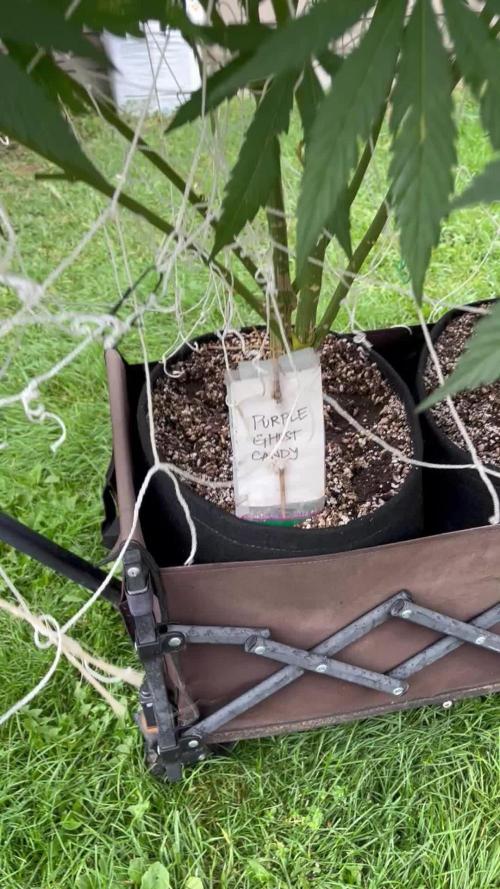
Sep 5: Purple Ghost Candy continues to bloom and the buds are filling in. She is the tallest and most sativa leaning of my four plants.
No signs of any problems and heading for the finiah in a few weeks. Right on track for my early schedule to use the good light before it gets too weak in the fall.

Likes
51
Share


@nonick123
Follow
Día 36 (25/11) Aplico ligero LST a LSD-25 Auto
Parece que OG Kush Auto se ha ralentizado un poco tras el Lollipopping y la defoliación
Día 37 (26/11) CBD Auto 20:1 #2 & LSD-25 Auto han parado el stretch y se dedican a engordar los cogollos
LSD-25 Auto sigue generando unos colores preciosos con todas las hojas inundandose de color morado / purpura
OG Kush Auto está empezando la floración en todos los nodos
CBD Auto 20:1 #1 es un monstruo que no para de crecer! Le hago un ligera defoliación (3-4 hojas) y Lollipopping en un par de nudos inferiores
Día 38 (27/11) CBD Auto 20:1 #1 sigue imparable hacia el cielo! Empieza a formar timidamente los nodos...
CBD Auto 20:1 #2 muestra pistilos rosas en el ápice! 😍
Día 39 (28/11) CBD Auto 20:1 #1 non stop! 🚀 Elimina algunas hojas que tapan a los brotes inferiores
LSD-25 Auto empieza a generar tricomas! 😍 Elimino un par de hojas que tapan los cogollos de la zona media
Día 40 (29/11) Solo riego. NO tiempo a más!
Día 41 (30/11) Día sin riego. Todas las plantas presentan el sustrato humedo
CBD Auto 20:1 #2 empieza a engordar muchos los cogollos y a mostrar pistilos entre morado y rosa 😍💥
Día 42 (01/12) CBD Auto 20:1 #1 non stop! 🚀 Elimino algunas hojas que tapan a los brotes inferiores
LSD-25 Auto tiene unos colores precisosos. Im in love
OG Kush Auto la floración está a tope! Elimino algunas hojas que tapan a los brotes inferiores
💦Nutrients by Bio Tabs - www.biotabs.nl/en/
🌱Substrate PRO-MIX HP BACILLUS + MYCORRHIZAE - www.pthorticulture.com/en-us/products/pro-mix-hp-biofungicide-plus-mycorrhizae
"GDBT420" 15% DISCOUNT code for the BIOTABS Webshop https://biotabs.nl/en/shop/


Likes
24
Share


@Newbiegrower420
Follow
Day 1 of week 6: 26th Sept
Slow start to this week with an update as my phone is broken. Girls looking good but no pics to show..
Day 2 of week 6: 27th Sept
Nutes in as usual! Girls looking good and I think the CalMag is working a treat! 🤞🏼
Day 3 of week 6: 28th Sept
Just added some pics and a lil vid today to kick this week off after a slow start!
Day 5 of week 6: 30th Sept
Nutes in again today and some more defoliation due to yellow leaves not getting enough light.. I was a little worried I hadn’t sorted the CalMag deficiency out properly but the girls are looking much happier now I’ve got rid of those yellow leaves and LST’d them a bit more. 😍
Day 6 of week 6, 1st October:
Girls looking much happier since yesterday’s removal of yellow leaves and more LST!! They’ve bounced back so nicely!! Happy days 😊❤️
Day 7 of week 6: 2nd October
Girls looking good, nutes in for the last time before switching to flower..
Switching to flower 🌹 during week 7 all being well!!
Can’t wait to see some cola action!!
❤️, ✌️ and hair grease!
