


Processing
Likes
6
Share


@Moss420
Follow
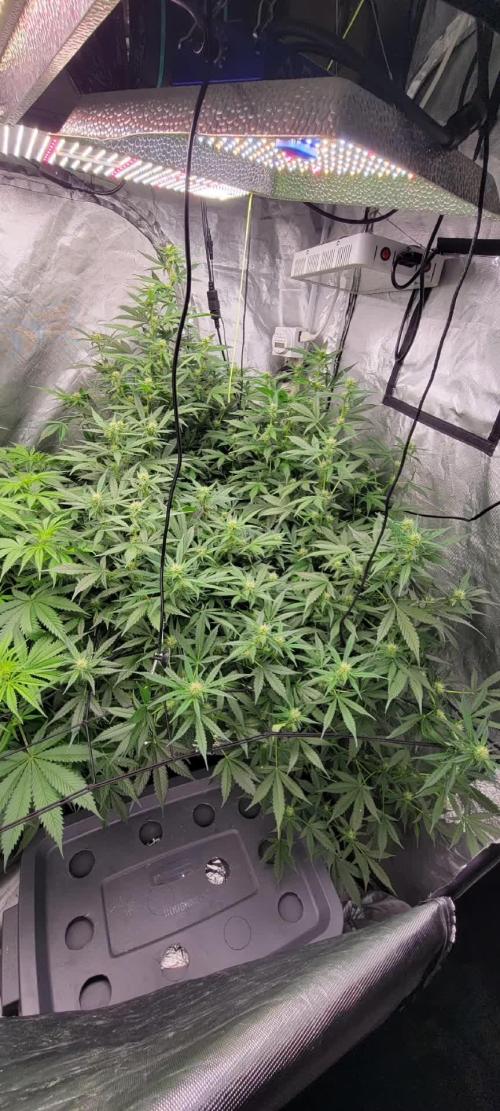
Got a new light this week, it's basically a HLG 260 R-Spec except locally manufactured using the same Samsung LEDs. Big Mumma got her 60x60cm tent today and will go in there under one Viparspectra 300W blurple (130w from the wall). I trimmed her, super cropped her main stem and added a scrog net in preparation of flowering her in the next couple of days.
Because my other plants were getting up past 75cm after 7 days of flower (100cm is my absolute max) , I decided to supercrop the canopy back down to about 60-65cm - it was pretty scary and I definitely broke the outer stem on some of them. Also gave them a good trim. Fortunately most bounced back strong the next day which are the most up-to-date photos you see (17/4/20).

Processing
Likes
21
Share


@Dunk_Junk
Follow
Almost doubled her height this week since transplant!
Lets see how she goes over the next few weeks.

Likes
15
Share


@Theia
Follow
A really explosive week of growth. I pushed PPFD up to 310umols. Dimmers are at 60% which is drawing 224w plus 18w of DRRB. I have alos started Emerson effect ... Another The Emerson effect is triggered by the simultaneous exposure of plants to light in the deep red and far-red spectra Deep Red 660 nm /Far-Red 700 nm .
A bit of boring science that explains why you need both far red and deep red in order to trigger Emerson.
The effect occurs because photosynthesis is driven by two distinct pigment systems working in series:Photosystem II (PSII): Absorbs energy most efficiently at shorter wavelengths (higher frequencies), like 680 nm (441 THz).
Photosystem I (PSI): Absorbs energy most efficiently at longer wavelengths (lower frequencies), specifically 700 nm (428 THz).
When you provide only the higher frequency (deep red), PSI becomes a bottleneck. When you provide only the lower frequency (far-red), PSII is not sufficiently excited to provide electrons. Providing both frequencies simultaneously allows both systems to work at peak efficiency, resulting in a rate of photosynthesis that is greater than the sum of the two lights used individually.
To understand the Emerson Effect, think of photosynthesis not as a single engine, but as a two-stage assembly line.
What is the Emerson Effect?
Discovered by Robert Emerson in 1957, this phenomenon shows that plants perform photosynthesis much more efficiently when they are hit by two specific types of light at the same time: Deep Red (660 nm) and Far-Red (700+ nm).
If you give a plant only Far-Red light, photosynthesis is very slow. If you give it only Deep Red, it's better but still limited. However, when you give it both at once, the total rate of photosynthesis is significantly higher than if you just added the two results together (1+1=3).
What is Happening? (The "Assembly Line")
Inside the plant's chloroplasts, there are two "workstations" called Photosystem II (PSII) and Photosystem I (PSI). They work in series, meaning the first one must pass "parts" to the second one.
PSII (The First Station): This station is tuned to catch Deep Red light (660 nm). It harvests electrons from water.
PSI (The Second Station): This station is tuned to catch Far-Red light (700 nm). It takes the electrons from the first station and uses them to create energy (ATP and NADPH).
The Problem: If you only provide Deep Red light, the first station works fast, but the second station can't keep up because it isn't being "powered" efficiently by that specific frequency. This creates a traffic jam of electrons. The Solution: By adding Far-Red light, you power up the second station. It now "pulls" the electrons from the first station much faster, clearing the traffic jam and making the whole assembly line run at full speed.
The Benefits for The Grow..
Because i am using the Biotabs water-only method, my plants already have a steady supply of organic nutrients. Implementing the Emerson Effect offers several distinct advantages:
Increased Biomass: Because the "engine" is running faster, the plant produces more sugars and carbohydrates, leading to heavier fruits or flowers.
Faster Finishing: Plants often reach maturity sooner because they have more surplus energy to complete their life cycle.
Better Light Penetration: Far-Red light is very good at passing through the upper leaves. This "wakes up" the lower parts of the plant that would otherwise be shaded, allowing the whole plant to contribute to growth.
Enhanced Secondary Metabolites: In many crops, this synergistic light can stimulate the production of terpenes and antioxidants, improving the "quality" (smell, taste, and potency) of the final harvest.
The "Sunrise/Sunset" Trick
I am using 4x Invisible sun Far red/Deep red bars,they use high-quality Samsung LH351H (660nm Deep Red) and specific Far-Red (730nm) diodes for 10–15 minutes at the start or end of the light cycle. This mimics the natural shift in light at sunrise and sunset, "waking up" the photosystems or signaling the plant to go into "sleep mode" faster, which can further optimize the flowering cycle.
Enviromentally i am chasing a VPD of about 1,1kpa. My room seem to sit nicely at lights on at 24c with no real drama and a little help from a 220W greenhouse bar radiator. Its using abot 4kw/h a day atm because my room is attached to the side of my house and its been -5c.. I have had to add some humidity as its also very dry atm. Im aiming for RH of 65% with my 24c but it is more around the 62s.. VPD is crucial and is the focus for this grow for me. The autopots and Biotabs make it so easy ican really just focus on perfect enviroment. A VPD of 1.0–1.2 kPa provides enough "atmospheric pull" to move calcium and magnesium up from the roots, which is critical for the rapid cell division happening now..
Plants will be flipped on Saturday which is their week 5 as im a bit behind..
As this happens i will push PPFD upto 4-500umols. by week 2 of flower. Thats the plan anyway..

Likes
17
Share


@Cultivandomedicinanatural
Follow
Es una variedad fácil de cultivar y muy agradecida, el peso que pongo arriba no es en mojado si no en seco. He sacado una media de 42,3 g por planta. También tanta cantidad es debido a que son muchas plantas para un metro cuadrado, pero se que el foco, los buenos nutrientes y la magnífica cepa como es green poison de sweet seeds ha hecho la mayoría del trabajo. La plantaría más veces, además cuando había alguna deficiencia corregía bastante rápido asique muy satisfecho con el resultado y más que satisfecho con todo lo elegido desde semilla hasta nutrientes y focos. Una planta de lujo para poder desconectar de los días duros y con un sabor exquisito. Buenos humos familia! espero que os guste este primer diario!
Likes
19
Share


@adam_pawloski87
Follow
Let’s Go !!! Today is day 17 for these little Ogreberry Autos #ogreberrychronicles from @twenty20mendocino an this little Bruce Banner from @fastbudsgenetics!! Week went real well , air temp an humidity is staying on point for us which is always great!, around 70-75 degrees throughout the day an 62-65 % humidity ! I turned up the pwr on the sun (Scorpion600Rspec) to 60% a getting a par reading of 430 - 440 par ! Can’t wait to see what these babies do this week!! You all have an amazing productive day an week! Peace love an positive vibes to all you Growmies out there! Cheers 😶🌫️💨💨💨💨💨🤙🏻Keep them eyes peeled for next week!!


Likes
69
Share


@nonick123
Follow
Cosecha
Reporte de Peso húmedo & Peso Seco de LemonPaya by FastBuds!
⚖️ Total peso húmedo 186
⚖️ Total peso seco TBD
💦Pérdida de H2O durante el proceso de secado TBD
🎨Colores
Un color verde claro brillante!
👃Olores
💐Floración Papaya (predominante) con un toque (potente) de delicioso limón
🏜️ Secado TBD
🍗 Curado TBD
🍽️Sabor
A definir cuando esté bien curada en el reporte de humo
Variedad
💪Resistencia
Resistente 9/10! - Floración detenida por 10 días por el bloqueo de nutrientes que se ha presentado en la mayoría de plantas de este ciclo.
Pero ella se recuperó muy bien y ha hecho unos cogollos densos al final de floración!
🏋️♂️Entrenamiento:
Se ha adaptado bien al topping (en 2 ocasiones), supercropping y LST!
Una crack!
🌱Vegetativo:
Un vegetativo sin incidencias, con una bonita estructura!
Ya en vegetativo al frotar las ramas, se desprendía olor a Papaya 😍
💐 Floración:
Cogollos muy densos a pesar del bloqueo de nutrientes que superó sin problemas en 10 días!
El olor a Papaya y fondo de limón es impresionante!
Genética:
Estupendo trabajo de breeding de FastBuds!
👨⚖️Conclusión:
Una cepa deliciosa a plantar una vez en la vida! Muy interesante el perfil de Papaya y Limón!
Likes
10
Share

@Stonerandgrower
Follow
It grew 14 weeks since sprout and it budding for 8 weeks and there's 7 pounds wet and it's some of the prettiest I've ever grown
Edit: there was 25 ounces dry


Likes
2
Share


@Home_Grower
Follow
Día 60 de Floración: En esta semana notamos increíblemente como explotaron en crecimiento.
El HPS combinado con led Citizen es una buena opción en estos días de frío. Pasamos de tener 15°C a tener 21°C con el período de luz por la noche.

Likes
31
Share


@The_Bearded_Grower
Follow
Welcome to 📅 Day 22 of veg 4/5/2021 and boy am I happy with the growth on the girl under the MH TS1000 she is growing fast and strong and that's just what I want to see later today I will be mixing a new batch of nutes but that's about it
Update 📅 Day 25 of veg 4/8/2021 she is still growing very fast under the TS 1000. I have done some more LST as she grows. I have noticed some problems in the leaves but it is very little and I hope it will not get worse only time will tell. Happy growing and keep your stick on the ice 🏒


Likes
29
Share


@Jjthejetplane79
Follow
Fastbuds with the heavy weight autos! Holy crap I thought she was a photoperiod
Likes
20
Share


@pifflestikkz
Follow
Day 73
Day 38 Flower
Monday 6th
Camera is doing no justice, little video, although to my own fault I did not have phone with me when feeding yesterday for decent pictures. I will update again on water tomorrow ✌️
So far stretch has stopped, the recovery from lollipopping and defoliating is immaculate, she is so strong, already seeing denser bud sites and focused energy towards tops.
Day 74 - picture updates, looking great 😍💪💚



Likes
43
Share


@biggreens420
Follow
this was a weird one started slow but soon picked up when she found her feet was easy enough to grow training is a must with this one she likes to drink loads but holds on to nitrogen quite a bit so would go low with it in flower buds grow huge and she gets really frosty I think another week and they would have been a lot more dense she handles struggles well as when i was on holiday and my friend was taking care the others suffered but she didnt as u can see from other diaries been a good one different in taste and high to anything iv had before so very happy thanks to all who help comment follow and make growdiaries the great place it is thanks for reading happy growing guys


Processing
Likes
16
Share


@Damonkey
Follow
Things going great in here. All racing into flower and stretching nicely. Banana Daddy’s in the lead tropics after that cookies trailing at the moment
Likes
20
Share


@Ultraviolet
Follow
Not particularly growing for speed or any dedicated reason this time round, just adding water and a abundande of positivity, gotta admit I do like the autoseed logo. Off we go again into the magical forest.
(Arthrospira platensis) cultivated in high-alkaline, mineral-rich water in Kailua-Kona, Hawaii. It is renowned for having a higher nutrient content, including more carotenoids and essential fats, compared to other spirulina brands. It is frequently cited as a "complete food" due to its dense concentration of proteins, vitamins, minerals, and pigments.
The nutritional profile of standard dried Spirulina platensis biomass. 3kg of spirulina powder has an approximate NPK ratio of 10-2-1 (or 10% Nitrogen, 2% Phosphorus, and 1% Potassium).
Here is the breakdown of the nutrient content for 3kg of powder:
Nitrogen (N): ~300g (10% of total mass)
Phosphorus (P): ~60g (roughly 2% of total mass)
Potassium (K): ~30g (roughly 1% of total mass)
3kg of spirulina powder is more than enough nitrogen for 4 cannabis plants in a 100-gallon pot—in fact, it is likely excessive and could cause severe nutrient burn or toxicity if not properly managed. Spirulina has a very high protein content (46% to 63% dry weight), which translates to a significant nitrogen source. It is often described as a 5-1-1 NPK fertilizer.
3kg (3000g) of powder in 100 gallons means 30g per gallon. General organic recommendations for potent amendments (like frass) are often around 1–3 tablespoons per gallon. 30g of powder is roughly 2-3 tablespoons, making this a very high-strength application rate if added all at once. Balance this with calcium/magnesium, and organic nutrient delivery in soil growing can lead to deficiencies in these nutrients.
Not all of that 100 gallon is used, so figuring out precise measurements was ballpark, but there is about 10kg of engineered biochar in that pot. Mostly in the top half. Ideally, I'd have 25kg in a full active 100-gallon, but......... don't mess with something that is not broken. Roots do not utilize the entire 100 gallons. This has been a couple of years of trial and error, mostly error. The amount of cations you can add in grams depends entirely on the specific cation exchange capacity (CEC) of your biochar and the type of cation being added. Biochar CEC values vary widely, typically ranging from 4 to over 300cmolc/kg. Multiple Biochars in use, ranging upwards of 100cmolc/km.
Different cations have different atomic weights
Potassium K+ 39.1g/mol.
Calcium Ca2+ 40.1g/mol.
Magnesium Mg2+ 24.3g/mol.
Nitrogen NH4+ 18.04g/mol.
You get more nitrogen bang for your buck. It all depends on the CEC of the biochar you use, but brrrrrrrrrr roughly I'm looking at 500-600 grams worth of elemental cation exchange capacity, give or take. That's just for the biochar alone. Elemental cation exchange capacity refers to the ability of materials—such as soil, minerals, and biochar to adsorb, hold, and release positively charged ions Ca2+, Mg2+, K+, Na+, Al3+, and Zn2+. This capacity is a critical measure of nutrient availability in soil and energy density in electrochemical systems.
Added calmag 2:1 to complement spirulina.
Calcium (Ca): Approximately 150g - 300g of elemental calcium.
Magnesium (Mg): Approximately 75g - 150g of elemental magnesium.
So long as pH stays in 6.3 to 6.7 ish, the plant will unlock hydrogen. Plants will be able to cycle CEC for their own needs. Hydrogen ion pumping (proton pumping) is a fundamental mechanism used by plant roots to facilitate the cycling of nutrients within a medium's Cation Exchange Capacity (CEC), directly increasing nutrient availability. A growing medium's Cation Exchange Capacity (CEC) does not contribute directly to Electrical Conductivity (EC). CEC represents potential nutrient storage, while EC represents active nutrients in the water/soil solution. A medium with a high CEC can hold many nutrients, but if there is no water present, the EC will be low.
98% of plant nutrient uptake comes directly from the soil solution.
2% of nutrient uptake is directly from soil particles.
Nutrients held on exchange sites (CEC) are not directly measured by EC until they are released into the soil solution through exchange with other ions (e.g., hydrogen ions from roots or fertilizer).
Plants source the H+ ions (protons) used in cation exchange primarily by exuding carbon sugars into the rhizosphere, then microorganisms perform root respiration, which reacts with soil water to form carbonic acid H2CO3 that dissociates into H+ and bicarbonate. Roots also actively pump out H+ ions directly to acidify the rhizosphere, plants trade hydrogen produced through metabolism for essential nutrients held by the soil.
In plant cells, the H+ (protons) used in proton pumping across the plasma membrane come primarily from the cytoplasm (cytosol). The protons are derived from internal cellular sources, including metabolic processes that release H+, and the regulation of intracellular pH homeostasis.
Distilled water is highly useful in managing the electrical conductivity (EC) of a growing medium by allowing for precise control over nutrient concentration and assisting in the mobilization of nutrients from the cation exchange capacity (CEC) into the active, plant-available nutrient solution.
Just add water & positive energy.
Potential hydrogen. pH. + - , potential charge balance for hydrogen.
So long as there is adequate oxygen in the soil and air and water moves at a decent interval, its practically impossible for the pH to skew in a soil that is taking in oxygen and releasing CO2 and nitrogen, I say practically, but meh, even with plenty of oxygen, the process of converting ammonium NH4+ to nitrate NO3- by bacteria releases hydrogen ions H+, which directly causes acidification (lowering pH). While water movement is necessary, consistent water moving through the soil can leach away basic cations Ca2+, Mg2+, K+, Na+, leaving behind acidic hydrogen and aluminum ions, causing pH to drop, especially in humid regions. High levels of CO2 in the soil (from intense respiration) dissolve in soil water to create carbonic acid, H2CO3, which lowers the pH. (barometric pumping removes that possibility) The pH in a cannabis cultivation environment, particularly in hydroponic or soilless setups, will often naturally drift towards acidic (lower pH) over time. Understand how to know when to lime the pH back up. Complex but critical. Once I understood this it helped ease the pain of understanding pH.
Base saturation directly reflects the percentage of CEC occupied by base cations. Generally, as base saturation increases, soil pH increases because fewer acidic cations, H+ and Al3,+ are present on the soil colloid surfaces.
At a pH of 7 or higher, the soil colloids are saturated with base cations, resulting in a base saturation of 90+%.
While many sources include Sodium Na+ as a base cation, some calculations focused specifically on plant nutrients (like in some nutrient management contexts) may focus solely on the "Big 3": Ca2+, Mg2+, and K+. However, in soil science and CEC (Cation Exchange Capacity) measurements, sodium is usually included in the definition of total base cations, making it the "Big 4" base cations.
At a pH around 5.5, soils often have a 45–55% base saturation, while a soil with a pH between 6.5 and 6.8 generally has an 80–90% base saturation.
Base saturation is considered a reliable, albeit complex, indicator of soil fertility and the degree of soil weathering, acting as a crucial metric in soil classification and management.
Once you take full control of the pH, so long as there is oxygen, and one keeps tabs on base saturation levels. Its near impossible for anything to go wrong. All you are essentially doing is adding water and waiting for any sign of deficiency. Not so much growing as eliminating the possibilities of things going sideways. Can't over or under water, can't skew pH, can't go anaerobic. Everything runs in optimal cycles, watering every 2 to 3 days or as required, depending on the rate of combined ET. A little warmer, a little drier, but never short on water. All the nutrients are already there in the medium, we still focus on the water, just not adding salts, but to mobilize nutrients held in the Cation Exchange Capacity (CEC) and move them into the active soil solution for plant uptake, the best supplements to add to water are fulvic acid, humic acid, or seaweed/kelp extract. Liquid solutions with high concentrations of essential trace elements. Distilled water has no alkalinity or minerals to help buffer or release nutrients. Adding these supplements turns the "empty" water into an active agent that forces nutrients off the CEC colloids into the solution for plant uptake.
When to water? When Electrical Conductivity of soil gets low. No water, no conductivity.
