The Grow Awards 2026 🏆
Processing
Likes
10
Share
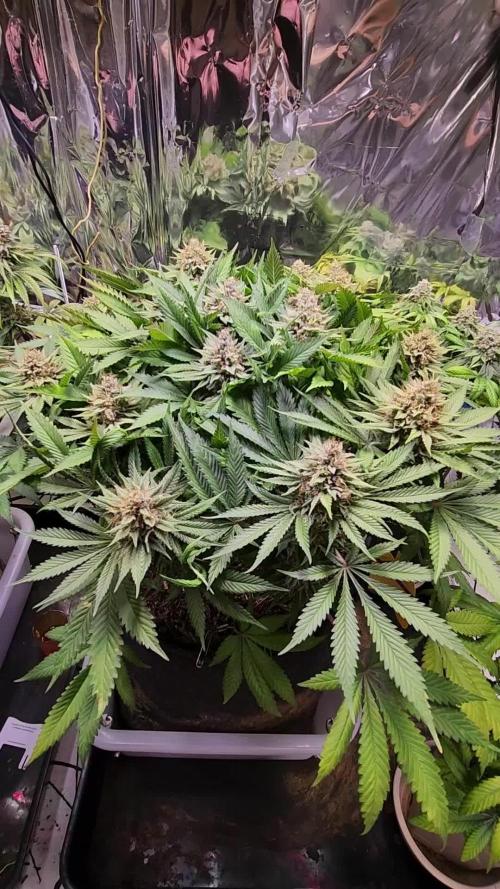
Explosive growth this week. I'm loving the results from using tons of Recharge (and so it she). I'm going to keep up with the overdose or Recharge each week. Looking forward to the end results! 👍
Likes
2
Share
@Ninjabuds
Follow
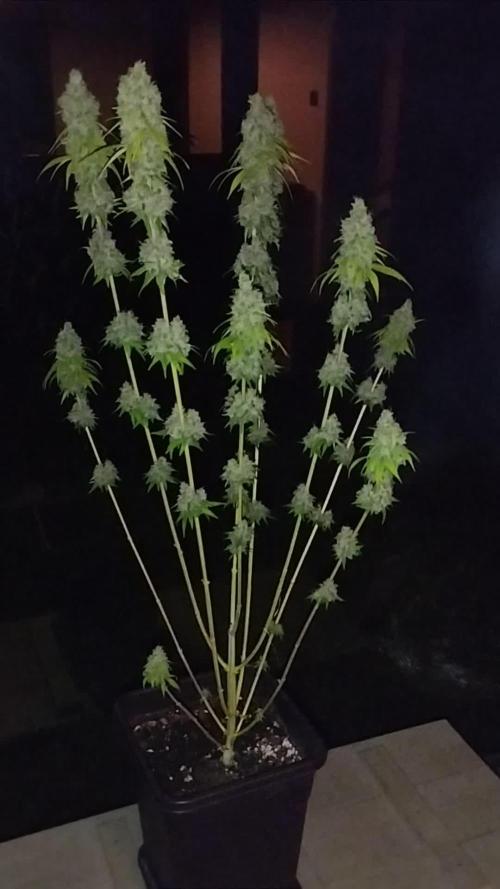
The Bubble OG plants are looking awesome! My tallest one is stacking up with super dense buds. It's crazy to think that the other one is almost ready to chop – the colors are so vibrant. And then there's that short and squat one with the purple leaves. It's definitely the oddball of the bunch, but I kind of like it. The past few weeks have been so beautiful, watching the plants grow and change. It's amazing how something so small and fragile can turn into something so strong and vibrant. Now that they're getting ready to bloom, it feels a little bittersweet. I'm so excited to see the finished product, but I'll definitely miss having them around while they're growing.
Likes
2
Share
@Justrite
Follow
Going well and strong in this week , Feed upped a touch and reacted very well , Quite impressed with this quantum board led light so far Also plucked off the petal leafs and first set of branches as they are non productive branches to work with Water is heated to 22oC and then cal mag is added till a level is set to 0.4 and stir in very well then add base nutes of mIcro stir very well then gRow then stir very well then add bloom stir very well and then finally b52 and stir in very well
Likes
Comments
Share
@Piro420
Follow
Just flipped, looking happy. Ph slightly rising, ec static planta looking happy. Accidentally had tent canopee fans off for 3 days i don't think it will be a problem.
Likes
207
Share
@SwissKush
Follow
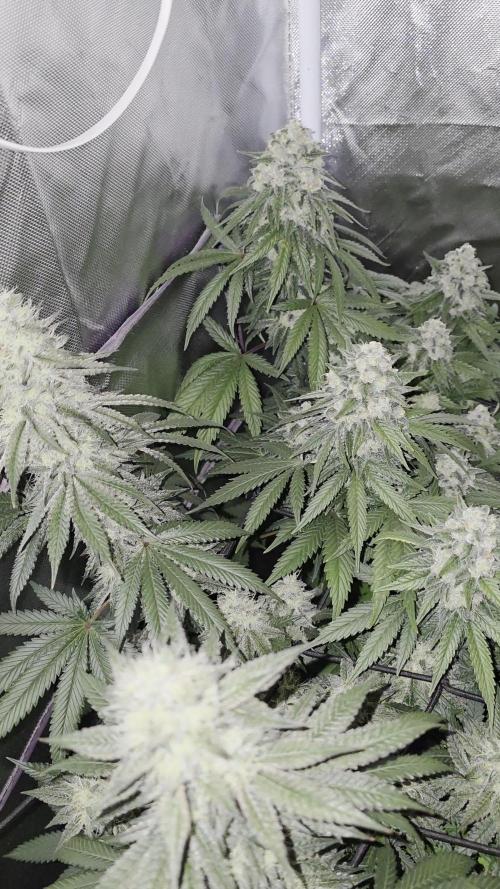
Day 78 - Ripening a. the buds are gaining more and more weight, humidity 45% b. the resin is dripping from the buds, the amount of resin on this plant is next level c. smelling this plant when I open the tent I smell floral fruity tones Day 79 - more resin a. the glands on this plant keep growing upward and multiplying all over the buds b. buds fattening Day 80 - buds are rock hard a. the colas are very dense, even the buds down the limbs are dense! Day 81 - the smell is so strong! a. glad I use carbon filter in this box, this plant smells crazy good like most citrus weed you've ever smelled. b. I clipped a bud, dried it safely, smoked .25g in a bong and the effects are already super strong. c. trichomes are about 60% milky, a few ambers here and there, still plenty of clears to let ripen. Day 82 - her pistils are 70% brown/orange - buds are becoming blue! Video uploaded a. the colas are very tight and dense with their leaves all being yellow now, many are able to remove by hand with no effort except the huge amount of resin holding them in. I will not remove any because I will be making hash later on. b. the buds are turning a nice blue color. I will be going the distance with this plant! c. Trichomes are 80% white, 20 % clear with a few ambers here and there, still needs more time! DWC and autos always take a little longer due to the abundance of readily available nutrients in the water pool. Day 83 - ripening fast! Blue Gelato buds! a. turned lights down to 50% intensity b. will begin the flushing process tomorrow Day 84 - We will begin the flush! a. I will use Florakleen to flush the ladies for a few days, then I will harvest b. the trichome production is next level with this plant
Likes
16
Share
🍼Greenhouse Feeding BioGrow & Bio Enhancer ⛺️MARSHYDRO The ⛺️ has a small door 🚪 on the sides which is useful for mid section groom room work. 🤩 ☀️ MARSHYDRO FC 3000 LED 300W ☀️Also special thanks to VIPERSPECTRA P2000 (200W) & XS2000(240w) LED growlights 🌱 DUTCH HEADSHOP SEEDS: www.dutch-headshop.eu www.dutch-headshop.nl ONE STOP SHOP . 100% germination success on first try! with HUGE seed selection! . Very friendly customer service . Best bio-seed packaging . Sells other products @ best prices: . Nutrients . Vaporizers . Smoking accessories (grinders, cones) . CBD Tinctures . Resin Extracts . Boveda humidity packs . Ziplock bags . Other health supplements such as: . Lion’s Mane Organic Capsules . Hemp Seed coffee
Likes
23
Share
@Ferenc
Follow
Day 51, 4th of November 2020: The 3rd day since the lamp switched to be 12/12... I raised up the nutrition intake as it can be seen above only the BioBizz family 2ml/l and removed some LST because the plant remains in shape or just set a bit but nothing significant.... She looks nice and strech is on the way..... 😅 Nothing really to report there is crazy 2-3 weeks from now ;) Kalini Asia let's go we can do it baby 😅
Likes
41
Share
Likes
15
Share
@Roberts
Follow
Blue Dream Auto is doing good. She is starting to form her colas. She is growing really good. Thank you Spliff Seeds, Medic Grow, and Athena nutrition. 🤜🏻🤛🏻🌱🌱🌱 Thank you grow diaries community for the 👇likes👇, follows, comments, and subscriptions on my YouTube channel👇. ❄️🌱🍻 Happy Growing 🌱🌱🌱 https://youtube.com/channel/UCAhN7yRzWLpcaRHhMIQ7X4g.
Likes
13
Share
@Corwinism
Follow
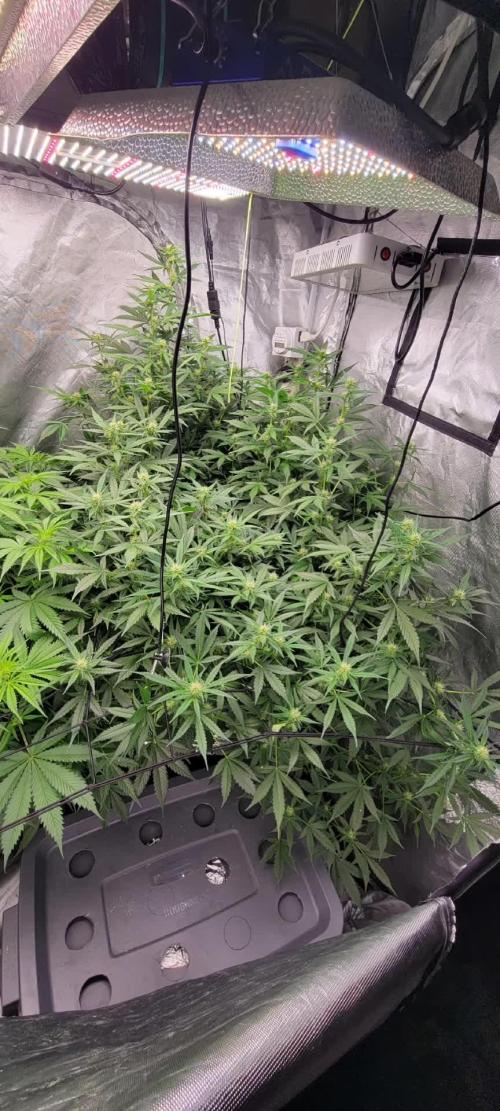
So it has begun... I've had to start utilizing string to hold up branches by tying them to the ceiling rods and surrounding equipment. These plants are healthier and happier than my first grow, so I wasn't quite expecting them to blow up like they did, therefore my single-layer screen was not enough to support the branches. Not to mention the net used was store-bought and kind of sucks. I prefer my double-layer from the first harvest. The Mimosa is packing on some major frost, followed closely by the Glookies. American Pie trichomes seem to appear and ripen much closer to the ending stages of flower.
Likes
58
Share
7 months after planting her from seed the day is finally here. A little earlier than I would of liked due to insects (crickets/grasshoppers eating buds) but she's thereabouts finished. Probably lost 1/3 of buds from the chewing insects but still a big yield and my drying room is full 😊 She survived two rainy season's and some serious wind from a tropical depression back in September. I have kept this grow completely organic so no pesticide or chemical fertilizers used. Apart from heavily amending the soil at the start I mostly fed her crabmeal once a month and seaweed and molasses in most waterings. A few of those waterings were diluted with my urine 😆👌 NPK right!? Why not.. then at the end I added a cultured pro biotic yogurt to the soil 2 days before I harvested. (Tip from a fellow grower @med_in_tropic - thanks bro) Not sure if it made any difference as I cannot compare with another plant but, the plant starting smelling like lemon furniture polish.. like a lemon scent with a fuel undertone. Almost menthol like 🤷‍♂️.. smells amazing. Me and my wife drank tea from the trimming and the citrusy flavour came though into the tea which was nice. Weather wise the temperature is down now to around 16c at night with RH around 50% so the buds should dry much slower than the last harvest so I should get a better flavour profile. Smoke report to follow after she has been in a jar for a week or so.. I did try a bud sample a few weeks back and the taste then was already pleasant so for sure this will be fire... 🔥 Thanks for all the kind comments, this was my first ever grow start to finish. Already looking forward to next season 😁
Likes
77
Share
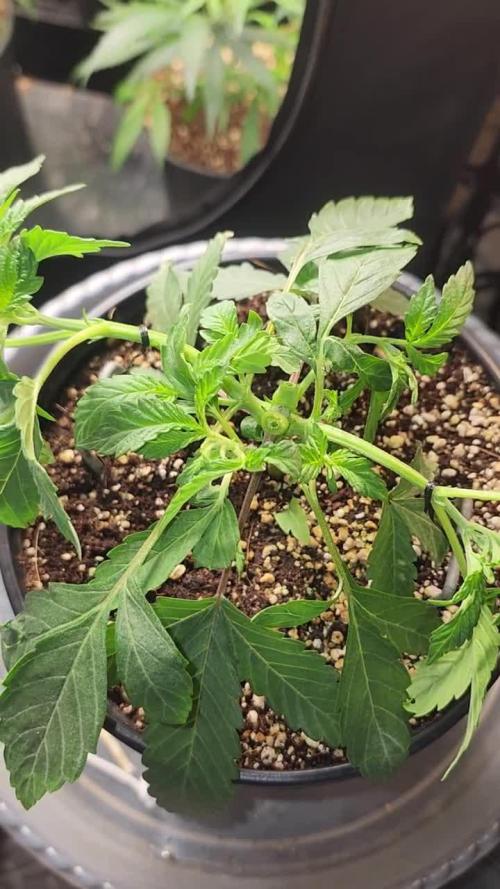
So I finally got there in the end, here we have 3 x sherbert mimosa and 2 x gelato cake. Classing this as week 1 as I repotted today so this is what I'm using. Light = bloomplus bp2500 Exhaust is a ac infinity 6inch with digital controller Inkbird humidity controller with a ram 5l humidifier. Veg only! Soil= biobizz light mix Nutes= biobizz roots 1 week using the 10 week schedule at half dose this run. Ph= 6.4 Room humidity is 70% Temp is 28°c Happy growing guys 💪💚 Grown under the bloomplus bp2500 The 4 smaller ones are in light mix And the middle one is in all mix hence its got nute burn. I have fed them 4ml of biobizz roots to a litre of water. I made a 2l bottle to share between them at this point. Tomorrow I will start them with the following biobizz nutes as follows. 2ml per litre of fish shite 2ml per litre of bio heaven 2ml per litre of acti Vera 2ml per litre cal mag I mix the cal mag on its own and feed separately. Happy growing guys 💚💜 Last pics of this weeks progress just put on, what a growth spert in 6 days 😁💚💜
Likes
22
Share
@BigDaddyK
Follow
Short plant , dense , would suit people with reduced height rooms , flavoursome
Likes
33
Share
@Rollex420
Follow
Day 28 Last day of the third week she has finally been moved outside for like 7-8 days now. Plus it looks like it's starting to bloom too! Just yesterday I noticed these little white pistils that can be seen in the video I uploaded.. Unfortunately at the beginning of the month she didn’t have an easy life.., there were many days of rain and wind.. so I had to shelter my little plant under a roof in these days. Now it would seem that for the rest of the following weeks there is a good climate with sunny days!☀️ So I hope the plant is able to start its flowering phase safely. I'll upload more posts on the next days😊💚
Likes
2
Share
Update of project Sea green 💚
Likes
4
Share
@Xpie77
Follow
Kweekverslag – Amnesia Lemon Kush (HY Seeds) Datum: Woensdag 10 juli 2025 Medium: Aarde Potgrootte: 11 liter potten Zaden: 25 zaden gezaaid – 20 succesvol ontkiemd Week: 5 van de groeifase --- 🌱 Status Week 5 – Groeifase Aantal planten: 20 Gemiddelde hoogte: ca. 28–35 cm Bladontwikkeling: Gezonde, brede waaiervormige bladeren. Donkergroen en glanzend. Stam: Verdere verdikking zichtbaar, stevige plantstructuur Structuur: Mooie spreiding – planten ontwikkelen meerdere zijtakken Training: Eerste ronde LST (Low Stress Training) toegepast bij 12 planten Lichtcyclus: 18/6 Watergift: Regelmatig, afhankelijk van gewicht pot (om de 2 dagen gemiddeld) Voeding: Groeivoeding verhoogd naar 75% aanbevolen dosering Temperatuur: 25–27°C overdag, 20–21°C ‘s nachts Luchtvochtigheid: 55–60% Afzuiging/ventilatie: Actief, extra circulatieventilator geplaatst voor luchtverdeling --- 📌 Opmerkingen & Acties LST goed ontvangen – geen tekenen van stress of herstelvertraging Planten reageren krachtig op ruimere potten, zichtbare groeispurt Start van pre-flower verschijnselen nog niet waargenomen Overweeg volgende week te beginnen met bloeivoeding als internodes volledig ontwikkeld zijn Controle op ongedierte: geen tekenen van trips, schimmels of tekorten
Likes
6
Share
@AGJr420
Follow
Honestly it took me 2 grows to catch on but my thumbs looking green y’all 😎💯✅
Likes
6
Share
@Roberts
Follow
I did a solution change on her a week ago. She has grow a lot since then. She is looking good now and making progress. Nothing else to report at the moment. Thank you ILGM, and Medic Grow. 🤜🏻🤛🏻🌱🌱🌱 Thank you grow diaries community for the 👇likes👇, follows, comments, and subscriptions on my YouTube channel👇. ❄️🌱🍻 Happy Growing 🌱🌱🌱 https://youtube.com/channel/UCAhN7yRzWLpcaRHhMIQ7X4g.
Likes
18
Share
Green light is radiation with wavelengths between 520 and 560 nm and it affects photosynthesis, plant height, and flowering. Plants reflect green light and this is why they appear green to our eyes. As a result, some growers think that plants don’t use green wavelengths, but they actually do! In fact, only around 5 – 10% of green light is reflected from leaves and the rest (90 – 95 %) is absorbed or transmitted to lower leaves [1]. Green wavelengths get used in photosynthesis. Chlorophyll pigments absorb small amounts of green wavelengths. Light that doesn’t get absorbed is transmitted to leaves that are shaded out from direct light. This means that leaves at the bottom of the canopy get more green light than leaves at the top. A high proportion of green wavelengths compared to other colors tells lower leaves that they are being shaded out, so they are able to react accordingly. Lower leaves may react by opening or closing their stomata or growing longer stems that help the leaves reach brighter light [1, 2, 3]. When it comes to growing cannabis, many cultivators are interested in the quality of light used for the flowering stage. In many plants, flowering is regulated by two main photoreceptors: cryptochrome and phytochrome. Both photoreceptors primarily respond to blue light but can also respond to green, although to a lesser extent. Green can accelerate the start of flowering in several species (although cannabis has yet to be tested) [1, 4, 5]. However, once flowering has begun, it’s important to provide plants with a “full spectrum” light that has high amounts of blue and red light, and moderate amounts of green, in order for photosynthesis to be optimized. Green light mediates seed germination in some species. Seeds use green wavelengths to decide whether the environment is good for germination. Shade environments are enriched in green relative to red and blue light, so a plant can tell if it is shady or sunny. A seed that senses a shaded environment may stay dormant to avoid poor growing conditions [1]. Some examples of plant species where researchers have documented this response are: ryegrass (a grass that grows in tufts) and Chondrilla (a plant related to dandelion) [1, 6]. Although green wavelengths generally tell plants NOT to germinate, there are some exceptions! Surprisingly, green wavelengths can stimulate seed germination in some species like Aeschynomene, Tephrosia, Solidago, Cyrtopodium, and Atriplex [1, 6, 7]. Of course, light is not the only factor affecting seed germination – it’s a combination of many factors, such as soil moisture, soil type, temperature, photoperiod, and light quality. When combined with red and blue light, green can really enhance plant growth [1, 8]. However, too much green light (more than 50% of the total light) can actually reduce plant growth [8]. Based on the most current research, the ideal ratio of green, red, and blue light is thought to be around 1:2:1 for green:blue:red [9]. When choosing a horticultural light, choose one that has high amounts of blue and red light and moderate amounts of green and other colors of light. Not many studies can be found about the effect of green light on cannabis growth or metabolism. However, if one reads carefully, there are clues and data available even from the very early papers. Mahlberg and Hemphill (1983) used colored filters in their study to alter the sunlight spectrum and study green light among others. They concluded that the green filter, which makes the environment green by cutting other wavelengths out, reduced the THC concentration significantly compared to the daylight control treatment. It has been demonstrated that green color can reduce secondary metabolite activity with other species as well. For example, the addition of green to a light spectrum decreases anthocyanin concentration in lettuce (Zhang and Folta 2012). If green light only reverses the biosynthesis of some secondary metabolites, then why put green light into a growth spectrum at all? Well, there are a couple of good reasons. One is that green penetrates leaf layers effectively. Conversely red and blue light is almost completely absorbed by the first leaf layer. Green travels through the first, second, and even third layers effectively (Figure 2). Lower leaf layers can utilize green light in photosynthesis and therefore produce yields as well. Even though a green light-specific photoreceptor has not yet been found, it is known that green light has effects independent from the cryptochrome but then again, also cryptochrome-dependent ones, just like blue light. It is known that green light in low light intensity conditions can enhance far red stimulating secondary metabolite production in microgreens and then again, counteracts the production of these compounds in high-intensity light conditions (Kim et al. 2004). In many cases, green light promoted physiological changes in plants that are opposite to the actions of blue light. In the study by Kim et al. blue light-induced anthocyanin accumulation was inhibited by green light. In another study it has been found that blue light promotes stomatal opening whereas green light promotes stomatal closure (Frechilla et al. 2000). Blue light inhibits the early stem elongation in the seedling stage whereas green light promotes it (Folta 2004). Also, blue light results in flowering induction, and green light inhibits it (Banerjee et al., 2007). As you can see, green light works very closely with blue light, and therefore not only the amount of these two wavelengths separately is important but also the ratio (Blue: Green) between these two in the designed spectrum. Furthermore, green light has been found to affect the elongation of petioles and upward leaf reorientation with the model plant Arabidopsis thaliana both of which are a sign of shade avoidance symptoms (Zhang et al. 2011) and also gene expression in the same plant (Dhingra et al. 2006). As mentioned before, green light produces shade avoidance symptoms which are quite intuitive if you consider the natural conditions where the plants grow. Not all the green light is reflected from the highest canopy leaves in nature but a lot of it (50-90%) has been estimated to penetrate the upper leaves at the plant level ((Terashima et al., 2009; Nishio, 2000). For the plant growing in the understory of the forest green light is a signal for the plant of being in the shade of a bigger plant. Then again, the plants growing under unobstructed sunlight can take advantage of the green photons that can more easily penetrate the upper leaves than the red and blue photons. From the photosynthetic pigments in higher plants, chlorophyll is crucial for plant growth. Dissolved chlorophyll and absorb maximally in the red (λ600–700 nm) and blue (λ400–500 nm) regions of the spectrum and not as easily in the green (λ500–600 nm) regions. Up to 80% of all green light is thought to be transmitted through the chloroplast (Terashima et al., 2009) and this allows more green photons to pass deeper into the leaf mesophyll layer than red and blue photons. When the green light is scattered in the vertical leaf profile its journey is lengthened and therefore photons have a higher chance of hitting and being absorbed by chloroplasts on their passage through the leaf to the lower leaves of the plant. Photons of PPFD (photosynthetic photon flux density) are captured by chlorophyll causing an excitation of an electron to enter a higher energy state in which the energy is immediately passed on to the neighboring chlorophyll molecule by resonance transfer or released to the electron transport chain (PSII and PSI). Despite the low extinction coefficient of chlorophyll in the green 500–600 nm region it needs to be noted that the absorbance can be significant if the pigment (chlorophyll) concentration in the leaf is high enough. The research available clearly shows that plants use green wavelengths to promote higher biomass and yield (photosynthetic activity), and that it is a crucial signal for long-term developmental and short-term dynamic acclimation (Blue:Green ratio) to the environment. It should not be dismissed but studied more because it brings more opportunities to control plant gene expression and physiology in plant production. REFERENCES Banerjee R., Schleicher E., Meier S. Viana R. M., Pokorny R., Ahmad M., Bittl R., Batschauer. 2007. The signaling state of Arabidopsis cryptochrome 2 contains flavin semiquinone. The Journal of Biological Chemistry 282, 14916–14922. Dhingra, A., Bies, D. H., Lehner, K. R., and Folta, K. M. 2006. Green light adjusts the plastic transcriptome during early photomorphogenic development. Plant Physiol. 142, 1256-1266. Folta, K. M. 2004. Green light stimulates early stem elongation, antagonizing light-mediated growth inhibition. Plant Physiol. 135, 1407-1416. Frechilla, S., Talbott, L. D., Bogomolmi, R. A., and Zeiger, E. 2000. Reversal of blue light -stimulated stomatal opening by green light. Plant Cell Physiol. 41, 171-176. Kim, H.H., Goins, G. D., Wheeler, R. M., and Sager, J. C. 2004.Green-light supplementation for enhanced lettuce growth under red- and blue-light emitting diodes. HortScience 39, 1617-1622. Nishio, J.N. 2000. Why are higher plants green? Evolution of the higher plant photosynthetic pigment complement. Plant Cell and Environment 23, 539–548. Terashima I., Fujita T., Inoue T., Chow W.S., Oguchi R. 2009. Green light drives leaf photosynthesis more efficiently than red light in strong white light: revisiting the enigmatic question of why leaves are green. Plant & Cell Physiology 50, 684–697. Zhang, T., Maruhnich, S. A., and Folta, K. M. 2011. Green light induces shade avoidance symptoms. Plant Physiol. 157, 1528-156. Wang, Y. & Folta, K. M. Contributions of green light to plant growth and development. Am. J. Bot. 100, 70–78 (2013). Zhang, T. & Folta, K. M. Green light signaling and adaptive response. Plant Signal. Behav. 7, 75–78 (2012). Johkan, M. et al. Blue light-emitting diode light irradiation of seedlings improves seedling quality and growth after transplanting in red leaf lettuce. HortScience 45, 1809–1814 (2010). Kasajima, S., et al. Effect of Light Quality on Developmental Rate of Wheat under Continuous Light at a Constant Temperature. Plant Prod. Sci. 10, 286–291 (2007). Banerjee, R. et al. The signaling state of Arabidopsis cryptochrome 2 contains flavin semiquinone. J. Biol. Chem. 282, 14916–14922 (2007). Goggin, D. E. & Steadman, K. J. Blue and green are frequently seen: responses of seeds to short- and mid-wavelength light. Seed Sci. Res. 22, 27–35 (2012). Mandák, B. & Pyšek, P. The effects of light quality, nitrate concentration and presence of bracteoles on germination of different fruit types in the heterocarpous Atriplex sagittata. J. Ecol. 89, 149–158 (2001). Darko, E. et al. Photosynthesis under artificial light: the shift in primary and secondary metabolism. Philos. Trans. R. Soc. B Biol. Sci. 369 (2014). Lu, N. et al. Effects of Supplemental Lighting with Light-Emitting Diodes (LEDs) on Tomato Yield and Quality of Single-Truss Tomato Plants Grown at High Planting Density. Environ. Control Biol. 50, 63–74 (2012).