The Grow Awards 2026 🏆 









Likes
Comments
Share
@Sejnik
Follow
Biobizz květy se od posledního týdne o něco zvětšili a vypadá to ze ještě trochu porostou. Zvětšil se i objem pryskyřice. Vůně ale není moc výrazná.
Florganics nevykazuje nějaký pokrok ani po přidání dodatečných živin.
Rozdíl můžete vidět na fotografiích.

Likes
6
Share

Likes
19
Share
@ZombieKushAddicted
Follow
the girls are now in my backyard, they are in a 1.5 x 1.2m terrace completely amended by @elcaudilloorganicproducts
Pheno B Is still veg
Likes
10
Share
@Skinnytalls420
Follow
Day 16-27/12/21 that lemon baby is getting strong!!!! Day20-31/12/21 all loooking good just need space in other tent so I can move half of them!!!!

Likes
16
Share
@JJs_Js
Follow
This week has been a breeze. Simply watered at 6.5, kept the humidity at 65%, and increased the power of my light to about 70%. Also made a tea with Roots Organic Terp Tea Grow, and watered it down 1 -4 tea to water. Even with diluting the tea, the plants showed a little burn, so I’m holding off on ferts til next week. All are looking great, besides the one LSD25 that is off to a slow start.
Likes
55
Share
@Ultraviolet
Follow
What's in the soil? What's not in the soil would be an easier question to answer. 16-18 DLI @ the minute. +++ as she grows.
Probably not recommended, but to get to where it needs to be, I need to start now.
Vegetative @1400ppm 0.8–1.2 kPa 80–86°F (26.7–30°C) 65–75%, LST Day 10, Fim'd Day 11
CEC (Cation Exchange Capacity):
This is a measure of a soil's ability to hold and exchange positively charged nutrients, like calcium, magnesium, and potassium. Soils with high CEC (more clay and organic matter) have more negative charges that attract and hold these essential nutrients, preventing them from leaching away.
Biochar is highly efficient at increasing cation exchange capacity (CEC) compared to many other amendments. Biochar's high CEC potential stems from its negatively charged functional groups, and studies show it can increase CEC by over 90%. Amendments like compost also increase CEC but are often more prone to rapid biodegradation, which can make biochar's effect more long-lasting. biochar acts as a long-lasting Cation Exchange Capacity (CEC) enhancer because its porous, carbon-rich structure provides sites for nutrients to bind to, effectively improving nutrient retention in soil without relying on the short-term benefits of fresh organic matter like compost or manure. Biochar's stability means these benefits last much longer than those from traditional organic amendments, making it a sustainable way to improve soil fertility, water retention, and structure over time. Needs to be charged first, similar to Coco, or it will immobilize cations, but at a much higher ratio.
a high cation exchange capacity (CEC) results in a high buffer protection, meaning the soil can better resist changes in pH and nutrient availability. This is because a high CEC soil has more negatively charged sites to hold onto essential positively charged nutrients, like calcium and magnesium, and to buffer against acid ions, such as hydrogen.
EC (Electrical Conductivity):
This measures the amount of soluble salts in the soil. High EC levels indicate a high concentration of dissolved salts and can be a sign of potential salinity issues that can harm plants.
The stored cations associated with a medium's cation exchange capacity (CEC) do not directly contribute to a real-time electrical conductivity (EC) reading. A real-time EC measurement reflects only the concentration of free, dissolved salt ions in the water solution within the medium.
98% of a plants nutrients comes directly from the water solution.
2% come directly from soil particles.
CEC is a mediums storage capacity for cations. These stored cations do not contribute to a mediums EC directly.
Electrical Conductivity (EC) does not measure salt ions adsorbed (stored) onto a Cation Exchange Capacity (CEC) site, as EC measures the conductivity of ions in solution within a soil or water sample, not those held on soil particles.
A medium releases stored cations to water by ion exchange, where a new, more desirable ion from the water solution temporarily displaces the stored cation from the medium's surface, a process also seen in plants absorbing nutrients via mass flow. For example, in water softeners, sodium ions are released from resin beads to bond with the medium's surface, displacing calcium and magnesium ions which then enter the water. This same principle applies when plants take up nutrients from the soil solution: the cations are released from the soil particles into the water in response to a concentration equilibrium, and then moved to the root surface via mass flow.
An example of ion exchange within the context of Cation Exchange Capacity (CEC) is a soil particle with a negative charge attracting and holding positively charged nutrient ions, like potassium (K+) or calcium (Ca2+), and then exchanging them for other positive ions present in the soil solution. For instance, a negatively charged clay particle in soil can hold a K+ ion and later release it to a plant's roots when a different cation, such as calcium (Ca2+), is abundant and replaces the potassium. This process of holding and swapping positively charged ions is fundamental to soil fertility, as it provides plants with essential nutrients.
Negative charges on soil particles: Soil particles, particularly clay and organic matter, have negatively charged surfaces due to their chemical structure.
Attraction of cations: These negative charges attract and hold positively charged ions, or cations, such as:
Potassium (K+)
Calcium (Ca2+)
Magnesium (Mg2+)
Sodium (Na+)
Ammonium (NH4+)
Plant roots excrete hydrogen ions (H+) through the action of proton pumps embedded in the root cell membranes, which use ATP (energy) to actively transport H+ ions from inside the root cell into the surrounding soil. This process lowers the pH of the soil, which helps to make certain mineral nutrients, such as iron, more available for uptake by the plant.
Mechanism of H+ Excretion
Proton Pumps: Root cells contain specialized proteins called proton pumps (H+-ATPases) in their cell membranes.
Active Transport: These proton pumps use energy from ATP to actively move H+ ions from the cytoplasm of the root cell into the soil, against their concentration gradient.
Role in pH Regulation: This active excretion of H+ is a major way plants regulate their internal cytoplasmic pH.
Nutrient Availability: The resulting decrease in soil pH makes certain essential mineral nutrients, like iron, more soluble and available for the root cells to absorb.
Ion Exchange: The H+ ions also displace positively charged mineral cations from the soil particles, making them available for uptake.
Iron Uptake: In response to iron deficiency stress, plants enhance H+ excretion and reductant release to lower the pH and convert Fe3+ to the more available form Fe2+. The altered pH can influence the activity and composition of beneficial microbes in the soil. The H+ gradient created by the proton pumps can also be used for other vital cell functions, such as ATP synthesis and the transport of other solutes. The hydrogen ions (H+) excreted during photosynthesis come from the splitting of water molecules. This splitting, called photolysis, occurs in Photosystem II to replace the electrons used in the light-dependent reactions. The released hydrogen ions are then pumped into the thylakoid lumen, creating a proton gradient that drives ATP synthesis.
Plants release hydrogen ions (H+) from their roots into the soil, a process that occurs in conjunction with nutrient uptake and photosynthesis. These H+ ions compete with mineral cations for the negatively charged sites on soil particles, a phenomenon known as cation exchange. By displacing beneficial mineral cations, the excreted H+ ions make these nutrients available for the plant to absorb, which can also lower the soil pH and indirectly affect its Cation Exchange Capacity (CEC) by altering the pool of exchangeable cations in the soil solution.
Plants use proton (H+) exudation, driven by the H+-ATPase enzyme, to release H+ ions into the soil, creating a more acidic rhizosphere, which enhances nutrient availability and influences nutrient cycling processes. This acidification mobilizes insoluble nutrients like iron (Fe) by breaking them down, while also facilitating the activity of beneficial microbes involved in the nutrient cycle. Therefore, H+ exudation is a critical plant strategy for nutrient acquisition and management, allowing plants to improve their access to essential elements from the soil.
A lack of water splitting during photosynthesis can affect iron uptake because the resulting energy imbalance disrupts the plant's ability to produce ATP and NADPH, which are crucial for overall photosynthetic energy conversion and can trigger a deficiency in iron homeostasis pathways. While photosynthesis uses hydrogen ions produced from water splitting for the Calvin cycle, not to create a hydrogen gas deficiency, the overall process is sensitive to nutrient availability, and iron is essential for chloroplast function.
In photosynthesis, water is split to provide electrons to replace those lost in Photosystem II, which is triggered by light absorption. These electrons then travel along a transport chain to generate ATP (energy currency) and NADPH (reducing power). Carbon Fixation: The generated ATP and NADPH are then used to convert carbon dioxide into carbohydrates in the Calvin cycle. Impaired water splitting (via water in or out) breaks the chain reaction of photosynthesis. This leads to an imbalance in ATP and NADPH levels, which disrupts the Calvin cycle and overall energy production in the plant. Plants require a sufficient supply of essential mineral elements like iron for photosynthesis. Iron is vital for chlorophyll formation and plays a crucial role in electron transport within the chloroplasts. The complex relationship between nutrient status and photosynthesis is evident when iron deficiency can be reverted by depleting other micronutrients like manganese. This highlights how nutrient homeostasis influences photosynthetic function. A lack of adequate energy and reducing power from photosynthesis, which is directly linked to water splitting, can trigger complex adaptive responses in the plant's iron uptake and distribution systems.
Plants possess receptors called transceptors that can directly detect specific nutrient concentrations in the soil or within the plant's tissues. These receptors trigger signaling pathways, sometimes involving calcium influx or changes in protein complex activity, that then influence nutrient uptake by the roots. Plants use this information to make long-term adjustments, such as Increasing root biomass to explore more soil for nutrients. Modifying metabolic pathways to make better use of available resources. Adjusting the rate of nutrient transport into the roots. That's why I keep a high EC. Abundance resonates Abundance.


Likes
24
Share
@Seedler
Follow
i used a low dose because for my plants even half strength is often too much, this saves nutrients tho.
Around 825ppm, 18 DLI, Ph 6-6,25
thanks to FastBuds and Terra Power!


Likes
25
Share
@DrGanj
Follow
Some mild defoliation this week. Budding up nicely and starting to frost. This girl was having a foliar feed of algae last week but this week she's getting light foliar sprays of the Lacalva stress treatment from madame grow on top of her other feed. I'll do this every 2/3 mornings and I'll only lightly mist the top. I'll concentrate most of my foliar feed on the lower growth and undersides, away from the buds. This is the main reason I kept so many lower fan leaves this time.
Likes
77
Share
@Baron_Codelli
Follow
report on week 6 :)
i think they stop growing now, so its time for buding :D i took a shot of a leaf, becouse im confused becouse i dont know whats missing her? maybe is just a light?
i still have problems with hum, it goes from 50 to 70, and thats to much i think....
hope you like the pics guys? ONE LOVE


Likes
89
Share
@nonick123
Follow
Día 54 (10/03) Riego 1,25 Litro H20 + Wholly Base 2,5 ml/l + Solid Green 2 ml/l + Early Flower 1,25 ml/l de Gen1:11
TDS 1033 PPMs - pH 6,51
Día 55 (11/03) Defoliation time!
Con la increíble ayuda de @miyaguiokpolilla, @dogdoctorofficial y @growwithflow420 hice la defoliación recomendada exactamente después de 21 días cambiada a 12/12
Consejos de defoliación
- Elimine menos del 20% de las hojas de abanico y solo las hojas de abanico
- Retirar el tercio inferior de la planta, incluidas las ramitas.
- Retirar las hojas en forma de abanico dirigidas hacia el interior de la planta.
- Retire las hojas de abanico que dan sombra a los futuros cogollos.
Día 56 (12/03) Esperando algo de estrés tras la defoliación... Han crecido 2 centímetros en 24 horas 😍🚀
Día 57 (13/03) Riego 1,25 Litro H20 + Wholly Base 2,5 ml/l + Solid Green 2 ml/l + Early Flower 1,25 ml/l de Gen1:11
TDS 1043 PPMs - pH 7,0
Las plantas muestras una ligera deficiencia de CalMag. Voy a subir el pH a 7.0 en este riego para mejorar la biodisponibilidad
Día 58 (14/03) Siguen con su crecimientos, los cogollos formándose y las hojas de azúcar empezando a llenarse de resina
Parece que la corrección de la deficiencia de CalMag ha sido muy efectiva! No hay más manchas y las plantas no paran!
Día 59 (15/03) Como mañana me voy a Spannabis 😍 voy a adelantar 1 día el riego reduciéndolo a 1 litro
Riego 1 Litro H20 + Wholly Base 2,5 ml/l + Solid Green 2 ml/l + Early Flower 1,25 ml/l de Gen1:11
TDS 1080 PPMs - pH 6,57
Día 60 (16/03) Spannabis time! 🚀
Día 61 (17/03) Spannabis time! 🚀
💦Nutrients by Gen1:11 - www.genoneeleven.com
🌱Substrate PRO-MIX HP BACILLUS + MYCORRHIZAE - www.pthorticulture.com/en/products/pro-mix-hp-biostimulant-plus-mycorrhizae
🎚️Controlled by TrolMaster TCS-1 Tent-X System Main Controller - https://www.trolmaster.com/Products/Details/TCS-1
Likes
63
Share
@Canna96
Follow
Strain grew very easy, I mixed nutrients and dumped em in the hopper every few days and they did the rest. Very encouraging to be able to pull some very sticky and much thicker flowers than my first try. Very nice job Sweet Seeds with the Jack 47 Autos. The quality and smell is amazing, I am going to continue to cure, but after 8 days of drying and 9 days of curing I am very impressed.

Likes
32
Share
@Ciocanna
Follow
From the 15th day I start adding half the norm of Hesi TNT Complex 2ml/L, we test with 210 ppm so as not to burn the roots.
On the 18th day, I moved the plant into a larger pot and watered it with half the recommended amount of nutrients and of course, transplanted the plant into a larger pot.
On the 21st day, I did LST (Low-Stress Training).

Likes
9
Share
@TheScouseBotanist
Follow
Found I had a problem with spidermite but caught it jst in time and quickly fixed


Likes
14
Share
@Salokin
Follow
Hi Growmies,
The buds are slowly stopping to stretch on this one. She was defoliated quite a bit as I was worried about aircirculation on her side of the box, another aspect speaking for a scrog in this box. Next week she will get some PK 13/14 to real kick off the fattening and ripening stage.
Likes
3
Share
@sellem
Follow
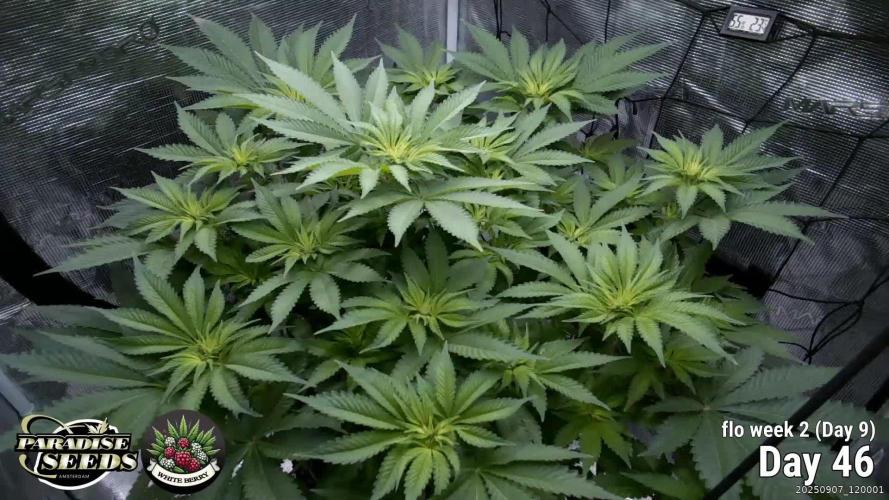
Week 2 of flower has come to an end. The tent is starting to get a bit of a smell now! really nice.
she is budding up alright. Fading out Terra Grow, last watering was 1 ml/L down from 5, and at the same time ramping up Terra Bloom now. Watering in Week 3 will consist purely of Terra Bloom 5ml/L, week 4 will se the addition of green sensation. Also no more Power Roots. I did however added one more dose of great white mycorhizzae again in the laster watering.
Watering is still 6L, around 6PH, every 3 Days with above mentioned nutrients.
I did try my hand at some lollipopping and some defoliation again. i removed everything in the bottom 1/4th of the plant.

Likes
1
Share
@Huckleberry39
Follow
Great grow!! Should end up with over a half a pound off of these 2 and the little I harvested about 2 weeks ago. I got 2 oounces dry off of her. They smell amazing and are covered with trichomes

Likes
8
Share
@4leksz
Follow
This Week i changed the solution and flush with flora kleen once again.
I have significant nute burns on many plants EC was rising on 1.7 optimum was on 1.4 to 1.5.
Maybe the reason for this is the Lights
I turn them up to 600w each now consuming 1300w with the led roundabout i need to make white foil over the tanks to get them not too hot inside.
Big Bud have sorted out because he was dying and have put the biggest plant in one tank alone so they is doing beautiful :)
Ph is Stable to 6.1 to 5.8 in each tank
So far looking forward on many problems solving and knowing for the next run :)
Happy Green Sunday :D


