


Likes
Comments
Share


@Puckdodger
Follow
Feed and defoliation Tuesday evening, was a little bit of work but a lot of fun too. Put some music on and giver! Was careful to try not to overdo it with the scissors, I even lay down on the floor and looked up from underneath to see how it looked that way. Buds are getting dense and sticky, the trichomes are starting to frost things up a bit. I can't wait to see where these endup. Next feeding I'll increase the amount of nutes a bit, according to schedule.
Fed Friday night, 5 litres of Remo week 4. Did a bit more defoliation I missed, like a dozen leaves per plant. I dunno, that could be smart, could be stupid. We just don't know. Now I'll let em boogie on down to the finish line and give em lots of light and love and tunes and tickles.
Gonna give em week 5 nutes on Monday 😎 Not sure how much runoff I should be getting. Last time it wasn't more than a few spoonfuls, @ pH 5.7 which seems fine with me as it's a hassle to deal with the excess. I'm sure someone somewhere will tell me I'm wrong???
Likes
3
Share


@BioGrowBayer
Follow
Nach dem Umtopfen ging es direkt weiter mit einem ordentlichen Wachstumsschub – richtig schön anzusehen! Die Pflanzen haben den Wechsel super weggesteckt und legen jetzt ordentlich zu. Alles verläuft bisher nach Plan, ohne nennenswerte Komplikationen.
Die Symptome des Calciummangels sind komplett verschwunden – die neuen Blätter sehen gesund und kräftig aus. Offensichtlich zeigt die angepasste Düngung Wirkung.
Auch die Thripse scheinen erfolgreich bekämpft worden zu sein. Ich konnte bisher keine neuen Spuren entdecken – hoffentlich bleibt das so.
Heute stand noch ein wenig Entlaubung auf dem Programm, um Licht und Luft besser ins Innere der Pflanze zu bringen und die Schimmelgefahr weiter zu minimieren.
Likes
12
Share


@Kingseeds
Follow
This strain has a yield of extra large, compact colas that are heavy in weight and covered in extra adhesive trichomes that stick to your fingers. Cherry Punch's exterior is dark green and exhibits small amounts of midnight purple leaves
Cherry Punch's exterior is dark green and exhibits small amounts of midnight purple leaves. Its aroma is fruity but skunk-like, and has a soft, sweet berry taste that resembles its parent Purple Punch

Likes
33
Share


@BodyByVio
Follow
Harvested 445g dry bud from 300w led light. I consider it a successful grow.

Likes
38
Share


@FrulaFrulaki
Follow
Nothing special this week. I've defoliated the plants this week even though I've planned to to that next week, but it was just getting too messy. I'll need to defoliate even more later this week so that I can switch them to a 12H cycle on the 7th week, and not cause too much stress doing both things at once.
Happy growing 🌿

Likes
18
Share


@GrowingisFunkO
Follow
Week 15 - 06/21 - 06/27
Light - 200 W HPS & 265 W LED
Day Temperature - 78 F
Night Temperature - 68 F
Humidity - 40 +/-5
D50 Flower - Fed the ladies their last nutrient feeding. Raised the HPS and LED lights up and turned the HPS down to 200 W, I am trying to emulate fall by lowering the amount of light.
D53 Flower - Started the flush today with ph'd water and blackstrap molasses. I also decided to go ahead and defoliate one of the clones and both of the scrog plants. I didn't strip it bare, I just cut out the larger fan leaves. I opened the tent today and they were glistening and super potent smelling, I am probably a week away from harvesting!
D56 Flower - Was on a trip and had to water the ladies with a timer and pump, thankfully everything worked fine. Flushed again with FloraKleen.

Likes
17
Share


@RakonGrow
Follow
**** HAARVEST ZOE ****
Nice Strain ,
My little Zoe really made all the mistakes you could possibly make. No matter when I give light or want water or fertilizer. It grows and grows and grows, the main thing is that there is light. It was one of my free seeds from Zamnesia. So far all seeds have germinated. I store my seeds in a dark, airtight container at 6°C. Tastes kind of sweet after curing.
Greenhouse Feeding is a really easy fertilizer to use. I used the BioEnhancer again and again. My little Zoe thanked me. The BioGrow was used as topdressing and is doing its job. The BioBloom also does its job at the right time.
And that's really great and easy if you don't have an autoflower. Of course there is a corresponding product. But I was happy to get anything here at all. Legalization has wiped out the market. But for next time I have an appropriate soluble fertilizer for fast-flowering plants. It doesn't work for 8 weeks :))
I use a Sanlight Evo 3-60 1.5 with Bluetooth dimmer. There's nothing to complain about there. Set daily cycle via app. Helpful if the weather or environment is so bad that you have to regulate the light intensity.
33g after 5 days dry . 24.5 °C to 22°C with 50%-60% .
curing in a vaccum box at 18°C .
It looks like I'm drying too long. // It tastes a bit crunchy.
Day 79:
trim , slow vacuum box to cure 22°C and 61%rH .
Day 76:
videostuff: been drying for 4 days (res 640x480) ( optical zoom x200 - x250 )
Day 72:
DLI usage total this Plant : 2236.6 DLI in 70 Days .
wet trimmed, cut off, hung upside down. see you after 14 days
Day 71:
preparing for harvest . 24h long night session .
DLI : 0
Day 70:
- Sanlight DaylightCycle
- + ON 200PPFD (00:00) - 800PPFD (03:30) - 800PPFD (16:30) - 200PPFD (18:00) OFF
video and photo tryouts with the digimicro mobil x300 optical zoom , mostly freehand
Day 69:
- Sanlight DaylightCycle
- + ON 200PPFD (00:00) - 1000PPFD (03:30) - 1000PPFD (14:30) - 200PPFD (18:00) OFF
incredibly hot and rain. lost some terpene :)) Well, summer is coming,
Day 68:
- Sanlight DaylightCycle
- + ON 200PPFD (00:00) - 600PPFD (00:30) - 800PPFD (03:30) - 800PPFD (14:30) - 600PPFD (17:30) - 200PPFD (18:00) OFF
- Added 1L bottle of water
It's hot, hot, hot, Zoe would like more water.
changed daylight cycle so it match the weather problems. tent is open until my real night comes.
103 flowers (including popcorn) counted, due to an accident about 15 flowers are missing.
Day 67:
- Sanlight DaylightCycle
- + ON 200PPFD (00:00) - 600PPFD (00:30) - 900PPFD (03:30) - 900PPFD (14:30) - 600PPFD (17:30) - 200PPFD (18:00) OFF
- watering bottle water 1.75L
weather to hot , changed daylight start time and daylight cycle so it match the weather problems.
I'm lucky, buds are still growing :)))
Day 66 (we are on the road with maximum sanlight )
- analyse some trichome .
- make some Zoom Pics and Video stuff .
- Sanlight DaylightCycle :
- + ON 200PPFD (00:00) - 1000PPFD (00:30) - 1000PPFD (13:30) - 800PPFD (17:30) - 200PPFD (18:00) OFF
- DLI will stress alot ...
Anyway, it's too hot in my room... I open the tent and now everything is fine with the temperatures and I increase the Sanlight to 100% for the first time. May Zoe love it or leave it :)) We'll see what happens
Day 65 :
Sanlight DaylightCycle : ON 200PPFD (00:00) - 800PPFD (00:30) - 850PPFD (13:30) - 800PPFD (17:30) - 200PPFD (18:00) OFF
It will soon be ready for harvest.

Likes
13
Share


@Robeeriegenetics
Follow
Week 15 going good…not bad …switching to bloom nutrient… and did a ton of defoliating to loosen up the canopy hopefully they won’t grow too much when I flip them to 1212 in a week I’ve seen these plants three times the size. Hopefully I can stunt that growth during the initial stretch by switching to Bloom nutrients early. Defoliating a week before flipping. I may decide to top them more but I probably won Do I have to type here for it to be green this is crazy. I’ve done more than a paragraph now at this point it’s kind of weird that it’s not green be green what the hell can it still not be green
Likes
7
Share


@gablmo
Follow
Another busy week with the vege. I gave it microbes, a HID lamp at 400 watts, sprayed for bugs and also covered the media with plastic wrap to get rid of 3 or 4 gnarts and of course a had another flood with the GoGro water system and I took one plant out of the garden because she is frozen in time. I still don't know why. The trellis is doing good. Lots of work.

Likes
12
Share


@FrecheOma60
Follow
Die meisten sehen relativ gesund aus, außer der große hintere. Dieser ist so extrem gestretscht, dass ich die lampe nun nicht mehr weiter weghängen kann. Ich habe die Stränge hinten noch mehr runter gebunden. Da die Pflanze etwas verkümmertes Budwachstum zeigt. Ausserdem bis jetzt die einzige Pflanze mit lila Stamm, vermutlich wegen Lichtintensität. Die restlichen entwickeln sich dann doch recht gut.

Likes
8
Share


@Philippovic
Follow
Die Temperaturen sind seit einigen Tagen sehr niedrig, was ich versuche, möglichst zu regeln, indem ich den Lüfter bis auf 10 % gedimmt habe Und eine Heizmatte im Zelt habe. Tagsüber hält sich die Temperatur relativ gut bei 18-20° nachts fällt sie auf 16° wenn das Licht aus ist.
Die Pflanzen wurden entlaubt und beschnitten. Sie entwickeln sich toll und werden langsam schön purple ❤️

Likes
57
Share


@Kmikaz420
Follow
Et voici le reste du jardin (sans la cherry cola qui sèche deja;)
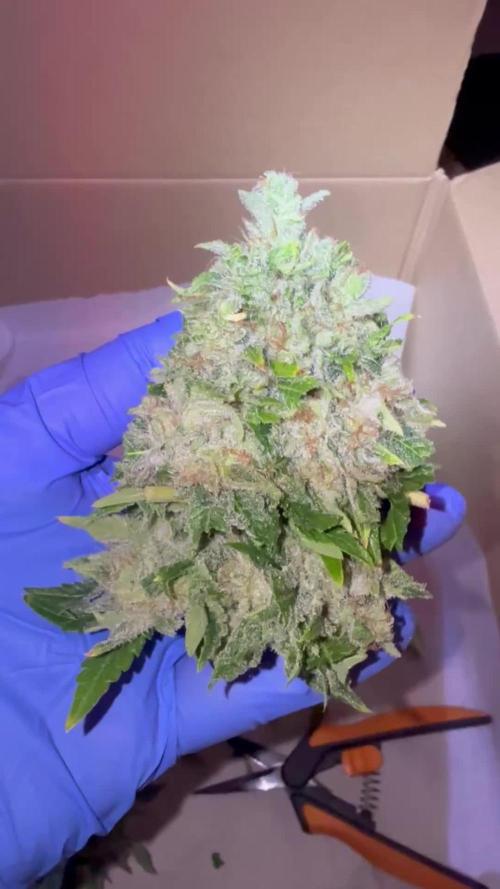
Rien à signaler à part les 2 monstre dans la tante qui n arrêtent pas de grandir ;) j ai fais une defoliation aux 2 ainsi qu aux dos i dos (qui produisent pas mal de feuilles à enlever;)
Mais autrement elle aussi évolue bien .
Demain la 2eme cherry cola va être recolter ainsi que la gorrilla x purple punch , et le reste du jardin ça continuer sont chemin encore une semaine avec nutriment puis on passera au flusch voilà voilà on y arrive tous doucement à cette douce et tendre recolte;)
En espérant que se que vous voyez vous plaît ;)
Bon dimanche à toute et tous je profite de vous postez quelque photo du jardin presque au complet (vue que j vais couper la cherry cola 2 ..et la gorrilla x purple punch
Mention spécial à la dos i dos de barney qui m étonne de jour en jour plus une odeur folle de kusch ,des têtes dur comme la pierre, et pour une plante de 40cm elle va faire une bonne recolte !! (A voir d ici une semaine voir 2 ) et j ai dans les dos i dos comme pour les strawberry x gorrilla 2 pheno différent
Un des pheno de strawberry prend 2 voir 3 semaine de plus à finir (j avais se pheno à mon premier journal de strawberry x gg4..
Dommage car l autre pheno est juste magnifique avec des têtes énormes (c celle de droite ) et elle fini bien plus tôt que l autre.. bon c été à peut près tout j voulais juste mettre quelque souvenirs en plus de ces magnifiques ladys 😀


Likes
78
Share


@Roberts
Follow
Pure Ice cream is doing great under the Spider Farmer G5000/UVR40 lights, in the Athena blended line nutrition. Shecis starting to flower nicely. The color mutation part is growing good. The plant is growing really Strong and healthy. Everything is going great. Thank you Spider Farmer, Athena, and Pure Instinto Seeds. 🤜🏻🤛🏻🌱🌱🌱.
Thank you grow diaries community for the 👇likes👇, follows, comments, and subscriptions on my YouTube channel👇. ❄️🌱🍻
Happy Growing 🌱🌱🌱
https://youtube.com/channel/UCAhN7yRzWLpcaRHhMIQ7X4g
Spider Farmer Official Website Links:
US&Worldwide: https://www.spider-farmer.com
CA: https://spiderfarmer.ca
UK: https://spiderfarmer.co.uk
EU: https://spiderfarmer.eu
AU: https://spiderfarmer.com.au
G5000 Light Amazon Link:
amzn.to/4643esa
UVR 40:
https://www.amazon.com/dp/B0BR7SGTHS
Discount code: saveurcash (Stackable)

Likes
14
Share


@DeeznugzAutoFlowers
Follow
This week she got top dressed with Gaia Green's All purpose 4-4-4 and Glacial Rockdust.She also got a little more LST and she is loving the treatment

Likes
9
Share


@Wakesk8
Follow
6 week flowering stage for those babies!! Looks good but I found some thirps and I’m fighting with water/garlic and but of neem oil. Hope everything will be good till the end. Let’s bit how many grams I will make for my self with those 4 babies!!


Likes
8
Share


@KratkyGrow
Follow
My smallest plant is starting to turn purple!
It's always exciting when you don't know what you're growing to see changes like that. Past crops of my mystery seed have been potent indicas when they turn purple. I'm hoping for that this time around too.
No nutrient feed this week, here's the stats on each plant individually.
P1 (looks like indica) Around 3200 PPM, 5.2 pH
P2 (starting to turn purple) Around 5100 PPM, 5.1 pH
P3 (Probably sativa or hybrid) Around 3800 PPM, 5.3 pH
P2 has always had a higher PPM, no signs of burn though. I just don't feel the need to add anything with the PPM for each plant being so high. I still think I'm about a month or less from harvest so I'll leave them as they are until I do a flush water change. Starve them for the last week or so.
I took lots of pics this week and a video that I think turned out pretty good. Very photogenic plants right now. Buds look great, they're bulking up really well and trichome density is fantastic.
They all smell really nice right now, each has a different scent. Outdoors the smell isn't overwhelming, especially with the small plants, but when I walk up to them I can smell them from a few feet away.
A small nugget tore off of P1 when I was trying to remove a leaf that was curling up, I'm going to dry it for a few days and use it as a test smoke. Lots of trichomes even on the leaf that was curling.
Likes
32
Share

@Cooky_420L
Follow
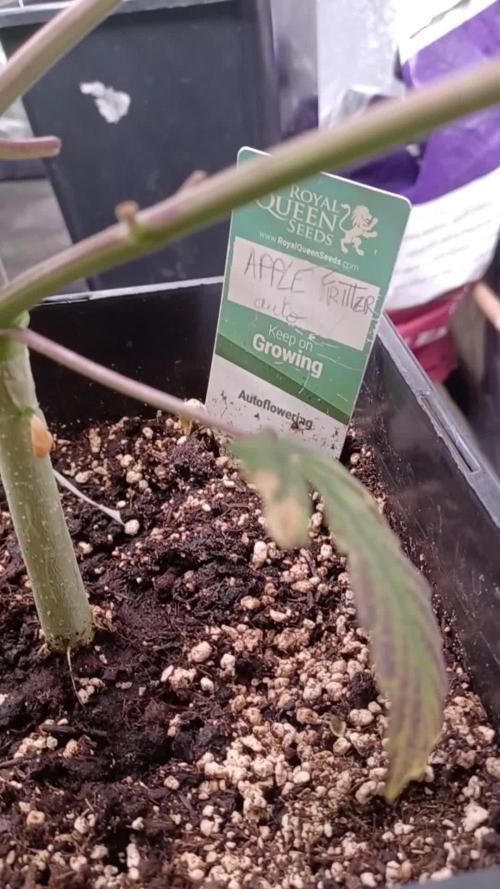
je me suis trompé de journal pour cette mise à jours fait partie du journal Appel Friter.
Merci les Growmies bonne semaine de croissance les p'tites ✋️ vertes 🌱🌞🌱


Likes
11
Share


@TOTEM
Follow
I don’t say I’m impressed, because it wouldn’t be enough. This plant stretched in a way that I’ve always dreamed about. She’s a REAL sativa, but not all the phenotypes are the same. My other Dance World is not as strong as this one, and she’s not going to become as tall as this as well.
The heat lamp is now very close to her pot, and this makes the soil to drain up faster. This means that I have to water (+ nutrients) twice a week, instead of one like all the other plants inside the grow room. But this is not a problem since she’s very big and needs a lot of food to manage all that stuff.
Likes
42
Share


@MadeInGermany
Follow
Unfortunately, I had to find out that my account is used for fake pages in social media.
I am only active here on growdiaries.
I am not on facebook instagram twitter etc All accounts except this one are fake.
Flowering day 35
since time change
to 12/12 h.
Hi everyone :-) .
We got lost in the middle of bloom.
The buds are developing really well 😁.
The scent gets stronger every day when you open the tent .
I watered it twice this week with 1.2 l each time (see table for nutrients).
Almost every leaf was examined for animals and diseases.
Everything looks great 👍.
I'm really looking forward to the coming weeks and I wish you all a lot of fun until the next update.
Stay healthy 🙏🏻
You can buy This Strain at :
www.Zamnesia.com
☝️🏼☝️🏼☝️🏼☝️🏼☝️🏼☝️🏼
Strain
Gelato clone from mother (Zamnesia )
☝️
Genetics: Wedding Cake x Gelato x Gelato 33
Vega lamp:
2 x Todogrow Led
Quantum Board 100 W
💡
Bloom Lamp :
2 x Todogrow Led
Cxb 3590 COB 3500 K 205W
💡💡☝️🏼
Soil :
Canna Coco Professional +
☝️🏼
Fertilizer:
Green House Powder Feeding
☝️🏼🌱
Water:
Osmosis water mixed with normal water (24 hours stale that the chlorine evaporates) to 0.2 EC. Add Cal / Mag to 0.4 Ec Ph with Organic Ph - to 5.5 - 5.8 .