


Likes
Comments
Share


@Santi_nf
Follow
Ya está empezando a verse diferente poco a poco muchacho

Tutti Candy · Zmoothiez

Critical Widow · Pev Seeds

Sweet Skunk Fast Version · Sweet Seeds
Skywalker OG Runtz XL Auto · Sweet Seeds

Cheese Berry · 00seeds

Hard Diesel · Gea Seeds

Scrambler Haze · Blimburn Seeds
AK · Gea Seeds
Cachalote · Gea Seeds
Gealato Kush · Gea Seeds
Gorilla Glue #4 · Gea Seeds
Somango · Gea Seeds
Likes
9
Share


@InceptionFarms
Follow
Wasn't able to top until day 26. Took 3 clones (max in IL is 5 plants over 5 inches) while topping. Will probably start working on another 3x3 tent this week. Day 28 I super-cropped the new main branches and trained down.


Likes
7
Share


@VanillaGorilla
Follow
OCT 14 - DAY 53 - Looking good she's a bit smaller than the other two but still looks great.
-----------------------------------------NEW RESERVOIR OCTOBER 14 2020---------------------------------------------

Likes
19
Share


@Aqualung
Follow
WOW these two beauts are really filling out! No complains from me just wish I LST the SBR like i did the Dinafem but at the time the SBR wasn't as bendy as the Dinafem, it is amazing what one bend can do to help produce more bud sites. I'm sure that one big cola from the SBR is going to very nice looking though! My next photoperiod grow I will prob top, LST and trim, but i need to do some research again because I forgot everything lol 😅. My next grow journal is up! Growing two Seedsman Pink Kush CBD 1:30 Autos! 👍

Processing
Likes
10
Share


@GrowerGaz
Follow
This week just water from the autopots and a soil soak with some bio enhancer . Plants are really starting to smell now . Resin production on the Rado z is insane. Sadly they did not make the cut for the next drop. Happy to have been able to test them. I think they look and smell great.


Likes
12
Share


@HAPPY91
Follow
Week 13 3/10/2021-3/16/2021:
Day 84 3/10:
Played Hip Hop Radio. Mixed 3 tsp Liquid Squid fertilizer to 0.75 gallons water=149 ppm 5.9 ph 69 f. 65.7-72.1 40%-60%
Day 85 3/11:
Played Santana Radio. 66.6-73.9 39%-57%
Day 86 3/12:
Played Classic Rock Radio. Mixed 3 tbs Blue Stream and 4 tsp Liquid Squid fertilizers to 1 gallon water=162 ppm 5.8 ph 66 f. Only drank 0.75 gallons with some runoff. 65.7-72.5 40%-57%
Day 87 3/13:
Played RAIGN Radio. 64.0-72.9 35%-56%
Day 88 3/14:
Played Reggae Radio. 65.8-72.7 41%-56%
Day 89 3/15:
Played Classic Rock Radio.
Day 90 3/16:
Played Mexican Radio Happy Taco Tuesday. Drank 1 gallon plain water=48 ppm 7.4 ph 70 f. 66.0-73.6 34%-49%
Final Weekly Notes:
This amazing girl is growing amazing. She is starting to really fill in all the spaces on each branch and soon starting to swell. Even her leaves are starting to bud a little. I am very excited and happy that she is very comfortable in the tent. As always feel free to leave a like comment question or even give that follow button a tickle. Always learning something new everyday. Thanks so much for stopping by and checking out my grows. Good luck stay safe happy growing cheers!!!!!!


Likes
23
Share

@SwabianMadness
Follow
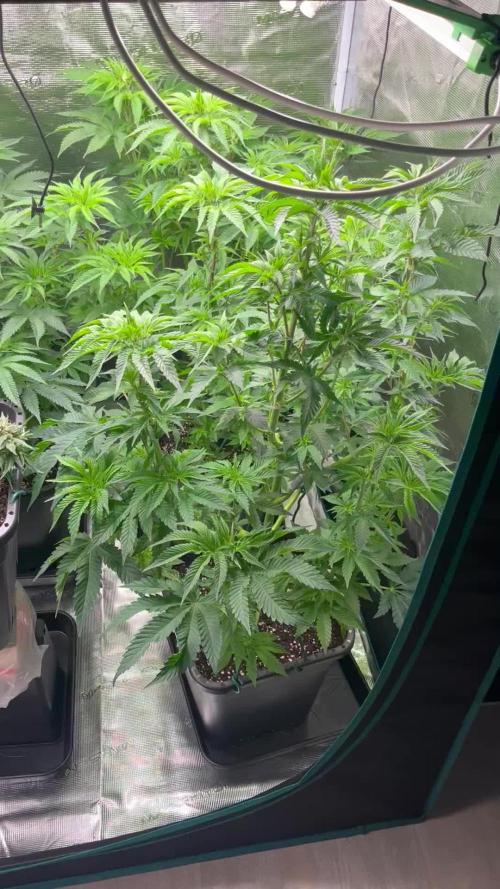
Was little bit nervous when i see them after the 5 Days. The Tent looks so empty because the Leafs hang down. I gave them 1,5 Liter of Water with Calmag. And next morning everything looks fine again 😊
The Stems where i cropped them are healed almost. Just two needs some Days more
It’s done with the vegetative Stage. They get to big if i wait longer. Gave them yesterday a Top Dressing with Mega Worm. And 15ml of Orgatrex in 6 Litre of Water. After one Litre the Pots are full. The other one i give them today
One thing i learned this Time is that you better don’t run IR Light on Vegi because the Nodes stretch to much. But the Photosynthesis Rate had a big Push..
Hope i can get the Ladies under Control

Likes
8
Share


@MTUZZIO
Follow
starting to see some crowning. nice stretching going on. very happy with how it's all going (except for the wyze camera timelapse, which still stops working halfway through the week)
I do have some weird stuff going on with one plant, I'll post some pictures, if anyone has any advice. the only thing I can really find online that looks like this is tobacco mosaic disease, but I don't think it's that. maybe this one plant had a little extra stress or something. I have some of that mosaic looking pattern. it's showing up mostly on one plant, and like two leaves on one other plant. maybe calmag defiency? i guess it can kind of look like that, and my RO system was down for a week or two so I had to use tap water, and to keep EC consistent that meant less nutes for a week or two (that was taken up by the tap water EC of like 150).
anyway, super excited. wish i had more to do, but it's pretty much just riding it out at this point. was crazy busy with work this week, i wanted to have got in a good defoliation already but I will get to that this weekend. going to remove everything below a certain point, all the lower leaves and the lower nodes that aren't going to make it to the top. probably going to put a trellis net up as i don't think they are going to be able to support their own weight once they start to really stack. i may do one or two final foliar sprays, all organic stuff, but one last IPM and maybe one amino acid / coconut water / aloe / bloom boost after the defoliation, just to help them bounce back quickly as i'm going to be removing a lot of biomass. all that is organic and there are barely flowers on so i'm not worried about it.
getting such a strong lemon scent off these already, skunk is starting to come in. can't wait to get some real flowers on them and for the terps to develop.
i'm not going to judge yet, but i think if i was to run these again i wouldn't do quadline. quadline was super interesting to me when I first started growing, but after having a bunch of grows under my belt, really i think my preference is to mostly let them grow natural, maybe supercropping the main cola, but my favorite grows have been the ones i did the least amount of hard training on. not sure why i decided to quadline this run, but i'm happy with the even canopy so it's all good

Likes
35
Share


@Eryan
Follow
Day 42 - Kinda crazy how fast it's gotten to be day 42 (the meaning of life - *) in the grow. Haven't watered yet. Plan on doing that with the above nutrient schedule tomorrow or the day after. And I think that might be the last time I give any nutrients to the plant. Pistils are beginning to curl, and I've seen (just a few) amber tirchomes on one bud. I want to harvest on the earlier side because I don't want this harvest to have a big couch-lock effect. Prefer a more cerebral high, although some bodily relaxation is nice too.
So I think I will be harvesting at the latest by April 10th (Day 56). Of course I will continue to watch how the plant develops and if no further trichomes are turning yellow/brown in a week, I'll wait longer.
The trichomes on the sugar leaves have a wonderful lemon citrus smell by the way. Not what I was expecting, but that's fine 😛
Day 45 - Made a video of the trichomes. They definitely look cloudy enough to me. No more nutes for sure, harvest in 10 days max I think.
Likes
12
Share


@LSchnabel
Follow
A great run! Had a ton of fun filling this whole tent in with one plant! I think I way do this again with an overgrown mother.


Likes
11
Share


@RamboGringo
Follow
This plant is Definitely a weird one growing one fingered leaves. Light penetration is perfect so I didn't have to train. Unfortunately 3 weeks of her life she grew under the older plants, and didn't get much if any light exposure. The buds would have been phenomenal had I got 3 more weeks out of her


Likes
Comments
Share

@ThreeLittleHerbs
Follow
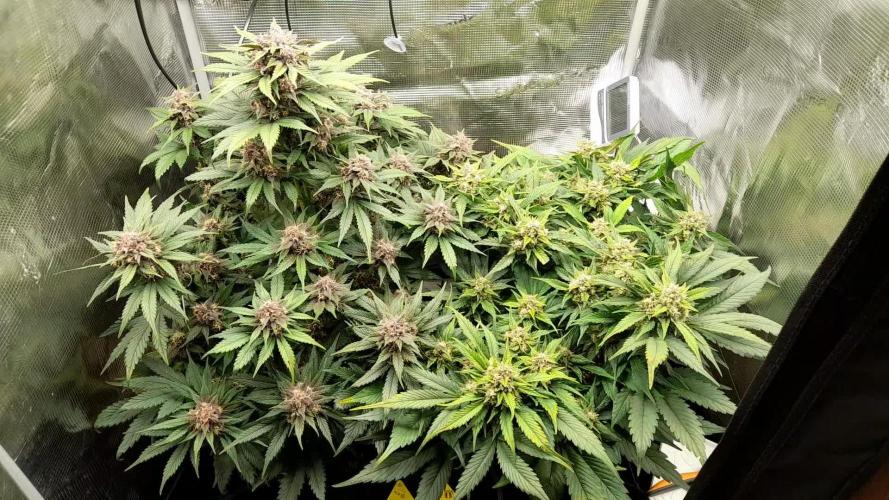
Lemon Cherry is maturing very fast, already looks, like i could harvest it very early now, but i do not. Both producing a lot of smell now, Lemon Cherry is more Cookie like, Papaya has a very fruity smell. 😎

Likes
9
Share


@Staffedition
Follow
Привет друзья.
Наше знакомства продолжается с новым сортом автоцветущих растений от Smail_Seeds сорт ORIGINAL AUTO CHEMZKITTLEZ F1 reg.
Сегодня растению 47 дней.
Растение очень хорошо развивается, ни каких сбоев в генетике не наблюдается.
Шишки наливаются😀
Сорт выводим сами.
Смотри мой профиль, у нас всегда есть что то интересное.
Не забудь поставить лайк❤️, если понравилась как прошла неделя
И читайте наш TELEGRAM: https://t.me/smail_seeds
#Smail_Seeds 😀
Likes
18
Share


@eldruida_lamota
Follow
La primera semana de floración les sentó bien la echaron su sexo, hembras, ahora ya queda ir viendo cómo se forman las flores.
La temperatura no pasa a los 30 nunca.

Likes
Comments
Share


@loyallion
Follow
PPFD 300-400 PPFD
Start brewing compost tea 10/10 at 1500, for 24hrs.


