The Grow Awards 2026 🏆 








Likes
Comments
Share
@GREENPHOENIX6262
Follow
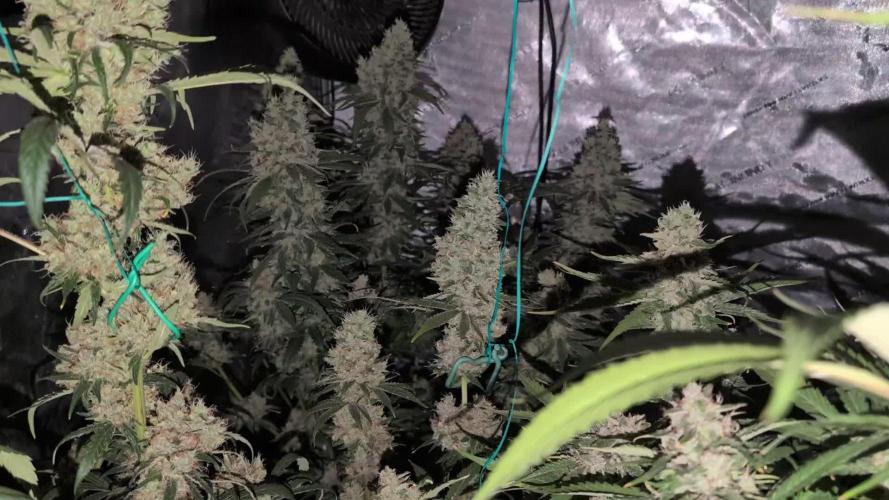
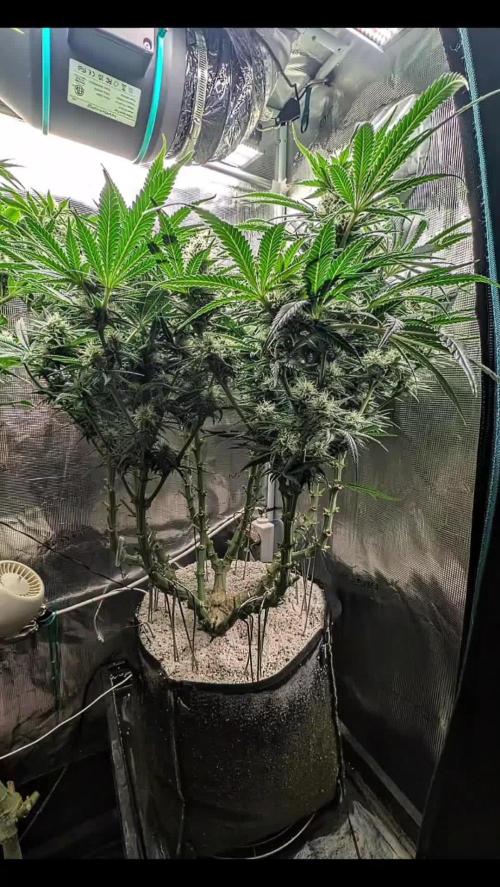
*03/01 - Week 8 (Week 4 flower) - Heavy Flower Fuel and Cal mag every other day - 18/6 light till harvest- Colas are getting heavy and terps coming in nicely - Lite defo*

Likes
101
Share
@DogDoctorOfficial
Follow
.
So were should i start lol they all growing and streaching as they should.
I tested my run outs ( since they all drink and eat diferent i've been testing all of them😅) and some are coming out a bit too hy for my taste (EC at 2,86 in one of them) so i'm going to start and do alternade feedings. one time with nutrients onother just water and test again to see if the numbers are more of my taste lol , PH is coming out at 6.1, that one i liked 😄
Apart from that yesterday i gave them a good air cut to help the ligth pass and to take out everithing i thout wasent nessesaire. they loved lol
I intruduce a bag of CO2boost, the boost buddy bag, this will help incrissing what ever CO2 numbers i have in there ( need to by a CO2 monitor )
Girls:
1-BlueBerry
2-Alaskan Purple
3-Poyote Gorilla
4-Hindu Kush
5-Whitw Mango
6-Super Glue
7-Badazz Cookies
8-S.A.D.
tent -8x8 / 2.4x2.4 but i'm only using 1/2 so 4x4 / 1.2x1.2
Led - Lumatek 465w Compact Pro at 100%
All i Grow is medicine for myself,
Stay safe, stay tuned and B Happy
Peace out
D


Likes
8
Share
@NORTHWALESAUTOS
Follow
Nice looking plant yhats for sure. Had no problems at all.. finally in flower. So the next Couple of weeks will interesting

Likes
3
Share
@Unculti_responsable
Follow
Bueno esta semana se amoldaron muy bien las ramas a la malla ya se levantaron y están engordando muy bien tiraron bastante resina y bienes muy bien, esta va a ser la última semana se fertilizantes después de esta semana vamos a empezar con el lavado de raíces, esperemos que sigan así de bien !

Likes
4
Share
@Kelly420
Follow
Okay so after 48 hours instead of 24 of darkness. These ladies were begging to be chopped with how much more intense the smell got. Cheesy , sweet , skunky , and a floral incense kind of scent. Made lots of finger hash just getting them off the plants , already smoked.
I’m about 75% done with chopping all the major tops. This time I decided to cut off the branches and dry on an eight tier 24” diameter rack off Amazon. All 8 tiers are full with gorgeous top colas.
I’m drooling. Can’t believe just how much bud this is turning out to be. They are dense , and oozing. Not going to get a wet weight because this is just too much. But holding the rack it’s like 20 lbs or more. My scales don’t go that high. Lol.
Gotta say it, I think my buds look 10 times better than the advertisement photos g13 lab’s mozzarella. My 2 cents and honest opinion. Please do give me your opinions.
I know I didn’t show the full grow because life gets busy. My next grow I want to control the humidity and heat levels a bit better. Or just humidity and run co2 to withstand higher temps. I have every angle of the grow under my tips now. It feels amazing to have this kind of harvest after the dedication these plants received. I’m Convinced…. rdwc with a water chiller , is by far the best way to do hydro. When it’s dry I’ll add the final weights.
My nutrient reg is this. Jacks 321 , botanic are cal mag plus, hydroguard,PK booster is flower fuel(purple can off Amazon) and unsulfured molasses. If you don’t have an ability to keep water at 70 degrees then only use jacks hydroguard and cal mag. You’ll still do well but that molasses , that sauce is the boss.

Likes
44
Share
@Chedderbob112
Follow
El living la Vida chedda mother Fukin Bob 112 here wee fuking go usual rite troops need tae go see a man aboot a dug


Likes
97
Share
@Master_weeda
Follow
Bonjour à tous les padawans et maîtres jedis
Merci à tous les growers qui m'ont aidé
À @laBOSSANOVA @Jésus @belzebut @vvince @Castafunk @bidou
JE ME SUIS RÉGALÉ !
Likes
26
Share
@Hawkbo
Follow
Videos were taken on day 37 of flower. The mac x peanut butter breath plants are looking great ones in the back left and ones in the back middle towards the right side. They have more orange pistils at this point than all the other plants and are packing on the frost. I gave all the plants just plain water with herculean harvest, enzymes and humic acids last feed and flushed it a little but and it seemed to respond well. The rocstar breaths are frosty too and smell gassy. Also, I just checked some of my DMs on here and theres alot that I've never responded to, I dont check them unless it's from a business. I put in a few diaries a while ago if anyone has any questions for me to ask them in the comment section or a journal that way people with the same or similar questions can see it and I dont have to answer the same thing 8 times. I'm happy to answer any questions about my grows and shit just try to ask them in the comments✌️
Likes
Comments
Share

Likes
11
Share
@Haoss
Follow
The plant has started active flowering, is actively fed, feels very well 💚❤️💜

Likes
7
Share
@Skull
Follow
Had good growth has anyone grown this strain Buddha magnum Auto the leaf looks indica it suppose to be roughly half half never seen leaf like this looks different to hybrids grown in the past

Likes
76
Share
@Nugs_are_us
Follow
Hey all welcome to week 7 of flower!!
The lady’s are slowly gaining some thickness of there buds and just going along quiet nicely. A tad smaller buds than I had hope for but that’s just life ain’t it.
We have had a quick look through the scope and think they will run for about her 2 weeks so they may fatten up a little more.
Until next week happy growing 🤙🏻

Likes
9
Share
@Canna96
Follow
Hey now, I hope everyone is having a relaxing weekend. The ladies are getting close, all trichomes are white and milky with very little amber, so I decided to start the flush today, and I will harvest the Apple Fritter and Durban Thai X C99 next Saturday. I did harvest the Donuts and Cherry Gar-See-Ya and I will post some pics and a smoke report once cured. Thanks for stopping by and Blaze On....


Likes
14
Share
@GrowBuv
Follow
Time to try out some new strains
This time we have Purple Lemonade from FastBuds!
Started off with 24 hours in a glass of water then into a paper towel,then once the taproot was about half an inch I transferred her into a coco pellet. Once she’s broken the soil it’ll be into the tent.
Day 3
Looks like it’s time to up pot her and get her under the light.


Likes
36
Share
@Themythicalchristine
Follow
These plants are tremendous!
they smell incredible, cheesy and fruity, very blueberry and purple kush like.
These plants have packed on some good weight this week, they look great as we move closer to harvest time.
This week we watered with fresh water and a molasses water mix.
We are allowing these to munch up the last feed worth of nutrients, and slowly flushing them to prepare for harvest in a few weeks time.
Very pleased with these three 🥊
Likes
22
Share
@eldruida_lamota
Follow
Vamos que os explico un poco critical es una variedad indica con una floración rápida, sus flores son compactas , y bastante resinosas, tiene aromas fuertes.
El ambiente en el secado estuvo en 23 grados de media y 40% de humedad se pasaron rápido al bote de cristal, 7 días en concreto.
Hasta aquí todo familia, espero que os agrade un saludo y buenos humos💨💨💨

Likes
181
Share
@yan420
Follow
🌸🍊✨🍭🌸🍊✨🍭🌸🍊✨🍭🌸
Back at it with Kannabia — huge thanks for the NEW EXCLUSIVE Upcoming Kannabia's seed Launch 🙏🍨🍊
Grateful for the trust and for everyone following along, I’ll run her clean and showcase what she can do.
Dessert-party goals: berry–citrus sherbet terps, creamy finish, tight stacks, easy trim, zero drama.
Veg 24/0, clean manifold + LST, flip on a happy, even canopy.
Coco’s fresh, seed goes in now. 🚀
Added on 12.10.2025
🌞 Light conditions: Limited direct light for the first 4 weeks — ~4 h/day on weekdays and ~10–11 h on weekends due to tent sharing and work schedule.
🌸🍊✨🍭🌸🍊✨🍭🌸🍊✨🍭🌸
💭❗💭❗💭❗💭❗💭❗💭❗💭
❗Events & thoughts worth noting❗
💭❗💭❗💭❗💭❗💭❗💭❗💭
10.08.25 GW1 Sowed seed, soaked starter pot with #1
12.08.25 GW1 Seed popped hip hip hurray
28.08.25 VW2 Stopped using GreenBuzzBloom, took it out of the schedule.
01.09.25 VW3 TriPartMicro 10→30ml, TriPart bloom 10→30ml
12.09.25 VW4 Applied nemadodes against thrips and fungus gnats.
20.09.25 VW6 topped and trained for first time, decided against a full manifold as I lost a few weeks already.
26.09.25 VW7 Topped her one more time for 8 mains
27.09.25 VW7 Topped up the pot with perlite instead of clay pebbles this time, just trying things out, TriPartMicro 30→40ml , TriPartBloom 30→20ml
10.10.25 VW9 have her a haircut, umm be trimming the side shoots tomorrow, rest in the video 📹
12.10.25 VW9 done some extra trimming to clean up a bit and chose two extra side shoots to nurture info mains, so kept the 8 original mains plus 2 rest in the video 📹
17.10.25 VW9 FfJ/fpj fish mix 30 → 60 ml
20.10.25 VW10 Feed tweak: added 3 g Calcium Nitrate/ 30 L (≈ 15 ppm N + 10 ppm Ca)
24.10.25 VW11 did a defoliation and trimming session 📹
27.10.25 VW11 Epsom Salt 0 → 2.5, Calcium Nitrate 3 → 9 g
01.11.25 VW12 CalMag 60 → 30ml, TriPartBloom 20 → 30ml, Magnesium 2.5 → 3.5g
02.11.25 VW12 Did a cleanup in preparation for flowering, rest in the video 📸
12.11.25 VW13 Did another cleanup in the tent 🎥, also switched to the FERMAKOR PK Micro schedule, (10.11.25) added Phosphoric acid as a pH down in preparation for flowering
14.11.25 FW1 FERMAKOR PK Micros 40 → 50 ml
05.12.25 FW3 about 2 weeks ago Calcium Nitrate 35 g → 25 g, FERMAKOR PK Micros 50 ml → 60 ml
🌱💦🌱💦🌱💦🌱💦🌱💦🌱
🌿 Day to day tasks & actions 🌿
🌱💦🌱💦🌱💦🌱💦🌱💦🌱
05.12.25 FW3 – Fed 5l of #1 → 2l runoff
06.12.25 FW4 – Fed 5l of #1 → 2l runoff
07.12.25 FW4 – Fed 5l of #1 → 2l runoff
08.12.25 FW4 – Fed 5l of #1 → 2l runoff
09.12.25 FW4 – Fed 5l of #1 → 2l runoff
10.12.25 FW4 – Fed 5l of #1 → 2l runoff
11.12.25 FW4 – Fed 5l of #1 → 2l runoff
12.12.25 FW4 – Fed 5l of #1 → 2l runoff
(*RUNOFF reused for tomato plants)
💧💦💧💦💧💦💧💦
🌱 Nutrients in 30 L #1 Veg – FERMAKOR
💧💦💧💦💧💦💧💦
Calcium Nitrate (Calcinit / Nitcal): 45 → 40 g → 35 g → 25 g
= 1.50 g/L → 1.33 g/L → 1.17 g/L → 0.83 g/L
= 207 ppm N / 253 ppm Ca → 184 / 225 → 161 / 197 → 115 / 141
PK Concentrate (FERMAKOR Base): 30 → 40 ml → 50 ml → 60 ml
= 1.00 → 1.33 ml/L → 1.67 ml/L → 2.00 ml/L
→ balanced 1:1 P:K + light micros (from extract)
Home-made FFJ/FPJ (Fish + Veg): 30 ml
= 1.00 ml/L
Epsom Salt (MgSO₄·7H₂O): 8 g
= 0.27 g/L → ~26 ppm Mg + ~35 ppm S
Fetrilon Combi 1 (Micros): 0.5 g
= 0.017 g/L
→ Fe 0.7 ppm · Mn 0.7 ppm · Zn 0.3 ppm · Cu 0.3 ppm · B 0.1 ppm · Mo 0.02 ppm
Phosphoric Acid (pH down) + Citric Acid (chelation): as needed
→ First set pH with phosphoric acid, then add a little citric only if you want extra chelation
Target pH: 5.8 – 6.0 (drop test yellow-green)
📦 TOTAL:
Liquids: 60 → 70 → 80 → 90 ml per 30 L
= 2.00 → 2.33 → 2.67 → 3.00 ml/L
Solids (CaNO₃ + Epsom + Fetrilon):
53.5 → 48.5 → 43.5 → 33.5 g per 30 L
= 1.78 → 1.62 → 1.45 → 1.12 g/L
💧💦💧💦💧💦💧💦
⚙️✂️⚙️✂️⚙️✂️⚙️✂️⚙️
✂️ Tools & equipment ✂️
⚙️✂️⚙️✂️⚙️✂️⚙️✂️⚙️
✂️ 2× MarsHydro SP3000
⚙️ MarsHydro 150mm ACF Ventilator
✂️ Trotec dehumidifier (big unit)
⚙️ Mini no-name dehumidifier
✂️ Kebab skewers (LST – stainless)
⚙️ Wire + roast skewers (LST assist)
✂️ Scissors (HST)
⚙️ Vacuum (for spills & cleanup)
✂️⚙️✂️⚙️✂️⚙️⚙️✂️⚙️✂️⚙️✂️⚙️
---
🍊🍧🌬️🍬🍊🍧🌬️🍬🍊🍧🌬️🍬 Mystery seed (Kannabia Seeds) — NEW EXCLUSIVE
🍊🍧🌬️🍬🍊🍧🌬️🍬🍊🍧🌬️🍬
Species: Hybrid (GF / swift-flowering line)
Genetics: TBA (breeder sheet pending)
THC: TBA
Effect: Euphoric, relaxed, creative (target profile)
Flavor: Berry–citrus sherbet, sweet candy, creamy finish
Flowering (indoors): ~6–7 weeks target (GF)
Resistance: High (aim: no drama)
Indoor yield: TBA
Outdoor yield: TBA
Structure: TBA
Notes: Brand-new exclusive from Kannabia’s GF line — I’ll update specs when the breeder card drops. Goal is rich sherbet terps (berry–citrus + cream), low leaf-to-calyx, easy trim. Stage harvest stays on the table if tops finish early.
YouTube Link: https://youtube.com/-m8h?si=A7x4Zlr2kj-_ga31

Likes
34
Share
@Short_N_stockY
Follow
Welcome to week 4 of the LSD-25 grow. Training her has kept me busy all week. Everyday small adjustments have been made to the LST. Since these grow so fast, I started to removed smaller bud sites and some fan leaves. By doing this, she should start focusing her energy where I want to.
I was able to collect rain water for her this week with a dose of Mammoth P. This coming week I'll be brewing her some compost tea as per BioTabs recommendation.
Majority of the training is complete and I am pleased with the results. It's just a matter of time before she is in full bloom. Looking forward to seeing how chunky and purple her buds turn out. At Day 5 of this week, she's already showing some purpose on her main stem
Likes
4
Share
@Growstopher
Follow
Fastbuds seeds
Gorilla zkittles auto
Only using spring water for first week and spraying with foop mist. Going to use foop nutrients with Humboldts secret cal/mag and nectar for the gods ph up and down!
Planted right into substrate. I’m using Mother Earth coco coir/perlite mix with hydroton at bottom of pot