


Likes
Comments
Share


@Spliffi
Follow
Week 7 👍🤙👍🌱
These Girls are stretching!!!🌱🌳🌳
Jon Dabs
Check them out here:
https://jondabs.com
@jondabs Instagram
The Sponsors
Check them out here:
Dutch Passion
https://dutch-passion.com/en/
Hydroponic.co.za
https://hydroponic.co.za/hydroponic/harvesting-and-growing-accessories/
Bud Juice
https://www.gohydro.co.za
The Best Grow
https://thebestgrow.co.za
Dynomyco
https://www.dynomyco.com
Nuclear Roots
https://www.nuclearroots.co.za
Photronic
https://shop.photronic.net
Special Thanks to Hydroponic.co.za. I buy all my products from them. Best service.
Daily updates coming...

Likes
28
Share




Likes
26
Share


@HowtoBubatz
Follow
In the third week of the cannabis plant growth cycle, significant developments occur that set the foundation for future growth and yield. This stage is crucial for implementing training techniques that ensure even canopy growth, promoting optimal light exposure for all parts of the plant.
To ensure uniform growth and maximize light exposure, LST have been applied
By the end of the third week, the cannabis plants have demonstrated excellent growth, supported by strategic training techniques and effective pest management practices.
Despite the plant's healthy growth, the presence of fungus gnats posed a potential threat. To combat these pests, beneficial nematodes (Steinernema feltiae) were introduced into the soil.
Continued monitoring and adjustments will be essential as the plants progress into the next growth stages to ensure a bountiful harvest.
Likes
15
Share


@Litngrn
Follow
Harvest went great but couldn't be happier with 12 oz of off of this girl. I did take a clone that I'm going to try to reveg. I think it's awesome that she turned out to be a photo. At 50 days she was selling those signs of flour until I say River in to 1212 flower lighting and she took off


Likes
5
Share


@johnwill
Follow
Pleased that both seeds germinated and sprouted. The fascination is just beginning.

Likes
2
Share


@Ultraviolet_
Follow
"You will know them by their fruits"
46-47 days from germination, she fills the canopy herself, and the apical dominance is broken.
It's not all about the amount of light, but the ratio too, as this will dictate growth through the ratio of phytohormones. In order for correct bud development, there needs to be a correct ratio of RGB. Different wavelengths have different penetration depths. When one grows using top-down lighting, only the entire canopy is limited to 2-3 layers of leaf, meaning there will only be correct bud development in those layers, regardless of getting 45DLI.
The biomass potential of a plant is linked to root mass. Generally, when a plant reaches its maximum biomass, you can help to chop off parts of the plant that are in less than efficient areas of the plant (low light). So that it can create new biomass growing towards the light.
Strength is the maximum potential, and power is the rate of conversion. You can have the biggest veg period of 18 weeks, and it means nothing, as soon as you start flower, the chronological clock starts ticking, the only metric that matters to bud size is how much energy you convert each cycle, not by how long it took you to build the framework.
Each leaf is like a satellite receiver attached to an antenna called a stem; each leaf removed lowers the energetic potential of conversion.
Not saying you cannot defoliate for a reason, only that you should have one, and at the right time. Don't defoliate 30+% on autoflowers or 4 weeks into the flower period and expect an increase in yields; it doesn't work like that. There is certainly room for dictating growth patterns and clearing out overcrowded nodes, but it needs to be done in veg because once that timer starts and buds start growing, it's all just energy conversion. Most grows I barely defoliate at all in a 4x4 because with side lighting, turning a 2d canopy penetration into a 3d, even lower buds are 90% the quality and density of top ones. The rate of photosynthesis and the ultimate density of lower buds aren't just about the sheer number of photons PPFD. The specific ratio of R:G:B dictates canopy penetration and drives different photochemical reactions. The Electron Transport Rate (ETR) measures the speed at which electrons are driven through Photosystem II (PSII) during photosynthesis. The ratio of Red, Green, and Blue (RGB) light heavily dictates this rate.
Plant leaves continuously perform cellular respiration regardless of the time of day, using energy and oxygen to fuel essential metabolic maintenance. If you over-defoliate, the remaining canopy may be unable to produce enough net sugars during the day to offset the constant respiratory demands of the plant. Must balance fixation with assimilation; there's no point in capturing 45 DLI if you only convert 20% every cycle due to an extreme lack of respiratory capacity to perform cellular oxidative phosphorylation.
A crinkle-cut French fry has more surface area. When it cooks, it has a higher capacity for energy transfer/conversion, which is what makes it slightly crispier than a regular straight-cut French fry when it comes out of the oven.
You can have a 4x4 canopy or a 4x4x4 canopy. Oversimplified, but you get the idea, yes, we know that side lights are not as effective at absorption from the sides or underneath, but it's not about DLI, it's never been just about efficiency, it's about the penetration ratios of RGB that drive ETR of/photosynthesis and trigger correct bud development. The size of each bud is its own ability to perform the ETR required for its own personal growth, and bud development is dictated by the ratio of RGB. It drives localized growth and acts as a regulatory switch for that development. Turgor pressure is another very important factor in understanding if you want big buds, for it is the "steam engine" that dictates the rate of bud expansion. Simply, never going to happen playing it safe metabolically at ambient 75F.
Because buds have less chlorophyll, they do not suffer from the same photosynthetic shutdown that over-exposed, light-stressed leaves do. They can soak up direct light energy to swell in density and size. Their tolerance to intense light is heavily limited by the temperature and humidity, but if you can control those temps and keep the rot away, buds have a much, much higher tolerance to high light than leaves. Beneficial to hammer with high light before trichomes appear. Balancing this with trichome maturity is key for rich terpene and flavonoid profiles, want it just right, somewhere in the middle, not too much, not too little. Find cannabis plants can defoliate themselves come harvest, given the right signals. Every last ounce of potential is recycled into buds by the plant itself (senseceance), given you can keep the level of conversion high enough to prompt a need to do so.
Get the canopy @ optimal PPFD range, 45-55DLI, then let the plant "stretch" the stems into a "PPFD range much higher, one that leaves don't like to grow in, but buds thrive in. What is optimal for a bud is different than what is optimal for a leaf photosynthetically. Genes provide the blueprint, but the environment dictates how, when, and if those genes are expressed. Must first signal the condition to increase the expression you want to exist through stress and response, cause and effect. A well-buffered CEC medium prevents extreme nutrient swings, allowing plants to maximize their dedicated genetic expression.
A plant is either genetically expressing "growing" or "recycling" genes based on its nutrient starvation level in the medium. Constantly toggling between "growing" and "recycling" hormonal states creates a futile cycle that wastes valuable metabolic energy. Plants rely on sophisticated biochemical switches to manage this trade-off, and prevent rapid fluctuations that disrupt that balance.
This energy inefficiency is a recognized biological challenge. Plants avoid this costly "flip-flopping" by using hierarchical master regulators (like the TOR and SnRK1 protein kinases) that act as strict molecular switches. These networks enforce cellular commitment to either growth or survival, preventing mixed signals.
This is something that was missing from previous grows.
Under nutrient-rich conditions, TOR promotes protein synthesis, cell division, and structural expansion.
Under starvation, TOR is inhibited and SnRK1 is activated. This triggers autophagy—where the plant breaks down old macromolecules and organelles to scavenge and reallocate essential nutrients to critical sinks.
"What's the point in flushing?"
The core idea behind a PK booster is to deliver a massive, concentrated surge of P&K exactly when buds are swelling in conjunction with a N starvation. Because these are short, targeted windows, the nutrients must be highly bioavailable so the plant can process them immediately. As soon as you go "organic," that's out the window. Much slower release, uncontrolled, very difficult to "spike". to cause the ratio that will initiate a response.
High-volume PK spikes rely strictly on the immediate uptake capabilities of mineral fertilisers. Making it far less efficient in organic/living soil setups.
When you use organic nutrients, it changes the dynamic with which the plant delivers and trades its nutrients; organic is always releasing new nutrients into the immediate EC. This prevents a lot of autophagic responses from occurring due to a constant stream of new nutrients into the immediate medium's EC. This can prevent nutrient starvation signalling.
PK boost is essentially just N starvation, triggering an autophagic response. Concentrated ratio of P&K while tapering off the Nitrogen base. To the plant, the sudden drop in Nitrogen registers as a severe environmental stressor—essentially, the beginning of starvation protocols. She aggressively strips nutrients and proteins from older leaves and vegetative structures and shuttles them directly to the developing flowers and fruit. Ta daaa. Call it a PK booster and sell it. Nothing to do with the P and K itself, it's the ratio immediately available in the medium triggering a nutrient recycling mechanism within the plant itself; all the "booster" sells is the trigger to the signal.
Very difficult to initiate a response when organic nutes are doing their thing. It takes 4x5x more water significantly to leach or wash ammonia out than it does nitrates. This alone will prevent flushing from having its normal impact.
I'll be manipulating the C:N ratio in the medium instead. One autophagic response has multiple potential signal triggers. Nutrient starvation is not an option. Well, it is, just it's going to be manipulated Nitrogen starvation through Excess Carbon, instead of starving the medium entirely(EC).


Likes
18
Share

@TrickzCutz
Follow
Die Buds sind schön fest geworden und ich finde der Pheno sieht auch wunderschön aus. Die rote Färbung sieht auch mega gut aus!

Likes
Comments
Share


@jporfiado
Follow
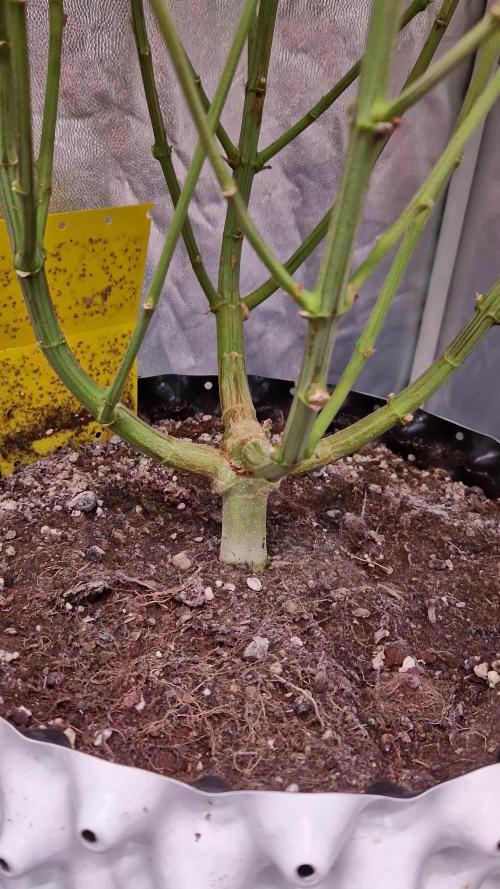
Las plantas se ven bien, hice una pequeña defoliacion para sacar las hojas grandes que hacian sombra directamente sobre otras ramas. Ademas quite algunas de abajo que me complicaban un poco a la hora de regar.

Likes
17
Share

@SpaceHaze123
Follow
Start of week 2 flowering. Put the triple cheese in my other tent under the spider famer SE3000 instead of the Sf2000 to give her that extra boost in flower. Because she is quite a biggie, she can use al the light I can give her. Gonne let her ride for another few days to a week before doing a heavy defoliation.
30 march. Defoliation time


Likes
6
Share


@jaydee702
Follow
Bubba CheeseCake is Amazing there total pigs consuming 2 gal of water per day and droping there ph from 5.96to5,1o over night when just last week the ph was rising from5.96 to6.86 daily so its a must to check the ph every 12 hrs to keep it 5.86 were it loves to be in DWC these girls are running out of space from my lights . I have had to bend several tops at 90 deg. to keep them from light burn . everything is going flawlessly so far only need another perfect four weeks .

Likes
6
Share


@MrsGreen_98
Follow
Since joining growdiaries I’ve seen that 420 Fastbuds are one of the (if not) the most notorious genetics on here.. so I’ve got my hands on some Fastberry seeds (which with the promotion I got one free!!) I’ve been very bored with the kind of weed I have been smoking recently the taste of the buds aren’t too great so I’m very excited to give this strain a try with the promise of berry flavoured weed!!! Happy growing!
Mon 8th March - after a few days of being in a damp paper towel stored in a dark warm place she’s popped a little tap root. I will leave until tomorrow then I’ll plant her directly into her final 3 gallon pot. 🍁
Tue 9th March -
Placed into her final pot gave her a little water and placed dome over her until she pops.
Likes
2
Share


@youdan
Follow
Non ci sono parole, la ciliegia og è sempre piu marcata ed io sono veramnete felice per questo cilo, e alta 1.70 e di tutte cime impilate della stessa grandezza da giu a sù
Likes
22
Share


@DadGrowsTomatoes
Follow
5/4/2022
Node additions have slowed but overall growth continues strong and healthy.
Continuing to make minor adjustments to LST. Generally watering every other day. Added too dressing of 2-4-2 dr earths and worm castings. May try daily watering but less water. They seem to love the fish tank water.
Decided against the 3rd topping. There's plenty!

Likes
3
Share


@StewartBloom
Follow
Day 54 and I think we're on track to harvest some time next week. I've decided not keep any of these as a mom, the back left one has some potential but non really seem like good hash plants. I'll jar test each to make sure but all have really greasy trichromes.


Likes
2
Share


