The Grow Awards 2026 🏆
Likes
Comments
Share
@Sauce_XL
Follow
3.9.2024: Start of week 8. Day 50 from seed, 46 from sprout. Nothing doing today, plant is healthy and getting fatter by the day. Plucked a few leaves but thats it. 3.10.2024: Day 51. Fed 1/4 strength fox farm trio mixed w/ calmag into over a gal of 6.5ph water. Gave roughly 3 liters of the solution. Runoff ppm is finally under 1000. Might increase nutes to 1/2 strength moving forward. I'm no pro when it comes to taking pictures so its hard for me to get clear, detailed shots of the nugs. 3.11.2024: Day 52, 48 from sprout. Moving along nicely. Some nice purple hues here and there. Still very "hairy." 3.12.2024: Day 53. Fed 1/4 strength, roughly 96oz at 6.4ph. I broke the feed/water/feed schedule and fed twice in a row. Also did some lite defoliation on the bottom fan leaves that weren't getting light. 3.13.2024: Day 54 from seed. Plant is doing its thing. 3.14.2024: Day 55. Fed again at 1/4 strength, 96oz at 6.6ph. Runoff ppm was 880. 3.15.2024: Day 56 from seed, 52 from sprout.

Likes
20
Share
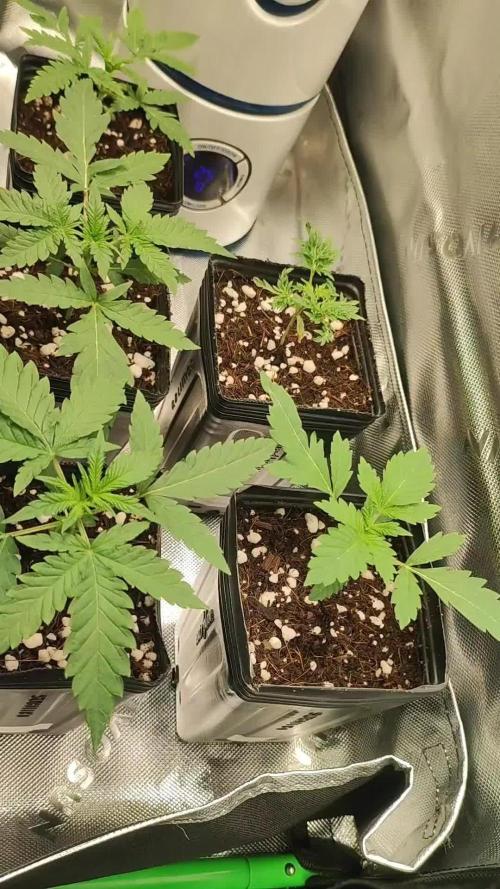
Left Side- Purple Punch Right Side- Gelato Soon will switch these girls to flower.
Likes
285
Share
👉Alrighty Then👈 ( 👉Bonus Video Showcases Everything I Have Going on in TropiCannibis HQ 👈) So we are at DAY 54 of Flowering with the Sugar Larry 👈 And she's doing fantastic 👍 😀 decided to showcase pheno #2 , definitely has different traits then #1 very interesting 😀 thoe both are killing it 👈 So just waiting on alittle more amber to show before we do the chop 👌 👉I had to Top her during the middle of 4th week 👍 Happy Growing 👉Soil Provided by ProMix.ca 👉Nutrients Provided by Agrogardens 👉Lighting Provided by MarsHydro.ca Thanks my friends for the great support over the years 🙏 Happy Growing
Likes
11
Share
Another great week. The Phantom and Red diesel are finally starting to mature to red and orange hairs instead of all white. I'm excited. Gave all the ladies a compost, molasses and kelp tea this week. Some of the buds on the phantom are starting to fall over from the weight. With all the stretch I got my nets are doing very little to help. The Gorilla zkittles has been on plain water since Wednesday. Keeping a close watch on the trichs. Maybe another 7 days, maybe not. Happy growing buddies. Thanks for the support!
Likes
45
Share
Back from vcation after two weeks the Ladys Look beautyful and Full of Color Today i will water them the last time on day 62 of flower and cut in the next 4-5 days The zake should be a week faster than the other two but that isnt the case The buds on all Ladys are dense and the smell is amazing cant wait to Test em out rauch
Likes
25
Share
ANTHOCYANIN production is primarily controlled by the Cryptochrome (CR1) Photoreceptor ( !! UV and Blue Spectrums are primary drivers in the production of the pigment that replaces chlorophyll, isn't that awesome! 1. Diverse photoreceptors in plants Many civilizations, including the sun god of ancient Egypt, thought that the blessings of sunlight were the source of life. In fact, the survival of all life, including humans, is supported by the photosynthesis of plants that capture solar energy. Plants that perform photosynthesis have no means of transportation except for some algae. Therefore, it is necessary to monitor various changes in the external environment and respond appropriately to the place to survive. Among various environmental information, light is especially important information for plants that perform photosynthesis. In the process of evolution, plants acquired phytochrome, which mainly receives light in the red light region, and multiple blue light receptors, including his hytropin and phototropin, in order to sense the light environment. .. In addition to these, an ultraviolet light receptor named UVR8 was recently discovered. The latest image of the molecular structure and function of these various plant photoreceptors (Fig. 1), focusing on phytochrome and phototropin. Figure 1 Ultraviolet-visible absorption spectra of phytochrome, cryptochrome, phototropin, and UVR8. The dashed line represents each bioactive absorption spectrum. 2. Phytochrome; red-far red photoreversible molecular switch What is phytochrome? Phytochrome is a photochromic photoreceptor, and has two absorption types, a red light absorption type Pr (absorption maximum wavelength of about 665 nm) and a far-red light absorption type Pfr (730 nm). Reversible light conversion between the two by red light and far-red light, respectively(Fig. 1A, solid line and broken line). In general, Pfr is the active form that causes a physiological response. With some exceptions, phytochrome can be said to function as a photoreversible molecular switch. The background of the discovery is as follows. There are some types of plants that require light for germination (light seed germination). From that study, it was found that germination was induced by red light, the effect was inhibited by subsequent far-red light irradiation, and this could be repeated, and the existence of photoreceptors that reversibly photoconvert was predicted. In 1959, its existence was confirmed by the absorption spectrum measurement of the yellow sprout tissue, and it was named phytochrome. Why does the plant have a sensor to distinguish between such red light and far-red light? There is no big difference between the red and far-red light regions in the open-field spectrum of sunlight, but the proportion of red light is greatly reduced due to the absorption of chloroplasts in the shade of plants. Similar changes in light quality occur in the evening sunlight. Plants perceive this difference in light quality as the ratio of Pr and Pfr, recognize the light environment, and respond to it. Subsequent studies have revealed that it is responsible for various photomorphogenic reactions such as photoperiodic flowering induction, shade repellent, and deyellowing (greening). Furthermore, with the introduction of the model plant Arabidopsis thaliana (At) and the development of molecular biological analysis methods, research has progressed dramatically, and his five types of phytochromes (phyA-E) are present in Arabidopsis thaliana. all right. With the progress of the genome project, Fi’s tochrome-like photoreceptors were found in cyanobacteria, a photosynthetic prokaryotes other than plants. Furthermore, in non-photosynthetic bacteria, a homologue molecule called bacteriophytochrome photoreceptor (BphP) was found in Pseudomonas aeruginosa (Pa) and radiation-resistant bacteria (Deinococcus radiodurans, Dr). Domain structure of phytochrome molecule Phytochrome molecule can be roughly divided into N-terminal side and C-terminal side region. PAS (Per / Arndt / Sim: blue), GAF (cGMP phosphodiesterase / adenylyl cyclase / FhlA: green), PHY (phyto-chrome: purple) 3 in the N-terminal region of plant phytochrome (Fig. 2A) There are two domains and an N-terminal extension region (NTE: dark blue), and phytochromobilin (PΦB), which is one of the ring-opening tetrapyrroles, is thioether-bonded to the system stored in GAF as a chromophore. ing. PAS is a domain involved in the interaction between signal transduction-related proteins, and PHY is a phytochrome-specific domain. There are two PASs and her histidine kinase-related (HKR) domain (red) in the C-terminal region, but the histidine essential for kinase activity is not conserved. 3. Phototropin; photosynthetic efficiency optimized blue light receptor What is phototropin? Charles Darwin, who is famous for his theory of evolution, wrote in his book “The power of move-ment in plants” published in 1882 that plants bend toward blue light. Approximately 100 years later, the protein nph1 (nonphoto-tropic hypocotyl 1) encoded by one of the causative genes of Arabidopsis mutants causing phototropic abnormalities was identified as a blue photoreceptor. Later, another isotype npl1 was found and renamed phototropin 1 (phot1) and 2 (phot2), respectively. In addition to phototropism, phototropin is damaged by chloroplast photolocalization (chloroplasts move through the epidermal cells of the leaves and gather on the cell surface under appropriate light intensity for photosynthesis. As a photoreceptor for reactions such as escaping to the side of cells under dangerous strong light) and stomata (reactions that open stomata to optimize the uptake of carbon dioxide, which is the rate-determining process of photosynthetic reactions). It became clear that it worked. In this way, phototropin can be said to be a blue light receptor responsible for optimizing photosynthetic efficiency. Domain structure and LOV photoreaction of phototropin molecule Phototropin molecule has two photoreceptive domains (LOV1 and LOV2) called LOV (Light-Oxygen-Voltage sensing) on the N-terminal side, and serine / on the C-terminal side. It is a protein kinase that forms threonine kinase (STK) (Fig. 4Aa) and whose activity is regulated by light. LOV is one molecule as a chromophore, he binds FMN (flavin mononucleotide) non-covalently. The LOV forms an α/βfold, and the FMN is located on a β-sheet consisting of five antiparallel β-strands (Fig. 4B). The FMN in the ground state LOV shows the absorption spectrum of a typical oxidized flavin protein with a triplet oscillation structure and an absorption maximum wavelength of 450 nm, and is called D450 (Fig. 1C and Fig. 4E). After being excited to the singlet excited state by blue light, the FMN shifts to the triplet excited state (L660t *) due to intersystem crossing, and then the C4 (Fig. 4C) of the isoaroxazine ring of the FMN is conserved in the vicinity. It forms a transient accretionary prism with the tain (red part in Fig. 4B Eα) (S390I). When this cysteine is replaced with alanine (C / A substitution), the addition reaction does not occur. The effect of adduct formation propagates to the protein moiety, causing kinase activation (S390II). After that, the formed cysteine-flavin adduct spontaneously dissociates and returns to the original D450 (Fig. 4E, dark regression reaction). Phototropin kinase activity control mechanism by LOV2 Why does phototropin have two LOVs? Atphot1 was found as a protein that is rapidly autophosphorylated when irradiated with blue light. The effect of the above C / A substitution on this self-phosphorylation reaction and phototropism was investigated, and LOV2 is the main photomolecular switch in both self-phosphorylation and phototropism. It turns out that it functions as. After that, from experiments using artificial substrates, STK has a constitutive activity, LOV2 functions as an inhibitory domain of this activity, and the inhibition is eliminated by photoreaction, while LOV1 is kinase light. It was shown to modify the photosensitivity of the activation reaction. In addition to this, LOV1 was found to act as a dimerization site from the crystal structure and his SAXS. What kind of molecular mechanism does LOV2 use to photoregulate kinase activity? The following two modules play important roles in this intramolecular signal transduction. Figure 4 (A) Domain structure of LOV photoreceptors. a: Phototropin b: Neochrome c: FKF1 family protein d: Aureochrome (B) Crystal structure of auto barley phot1 LOV2. (C) Structure of FMN isoaroxazine ring. (D) Schematic diagram of the functional domain and module of Arabidopsis thaliana phot1. L, A’α, and Jα represent linker, A’α helix, and Jα helix, respectively. (E) LOV photoreaction. (F) Molecular structure model (mesh) of the LOV2-STK sample (black line) containing A’α of phot2 obtained based on SAXS under dark (top) and under bright (bottom). The yellow, red, and green space-filled models represent the crystal structures of LOV2-Jα, protein kinase A N-lobe, and C-robe, respectively, and black represents FMN. See the text for details. 1) Jα. LOV2 C of oat phot1-to α immediately after the terminus Rix (Jα) is present (Fig. 4D), which interacts with the β-sheet (Fig. 4B) that forms the FMN-bound scaffold of LOV2 in the dark, but unfolds and dissociates from the β-sheet with photoreaction. It was shown by NMR that it does. According to the crystal structure of LOV2-Jα, this Jα is located on the back surface of the β sheet and mainly has a hydrophobic interaction. The formation of S390II causes twisting of the isoaroxazine ring and protonation of N5 (Fig. 4C). As a result, the glutamine side chain present on his Iβ strand (Fig. 4B) in the β-sheet rotates to form a hydrogen bond with this protonated N5. Jα interacts with this his Iβ strand, and these changes are thought to cause the unfold-ing of Jα and dissociation from the β-sheet described above. Experiments such as amino acid substitution of Iβ strands revealed that kinases exhibit constitutive activity when this interaction is eliminated, and that Jα plays an important role in photoactivation of kinases. 2) A’α / Aβ gap. Recently, several results have been reported showing the involvement of amino acids near the A’α helix (Fig. 4D) located upstream of the N-terminal of LOV2 in kinase photoactivation. Therefore, he investigated the role of this A’α and its neighboring amino acids in kinase photoactivation, photoreaction, and Jα structural change for Atphot1. The LOV2-STK polypeptide (Fig. 4D, underlined in black) was used as a photocontrollable kinase for kinase activity analysis. As a result, it was found that the photoactivation of the kinase was abolished when amino acid substitution was introduced into the A’α / Aβ gap between A’α and Aβ of the LOV2 core. Interestingly, he had no effect on the structural changes in Jα examined on the peptide map due to the photoreaction of LOV2 or trypsin degradation. Therefore, the A’α / Aβ gap is considered to play an important role in intramolecular signal transduction after Jα. Structural changes detected by SAXS Structural changes of Jα have been detected by various biophysical methods other than NMR, but structural information on samples including up to STK is reported only by his results to his SAXS. Not. The SAXS measurement of the Atphot2 LOV2-STK polypeptide showed that the radius of inertia increased from 32.4 Å to 34.8 Å, and the molecular model (Fig. 4F) obtained by the ab initio modeling software GASBOR is that of LOV2 and STK. It was shown that the N lobes and C lobes lined up in tandem, and the relative position of LOV2 with respect to STK shifted by about 13 Å under light irradiation. The difference in the molecular model between the two is considered to reflect the structural changes that occur in the Jα and A’α / Aβ gaps mentioned above. Two phototropins with different photosensitivity In the phototropic reaction of Arabidopsis Arabidopsis, Arabidopsis responds to a very wide range of light intensities from 10–4 to 102 μmol photon / sec / m2. At that time, phot1 functions as an optical sensor in a wide range from low light to strong light, while phot2 reacts with light stronger than 1 μmol photon / sec / m2. What is the origin of these differences? As is well known, animal photoreceptors have a high photosensitivity due to the abundance of rhodopsin and the presence of biochemical amplification mechanisms. The exact abundance of phot1 and phot2 in vivo is unknown, but interesting results have been obtained in terms of amplification. The light intensity dependence of the photoactivation of the LOV2-STK polypeptide used in the above kinase analysis was investigated. It was found that phot1 was about 10 times more photosensitive than phot2. On the other hand, when the photochemical reactions of both were examined, it was found that the rate of the dark return reaction of phot1 was about 10 times slower than that of phot2. This result indicates that the longer the lifetime of S390II, which is in the kinase-activated state, the higher the photosensitivity of kinase activation. This correlation was further confirmed by extending the lifespan of her S390II with amino acid substitutions. This alone cannot explain the widespread differences in photosensitivity between phot1 and phot2, but it may explain some of them. Furthermore, it is necessary to investigate in detail protein modifications such as phosphorylation and the effects of phot interacting factors on photosensitivity. Other LOV photoreceptors Among fern plants and green algae, phytochrome ɾphotosensory module (PSM) on the N-terminal side and chimera photoreceptor with full-length phototropin on the C-terminal side, neochrome (Fig. There are types with 4Ab). It has been reported that some neochromes play a role in chloroplast photolocalization as a red light receiver. It is considered that fern plants have such a chimera photoreceptor in order to survive in a habitat such as undergrowth in a jungle where only red light reaches. In addition to this, plants have only one LOV domain, and three proteins involved in the degradation of photomorphogenesis-related proteins, FKF1 (Flavin-binding, Kelch repeat, F-box 1, ZTL (ZEITLUPE)), LKP2 ( There are LOV Kelch Protein2) (Fig. 4Ac) and aureochrome (Fig. 4Ad), which has a bZip domain on the N-terminal side of LOV and functions as a gene transcription factor. 4. Cryptochrome and UVR8 Cryptochrome is one of the blue photoreceptors and forms a superfamily with the DNA photoreceptor photolyase. It has FAD (flavin adenine dinucle-otide) as a chromophore and tetrahydrofolic acid, which is a condensing pigment. The ground state of FAD is considered to be the oxidized type, and the radical type (broken line in Fig. 1B) generated by blue light irradiation is considered to be the signaling state. The radical type also absorbs in the green to orange light region, and may widen the wavelength region of the plant morphogenesis reaction spectrum. Cryptochrome uses blue light to control physiological functions similar to phytochrome. It was identified as a photoreceptor from one of the causative genes of UVR8 Arabidopsis thaliana, and the chromophore is absorbed in the UVB region by a Trp triad consisting of three tryptophans (Fig. 1D). It is involved in the biosynthesis of flavonoids and anthocyanins that function as UV scavengers in plants. Conclusion It is thought that plants have acquired various photoreceptors necessary for their survival during a long evolutionary process. The photoreceptors that cover the existing far-red light to UVB mentioned here are considered to be some of them. More and more diverse photoreceptor genes are conserved in cyanobacteria and marine plankton. By examining these, it is thought that the understanding of plant photoreceptors will be further deepened.
Likes
23
Share
So I found my issue with my droopy leaves and light leaves. Not enough water and she wants more phosphorus. I up'ed my water time to 15 mins 7x a day. (Ebb & flow in clay pellets). This week she has gotten most of her green back but I feel it's delayed the flowering alittle. Maybe not. This is my 1st auto and it's only supposed to have a week left. We will see.
Likes
22
Share
@Mr_Mister
Follow
Última semana de agua para limpieza de raíces, imposible sacar del scrog para limpiar mejor. He tenido que poner cables extra para soporte ya que las ramas se siguen retorciendo y cayendo por el peso de los cogollos. Algunas hojas debajo del scrog están marrones y quemadas, quizás por la falta de luz o nutrientes, ya para lo que queda no echaré ningún líquido más.
Likes
9
Share
Tout se passe bien jusqu'à présent les pistils commencent à sortir j'ai préparé le sol avec des engrais en poudre organique au dernier rempotage. Irrigation a l'eau uniquement. Remplacement de la 400wMh pour 400w SHP.
Likes
8
Share
@MG2009
Follow
03/18/2022 I have not shown the third clone as much because of training I will start with her this week. Did some wiring wrap around on two branches, and stem cracked, super cropped third branch. ( I ran out of wire had to improvise) I got one clone for this girl starting! All Girls update I will post pics on day 2. Tomorrow🙏🏻 Ps. I fed (watered) with molasses, and aloe gel fresh squeezed by me.and organic grown (by me) One tbls (14.787ml) of each in two gallon jug(7.571l) also I layered coast of Maine 5-2-4 one teaspoon per layer one on top as well. I like the extra potassium in this blend as plants can absorb and store more potassium and save for later use (flowering) . 03/20/2022 Here are flowering girls
Likes
28
Share
@Salgeezi
Follow
As usual my grows take forever. Healthy... just slow growth. Ph is good. Runoff EC is good. Lights 150w at 17". Humidity 59 Temps 79
Likes
15
Share
@Radagast_
Follow
10.08. Girl Scout Cookies Day 107# The plant has recovered, but has not completely healed yet. This morning it started to form crowns and will probably enter early flowering tomorrow or today. Two days ago she received half a dose of boost and a dose of bloom, and this morning bloom again. The day before yesterday was the end of her 15th week. Stay High and Keep Growing!!!
Likes
6
Share
Just feeding and letting them do their own thing. They have done really well for only being in 1litre pots.
Likes
8
Share
@Dysons12
Follow
Another good week done. Increased feeding to near on 1000ppm Wanted to do things differently with these to try and get the most out of them, so I am and will be feeding every time they are watered where as before I was alternating PH water with feeding every other day. No sign of starting flower yet so could potentially be a long Veg auto or I could be mis sold photoperiod plants. Should know more next week. I have seen some are 5 week veg so not too fussed at the moment. Humidity is high in the tent at the minute and that’s because I forgot to empty the dehumidifier and the damp outside weather was no help either, it tends to stick to 45%-55% See you again next week
Processing
Likes
10
Share
Critical Cure is still trucking alone nicely. No sign of bugs or nute issues. I had a friend who had issues with a couple of her Girl Scout Cookies that she's doing. She definitely had some lockout from heavy rain that we've been getting. That's why I'm glad I put down lime, but also got away from using mineral salts, because I think that was definitely an issue last year. Very happy with the results so far of going au naturale!
Likes
10
Share
@Boris1888
Follow
I've bn a bit late with update but all well ,I flushed 2 plants for 1 week and now just 1 lsd left,,,,I managed to get some ATA-XL so hoping for denser buds on the last one I'll give the overall harvest weight at the end,happy growing growers👍👍👍👍👍👍👍
Likes
4
Share
@Organic_G
Follow
War eh nur ein Experiment, wie sich die Pflanzen bei 4 h direktem Sonnenlicht verhalten auf dem Balkon. Ertrag ist dem entsprechend gering & die Dichte der Blüte fehlt, sehr sehr Fluffig aber der Geruch/Geschmack erinnert an 2014er Vibes. Also Smoke Qualität ist super und die Wirkung sehr klar & clean. Werde die Sorte sicherlich nochmal im Zelt ausgrown.
Likes
50
Share
🌟 Eternity Grow Cup – Week 3 Veg Report 🌱 Another week in the books, legends, and though the temps aren’t perfect, our Runtz babies are growing strong! 💪 This week marks a pivotal moment as we get serious and start to push these girls toward greatness. 🌱 Growth Update: • The girls are officially showing their third pair of leaves, and while they’re growing slow due to cooler temps, they’re consistent. Standing at 6 cm tall, these beauties are ready for the next steps in their journey. • The yellow sticky traps have also done their job, catching some gnats—always a win for pest management! Let’s talk about the unexpected guests making an appearance in the grow room—gnats! These tiny critters can be a common nuisance for growers, especially in environments with moist soil. While they’re not devastating, they can be a sign that things need a bit of tweaking. Why the Yellow Stickers? Yellow sticky traps are like candy for gnats—they’re irresistibly attracted to the bright color, which mimics flowers. These traps are a simple, non-toxic way to monitor and control the population. It’s not just satisfying to see them stuck (though, let’s admit it, it kind of is)—it’s also a great way to keep tabs on how many are lurking around and take action if necessary. What Causes Gnats? Gnats love moist environments, and overwatering or humidity that’s a bit too high can create their perfect breeding ground. Using high-quality soil like Pro-Mix HP with Mycorrhizae helps, but these little critters can still sneak in. How to Handle Them? While yellow stickers are a great first line of defense, staying vigilant with watering practices is key. Letting the top layer of soil dry out between waterings can disrupt their life cycle. Plus, products like beneficial nematodes or soil conditioners can help keep them under control. They may be tiny, but we’ve got our eye on them! Let’s not let the gnats steal the show—our Runtz have got all the spotlight! 🌟 Nutrient Regimen: This week, we’re sticking with the Aptus Clean Mineral Line for Veg, a powerful combo designed for optimal plant health: • Regulator: 0.15 ml/L – This keeps the plants strong, aids in stress tolerance, and boosts nutrient uptake. • RO Water Conditioner: 0.8 ml/L – Balances the water profile and improves nutrient delivery. • All-in-One Liquid: 1.25 ml/L – Provides a balanced mix of essential macro and micronutrients for sustained growth. 📌 Key Stats: • pH: 6.05 • EC: 1.0 • Temp: 18.3°C 🔧 Tech, Tools & Building the Dream Studio Behind the grow, I’ve been fine-tuning my workspace. Using just a piece of wood, carefully cut feet, and some imagination, I’ve elevated my monitors for better editing. It’s not fancy, but it works! 💻✨ For the grow, my trusted TrolMaster gear (from the Tent-X to the AMP-3) has been my go-to for precision. Every measure—pH, EC, temps—is logged and tracked to keep these plants thriving. 🌟 Exciting Milestones: 💚 Huge thank you to the community for helping me reach: • 500 YouTube Subscribers 🎥 – Weekly episodes are dropping, so make sure to tune in for detailed updates! • 4.5K Instagram Followers 📸 – Join the fun as we share the Runtz journey and so much more! 💨 Welcome, Ziggi Papers! A warm welcome to Ziggi Papers, our newest sponsor! 🌟 Ziggi’s high-quality rolling papers are the perfect addition to any smoke session. They’re all about sustainability and precision—just like this grow. Check them out at ziggioriginal.com. 💚 Shoutouts: To the diary sponsors, to my sponsors and this incredible community: • @GrowDiaries, @Plagron, @Zamnesia, @AptusHolland, @ProMixSoil, @TrolMaster, @ThinkGrowLED, @FutureOfGrowLED, @CannaKan, @ZiggiPapers Thank you for believing in the craft and making this journey possible! To the community—supporters, lovers, and yes, even the haters—you all inspire me to give my best every day. Together, we’re writing history with this grow. This week, I’m dropping: • A photo set of all 5 phenos, showing their progress. • Behind-the-scenes shots of my workspace build. • A closer look at the tools and products making this grow epic and more. For next week only God knows but one thing is for sure this promisses to be epic 💚 Let’s keep the momentum going, legends. This grow is more than just a competition—it’s a journey of learning, growth, and passion. Good luck to all the participants—may your grows be epic, your spirits high, and the journey fun for everyone involved! Stay tuned, and let’s make history together! Genetics - Runtz https://www.zamnesia.com/6000-zamnesia-seeds-runtz-feminized.html Nutrients - Plagron https://plagron.com/en/hobby - Aptus Holland https://aptus-holland.com/ Controls - Trol MAster https://www.trolmaster.eu/ LED - https://www.futureofgrow.com/en LED - https://www.thinkgrowled.com Soil - https://www.promixgardening.com/en Germination - Cannakan https://cannakan.com/?srsltid=AfmBOopXr-inLXajXu3QFgKXCXXos4F1oEvScjMKIB5MR5dk8-GJ-F49 DOGDOCTOR 15% off Smoking Papers - https://ziggioriginal.com/ Terpene saver - https://grovebags.com/ As always thank you all for stopping by, for the love and for it all , this journey of mine wold just not be the same without you guys, the love and support is very much appreciloved and i fell honored with you all in my life With true love comes happiness Always believe in your self and always do things expecting nothing and with an open heart , be a giver and the universe will give back to you in ways you could not even imagine so As always, this is shared for educational purposes, aiming to spread understanding and appreciation for this plant. The journey with nature is one of discovery, creativity, and respect. Let’s celebrate it responsibly and continue to learn and grow together! Growers Love To you All 💚 #EternityGrowCup #RuntzHunt #GrowersLove #CannabisCommunity #AptusHolland #ProMixSoil #TrolMaster #Zamnesia #Plagron #ZiggiPapers
Likes
2
Share
Pump went out and they had some root root...seems they are ok by now