Likes
Comments
Share
@valiotoro
Follow
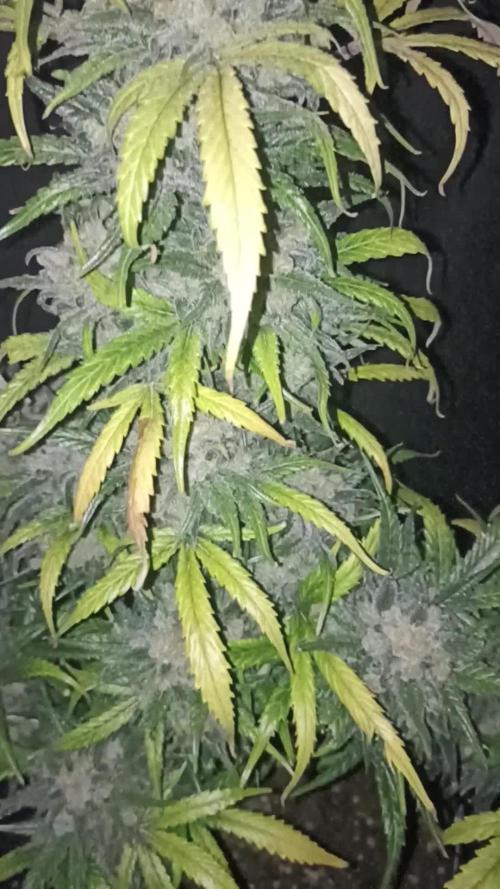
Hello everyone 😎 Week 6 of flower for the KK auto from Dutch Passion ❤️‍🔥 Spider Farmer SE-7000 80% For the nutrient 4ml/L terra bloom & 1ml/L power buds + green sensation 0,5ml/L from plagron Have a nice day 🤩

Likes
1
Share
@Crwfz1
Follow
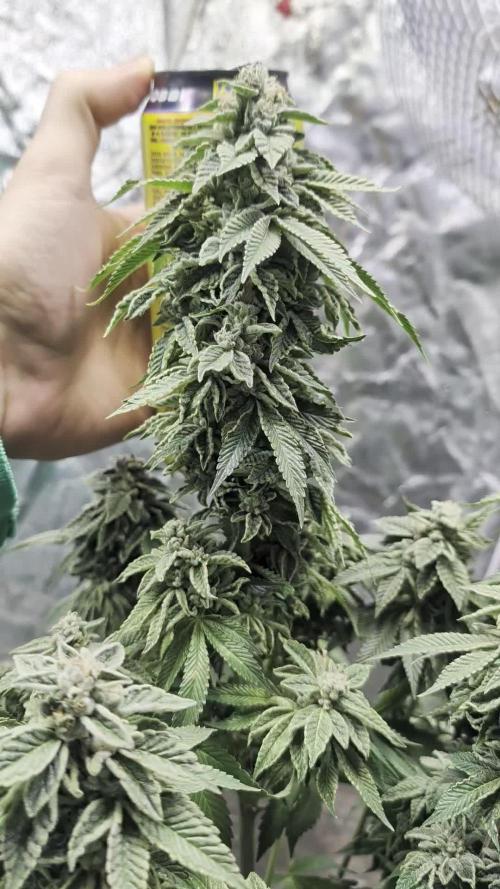
The girl came out great fat dense buds and boy they are skunky cant wait to taste 😋 was a joy to grow and easy as could be as usual a little slow but decent yield for the second run on that soil time for new stuff next round
Likes
22
Share
@Spliffi
Follow
Week 6 👍🤙👍🌱 I see signs of flowers!!! Jon Dabs Check them out here: https://jondabs.com @jondabs Instagram The Sponsors Check them out here: Dutch Passion https://dutch-passion.com/en/ Hydroponic.co.za https://hydroponic.co.za/hydroponic/harvesting-and-growing-accessories/ Bud Juice https://www.gohydro.co.za The Best Grow https://thebestgrow.co.za Dynomyco https://www.dynomyco.com Nuclear Roots https://www.nuclearroots.co.za Photronic https://shop.photronic.net Special Thanks to Hydroponic.co.za. I buy all my products from them. Best service. Daily updates coming...
Likes
2
Share
18 hours in seconds, 60x60x18 = 64,800 seconds, now multiply by the 833μMol/s reading off the PAR metre. μMol/s (micromol) is the unit in which P.A.R. is expressed. 64,800x833=53,784,000μMol 53,784,000μMol = 54 Mol 54 DLI @ 800ppm, powerful combination. Pushing photosynthesis to peak capacity, accelerated growth and increased biomass. Applied net, stretching her around for a week. Maintaining a minimum air velocity of 0.3m/s within the inner canopy. E=MC2 looks like a simple multiplication problem; it describes a fundamental physical truth: mass and energy are the same thing. The equation doesn't just calculate a value; it reveals that mass is effectively "congealed" energy. Energy is just numbers. Energy isn't a physical "substance" you can hold or touch. It is essentially an abstract, calculated number that we assign to a system to predict how it will change, interact, or move. A numerical label we attach to matter to track how it behaves. Because the universe runs on laws of symmetry (specifically, that the laws of physics don't change over time), a single global number must be conserved. We call that number "energy". How well a seedling grows is down to how much knowledge one can acquire to increase the level of conversion to occur. Applying knowledge effectively requires intuition, which comes from hands-on experience. A seasoned stoner learns to read subtle signs—like a slight change in leaf turgor (stiffness), subtle color shifts, or the specific texture of the soil—before a textbook diagnosis can be made. Ultimately, growing is the application of botanical science blended with active observation. Knowledge dictates your potential, but adaptability and attentiveness to the plant's immediate environment determine your results. The human eye is capable of distinguishing more shades of green than any other color in the visible spectrum. 1.618 Nature mathematically optimizes quantum energy transfer and light absorption efficiency within the photosynthetic machinery, as it naturally dictates energy scaling hierarchies and resonance dynamics. External vibration or electromagnetic wave that perfectly matches a plant's natural frequency directly influences plant growth. Low-frequency sound waves and targeted electromagnetic fields stimulate cellular processes and boost photosynthetic efficiency. An angular frequency aligned with the Golden Ratio is often used in wave mechanics and quantum physics to optimize energy transfer. . Does it produce better yields? All I know is the IVM loves being aligned with it. "Frequencies utilizing this ratio naturally minimize resistance (or impedance) and allow for highly efficient resonance, which can facilitate an increase in Electron Transfer Reactions (ETR) or energy pathways in molecular structures." Quantum coherence in photosynthesis occurs when a photon of sunlight strikes a leaf; the energy it carries must travel to a reaction center to be converted into chemical energy. This process operates at nearly 100% efficiency. If the energy moved in a traditional "bunching" or random hopping manner, a large portion of it would be lost as heat. Instead, plants utilize quantum superposition. The energy particle (exciton) doesn't just take one path; it exists in a wave state and explores multiple pathways simultaneously. It essentially "chooses" the most efficient route to the reaction center simultaneously. Research shows that molecular vibrations and the specific network arrangements of chlorophyll molecules (like the naturally evolved Chlorophyll A & B ratios) actively protect against energy overflow, optimizing light capture across different light intensities. Enzymes are the biological catalysts that speed up chemical reactions within a plant's cells, allowing them to grow, metabolize, and repair. Rather than relying solely on the classical kinetic energy of molecules colliding, plants use quantum tunneling. Subatomic particles like electrons and protons (hydrogen ions) can literally "teleport" through energy barriers that they normally wouldn’t have the energy to climb over. This makes vital metabolic reactions happen far faster than classical physics could ever explain! Chloryphyll b has peak absorption at 460nm (Blue) and at 647nm(Red). If we take the blue peak wavelength 460nm and a UV-B, UVR8 peak absorption wavelength 285nm, Tryptophan-285 (W285) Sensing protein. 460/285=1.618 Φ If we take chlorypyhll b's Red absorption peak 647nm and a UV-A of 400nm, we get 647/400=1.618 Φ. "Structure of light". The cryptochrome photoreceptor (CRY) is a UV-A/blue light receptor that shares this dual sensitivity with several other biological structures and functions, including significant sequence similarity and a common evolutionary ancestor with DNA photolyase enzymes. These are light-activated enzymes that use blue/UV-A light to repair DNA damage caused by UV-B radiation in plants. Synergistic. Effective quantum efficiency of photosystem II, often denoted as ΦPSII, represents the proportion of light absorbed by Photosystem II (ΦPSII) that is actually used in photosynthetic electron transport. It is a key indicator of how efficiently a plant is using light for photosynthesis, as opposed to losing it as heat or fluorescence. ΦPSII (effective quantum yield of photosystem II) functions primarily as a "multiplier" (a coefficient of efficiency) rather than an additive factor when estimating the overall photosynthetic electron transport rate (ETR). Multipliers are considered far more beneficial than additions because they generate exponential growth, leverage existing resources to their full potential, and create sustainable, self-multiplying capacity, rather than just incremental, linear increases. This fascinating observation is rooted in the intersection of subatomic geometry, fractal scaling, and quantum dynamics. In specific molecular arrangements—such as in conjugated polymer networks or biomolecular architectures—the Golden Ratio (PHI) naturally dictates energy scaling hierarchies and resonance dynamics. Mathematically tied to the fine-structure constant, which defines the strength of the electromagnetic interaction. The Golden Ratio can be mapped geometrically as the Golden Angle (137.5 degrees) in atomic structures, linking the charge of the electron to fundamental quantum constants like Planck's constant. An electromagnetic wave is neither electric nor magnetic, but a combination of both. 137.5 The Golden Angle (137.5) This angle is derived from the Golden Ratio (1.618). It is the smaller of two angles created when a circle is divided such that the ratio of the arcs equals the Golden Ratio. An electromagnetic wave (like light or radio waves) is not a static electric field or a static magnetic field, it is a self-propagating combination of both. An oscillating electric field creates an oscillating magnetic field, which then regenerates the electric field. They feed off each other and travel together through space at the speed of light, carrying energy without needing a material medium. The Fine-Structure Constant Alpha (Α/α): In quantum physics, is the approximate denominator of the fine-structure constant (often represented by the Greek letter Alpha (Α/α). It is a fundamental, dimensionless number that dictates how strongly charged particles (like electrons) interact with the electromagnetic field. Its value has puzzled physicists for over a century, as it bridges quantum mechanics, electromagnetism, and relativity. In quantum mechanics, Omega (Ω/ω) usually represents angular frequency. When applied to "quantum coherence"—the ability of particles to exist in overlapping states without immediately degrading—is key to calculating how long these states last. The Golden Angle, the value 137.5° is the geometric Golden Angle. It is derived from the Golden Ratio (1.618) and is famously responsible for the beautiful, mathematically optimized spiral patterns found in nature (such as sunflower seeds, pinecones, and leaf arrangements). Because of this, theoretical physicists and mathematicians have long speculated about why nature relies so heavily on the number 137 and the golden angle to govern everything from subatomic light interactions to the macroscopic geometry of the universe. Quantum coherence allows particles to maintain superposition and entanglement. In realistic, open environments, interactions with a noisy background typically cause decoherence, destroying the system's quantum information. A major challenge in quantum physics and quantum computing is preventing this decoherence at large scales. In quantum optics and driven systems, the Greek letter Omega (Ω/ω) often represents the Rabi frequency, which dictates the strength of the coherent driving laser or electromagnetic field interacting with the quantum system. The interaction of light and water generates specific Coherent Domains. Trapped electromagnetic fields cause water molecules to vibrate in unison at a coherent frequency, separating the liquid into structured quantum areas and an unstructured phase. When water interacts with hydrophilic (water-attracting) surfaces, the energy from UV and Infrared light can drive the formation of larger, structured layers known as Exclusion Zone (EZ) water. Exclusion Zone (EZ) water represents a structured, negatively charged phase of water critical to cellular biology. Driven by light energy and hydrophilic surfaces, this ordered state acts as a natural biological battery, with far-reaching implications for cell function and human health. In this domain, water molecules arrange themselves into a highly ordered, negatively charged lattice that excludes solutes and particles. At higher energy levels, UV light acts as a catalyst for photochemical reactions. Photons can provide enough energy to break the hydrogen and oxygen bonds in molecules, resulting in free radicals and a plasma of quasi-free electrons. This transfer of electrons forms the fundamental basis for redox reactions and energy metabolism in ALL biological systems.
Processing
Likes
13
Share
Hello again’ Misty gorilla i also doing great. It was a strange plant from the beginning but it keeps up with the rest of the crew. It wont be my masterplant but i hope the quality will be there. On the badside, ive had 2 herma’s in my tent, I hope I removed them on time! Now i will check every 2 days. See you next week!
Likes
8
Share
@Cana_Gen
Follow
Just pulled it today. Lots of pics to come and the weigh in. Going to update everything as I cure. Curing is going well. Speed dried a little as I’m impatient as hell. Pretty happy with the results. This White Widow strain is very good. Extremely resistant to bugs. I’ve dealt with a spider infestation throughout this grow and only got it under control in the last few weeks. Daily maintenance and cleaning got me through flower and I was able to pull this off. At harvest it was cut and immediately went into a bud wash to clean them up and remove any leftover mites, residue, etc. I usually do a bud wash, especially if it’s outdoor. If done properly it has no impact and I find it produces a smoother taste tbh. This was my second attempt at dwc. I’m very happy with it and will continue. I’ll update the weights when things are cured.
Likes
21
Share
@BLAZED
Follow
Week 15 (9-6 t/m 15-6) 9-6 Temperatuur: 30.8 graden (licht aan) 22.2 graden (licht uit) Luchtvochtigheid: 66% (hoogste) 40% (laagste) De toppen beginnen al wat dikker te worden, en de geur is nu ook erg aanwezig, het gaat de goede kant op! Watergift: 1000 ml, met 0.2 ml Silica Power per liter, 0.3 ml CalMag per liter en 1.3 gr Calcium PowderFeeding per liter. EC: 0.7 PH: 6.5 10-6 Temperatuur: 32.2 graden (licht aan) 23.2 graden (licht uit) Luchtvochtigheid: 62% (hoogste) 44% (laagste) Vandaag de lamp op 95% sterkte gezet. Watergift: 1500 ml, met 0.2 ml Silica Power per liter, 0.3 ml CalMag per liter en 1.3 gr Calcium PowderFeeding per liter. EC: 0.7 PH: 6.4 11-6 Temperatuur: 31.4 graden (licht aan) 24 graden (licht uit) Luchtvochtigheid: 70% (hoogste) 45% (laagste) Watergift: 1500 ml, met 0.2 ml Silica Power per liter, 0.3 ml CalMag per liter en 1.3 gr Calcium, 0.5 gr Hybrids en 0.5 gr PK+ PowderFeeding per liter. EC: 1.7 PH: 6.4 12-6 Temperatuur: 31.7 graden (licht aan) 24.5 graden (licht uit) Luchtvochtigheid: 62% (hoogste) 39% (laagste) Watergift: Geen. 13-6 Temperatuur: 31.7 graden (licht aan) 24.4 graden (licht uit) Luchtvochtigheid: 50% (hoogste) 35% (laagste) Watergift: 1250 ml, met 0.2 ml Silica Power per liter, 0.3 ml CalMag per liter en 1.3 gr Calcium PowderFeeding per liter. EC: 0.7 PH: 6.4 14-6 Temperatuur: 32.3 graden (licht aan) 23.7 graden (licht uit) Luchtvochtigheid: 50% (hoogste) 35% (laagste) Watergift: 1100 ml, met 0.2 ml Silica Power per liter, 0.3 ml CalMag per liter en 1.3 gr Calcium en 0.25 gr PK+ PowderFeeding per liter. EC: 1.0 PH: 6.4 15-6 Temperatuur: 31.6 graden (licht aan) 23.4 graden (licht uit) Luchtvochtigheid: 54% (hoogste) 37% (laagste) Nu nog 2 weken te gaan! 😁 Watergift: 1100 ml, met 0.2 ml Silica Power per liter, 0.3 ml CalMag per liter en 1.3 gr Calcium PowderFeeding per liter. EC: 0.8 PH: 6.4
Likes
6
Share
@Ninjabuds
Follow
Permant marker the one seedling I could not be more happy with. It has a distinct different look to it than any other plant in the tent with strong growth going on. I'm sad about the other seedling thou the 1st set of leaves were kinda deformed and it has like a spiral thing going on where new growth comes from. Hopefully it comes back around, I always like seeing atleast 2 phenos of a strain I feel it gives you a better idea of what a strain is. It's looking like a good start to a week the plants are strong they are getting to the point I can let the dried dry out completely. I'm thinking by the end of this week the plants will be starting to be sold. Last week I put all the plants into my bigger 2x4 tent with my medicgrow mini sun 2 the 500w version. Only a few of the plants were ready for that light. Seems like the only plants that really have good resistance and have a strong start are the weedseedsexpress.com seeds. Shout out to weedseedsexpress.com for the strong plants. I ended up putting all the plants back into my 2x2 tent with the 55w amazon light it has alot more blue light in its spectrum. It's kinda weird b4 I switched the plants to the 2x4 tent they were getting 220umol under my amazon 55w led then when I put them under the 500w light 25% strength about 50in from plants and they were getting only about 195umol in that tent but it was stressing most the plants. I assume a larger light has more side lighting hitting the plants. I think when useing larger lights it's good to measure umols from the top but also coming from the sides. I think durring seedling stage they only need about 50% the umols coming from the side the plants as the top is receiving. When I put the plants back in the small tent about the same umols as they were getting b4 the switch and they were still a little stressed. So for a few days I put the small light at the top the tent giving them 100umols for a few hrs then 130umols the rest the day.
Processing
Likes
3
Share
I wish I could've taken more picture this week and previous week but I just could'nt remember to do it. Feeling nervous, but wierdly excited. Most promising strains for big yields are Super Silver and Tangie. Girl Scout Cookies being an autoflower already started to flower, wish it would have taken more time on veg to get bigger but it is what it is. Now starting flower. 12/12 cycle. 9 weeks
Processing
Likes
4
Share
Noticed some slight tacoing on leaves, changed to my 18/6 light schedule to help control temps and give some rest. Noticed some nute burning also, will full flush next week.
Likes
8
Share
Einer der süßesten Sorten, die ich je angepflanzt oder gerochen habe. Die Panty Punch von Seedstockers war schon sehr Süß, aber die Ice Cream Cake schlägt dass nochmal ein bisschen. Das Aromaprofil reicht von super süßen Bonbon oder Loly tönen hin zu einem cremigen süßen Kuchen 🍰 mit Honig und ein Hauch exotischer früchten. Die Blütezeit ist nun abgeschlossen und die Pflanze war doch überaschend schnell fertig. Ich hätte durch den Haze Einschlag mit einer eher 9 oder 10 Wochen Blüte gerechnet. Doch nach 8 Wochen regenerativer Phase fertig! Die Trichome sprechen für sich... Ein wenig durchsichtige, viele milchige und auch schon einige in bernstein Farben. Jetzt geht es an die Ernte und über das Genusserlebnis bin ich mehr als gespannt.
Likes
3
Share
Well she is really doing well with the recent LST and will have lots of colas.Ill start training the other branches later on this week but she’s looking great day 22
Likes
17
Share
@BLAZED
Follow
Week 14 (1-5 to 7-5) 1-5 Temperature: 28.2 degrees (lights on) 22 degrees (lights off) Humidity: 62% (highest) 46% (lowest) No pictures. 2-5 Temperature: 29.2 degrees (lights on) 20 degrees (lights off) Humidity: 61% (highest) 48% (lowest) Removed the net, and tied down some branches to the pot with some gardening wire. This way i can easily move the pots in and out the tent to weigh them. I also moved the oscilating fan from underneath the canopy to above the canopy. This is because the leaves gets hotter as i increase the light's power output. The Gorilla Kush #2 and the Chemdog #2 are showing some heat stress. Before i watered them i weigh the pots. Dry weight: Chemdog #1: 4.2 kg Chemdog #2: 5.0 kg Added 10L to the reservoir. Opened the reservoir for a couple of minutes. 3-5 Temperature: 26.2 degrees (lights on) 19.9 degrees (lights off) Humidity: 61% (highest) 47% (lowest) No pictures. Increased the light's power output to 75% LUX: 16.000 / 20.000 4-5 Temperature: 26.9 degrees (lights on) 21.2 degrees (lights off) Humidity: 59% (highest) 41% (lowest) Opened the reservoir for a couple of minutes. 5-5 Temperature: 27.6 degrees (lights on) 21.2 degrees (lights off) Humidity: 60% (highest) 47% (lowest) No pictures. 6-5 Temperature: 27.6 degrees (lights on) 20.4 degrees (lights off) Humidity: 60% (highest) 42% (lowest) Dry weight: Chemdog #1: 3.9 kg Chemdog #2: 4.7 kg Added 10L to the reservoir, there was still 2850 ml left in the reservoir so now its almost 13L. Opened the reservoir for a couple of minutes. 7-5 Temperature: 27 degrees (lights on) 19.8 degrees (lights off) Humidity: 57% (highest) 44% (lowest The buds are looking good! Sadly i dont have a timelapse for this week.
Likes
16
Share
@Rinna
Follow
I’ll update ya’ll on the smells and tastes after drying and curing! So far both are packed with ice and smell very potent, a little overpowering still, so I want to give it some time before they’re cures and can show their true terpene profile!
Likes
60
Share
The plant is ready to flower. I covered the soil with inputs and did a little defoliation. It is developing well.
Likes
6
Share
@KarlOlga
Follow
Heute (01.04) noch mal entlaubt und alle Triebe auf gleiche Höhe gebracht bei der Mango. Die bloody skunk holt auf und ist aber direkt nach dem Topping in die Blüte gegangen. Bin gespannt! 04.04- paar Blätter entfernt 06.04 - LST und paar Blätter weg!
Likes
10
Share
@Organic_G
Follow
Mein bester und Ertragreichster grow kommt zum Ende… 115,5 g Shuga Leaves/small Buds 450g Proper Buds
Likes
11
Share
I had a little trouble this week Plants 1 and 2 are still droopy and the fungus gnats seem to be getting worse. I wasn't sure if it was overwatering or not enough nutrients. So I let them dry out for 4 days and noticed it got worse. So it probably was not overwatering. On day 56 I top dressed Plants 1 and 2 with some left over Nature's Living Soil. I used 2 tablespoons each and added 4 cups of Root's Organic soil also since the pots have settled a little. Then I gave all the plants a good watering. Hopefully after a few days they will perk back up. On day 55 I added sticky cards to each pot to keep an eye on how many fungus gnats I have. There was quite a few after just one day but I noticed less in the tent. I read some posts on Nature's Living Soil and another on air-pots. It seems like others have had nutrition problems with Nature's Living Soil if they went longer than a month of vegging, which would explain my issue. The other post about air-pots said fungus gnats love them since they can attack the soil from all sides instead of just the top layer. Apparently if you let the top layer of soil dry out well in normal pots the fungus gnat problem mostly goes away. But when using air-pots the top layer of soil might dry out but they can still get to the moist soil from the bottom or sides.