


Likes
Comments
Share


@MiyaguiOkPolilla
Follow
Hola amigo!
Una linda semana pasó para estas pequeñas, ahora ya se encuentran fuertes y muestran potencial en un hermoso tono verde. El sustrato orgánico les ayudó a adaptarse perfectamente!
Riegos cada 3-4 días.
Ph: 6.2-6.5
EC: 540 PPM 020+/020-
HR: 65% 5+5-.
C⁰: 19-26%
Grow yourself!

Likes
22
Share


@Mazgoth
Follow
It’s growing really well and she is tall enough for her 6/7L pot,I give her half of royal queen organic nutrients and the plant next day was happier than ever,I think she will be tall and fat
NOTE:I’m not using all of them,some times I’m using half dose biobizz and half from royal queen,some times only biobizz..

Likes
24
Share


@Kountryboi90
Follow
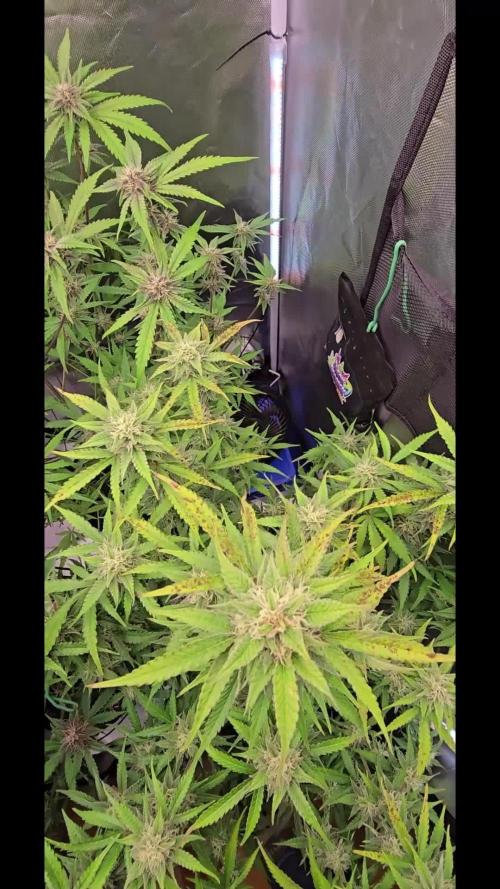
Day 75 since seed and and day 5 since flipping to flower. New light came in last Wednesday so I did another round of light defoliation and LST before flipping. The new Spider Farmer G4500 light is AWESOME! LOVE IT! This plants has basically filled half of my 2x4 tent, essentially, filling up a 2x2 tent! I must say I've impressed myself by being able to keep her healthy this long. I hope she rewards me very well I'm the end! Let me know what yall think or what I can improve on.

Likes
7
Share

@NSABND
Follow
Day 57 😁👌all the queens are ok 🙏
Day 58 the queens got some fertilizer 💪😃👍
Day 59 what should i say... everything seems to fine 😃🙏👍
Likes
34
Share


@D33jW
Follow
Hellooo growers!
It seems that everything is going in the right direction, which makes me very happy.
Last watering was with Soil Clean and this improve her growth.
Peace & love 🙌

Likes
23
Share


@SSGrows
Follow
IT'S A FEMALE.!! :D....Pre Flowers showing the white hairs. Flushed her last night with PH'd Cal-Mag, Will add Nutes again with next watering. Will keep this in Veg for a week or 2 more then switch to flower.


Likes
57
Share


@Silverback_Guerilla
Follow
1/4:
Moved a few other plants out of the closet, now they've got a little elbow room.
Both Zenzations are fattening and frosting up very nicely. The Gorilla Girls have finally stopped stretching and are budding up nicely now. Their lowers are as all as the tops.
The Black Jacks look great, too.
1/7:
Fed today and gave them all a sniff test...killer stink from the Zenzations.😵
I added a dose of endoboost in their feed today...kinda worried about the monstrous size of my plants considering that they are only in 3 gallon pots..

Likes
23
Share


@RazzleMatazzle
Follow
I'm slowly running into the problem that the RUNTZ is just getting too big. The buds could be developing a bit better. I was really unsure whether the seeds were just the feminized variety, but they are definitely automatics. It's really insane how well and massively the genetics grow. It's just crazy!

Likes
7
Share

@Marijuanaut
Follow
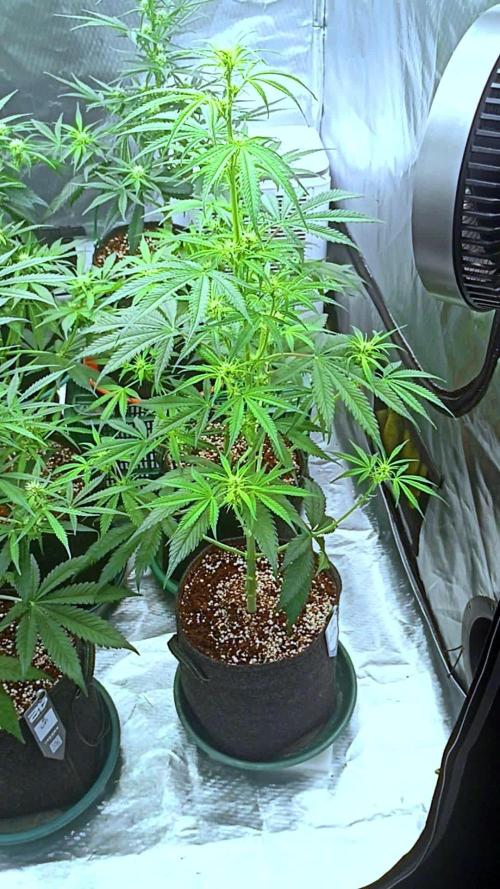
One managed to developed good the other one not so much 😔
I´m running out of the Aptus products and will be switching gradually to Plagron. 💪
💚💛❤️

Likes
13
Share


@Blunt
Follow
28/03/22 - The plants are looking happy, which makes me happy hahaha loving this grow! The clones I took from these girls are very happy as well have been put into air pots.
29/03/22 - Feels like im just sitting back and watching the magic at this stage, plants are not really needing any attention from me
30/03/22 - flowers are looking good and the same, very happy now 😁
31/03/22 - Plants are healthy, no signs of stress or deficiencies. Thanks AMS for these quality seeds 👍
01/04/22 - getting frostier every week 💪
02/04/22 - getting more beautiful every week, I have been switching between PK spike and Massive Bloom every week and seems to be working well for these plants, no signs of them lacking anything.
03/04/22 - End of the week and the aroma is getting sweet, I am really enjoying growing this plant!

Processing
Likes
12
Share


@BloodBath
Follow
I will be focusing this diary on the smoothie strain but you’ll be seeing some other plants in the tent that are not the same strain. I only have room in this tent so bare with me. There are 2 Smoothie, 1 CNC, and 1 Stardawg (dog). The smoothie are the two bigger ones in the back of the tent.
Now, the Smoothie from FastBuds is just killin it right now. Since I popped the beans they have done nothing but show signs of greatness. I don’t think this one is gonna slow down much either.
I’m going to push these plants harder than my last harvest. I had a really really amazing harvest last time. I was even able to pull sap out of all 4 plants. 2 Zkittles and 2 LSD-25. This was all done by feeding at the right times and keeping a “moist” soil. Also I want add that I ran pretty much the entire line of Nectar for the Gods at a little less then the recommended ratios. This time I plan on going a tiny bit over the recommended ratios just to see what these plants will do. Trust me, if the plants have a bad response I will go back to the recommended ratios.
The reason I want to do this is because I really think these auto strains can handle a lot more than a regular flowering cycle plant would. They can handle more stress, that’s for sure.
When do you think I should add a compost tea into my regimen? Soon or wait till the plant is a little larger?
Likes
32
Share


@LSnake
Follow
In this second week of veg I started adding some nutrients to the plant water. (below the recommended doses) 🔥
Since they are growing well next week I will try to apply the manifold , hoping to be able to increase the final yield of this genetics that I love. ✂️🌱

Likes
7
Share


@BudLoveJohn
Follow
Plants sprouted in just three days after planting! First week for the seedlings was me learning to get the humidity and light the right distance. A little bit of stretching but not too big of a deal. Plants fixed themselves


Likes
1
Share


@Baltimoregrower
Follow
So this week I added nutrients for the flowering stage. I gave her a little trim as well as added her netting. I flipped her on last Sunday PP
Likes
18
Share


@Grower_Of_Persia
Follow
my dry and cure style is this:
4 days of hanging upside down to get water activity lower to around 0.6 in 50% humidity and 26 C temp (i know its a little high but we are in a hot summer right now and i cant get it lower even with air conditioner) and then after 4 days of drying i remove leaves and stalks, trim buds and move them to jar for the rest of their life :D . and in the first 4 days of curing i open the jar door and let hem get some fresh air in the jar for about 5 minutes and close the jar door again, after 4 days of curing like that buds are smokable but they will get better as they getting cured about 1 month.
buds are one of the hardest as fucking rocks type of buds! very dense , compact , sticky , smelly , amazing at every aspect
growing stage was 56 days and flowering stage was 75 days total (harvested tops at day 64th)
the total weight of dry buds was : (plant #1 & #3 top buds 56 G + lower buds 22 G ) 78 G + (plant #2 top buds 47 G + lower buds 18 G ) 55 G + (plant #4 top buds 120 G + lower buds 67 G ) 187 G = 367 G

Likes
51
Share


@Corwinism
Follow
WEEK 9 - (04/25/2021 - 05/01/2021)
Day 67 (Week 1, Day 1 - FLOWER): 04/25/2021
Today marks the first official day of the flower cycle. Light timer has been adjusted to 12/12. First 12 hour dark period begins at 5 a.m. on the morning of 04/26. I would say 70-75% of the first screen has been filled.
½ strength nutrient feeding today.
Tap water: 220ppm, 8.2 pH, 70℉
+ FF Grow Big: 5ml/gallon = 45ml/9 gallons
+ FF Big Bloom: 7.5ml/gallon = 75.5ml/9 gallons
+ FF Tiger Bloom: 5ml/gallon = 45ml/9 gallons
+ FF Cal-Mag: 2.5ml/gallon = 22.5ml/9 gallons
+ Fish Shit: 2ml/gallon = 18ml/9 gallons
+ HydroGuard: 1ml/gallon = 9ml/9 gallons
+ pH Down: 14ml (6.5 pH before adding)
Mixture: 910ppm, 6.1 pH, 70℉
ppm/ppm = runoff/soil
JB#1 - 1510ppm/600ppm, 5.8 pH
JB#2 - 1530ppm/620ppm, 5.7 pH
AP#1 - 2500ppm/1590ppm, 5.7 pH
AP#2 - 2260ppm/1350ppm, 5.8 pH
GC#1 - 2490ppm/1580ppm, 5.8 pH
GC#2 - 2510ppm/1600ppm, 5.7 pH
-------------------------------------------------------------------------------------------------------------------------------------------
Day 71 (Week 1, Day 5 - FLOWER): 04/29/2021
Watered plants today. Glookies #1 gave off a really high ppm reading. Don’t think it was accurate.
Tap water: 220ppm, 8.7 pH
+ HydroGuard: 1ml/gallon = 9ml/9 gallons
+ pH Down: 28ml
Mixture: 230ppm, 6.2 pH, 68℉
ppm/ppm = runoff/soil
JB#1: 1320ppm/1090ppm, 6.7 pH
JB#2: 1115ppm/885ppm, 6.5 pH
GC#1: 3540ppm (seems too high)
GC#2: 2270ppm/2040ppm, pH 6.5
AP#1: 2410ppm/2180ppm, 6.4 pH
AP#2: 1600ppm/1370ppm, pH 6.6
Well, the first week of flower is in the books. All but one plant is starting to grow pistils. These plants are getting a little out of control being cramped in this 4x4. I defoliated just before flipping to flower, and they needed another touch-up. I'm a little worried this will cause me to have to do frequent touch-ups or kill one or two plants and create some space. I'm leaning more toward killing 1 or 2 plants, rather than risk all of them getting overly stressed from too many defoliations. I completely underestimated how much these Cannabis plants would grow, especially once they started to stretch.
I'm going to start saving the water that is collected through the dehumidifier. The plan is to use this water for the flush in the last 2 weeks of flower.
Thanks for dropping in and showing some Aloha, everybody. And remember, don't drink and drive, smoke and fly. See you next week. 🙏


Likes
15
Share


@I_Identify_As_A_Dan
Follow
Week 17 for Gelato 41 by seedstockers,
All photos were taken on 0.5x because the plant just doesn't fit in the picture frame... She's getting too big😂 I just want her to flower now i don't think i can take her getting any bigger than she currently is.
Last week was another hot hot week but we are coming down to the low 30's again for the rest of the upcoming week so think the plants will be happier.
Im not sure whether to just leave her be & not defoliate but at this point learning as i go along because ive never grown something so large. 😅

Likes
19
Share


@CannabisAprendiz
Follow
Bueno , este es el segundo cultivo que realizó del la cepa "Waka" , el anterior lo tengo igualmente documentado en otro diario .
en esta ocasión cultivamos los clones que habíamos recolectado del cultivo pasado , guardando los fenotipos que nos gustaron más y los clones restantes los pasamos a floración que fueron los que se le hizo seguimiento en este diario.
El crecimiento fue bastante explosivo y reaccionaron muy bien a cada trasplante realizado .
pude observar que los clones de cada fenotipo seleccionado se desarrolló con mucha similitud al de sus madres .
El olor en vegetación es bastante discreto y en floración se pone un más intenso
El desarrollo en floración fue explosivo generando bastante resina y se vieron muy hambientras .
Al fumar se puede sentir un rico toque cítrico en las N° 4 se siente un fuerte sabor a limón en algunas flores mucho mas marcado que en otras,
N° 3 y 13 un agradable toque a naranjas muy rico de sentir en el paladar , La N° 8 con pizcas dulces bastante interesantes.
El humo al fumar es muy suave lo que permite sentir mejor el sabor de cada fenotipo.-
saludos y buenos humos😉
Al momento de cosechar se cortaron los clone y se dejo secando en oscuridad a temperatura ambiente por cerca de 16 días posterior a eso se pasó a curar en frascos

Likes
11
Share


@SkunkyDog
Follow
Hallo zusammen 🤙.
Sie wächst sehr schön und riecht richtig lecker nach Käse oder so etwas in der Richtung stinkt.