The Grow Awards 2026 🏆 






Likes
Comments
Share
@WhiteEdge
Follow
26.03.2024
Continue into week 4
Update firmware on TrolMaster Tent-X (3.6)
Replace all filters, remove and clean drain buckets and tubing.
Mix new batch with 56ml AN connoisseur AB + 4.5g Big Bud Powder + 7.5ml Silica - total 30l @ 1.34EC. NPK Ratio is 1-2-3 , Cal/Mg ratio is 4-1.5
Target EC for this week is 1.2 start and end week with 1.3. Checking plants will determine timing of strength
Donne one pass off long misting (3min) with diluted solution @ 0.84@C
Set new misting time @ 60s ON time
Finally have time for managing canopy, pull down taller branches and position all tops to fit under screen without touching. Try ro spread them evenly across the net, top per square of net
Defoliating all girls, remove all fan leaves and prune lots of smaller branches from middle. Lot of foliage is removed!
After stripping humidity drop significantly (41%) , need to install humidifier again to keep RH @ 50-52%
Set dehumidifier thermostat to work @ 50% RH. Reduced light intensity for this day, let girls recover from stress
PAR map 1150max/650min PPFD, VPD -1.2-1.3, DRH 50-54%, NRH 45-49%, NT-20-21c, DT-24/25.5c, Leaf temperature 22-23c, Light distance 45-55cm, CO2 700+ppm
HLG Scorpion Diablo @ 65-75% - 45-55cm distance
60s ON time 20min OFF time @ Day Time
60s Off time 30min OFF time @ Night Time
NT-Nutrient Tank - PH -5.90-, EC -1.32, Temp-20-21
27-28.03.2024
All girl looking great after defoliation,)
Clean benches and floor in box
Replace all filters
Set dehumidifier thermostat to work @ 47% during night times, 50% @ day. Humidifier is also connected and set @ 49% Day and 45% @ night, if needed
Inkbird humidity controller stop executing's automation for day/night settings. Start manually to change day/night values for now
Next several days, until weekend, temperatures outside will be high , 29c max. Hope it will not raise temperature in box to much.
Light is set on TrolMaster Tent-X controller to dimmed at 28c
AC Infinity fans are set to AUTO mode with height temp set at 26c and high RH set at 54%
Top up tank with 25ml AN connoisseur AB + 4.5g Big Bud Powder + 7.5ml Silica - total 75l @ 1.34EC
PAR map 1180max/650min PPFD, VPD -1.2-1.3, DRH 50-52%, NRH 45-48%, NT-21-22c, DT-24/25.5c, Leaf temperature 22-23c, Light distance 45-55cm, CO2 700+ppm
HLG Scorpion Diablo @ 80% - 45-55cm distance
60s ON time 20min OFF time @ Day Time
60s Off time 30min OFF time @ Night Time
NT-Nutrient Tank - PH -5.95-, EC -1.24, Temp-21-22
29-30.03.2024
Refilled the tanks with 20l of fresh mixture. 25ml AN connoisseur A+B + 3g Big Bud Powder + 7.5ml Silica - total 20l @ 1.21EC
Refilling is done in two passes, one time before light up, and second time early in morning, two houres before night time.
This give additional nutrient cooling without running water chillier. Refill soulution is @ 18c
Checking EC and PH 2-3 times a day. The electroconductivity values are around 1.24EC.
I maintain the strength until it drops or rises. For now, I’ve caught the perfect strength, the liquid is almost static with very small oscillations in electroconductivity and PH.
Replaced all filters in the system, replaced on washing… Every other day is enough, during daily cleaning there is no dirt on the filters.
The girls are handling the environment well, leaves are raised as they should be, they seem like very happy plants.
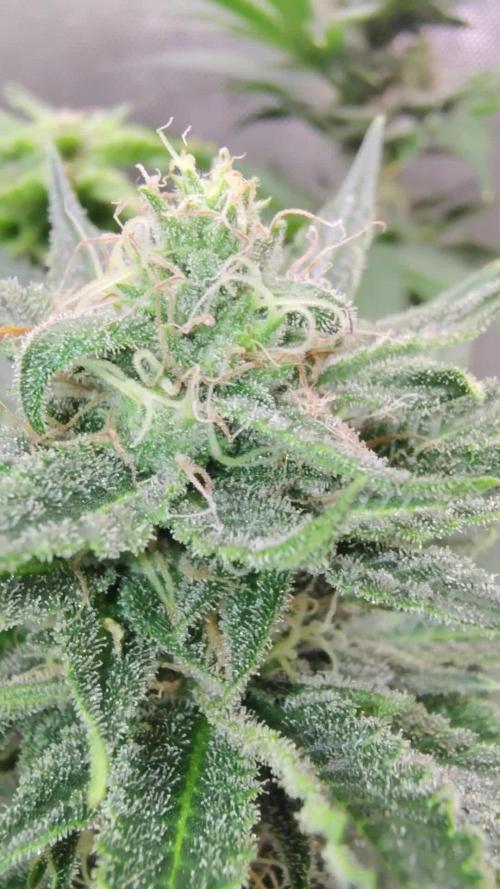
Formation and enlargement of flowers can be noticed with the naked eye.
The wave of warm weather continues all this week. Expected temperatures for the next seven days range from 25-29c. Need to pay attention to that
Raise light 10cm, top of canopy now is around 50-55cm
PAR map 1180max/650min PPFD, VPD -1.2-1.3, DRH 50-52%, NRH 45-48%, NT-21-22c, DT-24/25.5c, Leaf temperature 22-23c, Light distance 45-55cm, CO2 700+ppm
HLG Scorpion Diablo @ 80% - 50-55cm distance
60s ON time 20min OFF time @ Day Time
60s Off time 30min OFF time @ Night Time
NT-Nutrient Tank - PH -5.95-, EC -1.24, Temp-21-22
31.03.2024
Girls totally recovered from defoliation. Almost all gig leaves grow again on all girls.
Purple Lemonade is going to be a biggest in height in this grow . They already around 85+cm with SCROG branches.
Tropical condition continue. Temperatures going from 26-29c, night temperatures still colder and stay around 16c
Outside temperatures affected water temp in nutrient tank, will se if i need for a water chiller or i will cool with adding cooler nutrient solution.
Lower wattage on light , set Diablo @ 75%
Replaced all filters in the system, replaced on washing…
Refilled the tanks with 15l of fresh mixture. 25ml AN connoisseur A+B + 3g Big Bud Powder + 7.5ml Silica - total 15l @ 1.21EC
PAR map 1180max/680min PPFD, VPD -1.2-1.3, DRH 48-52%, NRH 42-48%, NT-22c, DT-25/25.5c, Leaf temperature 22-23c, Light distance 50-55cm, CO2 700+ppm
HLG Scorpion Diablo @ 80% - 50-55cm distance
60s ON time 20min OFF time @ Day Time
60s Off time 30min OFF time @ Night Time
NT-Nutrient Tank - PH -5.95-, EC -1.21, Temp-22-24
01 04.2024
Outdoor Climate: It’s hotter outside. I’ve set the Diablo at 73% to maintain temperatures in the box within the 25-26°C range.
Humidity: After defoliation, the humidity is low, which is great! The dehumidifier hardly worked this week.
Misting Routine: I start the day with a 3-minute misting session; this will be the routine for now.
Nutrient Solution Temperature: I’m keeping the nutrient solution temperature between 20-23°C. I refill the tank twice a day to cool down the solution.
Light Parameters:
PAR Map: Maximum PPFD is 1080, minimum PPFD is 650.
VPD: Ranges from -1.2 to -1.3.
Daytime Temperature (DT): 25-26°C.
Nighttime Temperature (NT): 22°C.
Leaf Temperature: 22-23°C.
Light Distance: 50-55 cm from the plants.
CO2 Levels: 700+ ppm.
HLG Scorpion Diablo: Set at 73%, positioned at a 50-55 cm distance.
Lighting Schedule:
Daytime: ON for 60 seconds, followed by 20 minutes OFF.
Nighttime: OFF for 60 seconds, followed by 30 minutes OFF.
Nutrient Tank (NT):
pH: Maintained between 5.9 and 6.1.
EC: 1.18.
Temperature: 20-23°C.
Week 4 off Flowering in Summary
120 litter off RO water,
210ml+210ml AN connoisseur A+B, 18g Big Bud Powder, 45ml Growth Technology Liquid Silica
70kW electricity in total for light, Pumps and AC Infinity Fans. 63kW for Light + 2kW Dehumidification + AC Infinity ventilation
Week start @ 1.31EC, nutrient strength., keep strength @ 1.24 till the end of the week
Girls look superb all time, Purple Lemonade is going to be tallest from all three stains. Nice bud formation also.
PH was stabile and move from 5.90 min to 6.2 max.
Light distance for this week - 50-55cm from tallest top , PPFD levels around 1100 in center, trough whole week. Lowest reading 680 @ corner
Temperature are from 23c at start off day to 26c max at some points. AC Infinity T6 extracting fan program in AUTO to kick in @ 26c
Night temps around 21-23c, dehumidifier work less this week. Outside humidity is low this week
Water temperatures in middle off week start to rise, refilling solution is cooled to bring temp back from 23-24 to 20c
Defoliate girls on first day off this week, pruning off smaller branches, lots off foliage is removed
After defoliation humidity drop immediately in box. Need to bring back humidifier for couple of days. RH was low trough whole week
Day RH is moved from 45% to 50% max, at night times drop to 40-45%
Next week outside temperatures continue above average for this time of the year.
Continue in next week, starting probably with one more light defoliation, bigger fan leaves only

Likes
20
Share
@R3LOADABLE
Follow
5/7-D1...beautiful weekend to grow. Each new week will be on Saturday. I will be updating along the way multiple times per week. Giving averages for my conditions.
D2-wonderful week of sun is scheduled in the forecast. Lightly misting and keeping the roots moist. A little water every morning should do the trick. Plant is looking healthy otherwise. Not able to care and maintain like my other plants but I'm hoping for an impressive yield without any training techniques.
D3-very windy today, avg temp 81f.
D4-hot and humid today. Avg temp 80f. Gave a little misting at the base to keep moist.
*reached 90f today...woah
D6-high of 93 today. Giving the base a good moisten each morning, afternoon and evening, as it has been so so hot
D7- misted the base this morning, will continue to moisten when dry. First week down, probably 9 more to go.
Likes
12
Share
@JolliGrowz27
Follow
Nothing really to report, but just 1 watering. No nutrients only recharge. I transferred the clones into soil party cups. All labeled and being fed low doses of dry amendments with the transfer. Buds are fattening up and getting frostier. Number 3 is still my favorite pheno. Next run I have 2 of the #1's and 2 of the #3's ready to go. As soon as the ladies are chopped, I will clean the tent quickly and start all of the clones in flower.

Likes
13
Share
@DeepRootsGrowTrees
Follow
JOANNE'S CBD / ROYAL QUEEN SEEDS
WEEK #22 OVERALL
WEEK #10 FLOWER
This lady started a little slow but definitely made up for the slow start she produced some fat buds and has a nice aroma to her!! Stay Growing!!
Thank you for stopping by and taking a look it's much appreciated!!
THANK YOU ROYAL QUEEN SEEDS!!
ROYAL QUEEN SEEDS / JOANNE'S CBD

Likes
4
Share
@Naujas
Follow
35 days!!! When I returned from vacation, I found her a little tired:) as far as I know, the weather wasn't very good, but the last 3 days we've had really sunny weather, so even though the girl lives on the north side of the house, she's still maturing there:) she looks really good :) good luck to everyone.



Likes
1
Share
@Bwright_315
Follow
This week on a tale of two plants
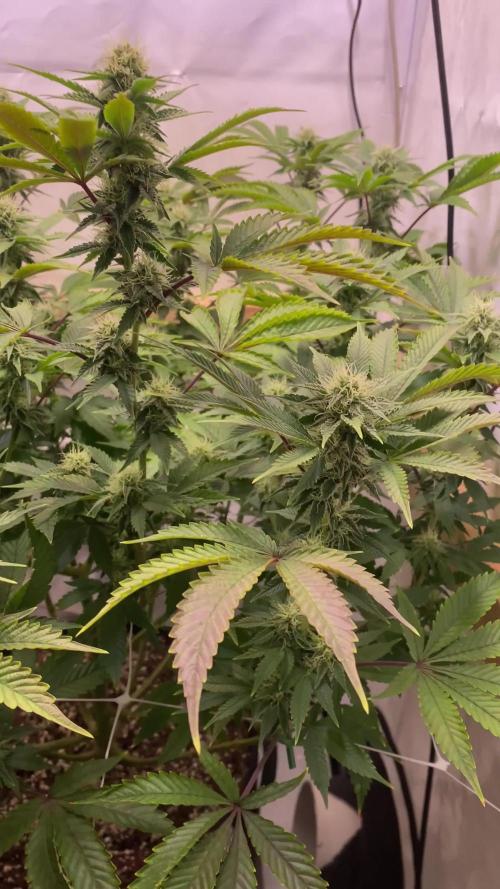
Plant A she is going very well. She is very sticky and tricone starting to turn milky have no issue with her and she smell amazing
Plant b is feeding like crazy I water her at least 4 time a week I think that why she was delay maybe so I been making sure to keep on top of that her smell and getting stronger and she is getting thicker with tricones starting to produce

Likes
17
Share
@420DeepGrow
Follow
Gracias al equipo de FastBuds y XpertNutrients sin ellos esto no sería posible
💐🍁 Ztrawberriez:
Ganadora de la AAC 2024, con hasta un 25 % de THC, la Ztrawberriez Auto surge del cruce de dos variedades californianas conocidas por sus extraordinarios perfiles de terpenos y su potencia. Esta variedad no solo produce hasta 600 g/m² de hermosos cogollos duros como rocas en 9-10 semanas, sino que también llevará a tus papilas gustativas en un viaje en montaña rusa por toda la gama de terpenos dulces y afrutados
🚀 Consigue aqui tus semillas:
https://2fast4buds.com/es/seeds/ztrawberriez-auto#description
⛽ XpertNutrients: es una empresa especializada en la producción y comercialización de fertilizantes líquidos 🍶y sustratos🐛, que garantizan los mejores resultados y cosechas de la más alta calidad. A través de una cuidadosa selección de materias primas y un proceso de producción avanzado, sus productos son sinónimo de resultados confiables.
🛒 Consigue aqui tus fertilizantes:
https://xpertnutrients.com/es/sobre-nosotros/#:~:text=Xpert%20Nutrients%20es%20una%20empresa,de%20la%20m%C3%A1s%20alta%20calidad.
Gracias al equipo de FastBuds y XpertNutrients sin ellos esto no sería posible
📆 Semana 11:
Los cogollos comienzan a engordar y tomar un tono purpura precioso , esta semana el clima va a ser muy bueno, espero que formen unas buenas flores.
En cuanto a resina, está bastante cargada
Likes
2
Share
@CannaIGrow
Follow
Topped this girl this week, she’s growing pretty good. Very nice looking plant to my eye.
Likes
3
Share
@Growella
Follow
Over all Blue Toof was a great strain to grow. Very easy to manicure and LST. Great strain funky dank and berry tasting. Defiantly a winner in my book. I advise anyone in the future who does grow this strain, have rubber gloves on deck!


Likes
22
Share
@Smith420
Follow
First go and journey is almost done. It was fantastic fun and educational. Gonna leave to dry for 7days or until stem cracks. Then gonna cure for another 7 days or until bakefully satisfied 🤤😎. Best of wishes and luck to everyone out there.

Processing
Likes
20
Share
@FlavoursUk
Follow
Day 15. Girls are steady but no major growth yet.
Day 19- stardawg girls seem to be just a bit infront in terms of growth rate compared to the GSC. 2 stardawg, 2 Girl Scout cookies in soil. One of each in rockwool cubes which seem to be growing nicely. Just double stacked them today. Used the rockwool along side soil as a little experiment as I’ve had good results in the past. Due to these being autos I’m wondering if they would of all been better in cubes. Time will tell.
Also had one of the Girl Scout cookies showing possible overfeeding but keeping a close eye on all plants and feeds will be just water till I establish what’s caused it.
Any questions feel free to ask!
Processing
Likes
10
Share
@CreoWeed
Follow
Hey guys, this other week went very cool, I start reducing the nuts to the minimum and I can see really how fattening are the buds.
Now I can see some pretty milky trichomes, and just few cloudy, so I consider to chop in max 2 full weeks... (71 total days from seed) but anyway I'll adapt to how the plant is at that time.
The smell it's absolutely, insanely strong and ill need to buy ASAP a carbon filter to reduce it.
The only issue encountered in this grow was keeping low the humidity, and in fact I was not really able to do so as it stands at 55-65...but without noticing any mold issue on flowers.
Can wait to update this post next week!
Stay tuned, stay high!
Likes
48
Share
@DudeGrowsWeed
Follow
Tangie'Matic is growing great, as expected. Nice looking bud site development. Started giving Mammoth P this week in combination with Recharge, looking forward to the results.
Likes
48
Share
@DudeGrowsWeed
Follow
Tangie'Matic is showing nice bud development this week. I backed down a little on the Recharge this week, but still giving twice the suggested amount. Also still giving her Mammoth P. Will start with MegaCrop (Greenleaf) nutrients later this week. 👍
Likes
17
Share
@Pierrougarou21
Follow
Bonjour mes amies,
merci de visiter ce journal de culture.
Cette Glookies a une forte vigueur , elle fait des feuilles énormes et porte sur elle une odeur deja bien présente.
Comme vous pouvez le voir sur les photos et vidéos, de jojr en jojr elle devient de plus en plus frosty.
Merci @Barneyfarm pour votre merveilleuse genetique

Likes
24
Share
@MaxMo8
Follow
Hello my friends . The last week before harvest, I gave her chlorinated water. And sorry for not leaving weekly notes due to lack of time, thank you all for my support. I wish you happy days😘🙏👌🙋♂️
Likes
54
Share
@Papablob
Follow
12/05 Ouai! Elle se porte bien mieux. Elle ne se crame plus sur les LED, déjà, et les feuilles se sont élargies. 😅 Une belle plante malgré des débuts ardus. 👍
15/05 Les points blanc c'est là ou elle à touchée les LED. Mais en même temps cela l'a étalé.🙂

Likes
2
Share
@DurbanPoison420
Follow
Although both plants are amnesia haze, they seem to be showing very different traits already. AH#1 is forming typical Sativa like buds as expected and should be ready for harvest in the next couple weeks. AH#2, while 3 weeks younger, is much much more pungent than her older sister and the plant is already a lot bigger in size!
Likes
22
Share
@DadGrowsTomatoes
Follow
5/4/2022
Node additions have slowed but overall growth continues strong and healthy.
Continuing to make minor adjustments to LST. Generally watering every other day. Added too dressing of 2-4-2 dr earths and worm castings. May try daily watering but less water. They seem to love the fish tank water.
Decided against the 3rd topping. There's plenty!
