


Likes
Comments
Share


@Krisis
Follow
04/16/24. Hey hiii helloooo.
We are entering week 8 wow. I can’t believe we made it. All in all I’m very happy with how thing have gone/are going. I’m not sure exactly how soon or not these will be done. I think they’ve done what they are gonna do and now we’re just watching trichomes. They look sorta done? Like I think I could chop them and all would be fine.. but I’m no expert on trichomes. I think they look milky LOL..mostly? I’m going to let them keep going and watch for any changes. Feeling happy and also sad at the thought of murdering them :( I love them
Oh and I dimmed the light to 50% and just giving water still when they’re dry which is every other day. Each drinking 1 gallon. Trichome pictures included for anyone who can look at them better than me.😅

Likes
3
Share


@I_Identify_As_A_Dan
Follow
Day 56
Shes fucked.. ahah but its my fault i think for giving that bit of top watering that one time. But oh well shes going to be ran again and im sure she will still give me a bit of smoke.

Likes
9
Share


@Ninjim8
Follow
Week 5
Day 39
Tucked what i could and they've popped back up pretty quick some started stretching more. It's a 6 inch trellis which has way to much space per square. I wish i could've found a 3 inch square trellis that was plastic instead of rope. Going to look into making my own next run.
Feed liquid nutes twice a week

Likes
6
Share


@midnitrtoker
Follow
Was trying to play around with a new feed schedule for the upcoming weeks but threw my EC outta wack figured I’d see what happens at 2.2 EC as I should be tapering down soon. Started to notice some over feeding symptoms but I might be tripping. Still trying to dial in this Autopot it could also be that I’m using doctor zymes as an IPM and I have to spray the coco on top causing the nutrient build up to go down towards the roots? Idk but either way we will still chug along we are 3 weeks away from chopping down anyway so let’s go!!!!
Likes
16
Share


@WeGrow
Follow
Flushed them as I think they are only a week or two away from harvest. They are getting really heavy and as I had to move them to the shower to flush them properly I tried to be careful not to break any branches. The PH is about 8.0 of the tap water, so after flushing I gave them enough PH 6.3 water. One or two plants seem to be finished, they already have some dark trichomes - but I can't harvest them as I only have this tent.
As always - if you have any advice for me or criticism, please let me know! Thank you!
EDIT: Humidity is currently a huge issue, there has been rain 24/7 since yesterday, so keeping humidity at oround 30-40% is impossible. Currently at about 55% - I know, it is too much but there is nothing I can do.


Likes
35
Share


@nonick123
Follow
Día 87 (26/08) Aplicación foliar de Bacillus thuringiensis a 1 g / litro para evitar a las temidas orugas de los cogollos!
Hace un día nublado (29 ºC de maxima) y NO es necesario regar
Elimino la malla de sombreado de la cara sur, ya que las temperaturas son más suaves después de la canicula
Día 88 (27/08) Riego con 500 ml H2O pH 6,5
Empiezan a bajar las temperaturas a 29 ºC de máxima, y se nota en la demanda de agua por parte de las plantas!
Día 89 (28/08) Riego con 500 ml H2O pH 6,5
Cada planta empieza a ir un poco a su marcha en la demanda de riego dependiendo de su tamaño y estado de floración
Día 90 (29/08) Riego con 250 / 500 ml H2O pH 6,5
He detectado un gusano de los cogollos muerto sobre una hoja! 💥 Parece que los Bacillus thuringiensis funcionan estupendamente! 😁
Día 91 (30/08) Riego con 250 / 500 ml H2O pH 6,5
Día 92 (31/08) Riego con 1 litro H2O pH 6,5 + 25 ml de Humus de Lombriz Liquido
Día 93 (01/09) Aplicación foliar Bacillus Thuringiensis
No es necesario regar tras el litro de ayer y dia nublado con pequeños chubascos!
💦Nutrients by Lurpe Solutions - www.lurpenaturalsolutions.com
🌱Substrate PRO-MIX HP BACILLUS + MYCORRHIZAE - www.pthorticulture.com/en/products/pro-mix-hp-biostimulant-plus-mycorrhizae

Likes
24
Share


@FlynnRyder
Follow
Alrighty, guys and gals it's another res change and another opportunity to make mistakes haha. All in all, I actually got a lot of helpful advice through the questions forum so a big shout out to anyone that helped with those issues. Unfortunately with the rest of the canopy being somewhat the same height, I decided to leave the lights on 100%. I can't raise them any higher and I just have to better in veg when it comes to keeping the canopy even and encouraging bud sites. I'm super tempted to trim up the top big fan leaves but I honestly am not sure if it would help any at this point in time. I'm looking forward to giving the buds more time to grow though and I'm hoping a surprise myself with a great turnout. I'm still at a loss for when to harvest as far as what to look for with the buds aesthetically. I've heard the trichomes cloudy bit so many times but I guess I just cant tell if I should harvest what's larger done and cloudy then harvest the rest later etc.

Likes
10
Share


@Jozef_Balcerek
Follow
Ostatnie dni. 2 może 3 i będziemy ścinać. temperatura 23-22C , wilgotność 40%. Podlewane tylko wodą. Zdecydowanie mniej pija, zszedłem do 0.6l.

Likes
Comments
Share

@Growfather1
Follow
Hello everyone!
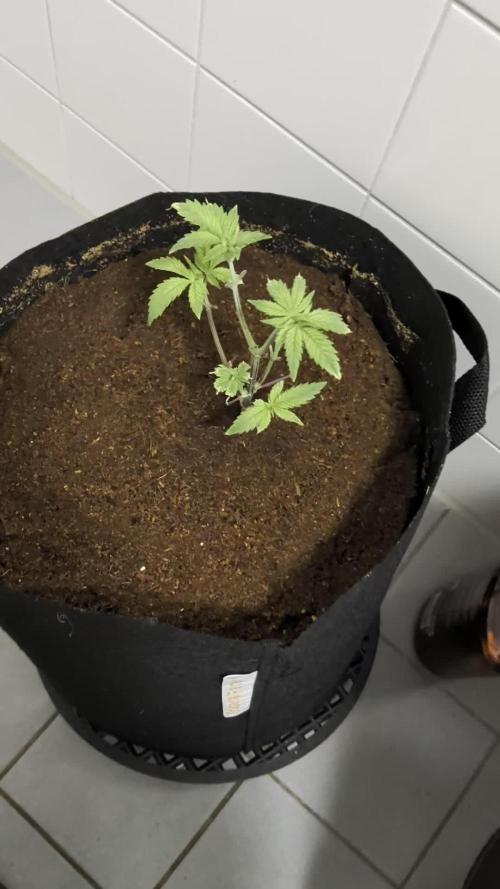
Here is the update for our Gorilla Glue #4 crew. We are officially rolling into Week 6, and things are looking solid overall. The girls have been successfully transplanted into their spacious 5-gallon pots, which should give those roots plenty of room to stretch out and get comfortable.
Right now, the plants are in okay condition. We have noticed a few burnt leaf tips—looks like they might have had a little too much of a good thing at the dinner table—but thankfully, the new growth is looking very promising!
We are giving them a proper, thorough feeding with plenty of runoff to wash away any residual drama. Best of all, we have officially retired the neem oil treatments. Let's be honest, nobody likes smelling like a walking pest-control truck, so the girls are definitely breathing a sigh of relief.
They should be bouncing back beautifully by next week.
Our climate control team is working hard to keep the environment dialed in:
Humidity Kept steady above 60% (shoutout to the humidifier doing the heavy lifting)
Maximum Temperature Hit a brief peak of 27°C, but mostly cruised at a comfortable 24°C
Minimum Temperature Dropped down to a cool 21°C
That is about all the news fit to print for now. Let's see how they stretch and settle into their new homes over the next week.
Thank you so much for stopping by, and have an amazing day!
Best regards,
Growfather

Likes
11
Share


@HornyMccoy
Follow
Noticed spots on leaves. I think she might have a calcium Or manganese deficiency.
DAY 16. TOPPING
DAY 18. removed 2 top leaves to clear light for undergrowth.
Day 19 definitely think i have calcium deficit plant. Will be adding some cal-mag nutrition in next couple days.
Say 20. Major fan leaf pruning. Hopefully new growth will explode soon.

Likes
9
Share


@Cestlaweed
Follow
Se realizo podas de bajo y comienza segunda semana de LSD 25.
Gran estirón al final de la semana.
Temperatura se comienza a elevar hasta valores de 31 grados.

Likes
49
Share


@MadeInGermany
Follow
Hey everyone 😀.
We arrived the week before last :-).
Since I already know the pheno and had it in my diary, I know how delicious it will be 😍.
Meanwhile every Bud is so heavy that it falls over without support ützen.
Otherwise, there is only adapted Ec water until the move to the darkroom.
I wish Have fun with the update, and let it grow 👍
Strain : Sour Diesel
☝️🏼😍
Genetic:
Diesel x Northern Lights
👍
Vega Lights : 2 x Todogrow Led
Quantum Board 100 W
💡
Flower Lights : 2 x Todogrow Led
Cxb 3590 COB 3500 K 205 W
💡 ☝️
Soil : Canna Terra Professional +
☝️
Nutrients : Canna Terra Vega, Canna Terra Flores, Rizotonic, Cannazym, CANNA Boost, Pk 13/14,
Canna Cal/Mag, Canna Ph - Grow,
Canna Ph - Flores
☝️ 🌱
Water:
Osmosis water mixed with normal water (24 hours stale that the chlorine evaporates) to 0.2 EG. Add Cal / Mag to 0.4 Ec Ph with Organic Ph - to 6.0
💦 💧

Likes
8
Share


@PajaritoUY
Follow
Estas últimas semanas tuve que mudarme y terminé sin poder hacer muchas imágenes

Likes
1
Share


@Mr_nugs_lover_David
Follow
The girl looks very healthy and ready for full flower,however I've noticed that she's not a very "big" plant she has the same size as her sister and her sister is in a 15 liter pot and she's in a 25 liter one,however the smell so far on the start of the second week is delicious,very aromatic and sweet, can't imagine how she's gonna smell like in a few weeks more.


Likes
3
Share


@brpet
Follow
Trichomes are turning amber slowly. Had some pH issues which the leaves did not enjoy. Also cut back on the EC - down to 1.3 now. Harvest next week!

Likes
8
Share

@BlaKX
Follow
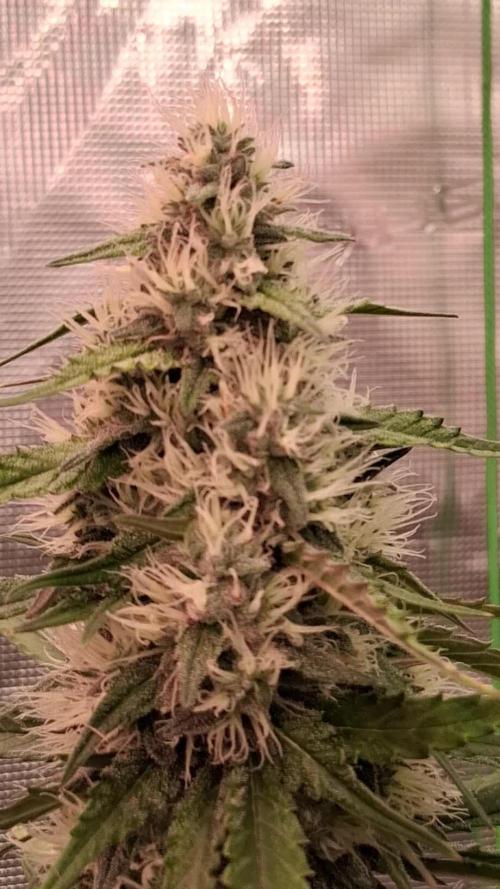
Woche 7 vorbei und die Guava Runtz Auto 🍈 hat zwar lange Blüten mit eindeutiger Sativa Dominanz !
Sie wird sicher 10 Wochen brauchen bis sie zur Ernte bereit ist!
Alles in allem keine Pollensäcke entdeckt!
Likes
22
Share


@bypado_farm
Follow
Day 43:
Watered each plant with 1L with nuts
1589 ppm, 3380 us/cm, 3.3 EC (purple punch and wedding cheesecake)
1563 ppm 3325 us/cm 3.3 EC (strawberry banana)
1476 ppm 3180 us/cm 3.1 EC (gorilla cookies)
I have 3 different feedings for the 10 plants
They look healthy
Day 45:
Watered each plant with 1L with nuts
1563 ppm, 3325 us/cm, 3.3 EC (purple punch, strawberry banana, wedding Cheesecake)
1286 ppm, 2765 us/cm, 2.7 EC
(gorilla cookies)
2 different feedings for the 10 plants
Day 47:
Watered each plant with 1L with nuts
1584 ppm, 3380 us/cm, 3.3 EC (purple punch, strawberry banana, wedding Cheesecake)
1481 ppm, 3180 us/cm, 3.1 EC
(gorilla cookies)
2 different feedings for the 10 plants
Likes
6
Share


@BioGrowBayer
Follow
Vorblüten. Insgesamt wirken sie gesund, mit kräftig grünen Blättern und ohne Anzeichen von Mangel oder Stress.
Die Beleuchtung läuft nun im 12/12-Zyklus. Der Abstand zur Lampe wird regelmäßig kontrolliert und angepasst, um Verbrennungen zu vermeiden. Die Temperaturen liegen tagsüber bei etwa 26 - 28 Grad, nachts bei 18–20 Grad. Die Luftfeuchtigkeit pendelt sich bei etwa 45 bis 50 Prozent ein.
Die Pflanzen werden alle zwei bis drei Tage nach Bedarf gegossen. Diese Woche gab es die erste Gabe Blütedünger mit reduziertem Stickstoffanteil und mehr Phosphor und Kalium. EC- und pH-Werte liegen im optimalen Bereich. Ein Schädlingscheck verlief ohne Befund. Alles läuft reibungslos.

Likes
2
Share


@Ultraviolet_
Follow
The nighttime VPD does not need to mirror the daytime VPD. Daytime VPD dictates the pull of water and nutrients, while nighttime VPD acts mostly as a prevention tool. A high nighttime VPD increases the risk of the leaf temperature dropping below the dew point, which can trigger bud rot and powdery mildew.
Switched down to 12's hours of light mid-week, changed spectrum, increased light intensity from 840umol up to 1150umol at current height. Overnight from 800ppm to 1500ppm, morning compensation point (microorganisms) 46-47 days from germination, she fills the canopy herself, once the apical dominance is broken.
Measuring a plant's overnight CO2 emissions provides an accurate estimate of its dark respiration rate. Because photosynthesis stops in the dark, you are isolating the respiration process, which allows you to gauge how much stored energy (glucose) the plant has consumed and estimate the scale of oxidative phosphorylation. Oxidative phosphorylation is the final stage of respiration that generates the bulk of the plant's ATP (90%) and relies directly on the oxidation of these respiratory substrates NADH and FADH2 along with the consumption of oxygen.
From a thermodynamic standpoint. Growth is an energy-capturing process, and the rate of that growth is bound by the available free energy (Gibbs free energy) and the First Law of Thermodynamics. While the ceiling or upper limit is dictated by free energy (such as photosynthetically active radiation), the actual amount of growth relies on how the plant balances that energy with other limiting factors. These are often described as the nine cardinal parameters of plant growth. 4 Above, 5 Below. If any one of the 9 becomes bottlenecked, the entire plant's cycle is restricted.
Operating an 80F+ environment at night to force rapid carbon conversion comes with major drawbacks, as the biochemical processes work differently than the deductive logic suggests. While raising nighttime temperatures to 80F indeed accelerates respiration and speeds up the conversion of captured sugars (sink activity), doing so also radically increases the plant's overall metabolic baseline. If the plant's metabolic rate is artificially forced too high via heat, it can actually "burn" through more energy than it managed to assimilate during the day. This leads to carbohydrate starvation, stretching, and a net loss in final biomass yield.
400 ppm is near the standard ambient level; the plant's stomatal intake is the primary limiting factor, not the dark-reaction enzymes. To push 45 DLI without burning out the plant. Trying to force the conversion of a massive daylight DLI in a compressed time frame (12 hours) becomes highly inefficient because the Rubisco enzyme simply hits a saturation limit. To successfully convert a 45 DLI into dense, productive mass, the ambient CO2 generally needs to be elevated to the 1000 to 1200ppm range. This creates a steeper concentration gradient, driving the stomata to inhale CO2 fast enough to match the high photon energy.
It's not all about the amount of light, but the ratio too, as this will dictate growth through the ratio of phytohormones. In order for correct bud development, there needs to be a correct ratio of RGB. Different wavelengths have different penetration depths. When one grows using top-down lighting, only the entire canopy is limited to 2-3 layers of leaf, meaning there will only be correct bud development in those layers, regardless of getting 45DLI.
The biomass potential of a plant is linked to root mass. Generally, when a plant reaches its maximum biomass, you can help to chop off parts of the plant that are in less than efficient areas of the plant (low light) so that it can create new biomass growing towards the light.
Strength is the maximum potential, and power is the rate of conversion. You can have the biggest veg period of 18 weeks, and it means nothing, as soon as you start flowering, the chronological clock starts ticking, the only metric that matters to bud size is how much energy you convert each cycle, not by how long it took you to build the framework, it helps a lot nonetheless.
Not saying anyone should not defoliate for a reason, only that you should have one, and at the right time. Don't defoliate 30+% on autoflowers or 4 weeks into the flower period and expect an increase in yields; it doesn't work like that. There is room for dictating growth patterns and clearing out overcrowded nodes, but it needs to be done in veg because once that timer starts and buds start growing, it's all just energy conversion. One barely needs to defoliate at all in a 4x4 because with side lighting, turning a 2d canopy penetration into a 3d, even lower buds are 90% the quality and density of top ones. The rate of photosynthesis and the ultimate density of lower buds aren't just about the sheer number of photons PPFD. The specific ratio of R:G:B dictates canopy penetration and drives different photochemical reactions. The Electron Transport Rate (ETR) measures the speed at which electrons are driven through Photosystem II (PSII) during photosynthesis. The ratio of Red, Green, and Blue (RGB) light heavily dictates this rate.
Plant leaves continuously perform cellular respiration regardless of the time of day, using energy and oxygen to fuel essential metabolic maintenance. If you over-defoliate, the remaining canopy may be unable to produce enough net sugars during the day to offset the constant respiratory demands of the plant. Must balance fixation with assimilation; there's no point in capturing 45 DLI if you only convert 20% every cycle due to an extreme lack of respiratory capacity to perform cellular oxidative phosphorylation.
You can have a 4x4 canopy or a 4x4x4 canopy, yes, we know that side lights are not as effective at absorption from the sides or underneath, but it's not about DLI, it's never been just about efficiency, it's about the penetration ratios of RGB that drive ETR of/photosynthesis and trigger correct bud development. The size of each bud is its own ability to perform the ETR required for its own personal growth, and bud development is dictated by the ratio of RGB. It drives localised growth and acts as a regulatory switch for that development. Turgor pressure is another very important factor in understanding if you want big buds, for it is the "steam engine" that dictates the rate of bud expansion. Simply, a lot harder to achieve metabolically at ambient 75F than at say 86F
Because buds have less chlorophyll, they do not suffer from the same photosynthetic shutdown that over-exposed, light-stressed leaves do. They can soak up direct light energy to swell in density and size. Their tolerance to intense light is heavily limited by the temperature and humidity, but if you can control those temps and keep the rot away, buds have a much, much higher tolerance to high light than leaves. Beneficial to hammer with high light before trichomes appear. Balancing this with trichome maturity is key for rich terpene and flavonoid profiles, want it just right, somewhere in the middle, not too much, not too little. Find cannabis plants can defoliate themselves come harvest, given the right signals. Every last ounce of potential is recycled into buds by the plant itself (senseceance), given you can keep the level of conversion high enough to prompt a need to do so.
Get the canopy @ optimal PPFD range, 45-55DLI, then let the plant "stretch" the stems into a "PPFD range much higher, one that leaves don't like to grow in, but buds thrive in. What is optimal for a bud is different from what is optimal for a leaf photosynthetically. Genes provide the blueprint, but the environment dictates how, when, and if those genes are expressed. Must first signal the condition to increase the expression you want to exist through stress and response, cause and effect. A well-buffered CEC medium prevents extreme nutrient swings, allowing plants to maximise their dedicated genetic expression.
A plant is either genetically expressing "growing" or "recycling" genes based on its nutrient starvation level in the medium. Constantly toggling between "growing" and "recycling" hormonal states creates a futile cycle that wastes valuable metabolic energy. Plants rely on sophisticated biochemical switches to manage this trade-off and prevent rapid fluctuations that disrupt that balance.
This energy inefficiency is a recognised biological challenge. Plants avoid this costly "flip-flopping" by using hierarchical master regulators (like the TOR and SnRK1 protein kinases) that act as strict molecular switches. These networks enforce cellular commitment to either growth or survival, preventing mixed signals.
This is something that was missing from previous grows.
Under nutrient-rich conditions, TOR promotes protein synthesis, cell division, and structural expansion.
Under starvation, TOR is inhibited, and SnRK1 is activated. This triggers autophagy—where the plant breaks down old macromolecules and organelles to scavenge and reallocate essential nutrients to critical sinks.
"What's the point in flushing?"
The core idea behind a PK booster is to deliver a massive, concentrated surge of P&K exactly when buds are swelling in conjunction with a N starvation. Because these are short, targeted windows, the nutrients must be highly bioavailable so the plant can process them immediately. As soon as you go "organic," that's out the window. Much slower release, uncontrolled, very difficult to "spike". to cause the ratio that will initiate a response.
High-volume PK spikes rely strictly on the immediate uptake capabilities of mineral fertilisers. Making it far less efficient in organic/living soil setups.
When you use organic nutrients, it changes the dynamic with which the plant delivers and trades its nutrients; organic is always releasing new nutrients into the immediate EC. This prevents a lot of autophagic responses from occurring due to a constant stream of new nutrients into the immediate medium's EC. This can prevent nutrient starvation from being signalled.
PK boost is essentially just N starvation, triggering an autophagic response. Concentrated ratio of P&K while tapering off the Nitrogen base. To the plant, the sudden drop in Nitrogen registers as a severe environmental stressor—essentially, the beginning of starvation protocols. She aggressively strips nutrients and proteins from older leaves and vegetative structures and shuttles them directly to the developing flowers and fruit. Ta daaa. Call it a PK booster and sell it. Nothing to do with the P and K itself, it's the ratio immediately available in the medium triggering a nutrient recycling mechanism within the plant itself; all the "booster" sells is the trigger to the signal.
PK BOOST with 50% ammoniacal N signals floral maturation.
PK BOOST with N starvation signals nutrient recycling/sinking.
Very difficult to initiate a response when organic nutes are doing their thing. It takes 4x5x more water significantly to leach or wash ammonia out than it does nitrates. This can prevent triggering N starvation from having its normal impact.
Manipulating the C:N ratio in the medium. One autophagic response has multiple potential signal triggers. Nutrient starvation is not an option.