


Likes
Comments
Share


@SzkolaZiola
Follow
First day of week 7
Mimozz and Grandpa's Cookies are ready 😅 It's crazy how fast they developed. 😎
Two plants of Cherry Atomic Sledgehammer are getting there. Should be ready at end of week 8.
Strawberry Cough will probably need 12 weeks to fully mature - but she'll be monster! Can't wait to see her later. 😈



Processing
Likes
17
Share


@KrudBuddysExotics
Follow
Hey guys idk what’s going on my autos it seems as if the Gelato and Zkittlez has just stop growing completely I mean there’s no change at all the Zkittlez Og is starting to fill in forming nice little buds but my other autos seems like they had stop completely
I know the lifespan on the Gelato is 76-80 days from seed to harvest
The Zkittlez lifespan said the same 76-80 days from seed to harvest
Zkittlez Og lifespan is 80-90 days from seed to harvest
And I know I’m for sure March 9th marked the 60th day on all autos and I know I stress the hell out of them overwatered etc but it looks as if I might only have one plant to successfully make it yet this is my first grow and why I choose to do autos first to give me a little insight on what I’m doing but I’m going to let these girls go for a full 90 days before I decide to trash em and focus purely on my clone grows


Likes
188
Share


@DeepWaterGrower
Follow
Hi guys, just a quick info for whoever read this diary:
I started this run with two plants but during Week 9 (57 days: 49 vegetative + 8 flowering) I had to remove the one on the right due slow growth (issue started after I topped her).
Enjoy the reading.
🌱🌱🌱🌱🌱🌱🌱🌱🌱🌱🌱🌱🌱🌱🌱🌱🌱
Third run begins.
🍪🍦Cookies Gelato by RQS, my first time with photoperiods.
I created this diary at the end of January but due some problem with the new drip system (too ph oscillations), I decided to go back to my first love: the DWC.
This time, however, I decided to build my own DWC, taking into account the negative aspects that I find in the expensive DWC of various brands.
This tank has about 50 liters capacity and on the bottom I have inserted a metal tap that will help me with the solution changes.
The lid is made up of two parts, the upper one on which I made a hole in which I inserted a 2 liter planter full of expanded clay and the two root riot;
the front part of the lid is magnificent because it opens and allows me to do a quick check of PH and EC.
This time I'm going to count the days from the germination date. I'm going to VEG for about 40 days, then switch to 12/12 for about 70 days.
I plan on topping the plants during week 4, then defoliation + SCROG during week 5, switch 12/12 during week 6. Then lollipopping at the end of the stretch.
In this run I will use my new MARS HYDRO TS1000 2022 (already have one with 2021 MOSO driver), bought a few days ago to test the latest model with the proprietary Mars Hydro driver. I'm sure there will be further improvement in my performance 💪.
No sponsor for me yet, what I have is what I bought but I hope someone can help me to bring my crops to the next level. I'm planning to buy a new 90x90 tent and a nice 300/480 watt lamp would be very nice. Crossed fingers! 🤞
🌱🌱🌱🌱🌱GERMINATION STAGE🌱🌱🌱🌱🌱
- 20/2/23: seeds in a glass of demineralized water, 2 drops of rootbastic and 3 drops of hydrogen peroxide for 24 hours, then in root riot;
- 21/2/23: seeds under TS1000: 100 cm distance / 33% dimmer = 50 watt;
- 22/2/23: first Cookies Gelato sprouted;
- 23/2/23: second Cookies Gelato sprouted. - Got some gift from RQS, really appreciated.
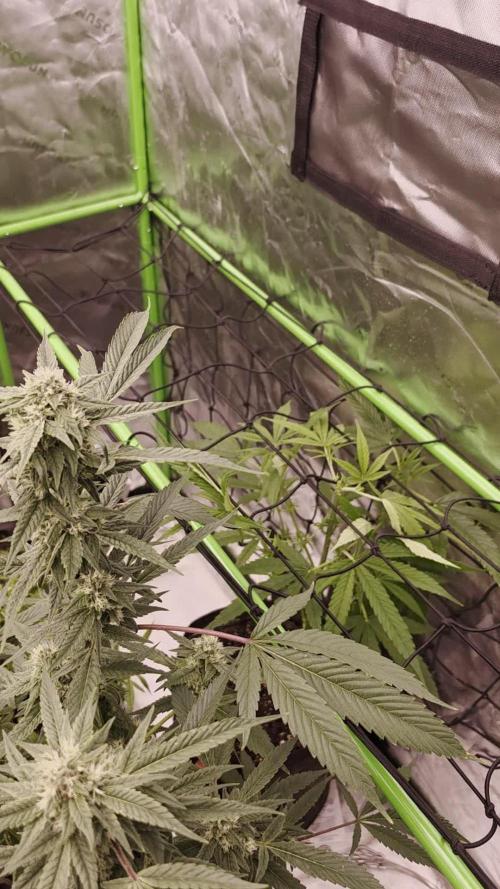
I'll consider tomorrow as 1° day of veg for all 2 seedlings. I'll switch 'em to 12/12 after 40/45 days of veg.


Likes
2
Share

@Chucky324
Follow
Hello This is the end of week 11 and the beginning of week 12 of flowering.
Oh Man... Got some yellow leaves still happening. I've been watering with rainwater and it's 6.8 ph
So I'll try some ph adjusted nutrient next time to see if that's the problem. It will be around 5.8 ph
The growing tips look good, it's just some of the older leaves that are going yellow.
OK. Be Cool.
Chuck.


Likes
Comments
Share


@TheGreenFingeredOtt
Follow
Missed a week because spider mites entered the party but we were quicker to act and shut the show down, lucky timing to say the least... dried the flower out in a cardboard box linked upto the bay6 grow tent. Took 7 days to dry properly since I left it in the tent beforehand for 6 days with no water... had a whopping weigh in at 180 grams!! Was shocked to say the least, as it was my first grow personally (but I have watched and cut with other people's grows).. all in jars burping process now. The banana smell is massively overpowering. I can't wait until its fully cured as it's only going get more potent..
Likes
27
Share


@Oetelando
Follow
We have Day 2 of Week 5 from flowering.
Everything looks green and nice.
The Buds get every day Bigger and more and more Frosty.
Wir sind in der 5. Blütewoche und alles läuft perfekt die Buds werden größer,keine Zickt rum und die zeit zur ernte Nähert sich langsam.


Likes
19
Share


@eldruida_lamota
Follow
Vamos familia tercera semana de floración de estás apollo black cherry de SeedStockers.
Que ganas tengo de ver el progreso de esta variedad, las plantas están sanas, se ven con buen color.
La cantidad de agua cada 48h entre riegos.
Esta semana añadimos nutrientes de la gama Agrobeta.
Las plantas están bastante bien ya llevan una semana en 12 horas de luz 12 oscuridad.
Estas próximas semanas veremos como avanzan.
Mars hydro:
Code discount: EL420
https://www.mars-hydro.com/
Agrobeta:
https://www.agrobeta.com/agrobetatiendaonline/36-abonos-canamo
Hasta aquí todo, Buenos humos 💨💨





Likes
74
Share


@420DeepGrow
Follow
Gracias a @James, Royal Queen Seeds y MarshHydro sin ellos no sería posible hacer este diario.
La Tropical Mirage es la última creación de los maestros de la cría de Royal Queen Seeds. Trabajando mano a mano con el DJ y productor Henry Saiz, nuestro equipo se propuso crear una variedad que sirviera como chispa de inspiración para las personas creativas de cualquier ámbito de la vida. Y ahora, por fin podemos presentar el resultado.
La Tropical Mirage desciende de la todopoderosa Zkittlez, uno de los híbridos más populares del mundo. Es el resultado de un cruce entre un esqueje seleccionado de la Forbidden Zkittlez y la Melonade, y es afrutada, edificante e inspiradora. Sus flores densas, alargadas y resinosas desprenden intensos aromas y ejercen un subidón energizante capaz de impulsar cualquier proyecto creativo, desde la música y las artes visuales hasta la escritura, el baile y mucho más.
En el cuarto de cultivo, la Tropical Mirage es rápida, fiable y muy productiva. Con una serie de cuidados básicos, esta variedad tan resistente te dará suficientes cogollos para mantener tu flujo creativo en acción durante todo el año.
🌻 🚀 Consigue aquí tus semillas:
https://www.royalqueenseeds.es/semillas-feminizadas-de-marihuana/647-tropical-mirage.html
💡 Mars Hydro TS 3000, como la lámpara de cultivo LED más grande de la serie TS, ofrece suficiente cobertura para un área de 4 × 4 pies con un precio asequible y rendimientos de calidad; a cambio, se puede aplicar tanto al cultivo doméstico como al cultivo comercial.
Potencia - 450w
Cobertura Vegetal – 5×5 pies
Cobertura de flores - 4 × 4 pies
La opción abrumadora para la mayoría de los productores que la aplican en tiendas de campaña.
Consigue aqui tu lámpara:
https://marshydro.eu/products/mars-hydro-ts-3000-led-grow-light/
📆 Semana 8:
Creo que va a ser la última semana que aplique nutrientes, los cogollos se han hinchado mucho esta semana. Finalmente quedaron cargadisimas de resina y con unos tonos morados que impresionan, el lavado de raices va a ser facil, estoy deseando cosechar esta variedad 😁⛽
Me hubiera gustado cubrir mas la carpa pero debido a la mudanza y posterior adaptación no ha sido posible.
Likes
35
Share


@Mrs_Larimar
Follow
March 11th.
All Seedlings are stable, Looking good
Working on Leafset 4
Rooting job is done, now the allover development can Start
Plants are sitting in 3l Pots, filled with my Soilmix
Watering with Beneficals
Spraying with Foliar Feed " Fast Plants Spray"
March 13th.
Iam done with setting up
Now i have another Babytent. and Inside the New Viparspectra XS-1000
and the other Stuff to run the Envoirement
I already ca see a difference between both Tents. If you stand outside and just look with Eyesight
the Viparspectra seems to be brighter// has another color of Light.
I made a Unboxing Video for more informations.
Amazon: http://url-9.cn/0y9i
Amazon US: https://amzn.to/3e0P2bk
Amazon CA: https://amzn.to/3bTnEJC
Amazon discount Code:
it10mlarimar XS1000 10%
it15mlarimar XS1500 5%
it20mlarimar XS2000 5%
it40mlarimar XS4000 5%
Likes
3
Share


@macrocefalo
Follow
We arrived in the third week the plants show good vigor and growth. Some cold days 17 Cº may have prevented further growth but we do not have to complain the plants demonstrate to be enjoying food and light. On the 15th the plants presented slightly wilted leaves as day 16 was the day of watering I imagined it was thirsty. But day 16 a few hours after watering the plant still had the same symptoms so I realized that the LED screen was 53 cm from the plant. I increased the distance to 65cm and the plant returned to normal both in force and I managed to correct the diagnosis. I am managing to apprehend some things finally putting into practice.
Likes
7
Share

@ThatsmyGrow
Follow
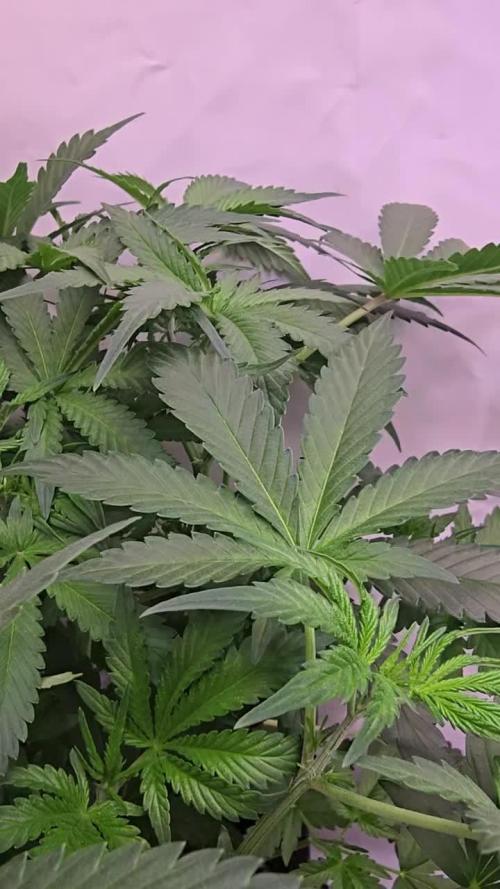
🌸 Week 5 – Gorilla Cookies Auto Pheno Hunt
Another week is done and the differences between the phenos are becoming more obvious with every update 👀🔥
Now that flowering is progressing, each phenotype is starting to show its own character much more clearly. Even though all plants are running under the same conditions, their reactions are very different.
📈 Current observations:
Some phenos are handling irrigation and feeding extremely well and continue pushing strong growth
Others are showing a bit more sensitivity and reacting differently to the same watering routine
Leaf size differences are becoming huge now — some phenos are producing massive fan leaves while others stay much more compact
Plant structure and overall vigor continue to separate more week by week
At this point, 4 out of the 6 phenos are currently looking like strong candidates and fall into what I’d personally consider the “good” category so far 👀
🍃 Maintenance & feeding:
I’m still managing the canopy and keeping an eye on how each plant develops through early flower. Small adjustments and observation are becoming more important now as every pheno responds differently.
📊 Current environment:
Temperature stable around 26°C
Relative humidity staying between 63–65%
VPD maintained around 1.3 kPa
Light intensity unchanged from previous adjustments
Now I’m especially excited to see how the buds start forming over the next weeks, because that will probably decide which phenos really stand out in the end 🔥🌸
The structure is there — now let’s see who delivers when it matters.
💬 Which pheno do you think will end up producing the best flowers?


Likes
4
Share


@ArtisticGrown
Follow
Yessssss HAPPY 420 I'm so greatful to be able to finish this harvest out and this diary. All the Love the BATTLE AXE has taken my heart. Lem dog x BalckPearl ♥️ oufff such a great cross. These flavors are on point. She was soaking in resin by day 49 in bloom. She loved the nutrients, absolutely enjoyed the micro brews I was giving em.
Such an easy trim tooo like it's wild when there's nothing but dank fat dense coals your trimming is easy. It's like deff not trim jail like resort chilling listening to the ocean waves haha 😅
Lets gooooo. I suppose I'll be quite now haha. The battle axe is a banger and should be in your collection. Get you some @ beanpatchseeds.com
Likes
26
Share


@KidAlienGrows
Follow
Really happy with how she’s turning out with massive bulking in this last stretch! GC is an amazing strain that I’d highly recommend to anyone looking for something very unique! Flushes are all done and we have about a week or two left, trichomes are all still very clear under the microscope want to wait for some borderline ambering before I chop her.
Likes
16
Share


@CanadianFillmore
Follow
Thanks for stopping by! Harvest completed and buds drying in the rack. I'm very impressed with this plant and am very excited to smoke this girl! Will update in about 2 weeks with dry weight and smoke report.
08/30 dry weight of 105 grams. Round 2 was an improvement in weight, but the smell and taste are not present like they were in round 1.
