The Grow Awards 2026 🏆
Processing
Likes
Comments
Share
@
Follow
Likes
47
Share
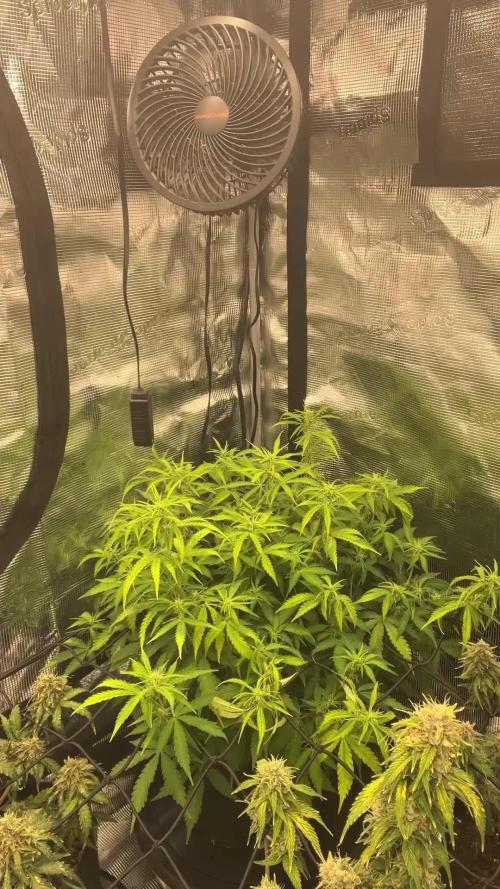
All content on this diary is for inspirational and educational purposes only. The ideas shared are not a substitute for professional advice. This diary/account is not officially affiliated with Alan Watts or his estate. All materials are used under the principles of fair use. I honor the legacy of Alan Watts by sharing his wisdom respectfully and with the intention of inspiring awareness and self-understanding. 2nd net is up. Early bud formations are promising. holding up to the extremes pretty well, some leaves taking minor damage, but overall, she is holding up, gave her 1 night at 50F see how she would react, stressful. Not advised as it messes with her metabolism, but I want to see if it triggers any anthocyanin response. Love to see her purp up but no signs yet. Remember, For every molecule of glucose produced during photosynthesis, a plant needs to split six molecules of water. This process provides the hydrogen needed for synthesizing glucose and other organic compounds, while oxygen is released as a byproduct. Homework. If Rubisco activity is impaired and it cannot properly function or regenerate its substrate, the plant's leaves are likely to turn a pale green or lime green, a condition known as chlorosis. Essentially, Rubisco activity is highly regulated and susceptible to various environmental and metabolic factors that can cause it to become inhibited, leading to an apparent failure in RuBP regeneration due to a lack of consumption. Rubisco regeneration is intrinsically linked to nitrogen supply because Rubisco is a major sink for nitrogen in plants, typically accounting for 15% to over 25% of total leaf nitrogen. The regeneration phase itself consumes nitrogen through the synthesis of the Rubisco enzyme and associated proteins (like Rubisco activase), and overall nitrogen status heavily influences the efficiency of RuBP regeneration. RuBisCO is a very large enzyme that constitutes a significant proportion (up to 50%) of leaf soluble protein and requires large investments in nitrogen. Insufficient nitrogen supply limits the plant's ability to produce adequate amounts of RuBisCO, thereby limiting the overall capacity for photosynthesis and carbon fixation. Maintaining the optimal, slightly alkaline pH is crucial for the proper function and regeneration of Rubisco. Deviations in either direction (too high or too low) disrupt the enzyme's structure, activation state, and interaction with its substrates, leading to decreased activity and impaired RuBP regeneration. (Lime/yellowing) Structural Component: Nitrogen is an essential building block for all proteins, and the sheer abundance of the Rubisco protein makes it the single largest storage of nitrogen in the leaf. Synthesis and Activity: Adequate nitrogen supply is crucial for the synthesis and maintenance of sufficient Rubisco enzyme and Rubisco activase (Rca), the regulatory protein responsible for maintaining Rubisco's active state. Nitrogen deficiency leads to a decrease in the content and activity of both Rubisco and Rca, which in turn limits the maximum carboxylation rate, Vmax, and the rate of RuBP regeneration Jmax, thus reducing overall photosynthetic capacity. Nitrogen Storage and Remobilization: Rubisco can act as a temporary nitrogen storage protein, which is degraded to remobilize nitrogen to other growing parts of the plant, especially under conditions of nitrogen deficiency or senescence. Nitrogen Use Efficiency (NUE): The allocation of nitrogen to Rubisco is a key determinant of a plant's photosynthetic nitrogen use efficiency (PNUE). In high-nitrogen conditions, plants may accumulate a surplus of Rubisco, which may not be fully activated, leading to a lower PNUE. Optimizing the amount and activity of Rubisco relative to nitrogen availability is a target for improving crop NUE. Photorespiration and Nitrogen Metabolism: Nitrogen metabolism is also linked to the photorespiration pathway (which competes with carboxylation at the Rubisco active site), particularly in the reassimilation of ammonia released during the process. To increase RuBisCO regeneration, which refers to the process of forming the CO2 acceptor molecule Ribulose-1,5-bisphosphate (RuBP) during photosynthesis, the primary methods involve optimizing the levels and activity of Rubisco activase (Rca) and enhancing the performance of other Calvin-Benson-Bassham (CBB) cycle enzymes. Biochemical and Environmental Approaches: Optimize Rubisco Activase (Rca) activity: Rca is a crucial chaperone protein that removes inhibitory sugar phosphates, such as CA1P (2-carboxy-D-arabinitol 1-phosphate), from the Rubisco active site, thus maintaining its catalytic competence. •Ensure optimal light conditions: Rca is light-activated via the chloroplast's redox status. Adequate light intensity ensures Rca can effectively maintain Rubisco in its active, carbamylated state. •Maintain optimal temperature: Rca is highly temperature-sensitive and can become unstable at moderately high temperatures (e.g., above 35°C/95F° in many C3 plants), which decreases its ability to activate Rubisco. Maintaining temperatures within the optimal range for a specific plant species is important. •Optimize Mg2+ concentration: Mg2+ is a key cofactor for both Rubisco carbamylation and Rca activity. In the light, Mg2+ concentration in the chloroplast stroma increases, promoting activation. •Manage ATP/ADP ratio: Rca activity depends on ATP hydrolysis and is inhibited by ADP. Conditions that maintain a high ATP/ADP ratio in the chloroplast stroma favor Rca activity. Enhance Calvin-Benson-Bassham (CBB) cycle enzyme activity: The overall rate of RuBP regeneration can be limited by other enzymes in the cycle. •Increase SBPase activity: Sedoheptulose-1,7-bisphosphatase (SBPase) is a key regulatory enzyme in the regeneration pathway, and increasing its activity can enhance RuBP regeneration and overall photosynthesis. •Optimize other enzymes: Overexpression of other CBB cycle enzymes such as fructose-1,6-bisphosphate aldolase (FBA) and triose phosphate isomerase (TPI) can also help to balance the metabolic flux and improve RuBP regeneration capacity. Magnesium ions, Mg2+, are specifically required for Rubisco activation because the cation plays a critical structural and chemical role in forming the active site: A specific lysine residue in the active site must be carbamylated by a CO2 molecule to activate the enzyme. The resulting negatively charged carbamyl group then facilitates the binding of the positively charged Mg2+ion. While other divalent metal ions like Mn2+ can bind to Rubisco, they alter the enzyme's substrate specificity and lead to dramatically lower activity or a higher rate of the non-productive oxygenation reaction compared to Mg2+, making them biologically unfavorable in the context of efficient carbon fixation. The concentration of Mg2+ in the chloroplast stroma naturally increases in the light due to ion potential balancing during ATP synthesis, providing a physiological mechanism to ensure the enzyme is activated when photosynthesis is possible. At the center of the porphyrin ring, nestled within its nitrogen atoms, is a Magnesium ion (Mg2+). This magnesium ion is crucial for the function of chlorophyll, and without it, the pigment cannot effectively capture and transfer light energy. Mg acts as a cofactor: Mg2+ binds to Rubisco after an activator CO2 molecule, forming a catalytically competent complex (Enzyme-CO2-Mg2+). High light + CO2) increases demand: Under high light (60 DLI is a very high intensity, potentially saturating) and high CO2, the plant's capacity for photosynthesis is high, and thus the demand for activated Rubisco and the necessary Mg2+ cofactor increases. Mg deficiency becomes limiting: If Mg2+ is deficient under these conditions, the higher levels of Rubisco and Rubisco activase produced cannot be fully activated, leading to lower photosynthetic rates and potential photo-oxidative damage. Optimal range: Studies show that adequate Mg2+ application can enhance Rubisco activation and stabilize net photosynthetic rates under stress conditions, but the required concentration is specific to the experimental setup. Monitoring is key: The most effective approach in a controlled environment is to monitor the plant's physiological responses e.g., leaf Mg2+ concentration, photosynthetic rate, Rubisco activation state, and adjust the nutrient solution/fertilizer to maintain adequate levels, rather than supplementing a fixed "extra" amount. In practice, this means ensuring that Mg2+ is not a limiting factor in the plant's standard nutrient solution when pushing the limits with high light and CO2. Applying Mg2+ through foliar spray is beneficial to Rubisco regeneration, particularly in alleviating the negative effects of magnesium (Mg) deficiency and high-temperature stress (HTS). While Mg can be leached from soil, within the plant it is considered a mobile nutrient, particularly in the phloem. Foliar-applied Mg is quickly absorbed by the leaves and can be translocate to other plant parts, including new growth and sink organs. Foliar application of: NATURES VERY OWN MgSO4 @ 15.0g L-1 in a spray bottle. For those high-intensity workouts when 1 meal a day is just not enough! Foliar sprays are often recommended as a rapid rescue measure for existing deficiencies or as a supplement during critical growth stages, when demand for Mg is high. Application in the early morning or late evening can improve absorption and prevent leaf burn. The plant was getting a little limey yellow in the centre. Shortly thereafter, she was back in business, green mostly regenerated. The starting point [of creativity] is curiosity: pondering why the default exists in the first place. We’re driven to question defaults when we experience vuja de, the opposite of déjà vu. Déjà vu occurs when we encounter something new, but it feels as if we’ve seen it before. Vuja de is the reverse—we face something familiar, but we see it with a fresh perspective that enables us to gain new insights into old problems. Confidence is evidence... nothing more. You are confident because you have driven 10,000 times, you are confident because you have spoken 10,000 times. People think confidence is a feeling, but it's not. If you want more confidence, then you need to create evidence, take more shots, collect more data, build more experiences, take more risks; fail, confidence doesn't come first; it is the reward you get for doing the work. no one else wants to do.
Likes
12
Share
Plants continue to enjoy the heat of the summer, Growing big fat leaves, going bone dry from sunrise to sunset and drinking lots of water every day at dusk. Some mild calcium deficiency started appearing the yellowing of the leaves with brown-ish spots, corrected with foliar spray Element XX (calcium supplement) I have also introduced my spray homemade pesticide with natural ingredients, you can find the recipe on my Instagram @Girlgoneweed (under the highlights), spraying 2x a week to keep rodents, deer, aphids, mites, mildew and other threats away. Thanks for following along, Happy Growing !! xoxo
Likes
12
Share
Fastbuds - Mimosa (2x) 08/27 Coming into week 4 Veg, User error stunted them lightly but things seem back on track. Exhale 365 C02 bag introduced last week to setup for early flower. No signs of concern or any deficiencies. Early flowering has begun *Mid-Week Update* *08/30* Both plants have recovered nicely, and placed under trellis net. Introduced NPK Phosphate Purged Pure Blend Pro Grow *End of week recap* Flowering has begun Stopped veg nute feed Introduced Raw NPK Phosphorus and Potassium
Likes
30
Share
~ FASTBUDS TESTER #2203 ~ Well friends, here we go on another 'canna-venture' together! The grow room has had a complete remodel and some upgrades done to it including brand spanking new 4x8 and 4x4 tents and a Trolmaster Hydro X controller along with a new Control Panel. This tester strain is one of six tester strains that FastBuds has graciously provided me with and I'm looking forward to seeing what this girl has to offer when she's grown to her full potential! One drawback of 'testers' is I have little to no information on it other than its number and that it's an autoflower... 🤪 But, it's ALWAYS a blast growing them for me because not knowing a lot allows me to just concentrate on the essentials: Light, Environment, Water, Nutrients and possibly a bit of LST... not complicated, just basics like keeping a constant temperature and RH in the tent at a level that gives a good VPD, watering when almost dry and maintaining proper light levels according to their stage of growth. ____________________________________________________________________________________________________________________________________________________________________________________________________________________________________________________________________________________________________________________________________________________________________________________________________________________________________________________ ~THE SETUP~ ~Initially seeds were lightly scuffed, then soaked for 3 hours in 78℉ distilled water after which they were transferred to moist paper towels laid out in a Jiffy Pellet plastic starter tray with lid. Underneath the tray was placed a Mars Hydro Heat Mat with Controller that was set to 78℉ where they stayed until their tap roots emerged. ~Planted into Jiffy Peat Pellets that were hydrated with distilled water warmed to 78℉ with a 7.0 ph. ~Once roots emerge from the Jiffy Pellet they're transferred to their fabric pots. ~Grown 100% organic in a 4g Gronest fabric pot and a 3g fabric pot by Wraxly filled with Mother Earth 70/30 Coco/Perlite medium and initially amended with Dr. Earth 4-4-4 / Earthworm Castings / Dr. Earth Flower Girl 3-9-4 and Coast of Maine Stonington Blend Organic Plant Food 5-2-4. ~19/5 light cycle for the entire run with supplemental UVA added during flower. Lights are controlled by a Trolmaster Hydro X controller set for a 15min Sunrise/Sunset simulation. ~Top dressing every 3-4 weeks with slow release dry amendments and Earthworm castings. ~Straight water ph'd @ 6.2-6.8 when needed and bi-weekly Compost Tea's. ____________________________________________________________________________________________________________________________________________________________________________________________________________________________________________________________________________________________________________________________________________________________________________________________________________________________________________________ Weekly Updates: 12/1- I soaked both seeds for 3 hours in 78℉ distilled water after which they were transferred to moist paper towels laid out in a Jiffy Pellet plastic starter tray with lid. Underneath the tray was placed a Vivosun Heat Mat with Controller that was set to 78℉ where they stayed until their tap roots emerged roughly 24 hours later. 12/3- Today their tap roots were about 1/4 to 3/8" so at 11 am I transferred them into Jiffy Peat Pellets that were hydrated with distilled water warmed to 78℉ with a 7.0 ph using a tine off of a plastic fork as a 'mini trowel' to make a hole in the pellet and to gently cover the tap root, leaving only the seed head slightly exposed. This method accomplishes most of the initial work the seed has to do by eliminating having to orientate itself, push it's root down and head up. By 10pm the #1 seed had her cotyledon leaves opened ...waiting on the #2. 🧐 12/5- Well this is Day ONE for the #1 FBT #2203 and I anticipate seeing her sister poking her head out real soon! I'll keep them in the covered/heated Jiffy tray until I see their roots beginning to emerge from the peat pellet, then I'll transfer them gently into their respective fabric pots. The #1 will be going into the 4g Gronest pot from FastBuds and the #2 will reside in a 3g pot by Wraxly, which I'm trying out for the first time. 12/7- Yesterday I checked the #1 tester and she had roots starting to emerge from her pellet so tomorrow I'll transfer her into her 4g Gronest pot. The #2 tester has finally made an appearance and this will be Day One for her! She looks great and I'm confident that she should be ready to transfer into her fabric pot in the next couple of days! 😎💚 Thank you for checking out my passion in life! Please visit as often as you wish and I hope you enjoy this journey as much as I know I will! Grow Strong! 💪😎🤙
Likes
7
Share
@darcness
Follow
Upgraded the light to Sunraise QB2000
Likes
6
Share
@Smiley33
Follow
Came in on Monday this week after first round of feeding the Friday before and the plants had all gone into full flower mode. They seem to be doing pretty good! It's been pretty hot this week but I feed just water every other day or when the soil is dry and feed them fertilizer every other watering with 1/4-1/2 strength
Likes
18
Share
Harvested at day 76, after 72h of darkness. Very good yield! 3.3 pounds of dry buds + 1 pound of trim The 2 keepers yielded 366 and 342g of premium quality smoke. Very uplifting and energizing high :) Love it!
Processing
Likes
13
Share
@Ghosttown
Follow
Day 42 Blooming nicely Day 43 Water Day 44 Bloom Day 45 Water plus 2lm cal mag. Day 46 Fert just lightly with Tiger Bloom 2ml in 2 litre water just to help stack buds. Pray it helps and enjoy my First Video. 08 May 20 Day 47 Bloom Day 48 Bloom
Likes
19
Share
Growth continues. Buds are starting to fill out and have started to see some pistils turning red. have lowered the nutes in the solution by a small amount and CO2 has been lowered. AND I did not put it back into Veg. It just tagged it that way and I can't change it.
Processing
Likes
12
Share
Last few white hairs left, fan leaves have yellowed off nicely beautiful pink purple colours coming through! Absolutely stinks cheesy kush smell. At one point I thought it smelled like prawn cocktail crisps 😉😂 let me know if you agree and I'm not imagining it!! Great strain would defo run it again!!!
Likes
41
Share
No complaints, no problems other than our current heat wave. Watering three times today's vs normal 2. Tricomes looking like they're getting real milky. I'd say two more weeks. FYI growdiaries says im on week 9 but by my count I'm in week 8f - 56 days. I'm thinking at least two more weeks based on tricomes. Starting to get milky buts nearly zero amber.
Likes
8
Share
La semana no fue mal, seguimos pero incrementando nutrientes,ya que entramos en la fase de que necesitan comer, he entutorado todas las ramas para proporcionar apoyo,he tenido que hacer lst a una Northern light porque se iva de altura
Processing
Likes
12
Share
@BloodBath
Follow
Didn’t get too many pictures this time but they’re really starting to pack on resin now. They smell so good. Everything is going smoothly. Just gave them a flush with some SLF and Herculean Harvest. Runoff is already pretty significantly low. They’ll be getting the same flush again in a few days and then plain PH balanced water until they get chopped down. Planning on them fading super hard from this point on. All the buds are super dense. Can’t wait to try some sooner than later.
Processing
Likes
17
Share
Primera semana del seguimiento...damos por iniciado éste nuevo cultivo!!
Likes
21
Share
well fuck! this round of grow did not go that great!!! These plants took way to long to flower! its week 12 and they still need like 2 more weeks!!!! i chopped down the Pink runtz b/c they HAD NOT EVEN BEGUN TO FLOWER! It was like they where stuck in Veg! definitly not my favorite auto grow at all! hopefully the Girl Scout Cookies are tasty. I have more seeds from this company, but i will be reluctant to use them going forward... i'm sorry for the negative review, hopefully the bud i get off GSC will change my mind, but i doubt it
Likes
6
Share
Going to water just phd water. Her run off is still around 1500ppm so i probably wont need to feed her this week either.
Likes
4
Share
Starting to pile on the trichomes and weight. Looking 🔥.
Likes
28
Share
Flipped the tent Removed two male trop cherry Replaced them with Cherry Gar see Ya from Ethos and Miami Madness and Strawneapple Light intensity: 65%% PPFD: approx. 2000 umol Light distance: 35 cm hours day/night: 18/12 Temperature day: approx. 31.5 degrees RLF day: 78% Temperature night: 25-27 degrees RLF night: approx. 70% VPD value: approx. 0.8-0.9 PH value water/fertilizer solution: 5.9 EC value: 4.5 ventilator oscillation: level 4 Humidifier: off Dehumidifier: on 🌿 Check Out My Cannabis Community! 🌿 👇 Like, Follow, Comment, and Subscribe to My YouTube Channel 👇 ❄️🌱🍻 DutchF4rmer on YouTube (https://www.youtube.com/@DutchF4rmer) ---------------------------------------------------------- 🎁 Join Our Discord Community for Weekly Giveaways! 🎁 👉 Join Our Discord Server (https://discord.gg/VMu6rH4a7V) ---------------------------------------------------------- 🌟 Get Exclusive Help, Advice, and Mentoring on Patreon! 🌟 👉 Join Our Patreon. (https://www.patreon.com/DutchFarmer) ---------------------------------------------------------- 📸 Follow Me on Instagram 📸 👉 DutchFarmer1 on Instagram (https://www.instagram.com/dutchfarmer1)