


Likes
Comments
Share


@Fullmeltalchemist
Follow
Alright I've updated this postmortem and cure just to give an idea of what I was up to during the dry and cure weeks. This grow was a ton of work and I'm very please with the results. I learned a ton about soil and environment control and really feel like I'm gaining confidence and coming into my own as a cultivator.
I've been playing a lot with ice water hash and rosin and have set some neat goals for the future like hunting ice water hash cultivars, going perpetual and expanding the amount of canopy I can work with by building a network of remote-operated satellite flower tents in friends' and family's abodes . I'm not sure I'll go through all this effort of documentation here again, but please follow along on my instagram, stay in touch and chill out with me sometime @Fullmeltalchemist.00
All in all, I was running 1000w of quantum board across three tents and pulled just over 1100 grams, which was a big goal of mine.
Thanks for all the advice and love growmies! And thanks growdiaries for the platform. It's been coo.


Likes
5
Share


@Jays_Not_Here_Man
Follow
A good week of growth for the 🌱. No issues, just trying to keep the RH high and not overwater them. I’ve been using a spray bottle twice a day, trying to keep the top soil moist , but not wet. Happy Gardening 👊🇨🇦❤️

Likes
14
Share


@Chi_K24
Follow
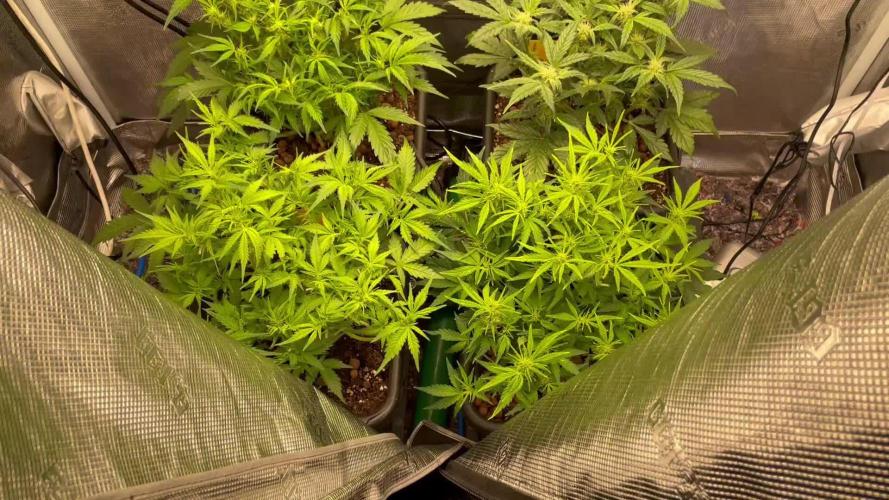
Hey folks. Into week 5. Nothing much happening here, some lst, hst, topping and some more defoil. Broke a branch while applying lst and taped her back up. They have been consuming more water now so I increased it from 4L every 2-3 days to 6L for the larger gals.

Likes
2
Share

@LST420
Follow
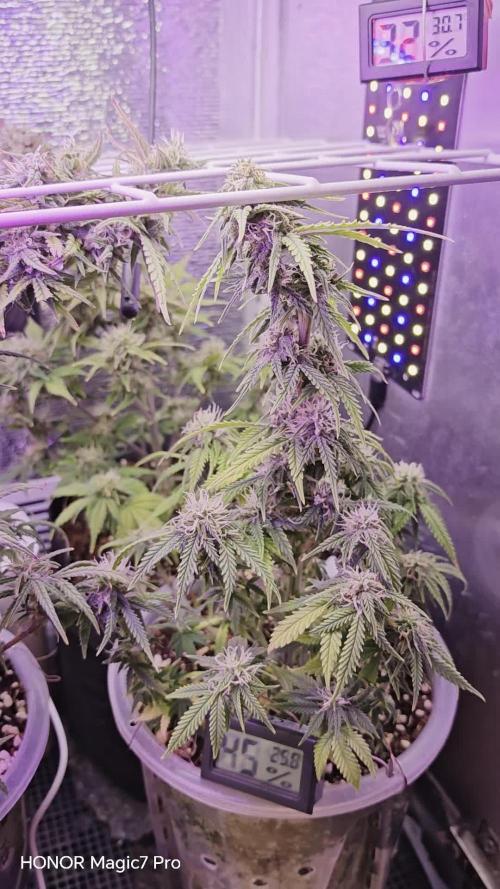
Week 5 The OG Kush and the Night Queen in the front are having some nutrient deficiencies (probably mostly Nitrogen and likely some Calcium and Magnesium) so I've been giving those some extra Orgatrex and CalMag.
Also 'oops I did it again', this time while trying to bend it I partially snapped the main stem of the Mimosa x OP and I immediately fixed it with a few small strips of duct tape. 🍀🙏
Btw the broken and taped stem of the OG Kush from week 3 (last two photos) appears to have recovered nicely.


Likes
2
Share


@johnjoe9525
Follow
I have also lowered the light a bit, increased the nutrients to 2ml per 1000ml and watered about 4/500ml. I have also changed the light schedule to 20 hours again.
Also I don't know why I have done the LST the way I have, i saw something similar on YouTube and the stem was bending in that direction one day so I thought I would give it a go. It might not have been the smartest move on my first grow but who knows, we will see.
I am thinking about getting Advanced Nutrients BigBud and was wondering if anyone thinks it is worth it or to stick with what I am using the whole way through before flush?

Likes
24
Share


@CanarianGrow92
Follow
This plant streched a lot the last week, she's showing quite some 'white hairs' already and she's nice and green, the weather has been good these days, hopefully it stays like this 😁
Likes
18
Share


@Grower_Of_Persia
Follow
week intel:
its time to harvest some of plants the ones that is mature enough. indica dominant plants will done first always so we should harvest them first
because my base nutrients and one of boosters was salt based, i'll do flushing this week to get some relieve to plants in the last days
stresses :
flushing
Drought stress via watering only one time with flushing this week
feeding:
day 1 : i flushed them with Advanced Nutrients Flawless finish and adjusted ph
day 3 : no more feeding from now on
day 5 : no more feeding from now on
guide of the week :
i harvest in 2 parts : first i harvest top of the branches and will let the lower buds to ripe another week then ill harvest the second wave.
indica dominant plants will get done 1 or 2 weeks sooner than sativa dominant plants that will often takes more than 8 weeks so be aware to harvest them sooner.
my dry and cure style is this:
3 days of hanging upside down to get water activity lower to around 0.6 in 50% humidity and 26 C temp (i know its a little high but we are in a hot summer right now and i cant get it lower even with air conditioner) and then after 3 days of drying i remove leaves and stalks, trim buds and move them to jar for the rest of their life :D . and in the first 4 days of curing i open the jar door and let hem get some fresh air in the jar for about 5 minutes and close the jar door again, after 4 days of curing like that buds are smokable but they will get better as they getting cured about 1 month.
im happy as hell with this harvest :D.

Likes
9
Share


Likes
18
Share

@vyndalin
Follow
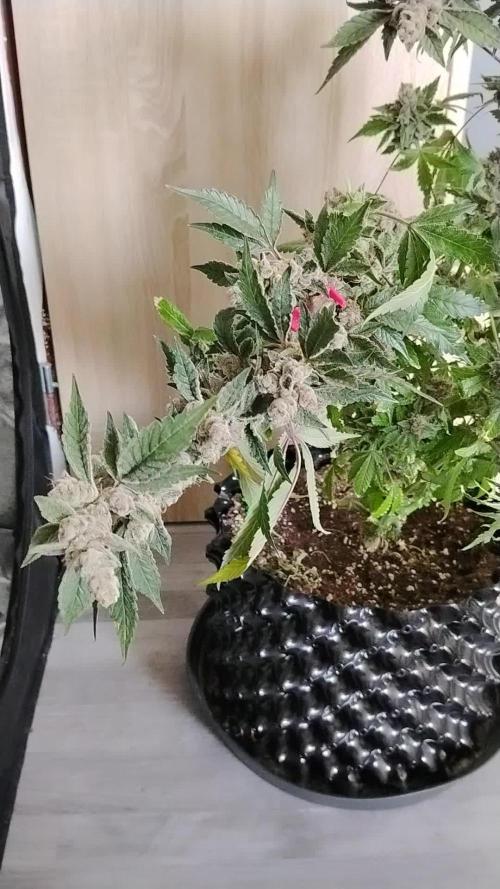
24.5 -Day 73 of flower is enough for this lady from lot 20.1125. I honestly can’t imagine what she would look like if I had let her grow naturally without any training. And because I really want to know, I germinated one more seed and tossed it on the balcony.
I tasted a small sample from the plant I harvested earlier and it has a very pleasant citrus, almost lime‑like flavor. But I’ll judge the real taste after a month in jars — and longer.
I also harvested the lowers from the Super Boof and the Blue Gelato 41. The buds turned beautifully purple and hardened up nicely. There will definitely be a few joints from those as well.
Overall I’m happy with this run, even though I’m taking a few lessons with me for the next rounds:
Three plants are too much for a 70×70 tent. One plant would be ideal, but I don’t like putting all my eggs in one basket, so I’ll go with two.
- Light was on 80% max with 1200+ ppfd to the nearest buds. She handled that like piece of cake.
I’m buying a dehumidifier (!) and tuning the ventilation. The current setup is technically strong enough, but I sleep right next to it, so I need a compromise between noise and performance. Maybe I’ll 3D‑print some adapters for the light and mount a couple of PC fans on it. I’ll see. Either way, I don’t want to harvest early because of mold.
Now I’ll let them hang in the tent until they dry, then they go into jars. After that, full tent disinfection and we’ll see what’s next. I still have Limoncello and Glookies from Barney’s (mostly sativa and mostly indica). I think I can handle that. But maybe I’ll throw in that S.A.D. F1 Fast Version I have on the balcony. Still deciding.
Anyway — may it grow, bloom, keep the pH steady, and stay mold‑free.💪
Likes
53
Share


@UnorthadoxDude
Follow
Harvested at the first sign of amber, could have gone longer. I will be running a full tent of these in a few weeks so look out for that grow. Considering these ladies were all five in a 40l pot, I am pretty happy with how they turned out. My intention was to LST them away from each other to give them room, but unfortunately a combination of moving house and lack of space meant that plant didn't happen, so they were certainly restricting each other light. I am really very excited to give them a proper focused grow in the upcoming series.
I will add more to this when I fill in the smoke report.


Processing
Likes
26
Share


@Master_weeda
Follow
Un rendement très intéressant pour une autofloraison une herbe de très bonne qualité avec un effet très agréable et un goût de baie citronné et une légère note d'épice
Je recommande tous les amateurs d'herbe goûteuse cette variété

Likes
6
Share


@Kanbal
Follow
Still no flowers, foliar calmag, silicate, proroots. Still problems with Calcium. Matterhorn is unstable genetics!
Likes
9
Share


@Ineed_cannabis
Follow
All looking healthy except for i found a couple of thrips defoliating can anyone recommend anything
Likes
60
Share


@Professor_Chaos
Follow
Beginning of week..
Damn she is a very nitrogen sensitive bitch! I really hope she starts to thicken up some.. I think it hurt the yeild some.. Unless she thickens up nicely. It's not as bad as I've seen other nitrogen toxic plants.. With every single leaf cupped or clawing downward.. But the top leaves are pretty clawed.. And even alot of the sugar leaves throughout the plant.. Damnit.. Also, I've noticed that she is actually using up nutrients like FastBuds said.. The runoff has been coming out alot lower than it is going in.. I guess they weren't bullshitting me lol.. Blah whatever.. Damnit, I really hope I didnt fuck this up 🤦🤞🤞🤞
Almost mid week...
So I'm using a Brita pitcher with filter for my tap water.. It doesn't do much lol.. Some, of course.. But I'm also using a very cheap filter in it.. Wal-Mart brand.. Which sucks.. But that is helping bring the TDS of nutrient solution down from 1000 PPM - 1100 PPM to about 850 PPM - 900 PPM.. Just regular tap water from 240 PPM - 260 PPM down to 180 PPM - 190 PPM.. Like I said.. Some.. But not much. I'm not sure if there should be any changes to the plant if the nitrogen toxicity is cleared out.. I went ahead and did a nice flush to get all that shit out of the medium.. It should have helped.. Still going to keep the FloraMicro down.. I really hope this doesnt hurt the yield or taste!!!! I'm assuming she should be close to about halfway thru flower so she should have time to recover before flushing and harvesting.. Will be updating with pics tomorrow! Oh.. And I also lowered the light to 14 inches from the canopy.. Well.. To the tallest cola lol
Mid week..
She is still maintaining herself.. The trichomes are so beautiful!.. Been keeping the PPMs a bit lower than I think I should.. I think Calcium deficiency is popping back up.. I think I'm seeing some new spots pop up.. Not too bad.. And it could just be from when I was flushing a bit at the beginning of the week.. Havent changed the amount of CalMag so I imagine that's what it's from. But other than that and the nitrogen toxicity, she is doing good!
Next day (Merry Christmas!🎄)..
So the trichome heads are still normal (not purple like I thought).. But the trichome stems(?) are purple. So fucking gorgeous.. But I can still see that the trichome heads are clear/milky/amber.. There are already quite a few milky! Damn.. Maybe FastBuds actually means 9 - 10 weeks from seed! Lol.. The colas are starting to fatten up a bit.. So I'm happy! I really enjoy the narcotic effect so I'm gonna harvest when there are quite a bit of amber trichomes.. My Lemon Berry from ETHOS had not many amber.. And the high is very paranoid like lol.. Dont get me wrong.. I love the high.. But paranoia is definitely there lol.. So I'm trying to avoid that with this girl!
Later that night...
So after running a couple gallons through the Brita pitcher filter (with Wal-Mart brand filter), the TDS is coming out around 150 PPM!!! Ok.. So not bad lol.. Works MUCH better than I figured it would! NICEeEeEe... Lol.. But as for the love of my life (lol not kidding).. She is starting to swell for sure!.. Still think she's gonna be a little airy tho.. But she shouldnt yeild small!
End of week..
Not seeing any new clawing.. Starting to see more spots.. I mean, they are super bad.. But there are alot throughout the girlie.. So as I've been feeding, watering, feeding, watering, etc... I've noticed the runoff PPM aren't as high as they normally would be.. This could be why the spotting is happening.. Not sure if these spots are from Calcium.. Magnesium.. Or even something else.. It's kinda hard to tell.. But honestly I'm not too concerned about them.. She is not TOO too far from harvesting.. Haven't began to flush yet.. But I think that may be happening very soon.. Maybe 1 more week of weak feedings and then 2 weeks of flushing.. I am definately seeing plenty of cloudy trichomes.. And some amber now.. I will be trying to get some pics of the trichomes next week for sure! They are so pretty! This is one finicky bitch for sure! But now that I know her issues, it should make it quite easier to avoid the same issues next time I grow her! Still very happy with this girl!... On to the next!!!...
Likes
233
Share


@Tropicannibis_Todd
Follow
🐶🐶🐶🐶🐶 👉Alrighty Then👈🐶🐶🐶🐶🐶🐶
We're 56 days in and we be moving along great 👈
👉Well my friends we are just moving along well so couldn't be happier 👈
All plants are blooming like crazy 🤪 🙀
We got some great growth right across the board on all plants 👈 All plants receiving at least a min of 850 PPFD
🐶 🐕 🐶 🐕 🐶 🐕 🐶
So we are back for another round 😛 But this grow is special because my big boy needs some love too , he's been getting on the old side of things and his hips have been giving him trouble so I've been buying CBD treats for him and it works great so 😉 👍
I've decided to grow this for my little buddy 🐶 so I can make him some Doggy 🐕 Treats and plus I've never tryed it myself and I really wanna give it a go👈 😊 so let's see what it's all about 👈
I will post the recipes at the end of harvest 👏
So Let's Do This👈
👉Soil Provided by ProMix.ca
👉Nutrients Provided by Agrogardens
👉Lighting Provided by MarsHydro.ca
👉Seeds Provided by Kannabia Seeds
