


Likes
Comments
Share


@BLAZED
Follow
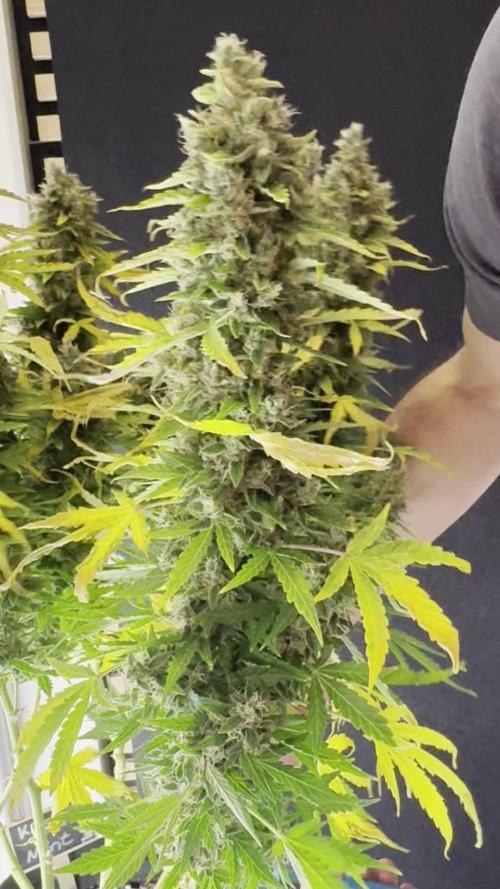
W15 (9-5 to 15-5)
9-5
Temperature: 24.6 degrees (lights on) 20.3 degrees (lights off)
Humidity: 70% (highest) 46% (lowest)
Watering: None.
No pictures.
10-5
Temperature: 25.2 degrees (lights on) 20.8 degrees (lights off)
Humidity: 67% (highest) 44% (lowest)
Watering: 1000 ml.
11-5
Temperature: 25.4 degrees (lights on) 19.8 degrees (lights off)
Humidity: 67% (highest) 36% (lowest)
Watering: 1000 ml.
No pictures.
12-5
Temperature: 25.9 degrees (lights on) 20 degrees (lights off)
Humidity: 59% (highest) 42% (lowest)
Watering: 1500 ml.
Set the strength of the light to 95%
13-5
Temperature: 26.8 degrees (lights on) 20.9 degrees (lights off)
Humidity: 61% (highest) 47% (lowest)
Watering: 1500 ml.
No pictures.
14-5
Temperature: 27 degrees (lights on) 19.2 degrees (lights off)
Humidity: 68% (highest) 41% (lowest)
Watering: 1500 ml.
15-5
Temperature: 26.1 degrees (lights on) 19.8 degrees (lights off)
Humidity: 67% (highest) 43% (lowest)
Watering: None.


Likes
8
Share


@Damaku
Follow
This week, the plants have shown strong growth, with nearly 10cm of height gained. Dominant branches are starting to emerge, though all the shoots are making their way towards the light. The plants are very thirsty, requiring more water, and I've removed a few side branches and shading leaves to improve airflow and light penetration.

Likes
20
Share

@DogDoctorOfficial
Follow
🌱 Nectar Drip Update
Week 8 from Seed · Week 2 Flower (12/12 from seed)
Quick recap for anyone joining us now:
This run is a 12/12 from seed experiment, meaning each plant chose on its own when to enter flower. Because of that, flower timing is not perfectly synchronized — and that’s an important part of this grow and of the decisions we’re making.
We’re working with an exclusive collaborative genetic pack, not commercially available anymore, bred for stability, vigor, and resilience. What you see here is a real-world expression of those genetics, grown without chasing trends or hype — just observation, patience, and consistency.
⸻
🌡️ Environment & Feeding (Why We Changed Nothing)
This week, we deliberately changed nothing.
• Day temperature: ~28 °C
• Relative Humidity: ~65%
• EC: 2.4
• pH: 6.5
• Plant height: ~40 cm to ~80 cm
• Lighting: LED
Many growers would say these temperatures are “too high for flower,” but context matters.
Under LED lighting, leaf surface temperature typically runs 2–4 °C cooler than room temperature. Because of that, we focus on leaf VPD, not room VPD. The plant is what matters — not the number on the wall.
We are not chasing numbers.
We are paying attention to them.
The plants are responding perfectly:
• Lush, deep green foliage
• No signs of stress
• Strong internodal structure
• Uniform uptake across different phenotypes
When the plant is happy, stability beats adjustment. That’s why the nutrient recipe stayed exactly the same.
⸻
✂️ Defoliation — Why This Week, Why This Way
This week marked an important decision.
Normally, defoliation would happen around day 21 of flower. But in a 12/12-from-seed run, there is no universal day 21. Each plant entered flower on its own schedule.
The room was getting dense.
Airflow was being restricted.
Light penetration was becoming uneven.
So we listened to the plants — not the calendar.
We opened the canopy, improved airflow, and allowed the plants to:
• Breathe better
• Receive more uniform light
• Push growth upward instead of inward
We’ll be honest:
👉 We went harder than planned.
But it was a conscious decision, not an emotional one.
Leaves removed were healthy — not sick — which tells us the plant had energy to spare. The remaining structure is strong, clean, and well-shaped.
⸻
🛠️ Training & Recovery
• Structural branches previously damaged were taped last week
• All repaired nodes bounced back perfectly
• Plastic clips are still being used dynamically — on and off — to guide shape, not force it
This tells us everything we need to know about the genetics:
stable, resilient, forgiving, and strong.
⸻
🔮 What We Expect Next
After a hard defoliation, plants tell the truth quickly.
What we expect:
• Fast rebound
• Vertical push toward the light
• Strong flower site development
• Clean airflow through the canopy
If they slow down, we listen.
If they explode, we let them run.
So far, these girls are behaving like champions.
⸻
❤️ Final Words & Gratitude
To everyone reading this —
the supporters, the critics, the silent observers:
You all have a place here.
Growth doesn’t happen without contrast.
Learning doesn’t happen without mistakes.
And progress doesn’t happen without conversation.
Thank you to:
• The platform
• The OGs
• The new followers
• The sponsors
• The lovers and the haters
We treat everyone the same.
Criticism is welcome.
Questions are encouraged.
This is Nectar Drip — honest, detailed, educational, and real.
Let’s see what the future shows us 🌱💧
📡 Please stay tuned.we never quit https://www.youtube.com/@DOGDOGTHEDOCTOR NEW
🙏 Thank you for your patience and continued support.
FOR DISCOUNT CODES AND MORE JUST FOLLOW THE LINK https://website.beacons.ai/dogdoctorofficial
📲 Don’t forget to Subscribe and follow me on Instagram and YouTube @DogDoctorOfficial for exclusive content, real-time updates, and behind-the-scenes magic. We’ve got so much more coming, including transplanting and all the amazing techniques that go along with it. You won’t want to miss it.
GrowDiaries Journal: https://growdiaries.com/grower/dogdoctorofficial
Instagram: https://www.instagram.com/dogdoctorofficial/
YouTube: https://www.youtube.com/@dogdoctorofficial Deleted by Youtube
Vimeo : https://vimeo.com/dogdoctorofficial Under construction stay tuned ⸻
Explore the Gear that Powers My Grow
If you’re curious about the tech I’m using, check out these links:
🔆 Lighting & Environmental Control
• Future of Grow — Advanced LED lighting technology
https://www.futureofgrow.com/
DISCOUNT CODE: DOG20
• Lumiflora — Under-canopy LED lighting
https://lumiflorade.com/
• TrollMaster — Environmental controllers and automation gear (past collaboration)
⸻
Genetics
• Zamnesia Seeds — Genetics used in this project
https://www.zamnesia.com/
⸻
🌱 Soil, Substrates, Boosters & Root Support
• Plagron — Substrates, bio mixes, and supportive products
https://plagron.com/en/
⸻
🎒 Storage, Curing & Preservation
• Grove Bags — Curing and storage solutions
https://grovebags.com/
⸻
📸 Photography Equipment & Tools
(Not sponsors, but part of my creative toolkit)
• Sony A6700
• Sony full-frame macro lens + few more
• Stacking photography workflow - learning
• iPhone (for behind-the-scenes shots)
We’ve got much more coming as we move through the grow cycles. Trust me, you won’t want to miss the next steps, let’s push the boundaries of indoor horticulture together!
As always, this is shared for educational purposes, aiming to spread understanding and appreciation for this plant. Let’s celebrate it responsibly and continue to learn and grow together.
With true love comes happiness. Always believe in yourself, and always do things expecting nothing and with an open heart. Be a giver, and the universe will give back in ways you could never imagine.
💚 Growers love to all 💚
📸 P.S. – The Eye Behind the Lens
All photos in this diary (for now — except for the ones showing the camera, which I took with an iPhone) are taken with a Sony A6700 paired with a Sony full-frame macro lens and a few more.
Photography is part of the story — it’s how we share the fine textures, the glow, and the quiet details that words can’t always capture.
I’ve also started experimenting with photo stacking — a technique where multiple images, each taken at a slightly different focus point, are layered together to create one perfectly sharp image from front to back.
It’s not digital enhancement or AI; it’s pure photography — a way to reveal the plant’s beauty in microscopic depth, from trichome to petal.
You’ll even see a few shots of "ghost me" capturing the shots — camera, lens, setup — because every grow deserves not just to be cultivated, but documented like art.
FOR DISCOUNT CODES AND MORE JUST FOLLOW THE LINK https://website.beacons.ai/dogdoctorofficial
NEW DISCORD - Official Server Invite Link : https://discord.gg/ksjAkA5T74

Processing
Likes
20
Share


@Excalibur
Follow
11 Sep
Day 78 -
Good development.
Stems thickening up.
Day 79 -
Slight spray to leaves.
Day 81 -
Slight trim of some fan leaves.
pH good, sprayed leaves
Day 82 -
LST Tightened to open grow up to allow more light.
500 ml water added.
Fans moved
Day 83 -
Added Nutrients
Day 84 -
All good. Red Veins and stems appeared.

Likes
5
Share


@CalGonJim
Follow
10/20 1230AM MONDAY. 11:14 AM I found some Halloween pictures.🎃🎃
IF YOU LOSE 1 MORE DEATH STAR IM TURNING YOU INTO DARTH VAPORIZER!!
Why u do dis 2 meesa Dimi???
10/21 5am 500mg Phe. & Proline spray in 1L, then an .25pb
10/21 238PM I asked Grok about EC readings. "Good question, CalGonJim! When using an EC meter, you don’t typically subtract the baseline EC of your water from the final reading—here’s why and how to handle it properly, tailored to your grow with **Blueberry KO** and **DDA** at 02:36 PM PDT on Tuesday, October 21, 2025.
### EC Measurement Basics
- **EC Definition**: Electrical Conductivity measures the nutrient concentration in your solution, expressed in mS/cm or µS/cm. It reflects all dissolved salts, including those from water and additives.
- **Baseline Water EC**: Tap or RO water has its own EC (e.g., 0.2–0.5 mS/cm for tap, 20% means flush with pH 6 water.
4. **Adjust**: If EC exceeds 1.4 mS/cm (**BKO**) or 1.8 mS/cm (**DDA**), dilute with water or flush to avoid burn.
### Your Context
- **Current Mix**: 500 mg/L proline + 500 mg/L phenylalanine adds ~0.6–0.8 mS/cm. With your base (1.5 mL/L Grow A&B + 0.25 mL/L each additive), expect 1.6–1.8 mS/cm total. If your water’s 0.3 mS/cm, it’s still 1.6–1.8 mS/cm—don’t subtract.
- **Action**: Test your 1-liter mix now, apply, and check runoff tomorrow. If **BKO** shows stress, drop to 300 mg/L each.
No subtraction needed—just roll with the total EC and keep an eye on your plants. How’s that surprise **BKO** sprout doing with your latest drench?""
10/22 502AM I SAW A CAT!!!!! CANT DO ANTYTHING ELSE..... GOT CHURUS OUT.....TAPPING ON THE GLASS, HE WONT COME BACK....BUT LOUD AND CRAZY ALL NIGHT.....HOW CAN THE CAT NOT HEAR ME???????
10/21 1PM Effects of essential amino acid (EAA) and glutamine supplementation on skeletal muscle wasting in acute, subacute, and postacute conditions.
https://pubmed.ncbi.nlm.nih.gov/38843393/
10/25 12pm afternoon. in 1 liter: 500mg Phe., 250mg TMG Powder, 260mg Proline as root drench and spray.


Likes
23
Share


@Kakui
Follow
V4, están creciendo rápido, desde este punto empezaré con una EC de riego más alta 1.5~1.8, hace 3 días que aparecieron las primeras hojas verdaderas, por lo cual la etapa de vegetación ha iniciado.
V6, el día anterior tuvieron un riego con pH 6.2 y EC 1.7, se me pasó el agua y quedaron algo tristes, pero ya se recuperaron hoy, todas las stash presentan puntos de decoloración en las primeras hojas, las cookies están en perfecto estado. Están comenzando a salir raíces por el fondo de los vasos(algo que nunca me había pasado con otras genéticas) además se ven muy gruesas las raíces, están pidiendo transplante ya, en unos días serán transplantadas.

Likes
9
Share


@Siriuz
Follow
Alright guys, now we're up to date
I didn't write that much before because I wanted to get here first.
Actual date
Feb 10th
They're looking good
No nutrient burnt so far
24/0 Schedule
Watering every 2 days but continue to spray on them like 2 liters everyday to increase humidity lvl to optimal condition
Temp is OK
Wish it was better but have to repair A/C
Anyways bout the girl
This gorilla girl XL is slow but developing good, taking her time to grow while it's fully LST, she's redirecting her energy to the other stems and leaves plus main trunk and slowly continues to grow its main stem
We're already on 1900PPM
We've been giving nutes from the very beginning plus bloom to make sure she gets loaded, but certainly lil bit not to mess up too much with her so we already on 1300ppm bloom stuff 😏
Want to get big yield let's see if we as much as we want
Likes
5
Share


@Deli_Weed
Follow
En general me encanto cultivar esta genética, siempre fue la primer genética que quise cultivar desde que empecé en esto y no me decepciono en lo absoluto, de una sola semilla obtuve 106 gramos de flores de gran calidad 😃 increíble para ser mi primer cosecha con semillas de bancos, ya quiero ver que resulta en la próxima cosecha ya con más experiencia y mejor equipo 🤩
Likes
7
Share


@Gardens_of_Of
Follow
They completed 4th week of flowering. They keep on growing new bud sides.
Humidity is still fluctuating between 52-55%. Temp is decreased to 23 Celsius in average which beings the VPD to 1,4.


Likes
2
Share


@Scottydarkmoon75
Follow
She is growing beautifully and the deep purple hues are absolutely stunning. I did notice that autoflowers grow a little slower outdoors but with amazing big results


Likes
46
Share


@eldruida_lamota
Follow
Vamos familia que ya actualizamos la cosecha de estas Candy Rain de Zamnesia, para el concurso POWER BUDS Plagron x Zamnesia CONTEST.
Ya era hora de cosechar, estoy bastante contento con los resultados.
Vaya flores que se han marcado repletas de tricomas, y las flores se marcan aromas dulces y afrutados.
Es una variedad bastante fácil de cultivar y muy resistente, crecieron desde el principio bien vigorosas, sin problemas y al final de todo recompensó.
Las condiciones ambiéntales han sido máximas en 25 y mínimas en 20 y una humedad estable en torno al 36% al final de floración y en el secado.
Os comento que tengo un descuento y para que compréis en la web de Zamnesia de un 20%, el código es ZAMMIGD2023
The discount 20% and the code is ZAMMIGD2023
https://www.zamnesia.com/
Espero que disfruteis este diario, buenos humos 💨💨