





Likes
10
Share


@Roscio99
Follow
hello beautiful ones, they managed to enter flowering!! everything is going smoothly apart from a few insects... I think it's normal when you do them outdoors. They have been flowering for a week and continue to grow every day! DAJE ROMA DAJE

Likes
22
Share


@julian100614
Follow
La pequeña ak48 esta empezando a llenarse de tricomas y empieza a desprender un olor bastante agradable y potente 🔥
Esta será la ultima semana en la que utilizaremos los productos para ir empezando a limpiar las raices de un modo mas progresivo 👌
31/10: Hemos hecho lavado de raices para prepararla en la cosecha
BUENOS HUMOS 🔥

Processing
Likes
8
Share


@Ka_rY
Follow
Greetings to all growers!
I´d like to share my experience with my plants. Growth was really fast, I didn´t even enjoy it.
It was really awesome, plants were growing in front of my eyes, I could adapt them as I wished, they tolerated anything.
The greatest joy I had when one of my C4 became purple (really beautiful). This is my first plant with coloring, so I´m really happy!
C4 has started to bloom in 3.week.
Lemon is absolutely crazy, he is still growing, he has 30.day and I still have to increase light because of his growth and he is starting to bloom.
Fastberry is also growing well and just like Lemon is also coming to bloom.
I hope everything will be fine and I will come to successfull end.

Processing
Likes
7
Share


@PoshGrow
Follow
Welcome to LSD-25 Grow by PoshGrow!
🍀 Week #1 2020 November 4th. - 11th.
General Info:
When planted: 2020 October 28th.
Week: 1
Days: 1 - 7
Last Update Day: 2020 November 6th.
Plants: 6 LSD-25 girls by @FastBuds.
Equipment:
Tent: MarsHydro 1mx1mx2m
Lights: HLG 260w V2 Rspec QB Kit & Spider Farmer SF-2000.
Exhaust: 4" 322 CFM fan + Viper Carbon Filter.
Intake: 4" 100 CFM Inline Fan.
Oscillating Fan:
Upper: 4" Ram Fan.
Lower: 9" Voxon Box Fan.
Humidifier: Taotronics TT-AH001.
Dehumidifier: Pavlit MD750.
Soil: NPK soil 40% Compost, 50% Peat Moss, 10% Agroperlite.
Pot: 5 gallon Fabric Pot x 6pcs.
Nutriens: GHE Trio & Botanicare CalMag Plus.
PH Correcton: Chemoform pH-Minus Granulat.
PH Pen: Cheap Chinese one, I callibrate it every time I use it.
Digital microscope: cheap Chinese USB X4, 1600X.
Comment:
Hey and welcome back to PoshGrow series!
Germination week went perfect, all girls doing great.
6 plants from 5 seeds lol 😆😍 Check germination week for twins info😉
Twins look healthy and growing as fast as other girls, one is abit smaller, but I think the reason for this is 2 times transplanting, its not recommended to transplant autos, but I had no choice if I wated to save both twins.
For this week ill be watering pH corrected water till the middle of the week, then they will get first feeding. Going to use nutes every other watering.
Also ordered Spider Farmer sf-2000 to support these girls in flowering stage.
Happy growing and stay tuned! ✌️
Likes
8
Share


@Squaregrouper
Follow
Extremely resinous and sticky it is stickier Outdoors then it is indoors same cologne but this is the first time growing this plant outdoors.
So I humbly ask your opinion and definitely the opinion of the seed company.
Dinafem I need your guidance..

Likes
16
Share


@Willy_Balls
Follow
Definitely 5-6 degrees lower offsets flowering by nearly a week. Even though reduced plant count this time still a bit to crowdy for my taste. Next time will do less plants or trim more agressively. 3 main branches would be more than enough with 12 plants. Maybe 5 branches with 9 plants.


Likes
21
Share

@Hempface86
Follow
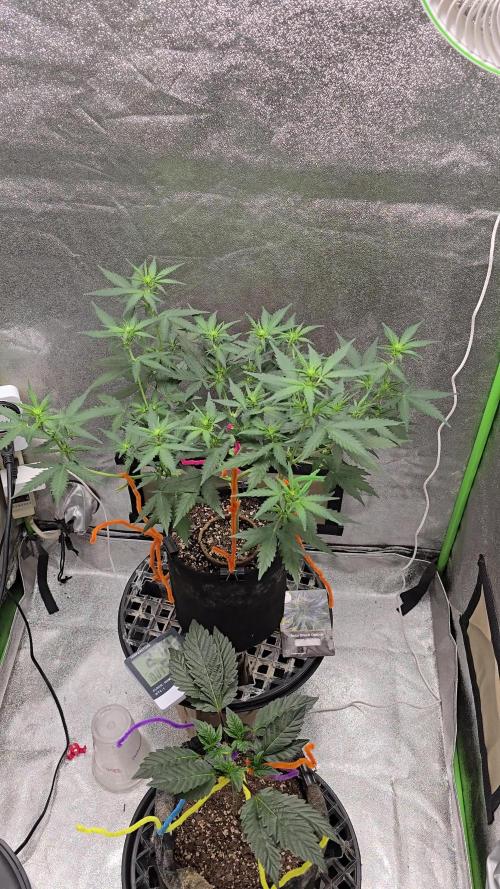
She is starting her stretch we are officially in flower =) ... so far a super super easy grow.. Divine seeds you guys are awesome.. Not much to update, she is definitely stretching now... Next update she should be crowning nicely... Hope everyone is doing well exactly the same God bless and happy growing

Likes
18
Share


@TheCannaProphet
Follow
~ DUTCH PASSION / SUPER SATIVA SEED CLUB FAST FLOWER 'TESTER' A and 'TESTER' B ~
Well cannafam, here we go again on another growing adventure together! This diary will be special to me for two reasons, one because I have the opportunity to cultivate some new and exciting strains from two of the TOP breeders in the industry! The second reason this will be special to me is that I will be growing these two strains in a brand new greenhouse that I put up! I'm super stoked to see how these two ladies turn out in this new setup.
On to the strains:
'Tester' Strain A info: Hybrid (I/S) | 6-7 weeks flowering | Fruity, Sweet, Candy
'Tester' Strain B info: Indica-Dominant (90%) | 7 weeks flowering | Fruity, Peppery, Sweet
I hope that you enjoy this run as much as I will... It's going to be fun and interesting for sure!
~GROW WHAT YOU LOVE, LOVE WHAT YOU GROW!~
____________________________________________________________________________________________________________________________________________________________________________________________________________________________________________________________________________________________________________________________
The Setup:
These beauties will be growing in a brand spanking new 10x14' greenhouse that I have equipped with automatic window openers, a complement of Hurricane fans and a de-humidifier/heater to help keep the environment as dialed in as possible.
I started both tester in glasses of tap water, where they soaked for 24hrs. After soaking, they were placed directly into whole eggshells with just their tops removed to make a natural seed starting pot that I filled with a 70/30 blend of Coco/Perlite which was pre-moistened with well water ph'd to 6.2, then placed under a 50w full spectrum LED on a 24hr light schedule.
Once, they both have their second set of leaves emerged, I plan on starting to put them in the greenhouse for 2-3 hour a day for a few days to help them acclimate and 'harden off' in the greenhouse. I'll be starting both off in 1qt pots, then transplanting them into to gradually larger pots until they're around 6 weeks old, then they will go into their final pots which are 25g fabric pots.
I mix my initial medium using 3 tbsp/g of Gaia Green Organics 4-4-4 along with 1 tbsp/g of Gaia Green Organics Glacial Rock Dust for the trace minerals it provides, 1 tbsp/g of Down To Earth Kelp Meal, 1 tbsp/g of Trichoderma/Mycorrhizae, and 1 cup/g of Wiggle Worm Castings. I hand mix my amendments to ensure an even distribution throughout the medium. I'll be watering with well water ph'd to 6.2-6.8 and providing bi-weekly compost tea's throughout the run.
____________________________________________________________________________________________________________________________________________________________________________________________________________________________________________________________________________________________________________________________
Weekly Updates:
6/9- Here we go into the eighth week of vegetation for the two 'Testers' from Dutch Passion/SSSC and they are both growing fast and the 'Tester B' is getting tall!
6/11- Daytime temperatures outside are now hitting 90℉, and the greenhouse temps are pushing 100℉. I have plenty of air circulating using 4 fans and I'm probably going to put a shade tarp over the greenhouse if the weather continues to get any warmer.
6/13- Daily waterings continue with 2g of well water that is ph'd to between 6.2-6.7 @ 72℉ along with weekly Compost Teas. Despite the excessive heat, both 'Testers' have shown absolutely ZERO signs of any stress whatsoever which is a testament to the superior genetics in both!
6/15- Eight weeks of veg are in the rear view mirror and I'm looking forward to the coming weeks to see how these gorgeous ladies begin to slowly transition into their 'pre-flower' stage. I can't say how impressed I am with both strains vigor and resilience to stress that they have exhibited!
Thank you for visiting my diary, I hope you will follow along and hope you enjoy what I do! Stay Blessed!😎💚
Processing
Likes
38
Share


@Silverback_Guerilla
Follow
8/31:
I fed today..8 gallons split between the 15 plants. Now that the 3 autos are out of the closet, they've all got a little more elbow room.
9/1:
Lotsa frost and aromas now..
9/4:
Fed today, rotated edge plants, plucked off some yellow and dead leaves, and sniffed them up really well..😋
I started germinating the next batch of beans today, so these bitches need to get busy...
9/6:
One of the FFT4's is starting to ripen up and show some senescence, and one of them is showing some potassium deficiency...
I'm switching over to Cha Ching and will be reducing the dosage of ONE at the next feed.
I lowered the lights to be at about 12" on the taller ones and 14" on the shorter ones shooting for maximum PAR for a few days...they'll either blow up really big or burn up really bad 😬

Likes
7
Share


@BushDoctor740
Follow
Day 35 and things are moving along fantastic and all the girls are very happy.I typically wouldn’t run so many different strains in one tent but Fast Buds genetics are very versatile.I can already tell these girls will have strong,amazing buds in the upcoming weeks into Christmas 🎄😊
Processing
Likes
5
Share


@Darkshaman
Follow
This week is been great. I started with high ppm on the 2nd week for the nutrient kick , now just a low dose of growth enhancer. Good roots system. Topped them just 1 time and cleaning them from useless leafs.
Using reverse osmosis water (15ppm)


Likes
29
Share


@Greenwolvesfarmer
Follow
1 semana en sustrato ..
Al fin !! ya está tomando forma ...
Nació con sus cotiledones duros y cerrados .. no hubo manera de ayudarla , lo único que traté de hacer fue de a poco "abrir" los cotiledones ...
Hoy se ve preciosa , pero claramente tendremos algunas dificultades de crecimiento...
La #pineapplekush tiene buenísimas condiciones climáticas , ella vive con 25°C ambientales , 20°C en sustrato / 66% de humedad , al igual que su hermanas de cuarto de cultivo ( gorila glue 4 / american pie auto / orange sherbet auto ...
Vamos , todo mis procesos están realizados minuciosamente y con amor. Aplicando todo cocimiento recopilatorio ...
Se alimentan con enraizante #deltaUno 0.6ml x 1L de agua con 20°C y EC 0.3 / pH 6.3
Vamos con todo!!!
Miércoles 6 de octubre 2021 / 11:51
Likes
Comments
Share

@Weedbuddy420
Follow
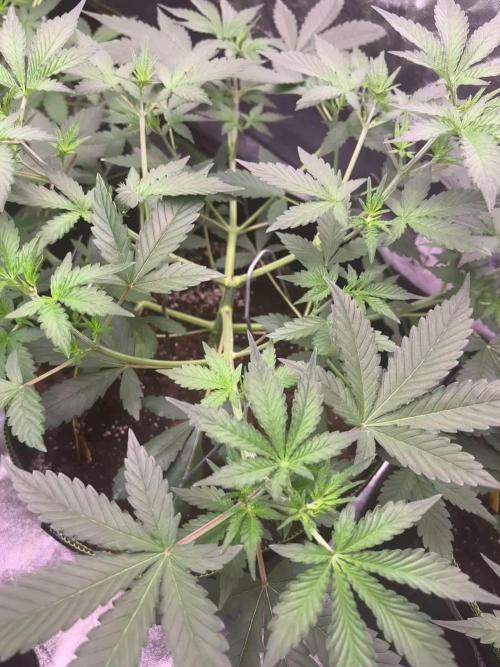
Hey, da bin ich wieder. Ich denke es geht langsam los, dass sie in der Blüte geht. Werde langsam den Dünger umstellen von Wachstumsdünger auf Blüte Dünger und schaue einfach, wie sich die Pflanze weiter entwickelt bin mit dem bisherigen Ergebnis mehr als zufrieden

Likes
2
Share


@Stankmeister
Follow
I harvested Whiskey Zulu at 75 days, it smells amazing and isn't building anymore.
It's a really light and airy structure but smells like a super funky sour grandaddy purple.
I quick dried and smoked some lowers and the flavor reminds me of GDP x Amherst Sour Diesel × an earthy og (with a slight note of northern lights.) Fantastic flavor and potency. It's like I'm smoking multiple buds at the same time—it's so complex.
Makes me want to find and breed this pheno to get this flavor on a bigger plant with a decently dense bud structure.
The flavor profile is nothing like anybody online said about it that I could find. Serious stuff for a freebie

Likes
12
Share


@B4niTa
Follow
Very easy to grow, this is my second Gorilla Zkittlez and both grew without problems


Likes
18
Share


@Grower_Of_Persia
Follow
my dry and cure style is this:
4 days of hanging upside down to get water activity lower to around 0.6 in 50% humidity and 26 C temp (i know its a little high but we are in a hot summer right now and i cant get it lower even with air conditioner) and then after 4 days of drying i remove leaves and stalks, trim buds and move them to jar for the rest of their life :D . and in the first 4 days of curing i open the jar door and let hem get some fresh air in the jar for about 5 minutes and close the jar door again, after 4 days of curing like that buds are smokable but they will get better as they getting cured about 1 month.
buds are one of the hardest as fucking rocks type of buds! very dense , compact , sticky , smelly , amazing at every aspect
growing stage was 56 days and flowering stage was 75 days total (harvested tops at day 64th)
the total weight of dry buds was : (plant #1 & #3 top buds 56 G + lower buds 22 G ) 78 G + (plant #2 top buds 47 G + lower buds 18 G ) 55 G + (plant #4 top buds 120 G + lower buds 67 G ) 187 G = 367 G
Likes
6
Share


@Brujha77
Follow
Leider nur noch 2 Damen über....
Tag42
Bei #2 wurden die unteren Triebe nochmal getoppt (beide nun bei 16 Haupttrieben)
Tag 45
Es wird so langsam👍.
Ich denke ich werde die beiden am 05.07. in die Blüte schicken.


