


Likes
Comments
Share


@420DeepGrow
Follow
Gracias al equipo de Kannabia Seed, Marshydro, XpertNutrients y Trolmaster sin ellos esto no sería posible.
💐🍁 Moby Dick 🐋:
Criada a partir de dos parentales icónicos, como es el cruce de White Widow y una Haze pura G13, este choque de titanes provoca un híbrido que golpea a las puertas de las sativas más fuertes disponibles en el mercado.
Estamos ante una criatura impresionante en todos los sentidos, con ejemplares que florecen en solo 9-10 semanas en interior y arrojan un peso en lonja de 550 gr./m²
Al igual que su padre Haze, nuestra Moby Dick ofrece agradables notas cítricas, pero con efluvios de vainilla y eucalipto, una mezcla de aromas que genera una combinación intrigante, que puede llenar cualquier habitación con una fragancia inolvidable.
El sabor es muy parecido a su olor, con toques de limón agrio que harán que tu lengua cosquillee al inhalar, convirtiéndose lentamente en un humo dulce y terroso, con pinceladas de madera e incienso que se adhieren al interior de la boca al exhalar.
💡TS-3000 + TS-1000: se usaran dos de las lámparas de la serie TS de Marshydro, para cubrir todas las necesidades de las plantas durante el ciclo de cultivo, uso las dos lámparas en floracion para llegar a toda la carpa de 1.50 x 1.50 x 1.80.
https://marshydro.eu/products/mars-hydro-ts-3000-led-grow-light/
🏠 : Marshydro 1.50 x 1.50 x 1.80, carpa 100% estanca con ventanas laterales para llegar a todos los lugares durante el grow
https://marshydro.eu/products/diy-150x150x200cm-grow-tent-kit
🌬️💨 Marshydro 6inch + filtro carbon para evitar olores indeseables.
https://marshydro.eu/products/ifresh-smart-6inch-filter-kits/
💻 Trolmaster Tent-X TCS-1 como controlador de luz, optimiza tu cultivo con la última tecnología del mercado, desde donde puedes controlar todos los parametros.
https://www.trolmaster.com/Products/Details/TCS-1
🍣🍦🌴 Xpert Nutrients es una empresa especializada en la producción y comercialización de fertilizantes líquidos y tierras, que garantizan excelentes cosechas y un crecimiento activo para sus plantas durante todas las fases de cultivo.
Consigue aqui tus Nutrientes:
https://xpertnutrients.com/es/shop/
📆 Semana 6:
Esta semana ha explotado 💣, los cogollos comienzan a tomar densidad y llenarse de resina, me hubiera gustado aplicar algo mas de nutrientes en la fase vegetativa, la próxima vez será.

Likes
15
Share


@TAXFR33
Follow
This grow is on it’s last lap 🏁
These are by far the most beautiful buds i have grown and would definitely recommend fast buds genetics to anyone. Can’t wait to try these now.
Last week i said i was starting the flush but decided to push it back to this week so they only have 1-2 weeks left
Will be checking the trichomes daily
Let me know what you guys think so far👌🏾🤞🏾

Likes
28
Share


@Trickybis82
Follow
Hi growmies,
Okay so I'm onto the final week of Flushing. With my wedding cheesecake and runtz muffin.
Runtz is on my other diary please have a look too!
The wedding cheesecake smells soooo nice and is covered from top to bottom in crystals thc galore lol 😆
The grape gushers has about 1 month left (roughly) this is because she is massive in size and holding alot of bud sites on her.
Pics and video on this diary aswell..
Into the final race with her too!
Till next week peace and love to you all and good luck with everything your doing ✌️👍🤜🤛

Likes
9
Share


@I_Identify_As_A_Dan
Follow
Week 10 for Black Lebanon by SSSC
She's looking a lot nicer after she's adjusted to the training the previous week. Unfortunately its been way too hot😥 She did end up getting a little leaf burn here & there but not much. Its a little hard figuring out when these 250L pots need to be watered/how much water they actually need😅 I gave her 7L of water yesterday afternoon but the temps are staying in the low 40's this upcoming week so ill be giving her more water this evening too. She's really turning into a big monster😂 Really enjoying this plant.

Likes
11
Share


@ILoVeThiSpLaNt
Follow
Day 7
Le piante sono nate e tutte e stanno bene.
Aggiunto un po' di terra diatomacea vicino al tronco perché ho notato che gli insetti che ho sempre nel box (tripidi) salgono proprio da questo punto e la situazione sembra migliorare.
Ogni 10gg per tutta la fase vegetativa userò Zeolite (5gr x litro) per via fogliare. Si macchie ranno un po' le foglie ma questo creerà una patina su di esse così da proteggerle da stress di calore e sbalzi termici. Protegge da malattie fungine (peronospora e botrite) e preserva le superfici da attacchi di patogeni, muffe saprofitarie e batteri.
A settimana prossima 😊


Likes
11
Share


@BudBeezy
Follow
Welcome to week 12 of my grow diary. There's not much new this week. The plant is growing as it should and is slowly starting to stretch. I have increased the watering quantity to 10 litres as the soil dries out too quickly. Unfortunately, my nettle slurry has now been used up. The stem is now 3cm wide.
See you next week ✌️
Likes
3
Share


@Mett420
Follow
Effettuato topping, lst con clip e defogliazione degli strati più vicini all internodo (questo la settimana scorsa), e si può vedere un importante espansione delle foglie e irrobustimento degli steli. Tagli e tecniche necessarie per questo tipo di genetica e setup

Likes
16
Share


@Plantinator
Follow
This grow was incredible—hands down the most enjoyable in years! The harvest may not be massive as I’m still fine-tuning my system, but it’s more than enough for me. The aroma is phenomenal, absolutely mouthwatering, and brought tears to my eyes while trimming. I’m thrilled to taste the final product!
Likes
2
Share


@Luke_Lee
Follow
———————————————
WEEK 12/ DAY 79-85
BLOOM WEEK 5/ DAY 29-35
Mars Hydro FC-E3000
Floragard Professional GrowMix
11L fleece bags
Light: 50cm
Schedule: 12/12;
PPFD: 875umol/m2/s
DLi: 38mol/m2/d
20° C - 65RH
3L per Plant
Hesi Bloom Complex (2ml/1L water)
Hesi Phosphor Plus (1ml/1L water)
BioBizz CalMag (1ml/1L water)
PH 6,5
Fan, extractor and pump ON 24/0.
————————————————————
•Day-79/Bloomday-29
The fifth flowering week begins.
I've been away for the last five days, but the plants have survived.
Unfortunately, the Black Orchid has twittered and formed a few pollen sacs during my absence. It was taken out of the tent. Unfortunately I can't say whether the other plants have been affected, we'll find out in the future.
So there are only the two OG Kush from the planned Zamnesia grow and the two cuttings I got, Ice Cream Cake and Sleepy Joe.
To avoid further stress, the light intensity and the amount of fertilizer have been reduced.
•Day-84/Bloomday-34
The plants were watered with 3L water with 2ml Hesi Bloomcomplex, 1ml Hesi Phosphor Plus, 1ml Hesi BOOST, 1ml BioBizz CalMag to 1L water.

Likes
3
Share

@ChubbyBudBros
Follow
-
Day 84
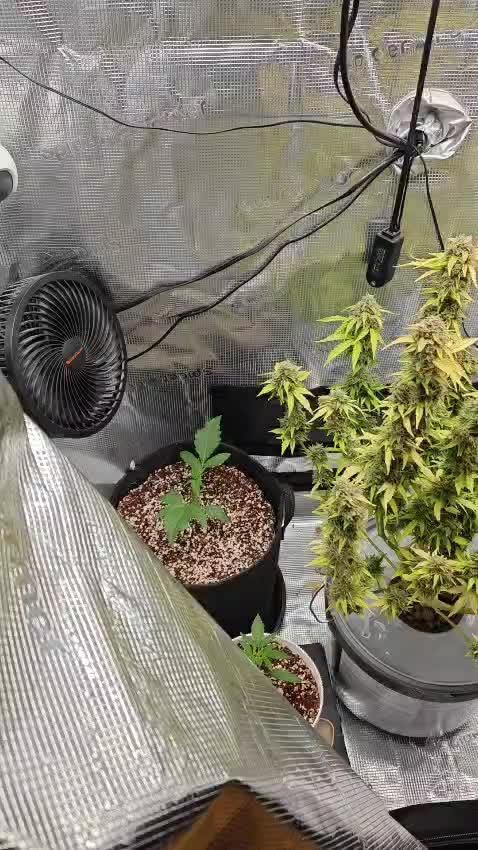
Going into week 8 of flowering now. A lot of fan leaves removed over the past few days, she's looking a lot less bushy now. I redid the reservoir, building down the nutrients now as she should be ready in 1-2 weeks.
Day 85
pH went back up to 6.6, got it back down to 6.0, barely any water out of the reservoir.
Day 86
Water stayed at 6.0 pH, still enough water in the res as well so not gonna do anything today, just removed some dead leaves. Did check the trichomes, and we still got a lot of clear, a bit more cloudy and some amber ones popping up.
Day 87
Just keeping the water level stable now and ph'ing when I have to. Gonna give those trichomes a few more days before I check again.
Day 88
Just topped up the res with some ph'd water. Not much change yet in the trichomes.
Day 89
No water changes needed today. Checked trichomes but still a lot of clear *saaaad*
Day 90
Topped up the reservoir today, was getting a bit low. Also removed another handful of dying leaves.

Likes
12
Share


@2SeedsToParadise
Follow
LFG!!
First week of flower and the auto kicked in. We've been at 24HR ON since seedling 🌱 and boom💥 during week 6 flower coming in @Fast_Buds genetics kicking in
Letzgetit
Likes
4
Share


@Kannamar
Follow
10/04/2023 Day 54
I've been adding Ripen in the mix lowering Flora Bloom. Started at 1.4 EC. Added 4 to 5L of water to refill the tank lowering progressively the EC, today 1.2 EC.
Will follow the strategy till Thursday, then will empty the tank, and fill back with 12L and only Ripen, for 1 week.
Then 3 days with GHE Kleen.

Likes
13
Share


@russrahl
Follow
Was a good second week, had some heat issues in the beginning, but once I rerouted my flowering tents air conditioner exhaust outside instead of the room this tent was in she cooled down. I was heating my basement with the exhaust from one of my air conditioners and my light exhaust as well. Snows coming soon so I’m trying to recycle some heat instead of dumping it outside, I will move them
back in probably when we hit the -20c to -40c weather in a month or so....Lol Topped her yesterday at day 15 at the 4th node. She didn’t even flinch! Roots are well established now and growing daily. Still got 2-3 weeks or so till they can hit the flowering tent so I will be making some more insulated top covers with anchor wires attached to begin LST once these new tops come up in a week or so. Loving this UC Roots stuff, keeping my shit pristine in all the buckets across all my tents. Even my RDWC systems are sparking clean still well into flowering, can’t really see my roots to much anymore to check them though because they are screened and Scrog’d out. But if the res and water is sparkling I’m hoping the rest is...lol well that’s it for this week! Cheers! 💨

Likes
Comments
Share

@AlbStoned
Follow
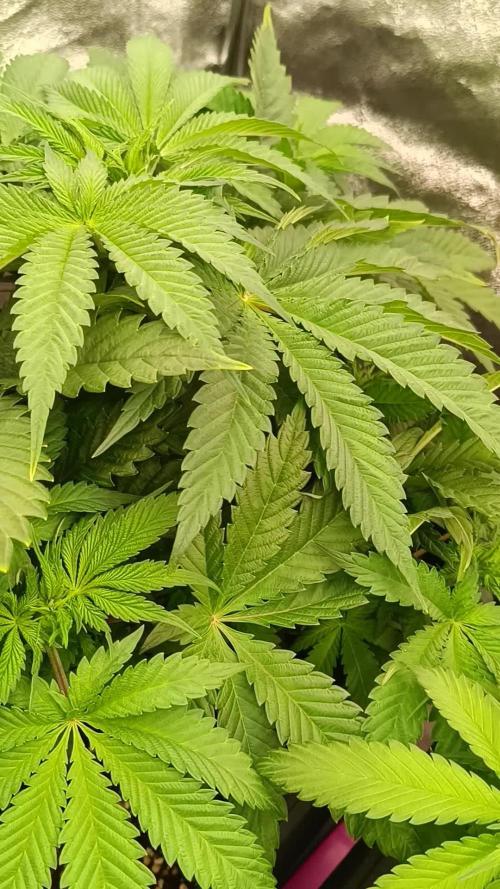
Die Pflanzen wachsen sehr gut unter den Verhältnissen. Die Umstellung des Lichtes hat am 12.10.25 stattgefunden.
Likes
14
Share


@playerkiller69
Follow
More training. And patience for plants to reach the scrog before flipping


Likes
21
Share


@Dapper_Buds
Follow
What’s going on lady’s an gentleman this week we got the M.O.A.B. Girls going into week 3 veg under the Double UnitFarm UFL3000 an now on full auto ride with the Autopot system now turned on. The girls are back up an going for full speed. Had ph issues due to I filled the spray bottle with .9 ph water an was hitting them with 9 ph just for 2 days. Then I caught my mistake after showing signs an soil ph out to 6.3. Ph the bottle spray an plants rebounded nicely now. The girl on the right got LST/ tied down. Some time this week I’ll train the girl on left(I’ll post updated pics). Other then that they are on full auto ride an lights are at the very top at full max. Par meter comes in this week. But on the photon app it’s reading out 600 par or 38-39 DLI on a 18hr light on the plants currently loving it. Tent stays at 81 day and 74 at night at 60%rh day n night. But also wanna say big thank you to UnitFarm for the dope UFL3000 setup. Happy growing everyone! An thank you for all the support an likes!
Can check out the UFL3000 in the link below if interested in it.
https://www.amazon.com/unitfarm

Likes
10
Share


@RookieGrower65
Follow
Fed all four twice with half a gallon nute water, PH 6.3, day 43 and 49. Video and photos from day 50.

Likes
Comments
Share


@TheCannaHouse
Follow
6/21/22-Placed in water fro presoak
6/22/22-Placed into damp paper towel
6/23/22-Seed cracked open so it went into its medium. Watered with about a shot glass of H2O.
6/25/22-Germination!!
Likes
12
Share


@2Stones1Bird
Follow
Checkout my Instagram @smallbudz to see the Small budget grow setup for indoor use, low watt, low heat, low noise, step by step.
25/10/2019 - First feed I gave her 0.25ml on 250ml of water of Biobizz-Grow, with 6.5ph.
26/10/2019 - Leafs looking a bit crooked, and some pale spot lets hope its not fungus. (gave her 100ml of just PH 6.5 water)
27/10/2019 - Feeding day, gave her 250ml water with 0.25ml Biobizz Grow, 6.4PH (changed feeding to once every 2 days with a plain water interval)
28/10/2019 - Started LST
30/10/2019 - Feeding day, gave her 250ml water with 0.25ml of each Biobizz - Grow,Bloom and Max, 6.3PH, added carbon filter and it raised the temps to 29c
31/10/2019 - A tad too much of nuts, little burn tip. (Sensi Seeds warned me but I still goofed it)

Likes
21
Share


@NG420
Follow
I wasn't sure how to properly flush with flawless finish my girls so I followed different ways. For the TOP I just watered with flawless finish until I had 20% run off. For the FIM I watered with flawless finish double amount than usual and after 12 hours ph'd water until having clear running offs.I think I'm going to cut them off in the middle of next week.Can't wait!
Likes
5
Share

@Aleks555
Follow
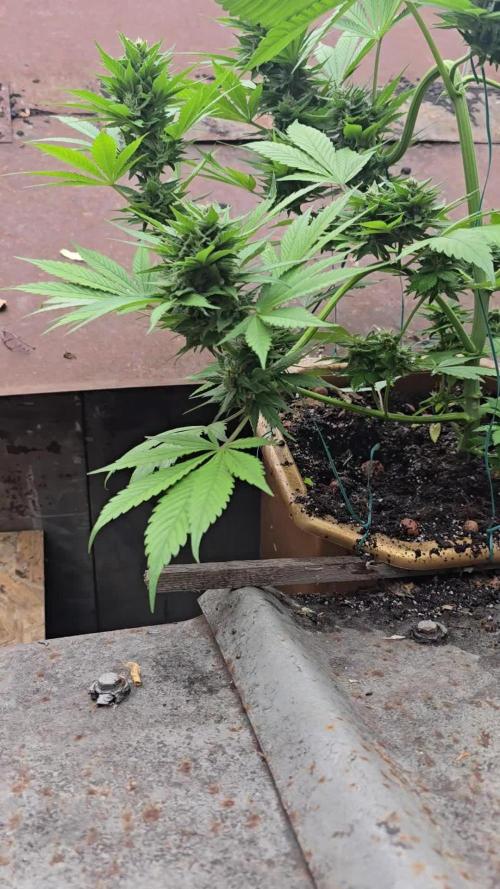
Week 9 and everything is going well. Even though the weather hasn't been very sunny and we've mostly had cloudy days and plenty of rain, our beauty keeps growing.
The trichomes have started turning cloudy, and we can already see some amber ones appearing. We're going to wait until about 50% of them are amber before harvesting.
We picked a small bud to dry and test at this stage so we can compare the effect, and then we'll try it again when the plant reaches around 50% amber trichomes.
The finish line is getting closer! 🌱💚