




Likes
40
Share


@BudXs
Follow
Things are taking shape. VPD in check, girls are just praying and loving their home. A constant 78 with lights on and a small drop at night. Top feeding twice daily for 90 seconds per feed. This is enough time for the hempy hole to overflow.
These girls were topped a few days ago and recovering nicely. A few weeks of veg and this room is going in to flower! And thats when the fun begins
Follow my son Budxless on his first grow

Processing
Likes
62
Share


@DudeGrowsWeed
Follow
Welcome to the 2018/19 indoor grow season!!! I am starting this diary for all current seedlings and clones I have started. I'll also be doing separate diaries for some strains individually (but not all).
So, currently I'm about a week in on average with these seedlings and clones. The Seedsman CBD Cream & Cheese and DinaMed CBD+ were started a few days earlier and started stretching using only the 18w T5 my humidity dome came with. So I set up one of my LED's over the humidity dome instead. So far that seems to be helping the newer seeds from stretching too high. I'm also seeing some burn on some girls, I guess the soil must be too hot. I started to try to flush through with straight ph'ed water, but then I started seeing signs of overwatering (rookie mistake, I know). Now I'm just trying to keep a little water on the bottom tray so it generates some humidity in the dome. There's also a heat mat under the tray I have the heat mat on a timer also, 30 min on/30 min off cycling all day. It seemed to get too hot on 24/7.
I'll be transplanting and moving to my 2'x4' tent in about a week. They will live there during veg, then I'll be moving to a 4'x8' tent (not purchased yet) for flower. I'm also planning on adding some COB LED's in the flower tent. Then I'll dedicate my 2x4 tent to mothers, clones and seedlings.
Its going to be a little different this season with both photo period and autoflowering strains going at the same time. But I'm looking forward to it! 👍
Stay tuned...


Likes
9
Share

@Canna96
Follow
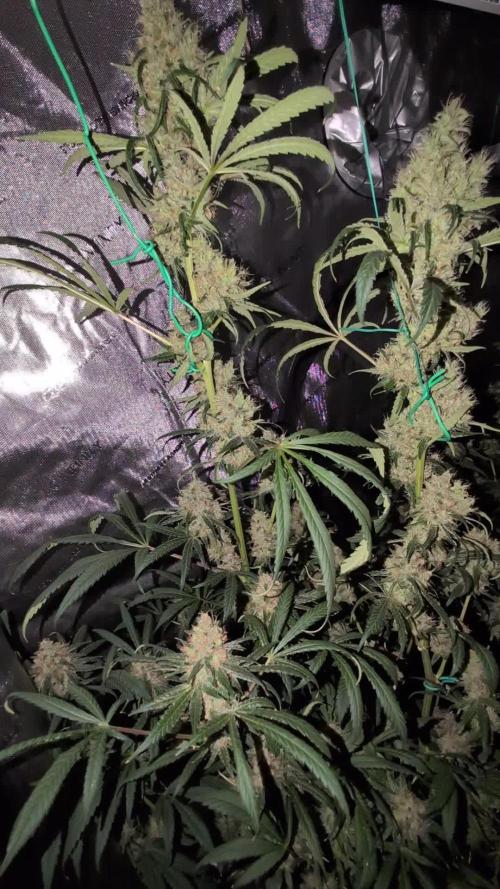
Hey now, hope everyone is having a great weekend! The Donuts is flushed and ready to chop, the flowers are very dense and smell amazing. I will start flushing the Cherry Garcia tomorrow, and the Apple Fritters and Durban Thai X C99 need another 2 weeks or so. Hopefully the flowers continue putting on weight. Thanks for stopping by, stay safe, and blaze on!


Likes
Comments
Share


Likes
57
Share


@Ultraviolet
Follow
Views expressed are my own. All opinions are my own. The opinions expressed here belong solely to me and do not reflect the views of Growdiaries or Grandcru Genetics.
The cannabis strain Grape Guava can be a purple strain, depending on its specific phenotype and genetic makeup. While not all phenotypes of Grape Guava are purple, some variations, such as the Zatix Grape Guava, are noted for their striking purple appearance due to the genetic expression of anthocyanin pigments.
Grand Cru Genetics is a cannabis seed bank that emerged in 2018 from a group of breeders in Madrid to provide a satisfactory experience to all cannabis users.
"If we do things, we do them well. Due to our experience in the sector and our taste for excellence, we know high quality and we seek it in everything we propose and do."
"We have a “cultivate without giving up” philosophy that we apply to everything we do. We do not give up, we are friends of change, and we adapt as necessary in a still restricted sector."
"We speak relaxed because we know how to relax. We are not intense or preachy; we accept everyone as they are, and we understand that farming is not for everyone. But for those who do, we are here to accompany you. We like to do it and tell it. We are experts in the field because we are the first to do it. We speak from experience and connect with others because we share the passion for cultivation."
"Cannabis has the ability to show us a world of possibilities. When you cultivate and live its growth process, you enjoy a path full of emotions and not just the final destination. At Grand Cru we find beauty in small things. We are attentive, observant, detail-oriented and aware of everyday things, and we savor them without rushing."
In a garden of green, Grape Guava gleams,
With its fruity aroma, enchanting dreams.
Clusters of grapes, guava's sweetness ignite,
A strain so divine, in purple and white.
Euphoria whispers, a lush fruity haze,
Grape Guava's embrace, a tranquil daze.
Off and away.@1400ppm. The increased CO2 allows plants to thrive at higher temperatures, which in turn necessitates higher humidity to maintain the ideal VPD for healthy growth and transpiration. 80F -5F = 75F LST with 70% RH = 0.72 kPa. Higher temperatures and humidity promote rapid growth, nutrient uptake, and photosynthesis while maintaining a lower stress level. Temperature influences the rate of enzymatic reactions involved in aerobic respiration. Enzymes, such as those involved in glycolysis, the Krebs cycle, and the electron transport chain, work most efficiently at an optimal temperature range. In low temperatures, enzymatic activity will slow down, thus reducing the rate of aerobic respiration. In high temperatures, enzymes can become denatured, thus impairing their function and stopping the process of aerobic respiration. Glucose is the primary fuel for aerobic respiration. The rate of aerobic respiration increases with the availability of glucose, as it is the starting point for glycolysis. If glucose levels are low, cells may rely on alternative energy sources such as fatty acids or amino acids , but these processes may yield less ATP or be less efficient. To determine this effect, carbon dioxide volume was measured (as carbon dioxide is an output of aerobic respiration)
18/6 with the 6 being IR. The near infrared (IR-a) borders around 700nm up to 1400nm @ photon par flux density of 1.8 instead of darkness, keeping temps overnight a neat 77F-80F.
I think of my tent as a lung. What goes in must come out. When the rate of air going out exceeds the amount of air coming in, it creates a negative pressure. Tent concaves (bends in). If set up correctly, the RH will begin to drop slowly to the desired level I set, and the extraction turns off when it reaches the desired RH. The plant, as it performs cellular respiration, will always release more water into the air; therefore, the RH% of the tent overnight will increase, as long as oxidative phosphorylation is occurring. As soon as the RH% creeps back up to 55%, the extraction turns back on, over and over. This creates a strong pressure differential, which will work wonders with mass flow. Replicating high and low-pressure fronts in nature. Critical for oxygen diffusion at the critical time of peak cellular respiratory function..
Moisture will not transfer from a saturated atmosphere to another if that air is already at or above its saturation point, meaning the air can't hold any more water vapor. Once I understood that water is produced as a by product during cellular respiration, specifically at the very end of the electron transport chain (ETC) where electrons are finally transferred to molecular oxygen, the higher the RH of the air, the more resistance there is for more moisture to be added to that environment, and effects the ease with which it does so. But none of that water comes from the pot; it's pulled from the air. If you run high daytime RH, your medium/pot is 100% reliant on transpirational root pull to move water. ZERO evaporation happens across the atmosphere if the tent air has high RH%, the medium cannot release its water through evaporation. Once a canopy develops, light no longer slowly wicks and evaporates from the topsoil. The Soil-Plant-Atmosphere Continuum (SPAC) describes the continuous pathway and process of water movement, driven by a gradient in water potential, from the soil, through the plant's roots, stem, and leaves, and finally evaporating into the atmosphere through transpiration. There is evaporation, there is transpiration, and then there is evapotranspiration; Evapotranspiration (ET) is the combined total of two processes: evaporation (water lost directly from soil and surface water into the atmosphere) and transpiration (water released from plants to the atmosphere through their leaves). Evapotranspiration represents the total amount of water that moves from the medium into the air. There is no such thing as a medium with too much water, only a medium that retains too much for too long.
The water must always flow efficiently from one atmosphere(Medium) to another(Air) in a timely manner. Moisture is a critical factor for bacterial growth and decay. Dictating how long it's allowed to sit in any one location for any given period is a key preferred control. To ensure a net reduction in a bacterial population, the rate of removal (ET) must exceed the rate of bacterial growth (decay rate), which is often modeled as a growth rate for the specific bacterium under the given conditions. By optimizing daytime VPD, we also optimize conditions for bacterial growth to explode exponentially above 77°F.. If water is allowed to sit in a medium without an escape within a timeframe, nothing good will happen. IF High RH is maintained overnight as well as during the day, placing 100% of water movement at the behest of daytime transpiration, roots can only pull where they can reach, and if soil is compressed above a certain point, moisture will become trapped in a medium with no way of moving day or night. This will begin the countdown for decay to take hold. When water stagnates in a medium, it loses oxygen, creating anaerobic conditions that foster the growth of harmful microorganisms like bacteria and fungi, which can produce toxins and disease vectors.
Thigmomorphogenesis, the process by which plants respond to mechanical stimuli like touch by altering their growth and development, results in significant morphological changes to improve survival against mechanical perturbations. This complex response involves sensing touch and initiating physiological and genetic responses, leading to changes in form and structure over days or weeks. The process is triggered by physical forces such as wind, rain, or touch. Plants adapt to these stimuli by changing their shape and structure, which may include slower growth, thickened stems, or altered leaf development. Plants possess sophisticated mechanisms to detect even subtle mechanical stimuli and initiate responses. A variety of molecules, including calcium ions, jasmonates, ethylene, and nitric oxide, are involved in signaling these mechanical inputs. Touch can induce the expression of genes that encode proteins for calcium sensing, cell wall modification, and defense mechanisms. A plant exposed to constant wind may become shorter and sturdier. A plant that is touched frequently might grow more slowly to conserve energy and develop thicker cell walls. These changes increase a plant's resilience and ability to survive in harsh environments.
Let's get Thiggy with it.


Processing
Likes
8
Share


@eldruida_lamota
Follow
Bueno pues lo dicho familia, es una cepa dulzona y acaramelada, con un porcentaje medio de 16% thc , me parece bastante potente está indica en verdad es un cebollazo épico, si te pasas sentirás hormigueo en las extremidades asegurado.
Sencillisima de cultivar, muy rápida de verdad tamaño entre 45/60cms no es muy grande pero las flores son muy compactas.
Espero que os guste este último trabajo, os dejo muchas fotos y algunos vídeos finales , un saludo y buenos humos.

Likes
43
Share


@Sejnik
Follow
Rozdíly mezi Florganics a Biobizz jsou nyní dost znát.
Biobizz má 2x větší květy (ne dost velké na to v jakém jsou týdnu) a zelenější barvy. Zalévám každé 3-4 dny 10 litry vody s vypsanými živinami.
Florganics má malé květy které se moc nevyvíjí, má světle zelené listy které se začínají zbarvovat do fialové. Přidal jsem jim canna PK 13/14 protože jim očividně chybí jídlo.


Likes
2
Share

@420Junglist
Follow
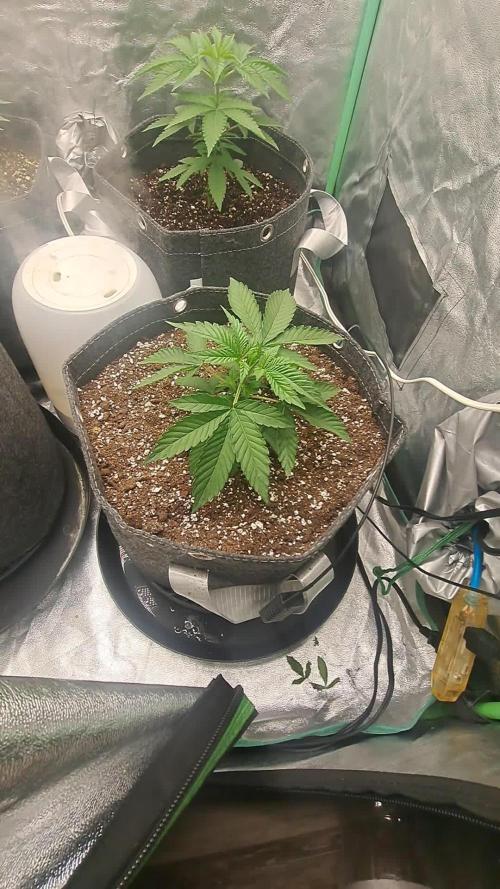
We are around week 4-5 and everything going as planed. Going to start the mainline before next feed. Only having to water 2-3 times a week.

Likes
46
Share


@Ju_Bps
Follow
Hello my friendly growers,
This end of week, smeel the end of the plant,
Trychromes of today look plant ready to harvest so I ll harvest tomorrow.
See you in few day for the result of harvest.
Thanks to follow and like me,
Nice community 😍🤩
Have a good week
Processing
Likes
73
Share


Likes
120
Share


@Kitties_and_Colas
Follow
~_~_~_~_~_~_~_~_~_~_~_~_~_~_~_~_~_~_~_~_~_~_~_~_~_~_~_~_~_~_~_~_~_~_~_~_~_~_~_~_~_~_~_~_~_~_~_~_~_~_~_~_~_~_~_~_~_~_~_~_~_~_~_~_~_~_~_~_~_~_~_~_~_~_~_~_~_~_~_~_~_~_
❤️💡🌱😽💨
Her trichomes are just starting to get cloudy.. it seems a little early to me but maybe the small container has something to do with this? Idk, bottle growing is definitely a first lol, we stopped nutrients ... I'm thinking maybe 1.5 more weeks...thanks for dropping by, happy harvests folks!!
~_~_~_~_~_~_~_~_~_~_~_~_~_~_~_~_~_~_~_~_~_~_~_~_~_~_~_~_~_~_~_~_~_~_~_~_~_~_~_~_~_~_~_~_~_~_~_~_~_~_~_~_~_~_~_~_~_~_~_~_~_~_~_~_~_~_~_~_~_~_~_~_~_~_~_~_~_~_~_~_~_~_


Processing
Likes
52
Share


@mr_black32
Follow
Day 37 : We begin this sixth week with the formation of many inflorescences, today I think of doing a defoliation! 😎
Day 39 : new resinous buds sites! 👽


