




Likes
3
Share
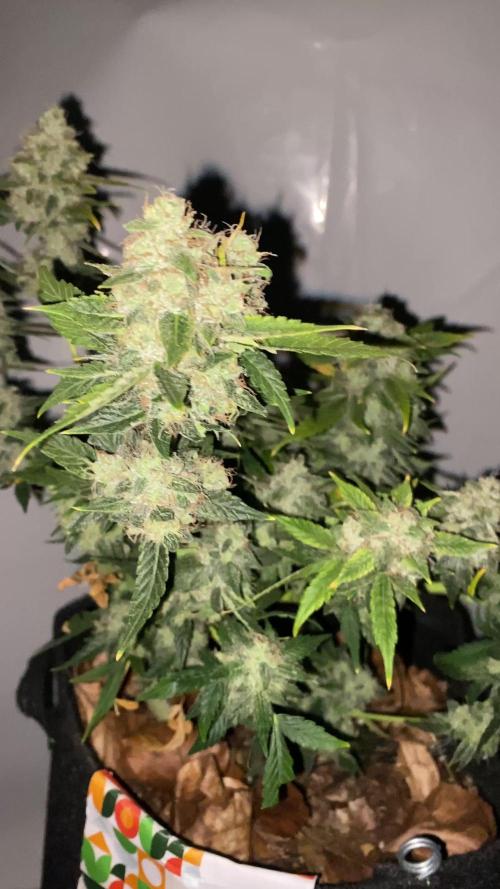

@German_GrowLab
Follow
Grüßt euch, liebe Grow-Community!
Zur 9. Woche / Blütewoche 6 dieses betreuten Grow-Projekts.
Und wie ihr seht, ist es doch etwas lichter in der Box geworden. Und ihr könnt euch ja sicherlich denken, was das heißt …
Letzten Montag (31.08.26) haben sich die Mephisto’s Wedding #1 und die Orange Diesel #1 für die größere Sache geopfert. Und mit „größerer Sache“ meine ich, bald von ein paar Studis gesmoked zu werden.😝 (Wir wissen dieses Opfer doch sehr zu schätzen.)😇
Also ran mit der Schere und ab dafür! Die Kleinen wurden nach einer kleinen Entlaubung im Ganzen aufgehängt und trocknen nun munter vor sich hin.
Da die Jungs doch tatsächlich keine Kohle für eine Klimaanlage locker machen konnten, da dies – Zitat – „doch etwas zu viel des Guten wäre“, trocknen die zwei nun bei etwas suboptimalen 20 °C und immerhin 60 % Luftfeuchtigkeit.😒
Was vielleicht gar nicht mal so verkehrt ist, da neuere Untersuchungen eher darauf hindeuten, dass es durchaus Vorteile haben kann, den Blüten zu Beginn der Trocknung etwas schneller Feuchtigkeit zu entziehen. Dadurch verlassen sie schneller den mikrobiell kritischen Feuchtebereich, was das Risiko eines Pathogenbefalls reduzieren kann. Gleichzeitig bedeutet eine möglichst lange Trocknung nicht automatisch eine bessere Terpenerhaltung – schließlich können sich flüchtige Aromastoffe auch über die zusätzliche Trocknungszeit weiter verflüchtigen.
Also ein State-of-the-Art-Ansatz, wenn man so will... 😅
Ich habe dazu mal ein Paper angeheftet, für diejenigen, die es interessiert.
Nach einem kurzen Blick in die Box muss ich sagen, dass ich über das, was ich sehe – und vor allem rieche – doch sehr verzückt bin.
Der andere Phäno der Mephisto’s Wedding hat sich zu einer wahren Frost-Factory entwickelt und besticht durch ein kräftiges Chem-Aroma. 😋Der andere Phäno braucht noch etwas länger, spiegelt dafür aber doch eher den Wedding-Cake-Elternteil wider.
Die zwei etwas unterernährten Orange Diesel machen zwar optisch nicht ganz so viel her, weisen dafür aber ein angenehmes Diesel-Orangen-Aroma auf, was der ersten geernteten Diesel doch etwas gefehlt hat. Ich hoffe nur, dass mein Erde-Topdress noch etwas Futter bereitstellt.🙏
Sooo, an dieser Stelle wünsche ich viel Spaß mit den Bildern/Videos. Wie ihr seht, haben wir hier keine Produktionskosten gescheut. 😂
Ich wünsche euch wie immer ein schönes Wochenende! Genießt die letzten Sommertage, bevor die Winterdepression wieder kickt.😅
Adios!

Likes
34
Share


@RastaMouse
Follow
Week 7 of flower.
Ro water
Calmag 5 ml per 10l
A+b 30 ml per 10l
Ult pk 25 ml per 10l
Ph 6
Light 100%
Last week before I start flush. They are putting on size nice and have a warm baked smell to them.

Likes
26
Share


@MG2009
Follow
03/13/2021
Side branches are developing nice, I may do a little more lst to help lower tops to catch up before flowering starts
Ps.
Couple videos uploaded
Day #6 doing some bending, and broke a branch off so I dipped in rooting powder,threw it in some vermiculite soaked with Bonide Garden Rich Root & Grow 4-10-3 with (IBA) Lets see if she will root! Fingers crossed🙏

Likes
7
Share


@PigBearMan
Follow
Hey there.
All photos and videos from flower day 27.
Plants are developing pretty good.
On flower day 26 (end of flower week 4) I started adding Green Sensation.
See you next week.


Likes
9
Share


@Gefjon_Grow420
Follow
Little white hairs are starting to show and she's really stretching new if you look at the pictures of last week


Likes
2
Share


@Fat_Olsh_Farms
Follow
Day 14. Starting off a little slow so lowered the light to experiment. Looking healthy. I plan on doing LST on day 16.
Day 16. First day of LST.
Day 20. Supercropped the top.
Likes
4
Share


@DoItBigGrows
Follow
Waiting on my new Opulent Systems 3x3 to come in so I can get these two out of the 4x4.


Likes
6
Share


@Santi_nf
Follow
Pues empezamos a dar crecimiento a las semillas tanto femi como auto que se plantaron entre el 28-12 y 06-01 .
Y nuevas plántulas de cachalote y ak x gea Seeds,algunas de las cachalotes me vinieron con dos raices lo que es igual a dos plantas en algunas ocasiones .
Un saludo a todos es un placer .
Y que contento estoy con mi cultivito.
Nuevas cepas plantadas día 1-2 gelato kush gorila glue y somango gea seeds

Tutti Candy · Zmoothiez

Critical Widow · Pev Seeds

Sweet Skunk Fast Version® · Sweet Seeds
Skywalker OG Runtz XL Auto · Sweet Seeds

Cheese Berry · 00seeds

Hard Diesel · Gea Seeds

Scrambler Haze · Blimburn Seeds
AK · Gea Seeds
Cachalote · Gea Seeds
Gealato Kush · Gea Seeds
Gorilla Glue #4 · Gea Seeds
Somango · Gea Seeds


Likes
37
Share


@XperencdGmanXG
Follow
well as you can see she is slowly crawling out of her previous issues. This is just not growing like the Thunderfuck genetics I have heard of. Amended for extra veg time. Gonna just leave her and feed only fish shit and humic and fulvic acids


Likes
9
Share


@MadeInGermany
Follow
Harvest day 62
since time switch
to 12 / 12 h
Hey guys :-)
Finally it's time 💚
The lady is done the large leaves have been removed and hung upside down to dry in the dark drying room.
You can now stay there for 13-15 days at a temperature of 16-18 degrees and 55-59% humidity.
After 13-15 days it is neatly trimmed by hand and placed in jars with boveda packs 62.
After 4 weeks Boveda 58% come in and are ready for testing ;-).
After everything has been cut cleanly, the last update comes with the smoke report and the finished pictures.
Let's get to the plant 💚.
Unfortunately, the rating system at Growdiaries is a bit strange because I have to give the stars before the Smoke Report and in the end it might have led to more stars in terms of taste.
. The smell is great I'm curious about the taste 💚
Have fun and stay healthy 💚🙏🏻
👇🏼👇🏼👇🏼👇🏼👇🏼👇🏼👇🏼👇🏼👇🏼👇🏼👇🏼👇🏼
‘Powered by GreenHouse Feeding’
Copy the link for 10% off all Nutrients 👇🏼
http://shop.greenhousefeeding.com/
affiliate/madelngermany_passiongrower/
👇🏼👇🏼👇🏼👇🏼👇🏼👇🏼👇🏼👇🏼👇🏼👇🏼👇🏼👇🏼
Water 💧 💧💧
Osmosis water mixed with Cal/Mag (24 hours stale that the chlorine evaporates) to 290 ppm and Ph with Ph- to 5.8 - 6.4
MadeInGermany

Likes
3
Share


@Majikninja
Follow
🏆 Grower’s Spec Sheet: "The Monster"
Cultivar: [unknown]
Harvest Date: March 6, 2026
Total Flower Time: 8 Weeks, 6 Days (62 Days)
📊 Technical Data
System: VIVOSUN Wicking Reservoir (1.6 Gal)
Medium: [Soil/Coco/Pro-Mix]
Lighting: Full Spectrum LED
Atmospheric Peak: Daytime 1.5 kPa VPD / 73.2°F
Nighttime "Color Trigger": 1.3 kPa VPD / 67.6°F
Final Flush Baseline: 234 PPM at pH 6.2
Finishing Technique: 48-hour Arctic Root Shock (35°F Ice Flush)
🌿 Organoleptic Profile (The Senses)
Aroma: Deep "sweet-honey" notes with a fading chlorophyll background. High terpene retention due to sub-75°F daytime finish.
Visuals: Heavy anthocyanin expression (Deep Purple/Violet) across 85% of fan leaves and calyxes.
Resin: High-viscosity "glass-bead" trichomes; milky heads with approx. 10-15% amber transition for a balanced cerebral/body effect.
🖋️ Grower’s Notes
"The Monster responded exceptionally well to a late-stage thermal drop. By maintaining a strict 1.3–1.5 kPa VPD throughout the final 14 days, we pushed resin production to its genetic limit. The final 48-hour ice flush was utilized to maximize the contrast between the dark purple leaf tissue and the heavy white frost for high-definition photography."
🏆 Final Harvest Summary: "The Monster"
Total Grow Time: 14 Weeks
Flowering Time: 8 Weeks, 4 Days
Final Flush Peak: 826 PPM (Purge) / 683 PPM (Settled)
Final Environment: 70.9°F / 52% RH (VPD 1.2 kPa)
📝 Grower’s Final Notes:
"We officially crossed the finish line with 'The Monster.' This run was a masterclass in environmental manipulation. Using the VIVOSUN Smart Controller, I was able to taper the temperatures down to a chilly 70.9°F in the final 48 hours to trigger a massive anthocyanin surge, resulting in deep violet and plum-colored colas.
The Arctic Flush: I performed a cold-shock flush using 44°F ice water. The plant responded immediately, purging stored minerals and causing the reservoir PPM to jump from 254 to a peak of 826. This 'internal detox' successfully removed the harshness, leaving behind the 'sweet' terpene profile confirmed in pre-harvest testing.
Final Results: The buds are dense, heavily frosted with trichomes, and exhibit the classic 'magazine-look' structure. The trellis system was essential in supporting the weight of these purple colas. Total success.
🏆 Final Harvest Report: "The Monster"
Genetics: [Insert Strain Name]
Total Cycle: 14 Weeks
Flowering Time: 8 Weeks, 6 Days (Final Chop: March 6th)
Medium: Coco/Perlite in VIVOSUN Wicking Reservoir
📊 Final Environment & Technical Specs
Final Temp (Blackout): 66.3°F (Triggered deep purple/black hues)
Final Humidity: 55% RH
Final VPD: 1.0 kPa
Lighting: VIVOSUN LED (100% Intensity final week / 24h Final Blackout)
Nutrient Management: VIVOSUN Wicking System
❄️ The "Arctic Flush" Results
To ensure the cleanest possible flavor and a smooth white ash, I performed a strategic cold-shock flush:
Pre-Flush Baseline: 254 PPM
Ice Water Shock (44°F): Triggered a massive mineral purge.
Peak Waste Discharge: 826 PPM (Confirmed successful salt removal)
Final Stable PPM: 577 PPM (Perfect landing zone for harvest)
📝 Grower’s Notes:
"The Monster exceeded all expectations. By utilizing the VIVOSUN Smart Controller, I was able to drop temperatures into the mid-60s during the final 48 hours, which caused the anthocyanins to explode. The canopy shifted from a forest green to a deep, royal violet.
The Arctic Flush was a game-changer. Seeing the PPM jump from 254 to over 800 proved that the ice water shock physically forced the plant to dump stored minerals back into the reservoir. The result is a heavy, resin-coated flower that smells incredibly sweet and lacks any chemical 'harshness.' This was a smooth, high-performance run from start to finish."
👅 Flavor & Aroma Profile
Primary Terpenes: [E.g., Sweet Berry, Fuel, Citrus]
Bud Density: 10/10 (Rock hard, thanks to the trellis support)
Bag Appeal: 10/10 (Deep purple with high-contrast white trichomes)
Time,Internal Temp,Internal RH,VPD,Fan Setting,Notes
12:21 PM,62.6°F,55%,0.9 kPa,Level 2,Humidity dropping fast; surface moisture evaporating.
8:47 PM,61.9°F,57%,0.8 kPa,Level 1,PRO MOVE: Dropped fan to buffer against dry basement air.
11:15 PM,60.8°F,58%,0.8 kPa,Level 1,"Achievement: The ""58/58 Handshake"" (Tent RH matches Grove Bag target)."
📓 Grow Diary: The unknownDrying Phase
Day 1: The Harvest & Hang
Action: Whole-plant hang of the "unkown”.
Initial Stats: High humidity in the tent due to the massive moisture content of the fresh colas.
Strategy: Establishing the airflow and setting the VGrow to manage the initial moisture dump.
Day 2: The "Danger Zone" Pivot
Challenge: Humidity spiked to 67%—risking mold and "wet" odors.
Correction: You successfully navigated the spike by adjusting settings, bringing the humidity back down into the safety zone (below 62%). This was the first sign of an "Advanced" grower at work.
Day 3: Setting the Baseline
Observation: Buds still felt damp/wet to the touch.
The Goal: Aiming for a 10-day dry due to the extreme thickness of the colas.
Stability: Environment stabilized at 62.6°F / 55% RH, establishing a solid foundation for the second half of the dry.
Day 4: The "Precision Craft" Transition (Current)
Tactical Change: Dropped Exhaust Fan to Level 1 to shield the tent from the dry basement air.
Texture: Buds transitioned from "wet" to "less wet/tacky." Small sugar leaves started feeling crisp while the core remained soft.
The Achievement: Hit the "58/58 Handshake" at 11:15 PM (60.8°F / 58% RH).
Decision: Committed to Grove Bags for the cure and the Frenchy Cannoli "Warm Bottle Roll" for the kief processing.
📊 Summary Stats (Day 1 – Day 4)
Coldest Temp: 60.8°F (Day 4)
Peak Humidity: 67% (Day 2)
Current VPD: 0.8 kPa (Perfectly steady for 11+ hours)


Likes
15
Share

@MadeInGermany
Follow
Hey guys :-)
She is developing great.
This week was poured 2 times with 1 l each (nutrients see table above)
Otherwise, everything was cleaned and the lady sprayed with Fast Plant Spray.
Since there are still 2 weeks left until there is space in the bloom tent, the topping was made again 😃
have fun with the update and stay healthy 💚🙏🏻
👇🏼👇🏼👇🏼👇🏼👇🏼👇🏼👇🏼👇🏼👇🏼👇🏼👇🏼👇🏼
You can buy this Nutrients at :
https://greenbuzzliquids.com/en/shop/
With the discount code: Made_in_Germany you get a discount of 15% on all products from an order value of 100 euros.
👇🏼👇🏼👇🏼👇🏼👇🏼👇🏼👇🏼👇🏼👇🏼👇🏼👇🏼👇🏼
You can buy this strain at :
https://www.amsterdamgenetics.com/product/kosher-tangie-kush/
Water 💧 💧💧
Osmosis water mixed with normal water (24 hours stale that the chlorine evaporates) to 0.2 EC. Add Cal / Mag to 0.4 Ec Ph with Organic Ph - to 5.8 - 6.4
MadeInGermany

Likes
422
Share


@Crashoverite
Follow
Hi all 😁
Welcome to my 🍌💜👊 week update.
Hope everyone keeping well and having a great week.
Thank you so much for your all support on this bananas journey 💜💚💜💚
What a amazing week. Very little to work around those beauties. The smell is so delicious already. They smells like sweet berries. Buds are loaded with trichomes, very sticky and hard as rocks especially on Athena. Trichomes are mainly clear and some parts milky. Absolutely love power of LST and how it worked on this strain. If you won't look under net it's almost impossible to see which cola belongs to main stem.
Week 11
Dec 25 - Dec 31
Dec 25-26
Joyful observation
Dec 27
Selective defoliation and
First watering for this week. Nutes adjusted, almost 8ltr between both. Runoffs PH on both at 6.2. I am finding this PH level for this strain as perfect. Girls are looking super healthy and drinking they mixture like crazy.
Dec 28-30
All is going smoothly. I can see more and more weight each day.
Dec 31
Secomd watering foe this week. 8 ltr beetwen both.
It's the last day of this week and also end of 2023!!
See you in the new year 🍾🥂🍀
Peace and love brothers and sisters ✌️💚
Links
https://2fast4buds.com/seeds/banana-purple-punch-auto
https://plagron.com
https://www.biobizz.com/
https://fishheadfarms.com/