


Likes
Comments
Share


@WeedM8
Follow
Hello m8 welcome to this journey with me in this diary will have very interesting strains hope u find something useful
O.G. Kush Titanium
- [ ] 1st week Veg: germinated in substrate lighting very close so it jets medium high humidity after the 3rd day they started sprouting
- [ ] 2nd week Veg: this week my ventilator broke down and as the temperature stayed very warm nothing developed much
- [ ] 3rd week Veg:fortunately this week i had fixed the ventilation and the temperature has go down a bit allowing the little plants to develop and reinforce
- [ ] 4th week:very good developments in this week I already started feeding a bit two times but i didn’t have to…once was enough
- [ ] 5th week Veg:this week they were very strong green i only had to water them good and keep the ventilators going no stop .They have good hight already ,but as i have to strains together. I want to transplant them when the hight of the other one have stretched… I’m thinking to transplant next week if not the next one
- [ ] 6th week Veg: this week it went great fortunatly i dont have pests that eat my buds i’ve givven a fed once the substrate is very rich already the plants streached very well i will transplant today so be ready m8 i cant wait to show you the progress
- [ ] 1st week Fl:they started stretching and looking very healthy just transplanted
- [ ] 2nd week Fl this week I’ve been away i had a friend taking care of them they stretching very well i hope that she starts putting energy into the flo
- [ ] 3rd week Fl:they are streaching very well ..getting the light very well
- [ ] 4th week Fl:there we aree guys the good stage is heree good high hope dosent effect de prod
- [ ] 5th week Fl:pumping very good this week a lot of changes started already being frosty
- [ ] 6th week Fl:this diaries its not daily updated this week its going’s so great we are close to harvest between next week and the other one . Ill harvest them at diffrent time just because they are not all at the same point of flowi
- [ ] 7th week Fl: im so satisfied from the way that this is going they didnt had any particular stress just that its 29 degrees during light and its going good so farr I haven’t constantly fed like on the peach g and pcr i hope for better taste at the end

Likes
Comments
Share


@all_about_420
Follow
Ein schier unendlicher Stretch prägt das Bild im Hintergrund des Gartens, wo die beiden Junkies mittlerweile zu beachtlicher Größe herangewachsen sind und den oberen Raum des Setups imposant einnehmen. Während die dritte Blütewoche voranschreitet, hat die Blütenbildung nun voll eingesetzt und zeigt überall an den langgezogenen Trieben eine wunderschöne, dichte Ansammlung von ersten, schneeweißen Blütenhaaren. Trotz des enormen Höhenflugs stehen beide Exemplare perfekt im Saft, zeigen tiefgrüne, vitale Fächerblätter und nutzen die Lichtenergie meisterhaft aus. Die Struktur hat sich hervorragend geöffnet, wodurch die entstehenden Buds perfekt ausgeleuchtet werden und die Basis für eine extrem vielversprechende Harzproduktion gelegt ist. Es ist eine wahre Freude zu sehen, mit welcher Kraft und Stabilität diese Genetik von Brothers Grimm Seeds abliefert, während die ersten echten Blütencluster jetzt von Tag zu Tag sichtlich an Masse zulegen.
Processing
Likes
17
Share


@Fabhz
Follow
Week #3: leaves are growing faster. I stopped adding root starter because of spots on the leaves; i don´t know why. She is having a new neighbor; my first magnum auto.

Likes
18
Share


@valiotoro
Follow
Hello everyone 😎
Day 30
she grew fast with a great structure and with a beautiful green colour on the leaves.
She is responding superbly to topping and Ist aswell growing like nothing has been done to her!
Have a great day 👨🌾🏻



Likes
1023
Share


@Grow3rPT
Follow
Cultivo LED The Smith 150w 4000k (Samsung) - Não tem opção de colocar esta marca no diário.
Também estou a usar nutrientes, da kayasolucions mas também nao tem disponível para adicionar ao diario.
Quem quiser saber mais, pode pesquisar The Jungle e uma growshop :)

Likes
3
Share


@hinterhofgrower
Follow
.
📹 : Full Video on YouTube @hinterhofgrower, please like & subscribe
🌱 : strategic defoliation on day 30, LST & strategic defoliation day 31, LST on day 33
💧 : 3l day 31
💡 : Dli: 40 mol/m²/d
🤔 : By week 5 it had clearly started to flower, so there was no drastic trim, just the strategic removal of a few leaves that were blocking the light for potential flowers, then the removal of leaves that were completely shaded, and some LST to direct the branches outwards to create more space for the flowers and ensure the flowers were at the same height.
Likes
96
Share


@The_Projexx
Follow
Well there's not much to say about this fine lady she started of as the absulute runt of the little and she come out queen of the litter ! Her main cola weight 50 grams ( wet ) which to me was really cool !! She had a total wet weight of 257G I will post the official dry weight as soon as the curing is done :)
A big thank you to everyone who's shown there support for me ! Much love !! A special thank you goes out to all my followers you guys are kick ass man I learn lots from you just like some of you may from me ! Keep on keeping on and I wish you all the best .
Overall she was fun to grow cool strain but it tends to hermie , even in the late stages . So to all those growing this strain keep a watch full eye !
-Happy Growing!

Likes
16
Share


@eldruida_lamota
Follow
Unos esquejes brutales pero las condiciones del cultivo no fueron óptimas tuvimos retrasos al principio con el crecimiento problemas de nitrogeno, algo de humedad alta al principio de la floración y aun así salió el producto muy bueno, tanto de sabor como de cómo con.
Sencillez es fácil de cultivar es rápida de cojones y además es resistente.


Likes
16
Share

@OrionGrowgul
Follow
07.02.2026
PPFD= 200
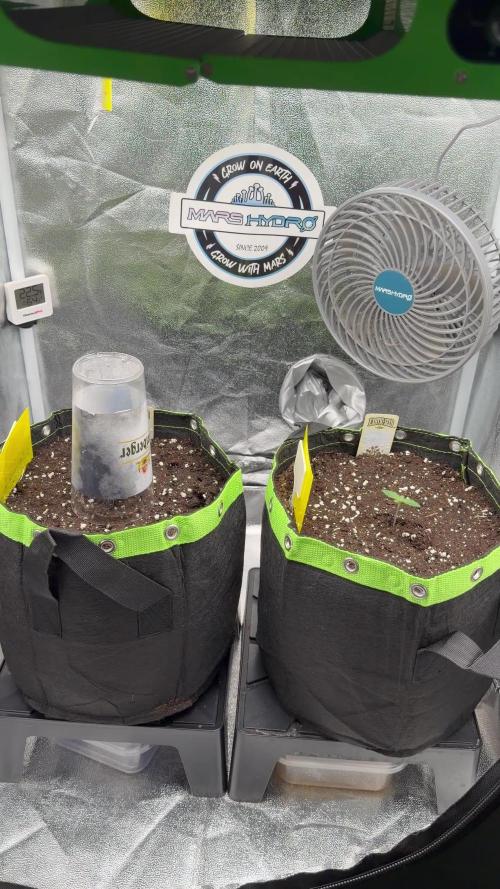
Pflanze in 11L Topf umgetopft.
Leider Trauermücken im Zelt gehabt. Gelbfallen aufgestellt sowie Nematoden gegossen.
Ich hoffe es hilft.
Pflanze entwickelt sich ansonsten sehr gut.
Becher lasse ich zwecks der Luftfeuchtigkeit erstmal noch drüber.

Likes
18
Share
@ThatsmyGrow
Follow
🌸 Week 10 – Gorilla Cookies Auto Pheno Hunt
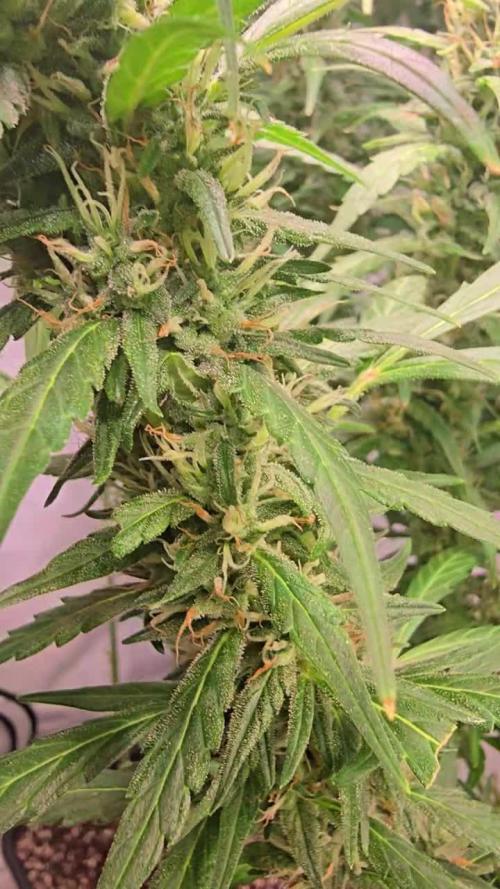
Another week has passed, and the girls continue to impress with their flower development. 🌸🔥
The canopy is filling out nicely, and every pheno is putting more energy into building bigger, denser buds. It's exciting to see how each phenotype is expressing its own unique characteristics as flowering progresses.
📈 Current observations:
Bud development has been excellent across all six phenos.
We performed another lollipopping session and removed additional fan leaves to improve light penetration and airflow around the buds.
The canopy is much more open now, allowing the lower flower sites to receive more direct light.
Pheno #6 continues to surprise me. Even though it was the slowest plant in the beginning, it is now steadily developing its flowers and catching up nicely.
Pheno #4 is already showing a very unique terpene profile. It has an incredibly sweet aroma with strong Kush-like notes, making it one of the most exciting phenos so far.
📊 Current environment:
Temperature: 31°C
Relative Humidity: 63%
VPD: ~1.66 kPa
SANlight fixture at maximum height
Light intensity: 90%
🌿 Looking ahead:
The plants are now entering one of the most exciting stages of the grow. Over the next few weeks, the flowers should continue to swell, resin production will increase, and the terpene profiles will become even more pronounced. I'm really looking forward to seeing which phenotype delivers the best combination of structure, aroma, and overall flower quality.
💬 Which pheno would you keep as a mother based on what you've seen so far?
Likes
3
Share


@PhantomzWrath
Follow
Think I fed too much water but not sure, it’s been a couple days and medium still feels wet. One of the gorilla cookies is looking terrible and the other looks like it’s kinda starting to show some deficiency that I think might be magnesium deficiency but not sure. Anyone got any suggestions to help?
Likes
6
Share


@CrashTest420
Follow
So just started giving them a bit of low stress training and upped the ml's nutrients. These are my first ever auto's and im a bit dubious to how they'll turn out. I do have high hopes for that tiny one i got there i think she'll put out most just you wait and see. Take care guy's n gals stay safe and happy growing :)

Likes
12
Share


@Gdawg
Follow
They are an amazing plant to work with easy and robust they love the inviroment and are starting to smell amazing combined with the lights and climate control its a breeze don't have to do nothing the un topped one is a monster 3.5 ft hopefully fill right out thanks fast buds 💕
Likes
5
Share


@Woodz
Follow
Good week this plants going steady about 3 n a bit weeks more than four but that's OK giving an update anyway plant going good nice and easy going once I've controlled temps being winter and all plus controlling nutes a bit more this plant seems to need more trace elements good learning loving it.

Likes
23
Share


@Nonno_Fede
Follow
Per cominciare auguro Buon Anno a tutti.
Oggi finisce la 10 sett.da nascita,domenica finirá la 5 sett. di flow. Mi sembra la pianta dietro a destra abbia carenza di qualcosa,ma ho letto da altri utenti che le Charlotte's Angel tendono a ingiallirsi,perciò la lascio cosí per il momento. Domenica aggiungo altre foto della fioritura.🏻☮️

Likes
12
Share


@Luv2Grow
Follow
Day 57 - Starting week 9 and thinking I might give her one more week or so. Might end up chopping the top colas and letting the bottom buds catch some light for a week and then harvest the rest.
Likes
4
Share


@Crusty_Juggler
Follow
60x60 cm tent in a 1920's peek-in-closet
Oversized vent for silence
High power DIY LED
True SoG 12/12 from seed with 15 plants in 2L pots
Watering all plants in bottom tray with 30% of total pot size (10L)
WEEK 1
DAY 1 - Germinated in paper towel
DAY 3 - Planted into pots + Lights ON at 125w
DAY 5 - All plants have broken soil
DAY 7 - Slight stretch - Light at 185w
WEEK 2
Two of the Iced Out are lagging behind, others are on point - I'm trying to push light and nutes to the max.
Extraction fan (AC infinity Cloudline T6) on level 2.
DAY 13 - First full watering (10L) with 20 ml Canna Terra Vega
DAY 14 - Circulation fan turned on (low) during lights on
WEEK 3
Good growth, two Iced Out still lagging
DAY 18 - Light at 225w, Extraction fan on level 3 during lights on
DAY 20 - 2nd watering, 8L with 30ml Vega + Light at 250w
DAY 21 - On point, mostly :) Could've pushed nutes a bit more from the go
WEEK 4
DAY 24 - So far this week I'm just kicking back and watching them do their thing. The two lagging Iced Outs are trying to catch up.
DAY 26 - Watering 10L with 50 ml Vega (one day too late...) + light on 300w (max)
DAY 28 - 4 weeks from popping the seeds, looking good except for the two Iced Outs, one of them is trying to get with the program, the other... Well, some plants are just pricks.

Likes
151
Share


@CANNASIM
Follow
Training > topping, defoliation, and LST, using a cage for the first time, liked a lot to model a even canopy.
Girls wore grown in 15l fabric pots, I choose a higher pot so is not wide, my idea was to grow three, felt that 25l pots still ideal, the girls net bigger and have more room for the roots.
She was constant feed
> Watering 1 = Base Nutes + Recharge .
> Watering 2 = Boosters.
> Preventive Cal Mag every 15days +- .
Based on my feeling, and the leafs color I released some nutes or added so this is just an Idea on my schedule, no expressive or relevant burning.
— — —
My LED started to fail in mid cycle, so the light intensity started to vary, and i feel the matrix is not working and full potencial anymore.
At first was hard to control the RH but in a few weeks i have got a hang of it, and all went ok besides my LED.
Liked a lot this cycle, was flawless, simple and rewarding, only downfall was the weight, but everything was new, the tent, the pots size, the nutrient line, so on, so i’m satisfied.
Weight is compensated over quality, none the less she was not heavy flushed, without the cure she was already tasting amazing, butter smooth, and white ash.
When you open the jar a very pungent sweet, berry like smell comes out mixed with a pleasant cheese cake sour end.
Potency is above average, 3 hits are what I can take, a bit more and the fun is over and the experience becomes too strong for me.
The effect is just perfect for a night smoke, to me is instant, I feel mainly on the body, just want to lay and relax. Just perfect for our needs home.
Smoke is clean and easy to smoke, you feel the joy of the usual insense smell around, very strong, stealth smoking is not a option, taste is sweet and fruity, easy to overdo.
——
UPDATE 1
Vaping is a joy, the effects are more controlled as you have the temps to do that. The terpenes profile is very pronunced with the Volcano and the Davinci IQ, Pine berryes is what i taste.
At this point buds are curing woth boveda 62 for 1 1/2 weeks, then I will change the humidity pack to a dryer one.

Likes
21
Share


@MadeInGermany
Follow
Hey guys :-)
The ladies are developing really well 😊.
I'll decide spontaneously whether I'll do topping again because I hardly have any space in the flower tent and I'll soon have to set it to 12 / 12 h due to time constraints :-( .
But this week they will definitely get the veggie phase.
Was poured 2 times with 1 l each (groundwater see description at the bottom)
Everything was made clean.
Fresh osmosis water is applied and the plants are sprayed and checked.
Stay healthy 💚🙏🏻
👇🏼👇🏼👇🏼👇🏼👇🏼👇🏼👇🏼👇🏼👇🏼👇🏼👇🏼👇🏼
You can buy this Nutrients at :
https://shop.greenhousefeeding.com/us/
👇🏼👇🏼👇🏼👇🏼👇🏼👇🏼👇🏼👇🏼👇🏼👇🏼👇🏼👇🏼
You can buy this strain at :
https://www.amsterdamgenetics.com/product/double-blue/
Water 💧 💧💧
Osmosis water mixed with normal water (24 hours stale that the chlorine evaporates) to 0.2 EC. Add Cal / Mag to 0.4 Ec Ph with Organic Ph - to 5.8 - 6.4
MadeInGermany
