


Likes
Comments
Share


@HomeGrowHeaven
Follow
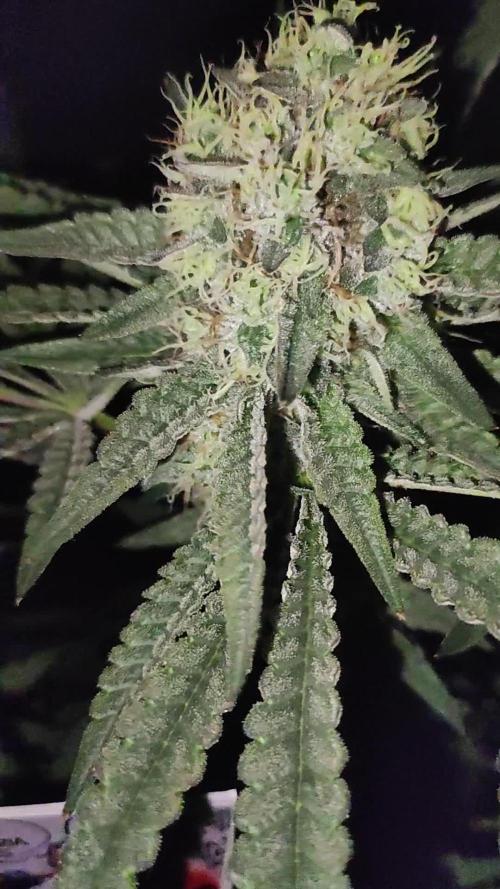
We chopped down the plants. Now they hang out to dry in the tent.
The Trichs looked very good. Some milky, some amber, hardly any clear. Just the way I want it. The popcorn buds were rather milky. So we have more of a couchlock effect on the head buds and the maximum THC on the popcorns. I'm really looking forward to the taste💚

Likes
16
Share

@Bncgrower
Follow
Final stretch, next week it's time to flush them. The smell is really strong when I open the bedroom door, I believe in an extremely satisfactory result.. ❄️💪🌲
***The photo of the trichomes ended up getting mixed up, so I'll post photos of all the plants.


Likes
Comments
Share

@gr3g4l
Follow
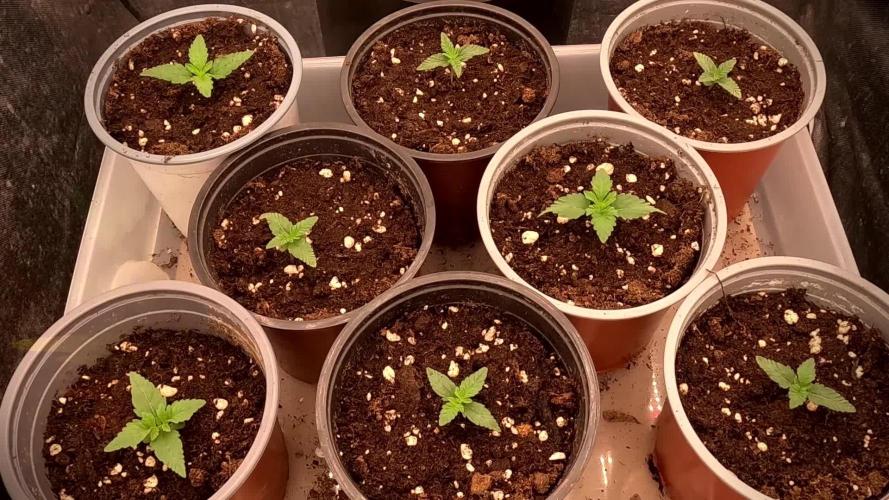
Esta semana añadimos el humidificador para mantener una humedad mas alta.
con 14 dias asomaron las raices y las trasplanté en la maceta definitiva de 6L. y aumenté la potencia W a 220. De 150 a 220W.
Likes
1
Share


@FarithAriasFajardo
Follow
Aquí las fotos de esta nueva semana de vegetación para ambas plantas, cumpliendo así la white widow 23 dias de plantada y la zinfandel 16. La fotos corresponden al 21, 24 y 27 de abril. Por ahora no hay nada más que agregar. Ya que esta semana solo agregué algo de sustrato en ambas y el riego fue de agua reposada con una bomba dando oxígeno por 24hr y un ph de 6,1 a 6,5. Lo que no sé es si realizar alguna tipo de poda más adelante o si mejor las dejo crecer como son, ya que no sé mucho. Existe el temor de dañarlas o estresarlas demasiado. Lo pensaré, también recibo cualquier consejo u observación con ellas!


Likes
16
Share


@Oldwied
Follow
I am super happy with the harvest.
Unfortunately, the grow was not a brilliant performance. But MimosaEvo is always a great choice.

Likes
24
Share


@DogDoctorOfficial
Follow
Hello, Grow Diaries fam! 🌿✨
We’re now in Week 10 from seed, and what a journey it’s been. This week, the grow room has transformed into a breathtaking display of autumnal beauty, with the plants showcasing stunning fades and vibrant colors as they enter their final stages of life. It’s a true celebration of nature’s cycles, and the energy in the room is palpable. Let’s dive into this epic week!
🌟 Week 10 Highlights 🌟
The plants are embracing their last days with grace, each one revealing a unique spectrum of colors and expressions. The transition to 12/12 light cycle continues to push them toward their full potential, all thanks to the Big Demon, who’s still leading the charge with her massive stature. Here’s a closer look at what’s been happening:
1. Moon Rock 🚀:
• Appearance: Moon Rock is a sight to behold, with her compact buds now radiating deep purples and blues. The fading leaves add a touch of gold and burgundy, creating a gorgeous contrast.
• Maturity: Trichomes are nearing their peak, with a beautiful mix of milky and amber hues. The plant is exuding a rich, earthy aroma that’s both soothing and powerful.
• Notes: Moon Rock’s structure remains solid, with every bud dense and resinous. She’s almost ready to harvest, but we’re giving her a bit more time to fully mature and express her genetics.
2. Opium 🌸:
• Appearance: Opium has embraced the autumn spirit with a stunning display of fiery reds, oranges, and purples. The buds are heavy, covered in a thick layer of trichomes, and the leaves are curling into a final, beautiful farewell.
• Maturity: The buds are at their densest, with pistils mostly curled and darkened. The scent is intoxicating, with sweet and spicy notes filling the room.
• Notes: Opium is reaching her final form, with the fade adding to her allure. She’s almost ready to give up her bounty, and we’re closely watching the trichomes to catch the perfect harvest moment.
3. Big Demon 💪:
• Appearance: Big Demon continues to dominate, with her towering colas still swelling and gaining density. Her leaves are just beginning to show signs of fade, with a mix of deep greens and light yellows starting to emerge.
• Maturity: She’s not quite there yet, still pushing out new growth and adding weight to her massive buds. The trichomes are mostly clear, indicating that she’s got more to give before she’s ready.
• Notes: Big Demon is the reason we switched to 12/12, and she’s proving to be worth the wait. Her potential is enormous, and we’re excited to see how much more she’ll develop in the coming weeks.
🌟 The Beauty of the Fade 🌟
This week, the grow room has become a canvas of color, with each plant expressing its own unique fade:
• Moon Rock: Deep purples and blues with a touch of gold.
• Opium: Fiery reds, oranges, and purples, creating a warm, autumnal palette.
• Big Demon: Still mostly green, but with hints of yellow signaling the beginning of her fade.
The fade is not just a visual treat—it’s also a sign that the plants are nearing the end of their life cycle. As the leaves lose their chlorophyll, they reveal the hidden pigments underneath, resulting in the stunning colors we see now. It’s a reminder of the natural process of life, death, and renewal, all happening within the grow room.
🌟 Environmental and Nutrient Strategy 🌟
We’re continuing with our tried-and-true strategy:
• Water:
• TDS: 400 ppm
• pH: 6.2
• Temperature: 18°C
• Grow Room Conditions:
• Temperature: 30.3°C
• Relative Humidity (RH): 51%
The Lumatek Zeus 465 Compact Pro LED is still our powerhouse, providing the perfect light spectrum for these final weeks. The TrolMaster Hydro X controller keeps the environment stable, ensuring that the plants have everything they need to finish strong.
🌟 Reflecting on the Journey 🌟
As we approach the end of this run, it’s amazing to see how far the plants have come. From tiny seeds to these magnificent, flowering beauties, it’s been a journey of growth, learning, and appreciation for the magic of cultivation. Each plant has its own story, and the fades we’re witnessing now are like the final chapter of a well-written novel.
🌱 Next Steps 🌱
• Monitoring Maturity: We’re keeping a close eye on the trichomes and the overall appearance of the plants to determine the perfect harvest window.
• Final Feed Adjustments: We’re starting to consider a flush for the plants that are nearing harvest, ensuring the smoothest, cleanest smoke possible.
• Harvest Preparations: With harvest just around the corner, we’re getting everything ready for a seamless transition from plant to drying room.
Thank you for following along on this incredible journey. The finish line is in sight, and we can’t wait to share the final results with you all!
Happy growing, and may your gardens be ever green! 🌿💚
#DivineSeeds #Week10FromSeed #Week7Flower #AptusHolland #MoonRock #Opium #BigDemon #GrowDiaries #PlantMagic #GreenThumb #Inspiration #LumatekZeus #TrolMasterHydroX
Germination method 🌱 @thecannakan
Nutrition
@aptusholland 🌿
@aptus_world 🌎
@aptus_es 🌍
@aptusbrasil 🌱
@aptus_thailand 🌿
@aptus_portugal 🌳
@aptususa_official 🍀
@aptusplanttechnz 🌺
@aptusplanttechaus 🍃
Ambient controls🎮
@trolmaster.eu @trolmaster.eu.support @trolmaster.support @trolmaster.agro
Soil @promix_growers_eur @promix_cannabis
LED - @lumatekeu
Watering- @autopot_usa @autopot_global
Love and attention- @dogdoctorofficial
#aptus #aptusplanttech #aptusgang #aptusfamily #aptustrueplantscience #inbalancewithnature #trolmaster #trolmastereurope #trolmastersecrets #Autopots #GreenJoy
As always thank you all for stopping by, for the love and for it all , this journey of mine wold just not be the same without you guys, the love and support is very much appreciated and i fell honored and so joyful with you all in my life 🙏
With true love comes happiness 💚🙏 Always believe in your self and always do things expecting nothing and with an open heart , be a giver and the universe will give back to you in ways you could not even imagine so 💚
More info and complete updates from all my adventures can be found ⬆️ link in the profile description ⬆️
Friendly reminder all you see here is pure research and for educational purposes only
💚Growers Love To you All 💚

Processing
Likes
21
Share


@DogterB
Follow
Week 8
Day 50 (9/4)
Honestly, not much to talk about. She's thickening up at her bud sites some, and will probably need water tonight or tomorrow morning. My fan & carbon filter SHOULD be in today, so I hope to work her into her new home tonight in my legit 2x2 tent. I've been shopping around for lights for my 4x4 for the future...😀
Day 51 (9/5)
This morning I checked her weight to see if she needs watered. She seemed pretty good still. I'm guessing giving her the whole gallon soaked her enough to get her by a few days. I'm toying with the idea of if a gallon lasts 3-4 days, maybe giving her nutrients each time. Idk, I probably won't but it is a thought. I wasn't able to get the fan & filter set up last night, wifey decided she wanted a date night so the tent got put off until today. I do need to get some 4" ducting, the ducting I have is dryer ducting and doesn't really fit.
Day 52 (9/6)
Got her all settled into her new home last night. I still need to figure out how to rig the oscillating fan in there for her. After running the lights for 3 hours or so this morning, her temp was 74F and humidity was 58%. I turned down the exhaust fan some to see if the temp goes up a bit. I only have one air intake opening open and have my humidifier sitting in from of it. This morning I fed her a gallon of water with Soil A&B, Top Booster, Bud XL, Drip Clean, and some Cal-Mag Plus. I did see that the pistils that had browned on some of the lower bud sites that I had noticed a week or two ago have been replaced with all new white ones, so she seems to be getting back on track.
Day 53 (9/7)
It looks like fall has finally rolled in. It's going to be nice and cool this entire week, so the windows will be open and she'll be getting fresh air. So far, the tent has been great. Holding good temps and humidity, even though I don't have the humidifier in the tent. Still working on a way to get my oscillating fan in there...
Day 54 (9/8)
Nothing much new going on, just playing the waiting game. Her last feed/water was two days ago. I checked her weight last night and she was good. I'll check again tonight and see where she's at.
Day 55 (9/9)
Her pot was still pretty heavy this morning. She hasn't been watered in 3 days (day 52), so she'll probably be getting light tonight or tomorrow. I'm sure the cooler temps have been helping her conserve water. Yesterday she stayed pretty cool, so overnight I stuck a space heater in the room and opened up the tent vent flaps. This morning she was at about 80F. I will keep the heater going and the humidifier going today to keep her nice and warm and humid.
Day 56 (9/10)
So far I've been able to maintain the temp and humidity in the tent pretty well. I have an exam this afternoon, but once I'm done I'll probably head home and mix her up some feed.

Likes
33
Share


@Belverde
Follow
Welcome growers
Week n°6 is ended, the first in flowering for this two BLUEBERRY CHEESECAKE 🍰
The one that is growing in its most natural form apparently looks fitter than her sister where I have practice a topping technique, but in general they are quite beautiful and healthy..
The plants are starting to show early pre-flowers 🌻🌻
The appearance is not extremely healthy because of me, I was away for a few days and my self-irrigation system did not work properly, leaving the plants in shortage of water 💦
Maintaining the correct proportions between dry and wet soil is essential
But they will recover anyway..
In this week I have slightly defoliated to allow the light to penetrate more and also better ventilation ✂️✂️🍃🍃
About the lights cycle 💡
We are now in a 12/12 on / off..
Always under two SP3000, from Mars-Hydro, at 75% of the power..
About nutrients 👇
I still giving their always organic/veganic nutrients..
A little bit of silicium (Bionova) / Activator (Biomagno) / Crescita (Biomagno) / Activera (Biobizz) / Grow vegan (Bionova) / The Missing Link (Bionova) / X-Cell (Bionova) / Bioheaven (Biobizz) , a little bit of P-K 3-5 (Bionova) {in spray solution } and for the firsth time a little bit of Fioritura (Biomagno) and Bloom vegan (Bionova)
Like i usually do, a little bit of everything at any watering 💧
And that's pretty much everything i've done..
See you in week n°7 📆
Thanks for stopping and watching 😎👍👍
FC ✌️
🇮🇹

Likes
15
Share


@AllieO
Follow
2/2: not much to report. Slow going, but going
2/5 NL: Still have a few weeks to go, but buds are fattening up. Watered with pH balance water as she was given nutrients on last watering. I didn't have high hopes for this plant. Still unsure of the density of the buds.

Likes
44
Share


@Jeffrokush
Follow
Well today the Purp kush has yellow leaves at the very bottom two 🍃 going to ask whether or not I can pin in down to either too much or too little of something… light water or nutes!! Unfortunately I’m not to sure yet about these three being I have a new light plus any light is new to me…lol and I didn’t use a soil that has any nutrients(Ocean forest)+(unknown medium) I was desperate so made the choice!!! Almost done with Veg going into flower!! I have my second purp kush plant is 2 weeks behind this plant.. But let’s see I’ve topped her and used lst and I’ve also used stakes to position the girl where she can receive the most light on her leaves!!
Thoughts??

Likes
6
Share


@gr3g4l
Follow
Estas dos últimas semanas están creciendo notablemente y ya tocaba hacer algo. Esta segunda semana de flora tocó ir preparando la estructura para poder más adelante atar todas las ramas sin mucha dificultad. También se le añadió un tutor central para mantener la planta bién recta y aguante bién en un futuro el cogollo apical.
a dia 60 diria que dejaron de crecer en altura como lo venian haciendo estos últimos dias, esta semana no llegaremos a los 20 ctms de más. Sin embargo se han ido ensanchando algo más, las ramas bajeras miden ya lo suyo.
Observamos también el inicio de la formación del cogollo sin ninguna duda.
con 63 dias Nº1 - 156 ctms. y la Nº4 133 ctms. de altura.
de nuevo volvimos aplicar via foliar el Plant Vitaly Plus 50ml/L. por última vez.

Likes
19
Share


@Momentum
Follow
nach hin und her, zeigt sich meine frau gnädig die pflanze zu behalten, derzeit



Likes
29
Share


@Kushycat
Follow
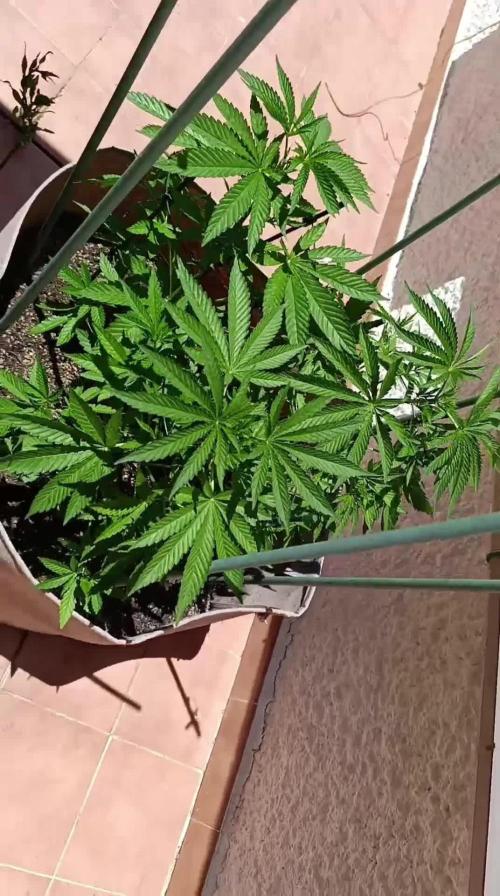
So now we’re in the first week of flowering, and I’m really happy with how things are going. The plants are constantly putting on more leaf mass, so I have to prune them every few days to remove the light-stealers and the small shoots that keep popping up. They take it all in stride and reward me by stretching nicely. 😄
The lights are now running at 60% power. My goal is to reach 80–90% during flowering weeks 5–6, and then gradually dial them back again for a nice fade.
A very kind person sent me a few very special treats, so I already have some of the ingredients for the next run ready to go. But more on that once this one starts winding down. 😉


Likes
1
Share


@Elguacho420
Follow
Buenas a tod@s... Bueno cuarta y trágica semana( para mí) por dos bajas que tuve en el indoor, que fueron las dos plantas hermafroditas, se vio a tiempo el problema y se tomó se quitaron las variedades que fue la psicodelicia y una variedad de estás tres q tenía... Estás dos de momento van bien, en cuanto vea algo q no me cuadre, o me quite la tranquilidad solución rápida, TODOS LOS DIAS se revisan las plantas a ver q tal van evolucionando posteriormente a el problema ocurrido... De momentos estás dos van creciendo muy bien, fuertes y espero no tenés más disgustos de este tipo, todo pasa x algo... A seguir trabajando duro como siempre.. 💪🏻💪🏻💪🏻⚡⚡⚡⚡😎⚕️
🇦🇷🤝🏻🇪🇦


Processing
Likes
5
Share


@Drtomb
Follow
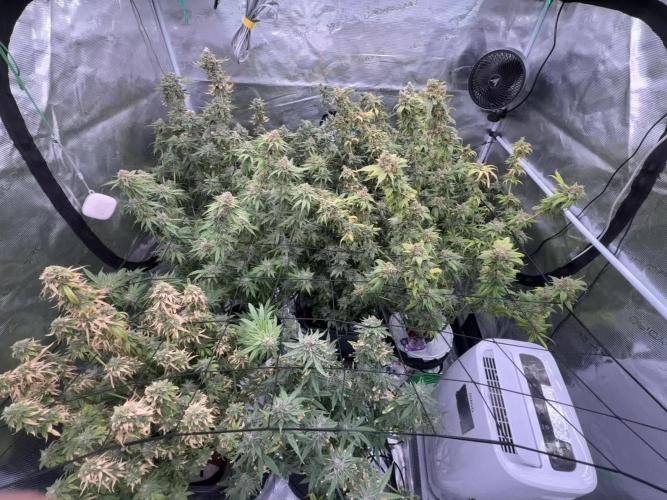
I'm 4 days into flower.
Topped all the plants nice and even. Then removed all bud sites below the top 4 on each branch. Leaving fan leaves intact. I allowed them to recover for 2 days. Then flipped the lights.
Saskatoon Berry is stacking nodes very closely. I'm thinking these will be nice big colas.


Processing
Likes
12
Share


@2Stones1Bird
Follow
Checkout my Instagram @smallbudz to see the Small budget grow setup for indoor use, low watt, low heat, low noise, step by step.
30/01/2020 - One more week to go ! Trichomes still transparent.
01/02/2020 - Gave her 1,5l RO water
