


Likes
Comments
Share


@PostMaGrow
Follow
Jetzt sind wir in der 7 Woche angekommen! 🤗Tag 49-53 mit Keimwoche angerechnet.
Die Lady entwickelt sich bis jetzt gut, die Buds sind auch schon etwas dicker geworden.👍🏻
Düngerschema ist gleich außer 1 ml mehr Bloom Booster und 1 Liter mehr Wasser.
Schauen wie's die nächste Woche wird🏻

Likes
229
Share


@Crashoverite
Follow
Week 8
Hi everyone 😀
I am so delighted with this little grow. Finally upper growth slowed down and buds are getting structure and weight. Have adjusted nutrients and increased watering to approx. 2 liters every 2 days. The aroma inside this cabinet it's very strong. It's smells a little bit fruity. 2 kg active carbon filters doing the job perfectly and nothing is coming out.
Will update progress of this week every couple days.
12/09 Day 51
Buds on 2 most developed girls are getting frosty and gaining weight. Due to extreme fast flowering time on this strain decided to start applying final nutrient - Green Sensation from Plagron. Today only 0.5ml per liter but will increase to 1ml on next watering.
14/09 Day 53
Girls got so bushy again and decided to apply selective defoliation and tied some branches to netting. Not easy task if you have only frontal access and can't remove pots out 😅
17/09 day 56
Its the end of week 8
Everything is going well, buds and leaves are covered with lovely frost now. Thankfully have no major issues accept the humidity which can't be dropped below 50%.
Stay tuned for upcoming updates.
Peace and love ✌️

Likes
6
Share


@Chucky324
Follow
End of week 9 and the beginning of week 10 of veg.
Got them outside... A bit late this year because of the weather. Cold nights.
I put a heat sink in there this year to help keep the temp up at nights.
40 gallons of water is under the table. 8 - 5 gallon containers.
I'll get them out of there when the weather gets warmer at night.
The plants sure look happier in the last pictures that were taken this morning.
The soil is 5 gallons of Sunshine Mix #4 (70% Moss) and 5 gallons of compost out of my composters, and mixed them.
When I transplanted the plants I surrounded the root balls in the Sunshine mix that has neutral ph, so the roots will grow into the compost and not get burnt by the hot soil right next to the root ball. I added another 3 gallons of Sunshine mix to do that, and to top dress and fill the pots. All the plants have about the same amount of soil in their new pots.
Just rain water for now. There is lots of food for them when the roots get to the compost mix.
OK. Be Cool.
Chuck.

Likes
7
Share


@Ryno1990
Follow
Purple Goat Cheese fast flowering photo from Goat Genetics comming in nice on her first week of veg from seedling stage
Comming up on the end of week 1 of veg they are now planted into 1 gallon pots were they will stay for a little wile

Likes
9
Share


@DropSeedsNotBombs
Follow
Colour really showing through now, and really starting to swell everywhere! Smell is also unreal, very fuely and sweet, naughty combo! Had to tie the side branches to the main stem as they were so heavy they were all sagging down! Started to flush at the end of this week :)
Likes
8
Share

@ThatsmyGrow
Follow
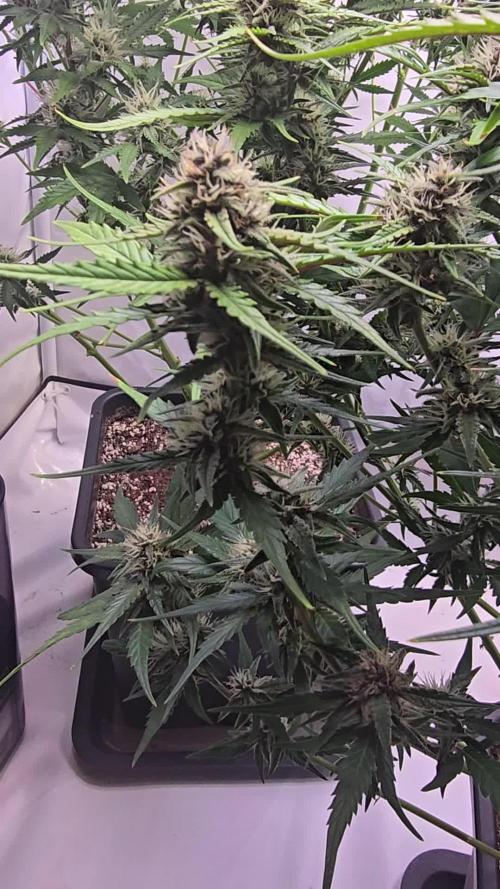
Another good week, i love how red some buds get. Never saw some buds purple like that, but i hope they Taste like they look.
Likes
14
Share

@carlitospiratahaze
Follow
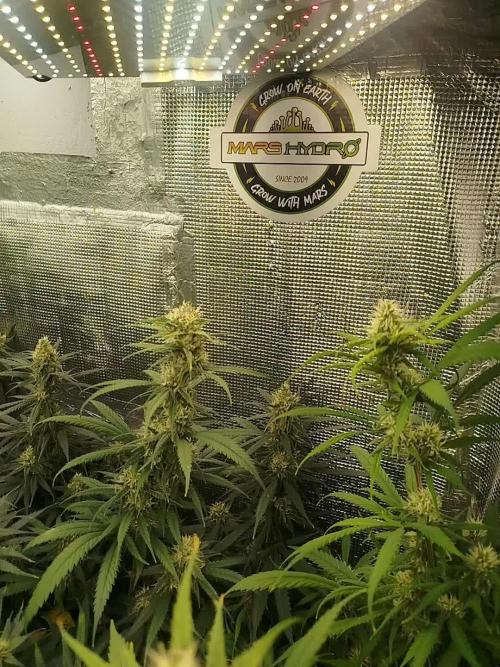
Nos vamos acercando a la recta final de los últimos 10 días.
Espectacular la cantidad de resina y los cogollos los grandes que se han quedado en esta última semana el olor se a vuelto muy marcado!
Poco a poco se va definiendo más los matices terrosos y inciensados por encima del toque a lima 🍋?
Hemos estado reduciendo la comida y la planta anda tirando de las reservas de las hojas se ve que aún está a tope comiendo.. por eso no le quite toda la comida de golpe no quiero que llegue tan justa al ultimo día.


Processing
Likes
7
Share


Likes
6
Share


@Growin_it
Follow
Needed to defoliate to create airflow and start shaping the ladies.
Stretching out the lower colas across the base.
Fimmed the ends of the longer stems to get a split going for more colas.
Recharge added to feed after stripping 30%+ of the lower canopy.
Will turn to flower in a week or too.
Notes: slow growth due to the lower heat in the tent. Okay with that because the Lecky bills have been huge with all the price gouging going on.

Likes
15
Share


@Kurow
Follow
Had a bad humidity (spots on leave are wet spots that got handled ASAP) scare last week so got a dehumidifier up in there comfortably. Still smooth sailing.

Likes
2
Share


@Huckleberry39
Follow
I just fed for the last time a few days ago. I can tell she is getting ready because she is not drinking anymore. I think I will flush and let the soil dry then I will chop. She will be down by the end of February. I can't wait....this is the first photo I have ever grown. And I think I am stuck!!! She took about 5 or 6 weeks longer than the autos I've been growing but she is going to give me twice as much, and her buds are rock hard. Can't wait to see how they are when the are dried and cured!!
Likes
9
Share


@Krautbauern
Follow
those nugs are getting bigger and bigger each day. They‘re just soaking up the fertilzers. We have to water them every second day 2l per plant

Likes
9
Share


@DeepRootsGrowTrees
Follow
KICKASS AUTO by KANNABIA
Week #13 Overall
Week #7 Flower
This week it got over 100° outside so it kinda took a little toll on her but she's still producing buds still growing and getting dense. Stay Growing!!
Kannabia.com KICKASS AUTO

Processing
Likes
70
Share


@CBD_Sweden
Follow
Illuminauto 21 - Sour Crinkle (Grape Crinkle x Sour Crack)
Two of our fastest and frostiest varieties collide to make a sweet and sour delight!
Expect super frosty, compact nugs that won't be a toke for novices.
Destined to be a great strain for extraction work too!
Plant size - Small - Medium
Cycle time - 60-65 days from sprout
Indica/Sativa - 80/20
Frost level - Extra Ridiculous
https://www.mephistogenetics.com/product-page/illuminauto-21-sour-crinkle
--------------------------------------------------------------------------------------------------------
2017-10-18. Week 8 day 56 from germination. She is 33 cm high and really frosty and have nice buds. Maxed the nutes and hope she will grow a little more in the buds.
Added video and pics.
Its getting close to harvest i think.


Likes
12
Share


@The_Good_Twin
Follow
7/16/22
Today marks the 1st day of week 14, and the start of the 2nd week of the ripening stage.
Stella received a gallon of water mixed with the following nutrients:
FloraMicro - 5 ml
FloraBloom - 15 ml
Floralicious Plus - 1 ml
Dry KoolBloom - 0.5 tsp.
I seem to be having an issue with pH the last 2 feeding days. I think my gallon jugs have reached the end of their lifetimes, and THAT is what is causing my issue. It has happened to me once before, and getting new jugs cleared up the issue. I’m assuming that will be the solution to the problem.
However, we all know what “assume” stands for don’t we? If you don’t, leave a comment and I’ll explain.
The initial pH was 5.4. That is the lowest that I have ever had simply after adding nutrients. I added a total of 10 ml’s of pH UP, which in my opinion is way too much! But, I did it in 3 separate increments. Not that that makes it better.
The final pH after all that was 6.3. The runoff pH was 5.6.
She is still looking good, but you can tell she’s getting ready to start getting to her end stage. I wait with baited breath!
The tent was 81.7F, with a humidity of 56%.
We’re almost there! Happy growing everyone.
7/18/22
Today I’m going to keep this note brief… I promise.
Stella is continuing to fatten up getting ready for harvest in a few weeks. She is still doing well.
Today she received a gallon of water mixed with the ripen stage nutrients again. I changed all of my jugs, but after mixing everything up the initial pH was 5.5. I added 8 ml’s of pH UP which adjusted the pH going in to 6.2. Her runoff pH was 5.6.
The tent was 83.3F, with humidity at 58%.
See! A short note is possible!! Happy growing everyone.
7/21/22
Stella and all of her children were fed today. As usual, a day later than planned, but they got fed, and are all still doing wonderful.
We’re keeping with the ripen nutrients mixed into a full gallon of water.
FloraMicro - 5 ml
FloraBloom - 15 ml
Floralicious Plus - 1 ml
Liquid KoolBloom - 2 ml
Initial pH was 5.2. I added 12 ml’s of pH UP which adjusted it to 6.2. She had plenty of runoff with a pH of 5.8
The tent was 83.9F, and humidity was 52%.
Her buds are FAT!! Happy growing everyone!

Likes
8
Share


@nelgrow
Follow
La pianta sta crescendo piano piano...e sto pensando di cambiare la lampada CFL agro con una HPS vegetativa
Likes
42
Share


@JohnDee
Follow
Hello all, some pistils are turning brown, a quick google search tells me it could be 3 things
1-Light heat
2-Herm
3-Nutrient burn
I would appreciate any opinions
Happy growing