


Likes
20
Share


@Elysian_gardens710
Follow
AK-47 Goxuak Autoflower by Genehtik is a truly awesome plant and really really fun to grow! My 1st thought was I wish I had know more when I ordered the seeds. I only bought 1 from the single seed centre .com 🤦♂️ Of all the plants our house sitters watched for us back in week 7, this is the only one they regularly ask about and want to know when its finished. Even they loved growing it! And they only spent a week with her and aren't gardeners 😄
Ashoka started in a Jiffy tomato pod and was transplanted almost as an afterthought. In fact we ran out of containers and had to improvise with the water pitcher. (We didn't have high hopes) Oops. The pitcher turned out to be a big benefit in that I could see the roots and diagnose and potential issues.
She has been in the same Fox Farms; Happy Frog soil ever since planting the pod into the pitcher. The soil held up good too. Ashoka didn't start showing any deficiencies until the end of week 6, around the middle of her stretch. Correcting this was very easy, we added the recharge at first but it didn't quite do it. We had to feed her Advanced Nutrients Bloom and Grow for about 2.5 weeks. But this Goxuak really never complained : 1:😎
Low Stress Training (LST) for Ashoka was a breeze! At 14 days she was 4" tall and too short to train. She doubled in height in a week and we started training around day 24. Just in the nick of time too! She entered flower about a week after that and stretched like crazy!🤪 the AK-47 gave us about 3 full weeks of nice flexible branches to train before hardening up. We ended up with a pretty even canopy and some solid colas too
I wanted to touch on the lighting as there isn't a lot of options on this platform. Ashoka spent her life under 2 different lights. 1st, she sprouted and spent the first 4 weeks vegging under 2x Viparspectra 600w(250 true watts) LEDs at an 18/6 light cycle. She finished her flower and fade under A Optic 8 (500 true watts) LED. At 18/6
At around day 60 I started flushing her.(well my house sitter Sam did the first time) We used Cyco Kleanse and flushed 5 Gallons thru her until the ppm was down to 350ish, I did the next 2 flushes. The 2nd I used Kleanse again getting the runoff ppm to ~120. Her final week I stopped ph-ing the water and just watered tap. I also gave her the 3rd and final flush with straight Ice cold tap water. She really showed a great fade!! Some buds definitely colored up too!!
Finally the Harevst:
I put her in a 5Gal bucket of ice in complete darkness for 4 days.😈 This was done with the intent to help her produce more resin and frost up. I can't say if it truly worked. She absolutely doubled the trichome production in those 4 days, but idk if it was the time or the darkness and ice. 🤷♂️🤷♂️ I kept her in a sealed closet with a oscillating fan and humidifier at 75°and 63%RH. On the 3rd day I lowered the RH to 50%. She got trimmed and put into jars on the 5th day after harvest. I am monitoring the humidity and burping regularly (8-10x a day)
Smoke Report:
Creamy pepper with a cherry syrup aftertaste.🤣🤪 I've only smoked a bowl so haven't tested the ashes. But she is curing nice. A bit harsh yet I expect will go away after a couple more days. The high is perfect tho! Just what we wanted. It creeps up on u. But you will be confused by the time you finish the bowl. A very cerebral high(I chopped her whole trichomes were only 10% amber) that was great with good company. My girl andI are both veteran smokers, but this bud still made us both giggly(a rarity). It's a good social smoke and was fun to be on around others. The only downsides were it caused a mild confusion and paranoia. Like I would forget what I was talking about then worry ppl were laughing at me for it(they were though) 🤣🤣
I plan to report more feedback after it had cured a couple weeks. I'll invite others people's opinions as well. Right now I can definitely say the AK-47 Goxuak from Genehtik it an autoflower I would recommend to anyone, but especially new auto growers. I will be ordering more next season if they ate available. Genehtik has won me over. They genetics were extremely stable and safe. No herms no deficiencies nothing but greatness!
🌱🌱🌱
I had to share! I was looking on the breeder Instagram page( @Genehtik_chile) and they used a few of my pictures of Ashoka to represent their AK-47 Goxuak auto. I really feel honored by this. I have only been growing for 5 months and know I'm not good, but it's inspiring and motivating when the breeder of the strain give you an attaboy like this. Thanks Genehtik! Stay tuned for my next autoflower run!!

Likes
15
Share


@Colo420
Follow
Planta de buena ramificación, tallos un poco debiles.
Cogollos compactos y redondeados en la punta

Likes
9
Share


@AroundTheF1RE
Follow
Love ABseedCo Michigan Craft Breeder with Great Genetics. I am not sponsored or associated with them but I will give credit where it is due.
On to the grow Rainbow Pebbles have everything from Gas to skittles and Starburst terps. They are starting to really build that nice dense structure of a nice hardy nug.
Been super easy grow dialed in my tent running 2 ac infinity inline. Code (Boots2Buds15) and all proceeds go to help our veterans off pharma and growing their own meds all while saving you money. 2 carbon air filters 6in. 4 clip on fans and 1 oscillating fan under sf4000 and HLG 600 Rspec
Happy Growing Stay Lifted Stay Blessed and I'll see You....Around_The_F1RE
Likes
4
Share


@Brentb2607
Follow
10 days of darkness during the flush begins. Had great results with Wanda and her genetics. Blessed for a first grow. Cut Wanda down at the end of the week. She’s now drying. I will be giving a thorough review for my harvest diary. Excited to share what I’ve experienced and learned from this grow.

Likes
10
Share


@CL_fito
Follow
Buenas cultivadores.
Por el tamaño que tenia le día una semana más de vegeta, ahora ya empiezo con el periodo 12/12, se ve una planta sana y se han mantenido los parámetros de forma óptima, estaré actualizando.
Saludos desde chile.


Likes
27
Share


@TheCannaProphet
Follow
~ FASTBUDS TESTER #2205 ~
Well friends, here we go on another 'canna-venture' together!
The grow room has had a complete remodel and some upgrades done to it including brand spanking new 4x8 and 4x4 tents and a Trolmaster Hydro X controller along with a new Control Panel.
This tester strain is one of six tester strains that FastBuds has graciously provided me with and I'm looking forward to seeing what this girl has to offer when she's grown to her full potential!
One drawback of 'testers' is I have little to no information on it other than its number and that it's an autoflower... 🤪 But, it's ALWAYS a blast growing them for me because not knowing a lot allows me to just concentrate on the essentials: Light, Environment, Water, Nutrients and possibly a bit of LST... not complicated, just basics like keeping a constant temperature and RH in the tent at a level that gives a good VPD, watering when almost dry and maintaining proper light levels according to their stage of growth.
____________________________________________________________________________________________________________________________________________________________________________________________________________________________________________________________________________________________________________________________________________________________________________________________________________________________________________________
~THE SETUP~
~Initially seeds were lightly scuffed, then soaked for 3 hours in 78℉ distilled water after which they were transferred to moist paper towels laid out in a Jiffy Pellet plastic starter tray with lid. Underneath the tray was placed a Mars Hydro Heat Mat with Controller that was set to 78℉ where they stayed until their tap roots emerged.
~Planted into Jiffy Peat Pellets that were hydrated with distilled water warmed to 78℉ with a 7.0 ph.
~Once roots emerge from the Jiffy Pellet they're transferred to their fabric pots.
~Grown 100% organic in a 4g Gronest fabric pot and a 3g fabric pot by Wraxly filled with Mother Earth 70/30 Coco/Perlite medium and initially amended with Dr. Earth 4-4-4 / Earthworm Castings / Dr. Earth Flower Girl 3-9-4 and Coast of Maine Stonington Blend Organic Plant Food 5-2-4.
~19/5 light cycle for the entire run with supplemental UVA added during flower. Lights are controlled by a Trolmaster Hydro X controller set for a 15min Sunrise/Sunset simulation.
~Top dressing every 3-4 weeks with slow release dry amendments and Earthworm castings.
~Straight water ph'd @ 6.2-6.8 when needed and bi-weekly Compost Tea's.
____________________________________________________________________________________________________________________________________________________________________________________________________________________________________________________________________________________________________________________________________________________________________________________________________________________________________________________
Weekly Updates:
12/29- Here we go into Week One of Flower! It's been a month since these pretty ladies popped out of the ground and they're both looking perfect and have pistils popping out everywhere!
Their fabric pots were still heavy when lifted, and they looked happy, so I skipped watering today and will check them tomorrow morning after the lights come on.
Since being topped roughly a week ago, they have two new shoots that are emerging and looking extremely healthy with excellent vigor and have a beautiful healthy green color! The #1 is now at 7" tall and the #2 a bit taller at 9".
12/31- Today was a 'dry day and all I did was refill the humidifier and some canopy maintenance, tucking shade leaves and gently bending branches.
It's been a little over four weeks since they were planted in their amended medium and it's time to give their microbes a good feed so they can continue to provide them with all the macro and micro nutrients they need so, yesterday they got a good watering with 0.5g of de-chlorinated water with GreenGro's Veg, Flower, Green Aminos, Natures Brix and Granular Myco added to it @ 1.5 tsp/g and then ph'd to 6.4 @ 73℉.
01/02- Today I watered them from the bottom with 0.5g of de-chlorinated water to which I added 3ml/g of Earth Juice OilyCann cal-mag to prevent any Cal-Mag issues they may encounter before they arrive.
I also have the HLG 650R set 36" above canopy and it's set at 60% power which is being controlled by a Trolmaster HydroX controller. The tent environment is on point with temp's running 70 when the light's off and 74℉ with the light on. I'm keeping the RH at 55-60% right now but will drop it as flowering progresses. Finally, I've been keeping the VPD in the tent running 0.85 - 1.05 which I'm happy with!
01/04- They have both been doing really well getting watered every other day and yesterday they received 0.5g each of de-chlorinated water with 3ml/g of Fish Head Farms Fish Sh!t Soil Conditioner which was then ph'd to 6.3 @ 72℉.
They're both doing fantastic but were really beginning to get choked up with growth so I went in and selectively removed a few shade leaves from both to get some light penetration down into their canopies to give that lower growth some much needed light. While I was doing that I also did a little more LST on both to also increase light penetration.
Well, there goes another week in our journey and I'm looking forward to the coming weeks as flowering gets cranked up! 😍👍
😎💚 Thank you for checking out my passion in life! Please visit as often as you wish and I hope you enjoy this journey as much as I know I will! Grow Strong! 💪😎🤙
Likes
7
Share

@Stacy_smokez
Follow
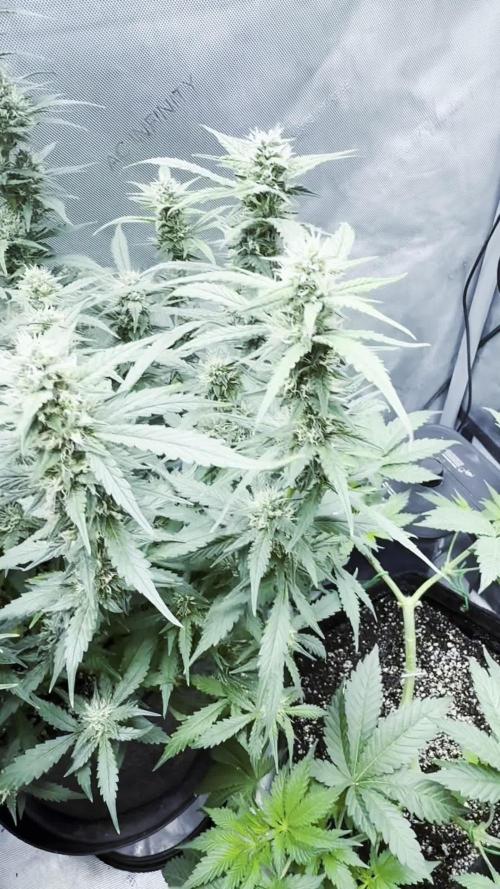
Left the 4 main stocks alone and thinking taking some of the bigger fan leaves off. Overall she is happy and thriving very well can wait to flip to flower.


Likes
3
Share

@vaginacircus
Follow
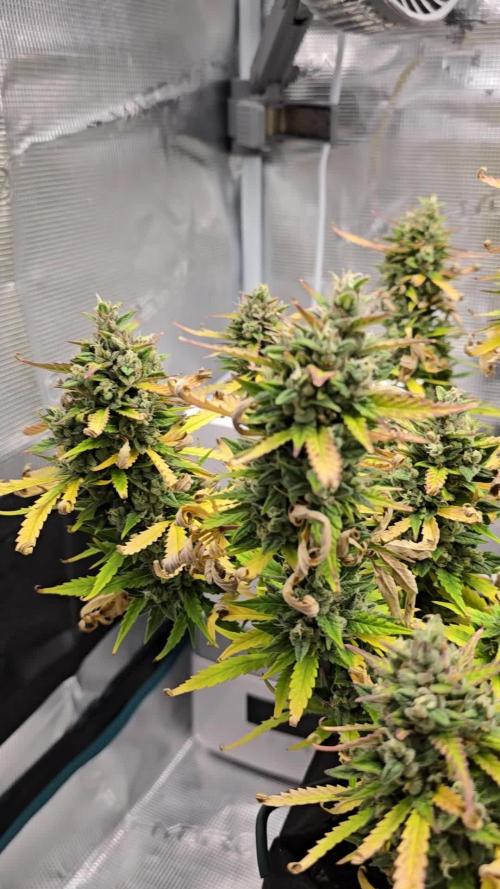
Toujours en rinçages. quelques trichomes bruns sur une tete matures, mais sur des tetes plus basse, on a encore des trichomes transparents, je pense qu'on arrivera à terme la semaine pro !
Likes
2
Share


@Topshelf_only
Follow
Still very hot with high humidity. still not to worried this strain is meant to be mold resistant. Definitely putting it to the test.
Likes
12
Share

@Gram_Solo
Follow
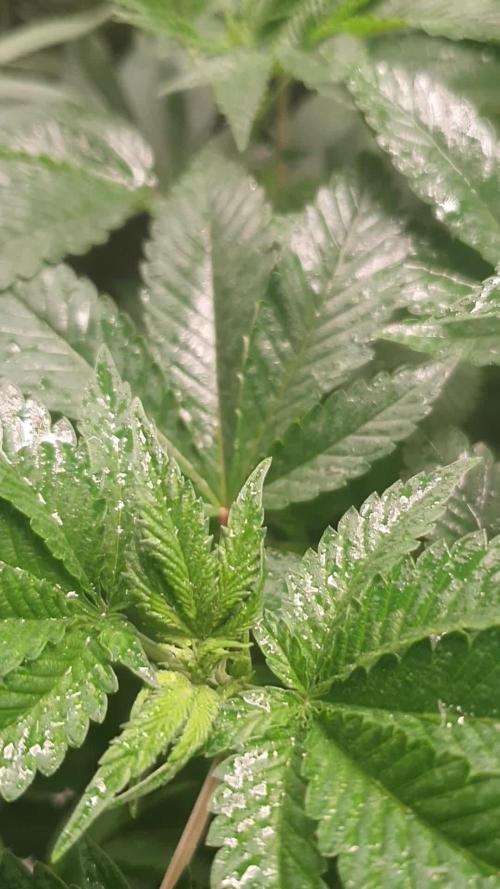
We're nearly ready for flipping this gopnik to the dark side! 2 weeks and we switch to 12,12
Tent is nice and full now from the Kannabia Strains!


Likes
43
Share

@TheCannaProphet
Follow
~Entry for the 'Best Rarest & Smallest Pot by Seedsman' contest~
Starring 🤩....
~ Seedsman Zkittlez Auto ~
Zkittlez (Grape x Grape Apple) Auto x Auto Fruit (Auto Fruit Cheese x Auto Blueberry)
Zkittlez Auto is one of the very sweetest-tasting auto strains available anywhere. It is a sativa-dominant (60%) strain that was bred from Zkittlez (Grape x Grape Apple) Auto crossed with a male Fruit Kush Auto, the latter a remarkable fruity strain bred from Fruit Cheese Auto and Blueberry Auto. Growers can expect to harvest some good yields of high-THC buds.
Zkittlez Auto remains a fairly short plant, rarely exceeding 120 cm. in height wherever it is grown. This is a vigorous plant which is able to metabolize a high level of nutrients and she's a thirsty girl too! If growing indoors close to neighbors it is strongly advised to ensure good and effective carbon air-filtration in order to neutralize powerful odors. This strain's life-cycle is approximately 90 days from seed to harvest.
The leaves on this plant are big and wide serving to convert every lumen available into Zkittlez goodness. Indoor growers should obtain between 400 - 500 gr/m2 while plants cultivated outdoors will produce slightly more at 500 - 600 gr/m2. Lateral branching is very good and it is recommended to use supports/ties to prevent snapping and keep buds close to the light source.
This strain's scent is sweet and fruity with candy and berry notes. Its high-THC has been measured at between 21 - 24% with less than 1% CBD. The effect is well-balanced, cerebral and euphoric, and is very good for social situations as well as for relaxing in front of the TV either alone or with company. It also has the added effect of helping to relieve chronic pain, helping with nausea, insomnia and depression as well as stimulating the appetite.**
**Credit to Seedsman.com
________________________________________________________________________________________________________________________________________________________________________________________________________________________________________________________________________________________________________________________________________________________________________________________________________________________________________________________
~ The Setup ~
~ Grown in a 2qt plastic popcorn pot filled with Mother Earth Grow 70/30 Coco/Perlite with Xtreme Gardening Mykos added.
~ Seed was germinated directly in the medium without any 'pre-soak'
~ Feeding will be by Dutch Pro Nutrients
~ 24hr light cycle while germinating
~ 20/4 light cycle after first leaves appear.
~ 4x8 Gorilla Tent
~ HLG 650R w/ 30w Supplemental UVA Bar controlled by a Trolmaster Hydro X controller set for a 15min Sunrise/Sunset simulation. (also a HLG Blackbird for additional side lighting if necessary)
~ Supplemental co2 controlled by an AutoPilot APC 8200 co2 controller
~ AC Infinity Cloudline T6 with Controller 67 using a Terrabloom 6x24" carbon filter
~ De-Humidifier and Humidifier when needed.
~ 14k BTU IdealAir portable A/C unit plumbed into tent for temperature control.
~ BlueLab testing instruments
~ Two Hurricane 18" oscillating fans
~ Two 6" Clip-on fans
~ Two 10" floor mounted fans
________________________________________________________________________________________________________________________________________________________________________________________________________________________________________________________________________________________________________________________________________________________________________________________________________________________________________________________
Weekly Update:
11/22- Today her leaves were just starting to show signs of drooping and her pot was light so I went ahead and watered/fed her with 0.25g of well water with a base ppm of 100 that I allowed the excess to drain to waste. To the well water I added the following Dutch Pro nutrients: Grow 'A' & 'B' @ 10ml/g, Multi Total @ 7.6 ml/g, Take Root @ 3.8 ml/g, Silica Von Liebig’s Special @ 1.2 ml/g along with Earth Juice's Oily Can @ 5 ml/g to end up with a total 850ppm nutrient solution. After adding the nutrients and checking the EC, I ph'd the solution to 6.0 @ 74℉.
11/24- I didn't water her today as her pot still had some weight to it. Her color and stamina remain excellent and she's approaching 6" tall now!
11/26- Today when I checked her pot it was feather light so I went ahead and watered/fed her with 0.25g of well water with a base ppm of 100 that I allowed the excess to drain to waste. To the well water I added the following Dutch Pro nutrients: Grow 'A' & 'B' @ 10ml/g, Multi Total @ 7.6 ml/g, Take Root @ 3.8 ml/g, Silica Von Liebig’s Special @ 1.2 ml/g along with Earth Juice's Oily Can @ 5 ml/g to end up with a total 850ppm nutrient solution. After adding the nutrients and checking the EC, I ph'd the solution to 6.0 @ 74℉.
I also noticed today that she is starting to show signs of pre-flower with some nodes showing emerging pistils!
11/28- The Zkittlez Auto has entered into pre-flower and in a week, give or take, she'll be going through her stretch and we'll see what this girl's got going on!
No water today, I just turned her pot and tucked a couple of shade leaves. See you all next week! 😎👍❤️
~ Thank you from the bottom of my heart for following my grows and for all the ❤️and support you give! 💚What you grow - Grow what you💚
Likes
5
Share


@Nune2021
Follow
happy Halloween 🎃 🎃🎃zusammen !! Die Pflanze macht sich gut aber ist nicht mehr viel in der hohe gewachsen und fängt schon an zu blühen sieht ganz lustig aus die topf combo !! die Pflanze ist vielleicht 25 cm groß also ein Zwerg


Likes
26
Share


@UkDank420
Follow
Shinning silver haze start of week 8 really starting to stink now :) can’t wait to taste it growing really well with no problems will definitely grow this strain again :)

Likes
27
Share


@adam_pawloski87
Follow
What a great week it’s been!today is day 65 from seed!! One of the Forbiddin Runtz got it’s last feeding on Friday and will get flushed for 2 weeks and will be ready for dry and cure! The rest will still remain getting same dose of nutes the rest of this week and most likely into the next! This batch felt like it went so quick ! Hope you all enjoy an watch out for next week !