


Likes
Comments
Share


@JohnnyBarrel
Follow
Week 17
Last week before harvest. Just let the plants ending the maturation process. Good synchronization between the different strains, selected with an approximate identical flowering period. I want harvesting all the plants at the same time.
Flowers are dense, hard and thick, pretty resinous. 4 strains = 4 different smells, 4 different colors….🤩
I flushed consciously and stopped watering 4 days before the harvest day. I turned off the light during 48h, with ventilation on.
All is ready for the cut. Date is programmed to the full moon period….why not…🤔
I will trim a little bit the plants before cutting and hanging them in the tent with the same ventilation cycle, no light of course…


Likes
25
Share


@DrGanj
Follow
Some mild defoliation this week. Budding up nicely and starting to frost. This girl was having a foliar feed of algae last week but this week she's getting light foliar sprays of the Lacalva stress treatment from madame grow on top of her other feed. I'll do this every 2/3 mornings and I'll only lightly mist the top. I'll concentrate most of my foliar feed on the lower growth and undersides, away from the buds. This is the main reason I kept so many lower fan leaves this time.
Processing
Likes
9
Share


@MG2009
Follow
04/28/2020
Week #8 of flowering begins will post more pics latter.
04/29/2020
Did some leaf removal had some powdery mildew on some leaves took infected leaves off, plus some for good measure. Drying out every day or two today she took one liter before run off. You can see in the video the colors? And sparkling buds?
04/30/2020
Day 50
I decided to take the top buds in pics , 47 grams wet.
It is a 9-12 week strain but I think she need a week or two? But we will see.

Likes
16
Share


@Northern_Ent
Follow
July 13: first heat wave of the year was last week, and there is another forecast for next week, but for now this is pretty ideal cannabis weather.
Added a third Scrog layer and tied it off to some weights (partly filled water bottles) to open up the canopy further. Works, simple, and easy to move around the yard as needed.
I really like this plant and how it’s going so far.
July 14: re-scrogged again to widen the canopy further. Supercropped the ends to maintain the same elevation at the various growth tips. Four stems in middle were topped to keep them from getting ahead of the others. Experimenting to see how it goes.
July 16: hot again. Increased water volume and sometimes misting air with garden hose water for the evaporative cooling. She looks great.
July 17: another 32 C day. Watered four times today so likely 7-8 L in the heat with the growing plant.
July 18: hot again. Mixed Power Bloom and malted Barley with some soil and added as a top dressing.Hit 34 C and 20% relative humidity which is far too hot and dry for cannabis. Lots of watering, and misting of leaves and air to provide some moisture and cooler temperatures.

Likes
10
Share

@trelopoulos
Follow
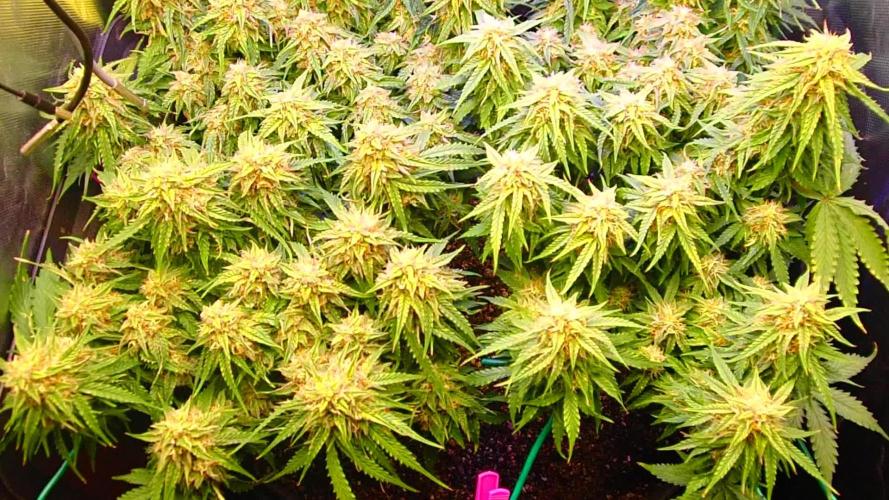
Ladys are ready! they look and smell delicious.. started drying them.

Likes
18
Share


@Ageddd
Follow
Another cold week, we are having around 2ºC Minimum temperature, and its really cold at night( I mean, for Spain, because if some Nortern people hear this may be laughting at me hahaha)
But there is a range of hours when then sun hits directly the plant if its not cloudy, like 6h-8h, this if i dont have to roll out the awning, so the plant is protected when raining.
Did not feed the plant until past the middle of the week, because i ovserbed that the flowers were developing slowly as im accostummed, probably because of the low temperatures, so i decided to give her the last feeding and start the flush at the end of this week, because i felt the plant was like at least 2 weeks from proper harvest, and still developing the flowers with white hairs... Im looking for something narcotic with a nice Therpenoid Profile so the later the better in my opinion, but without passing he Ripper Line hahaha :)
So last feeding was like a fattening one... Higher Dose of nutrients for the plant, and later added some Micro Vita to the soil, 3grams, and until the end with water and some carbs in 1/2 irrigations ...
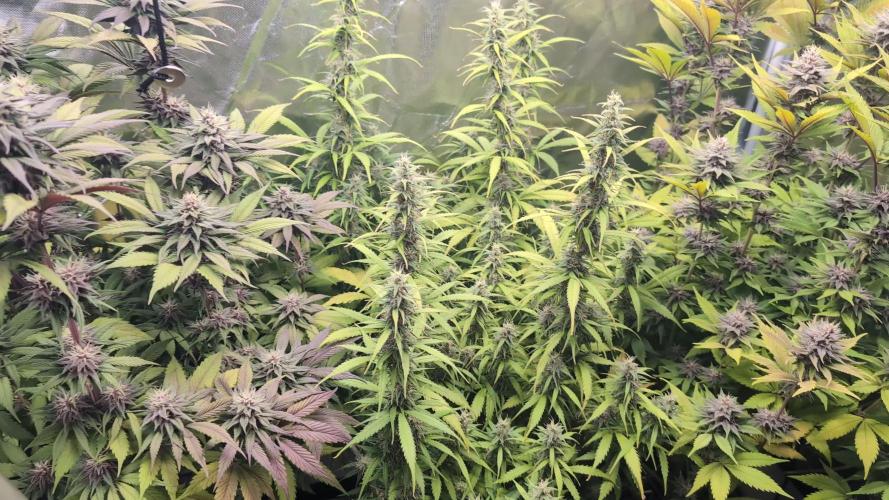
What amazed me is the strenght of this plant, surviving these really low temperatures, growing a little slowlier, but without problems or buds, amazing plant, as amazing as beautiful, im in love with the colours..
So i hope you enjoyed reading this week Growmmies :)
Have a nice week and dont forget to roll one ^^
Good vibezz.



Likes
12
Share

@Z420Organics
Follow
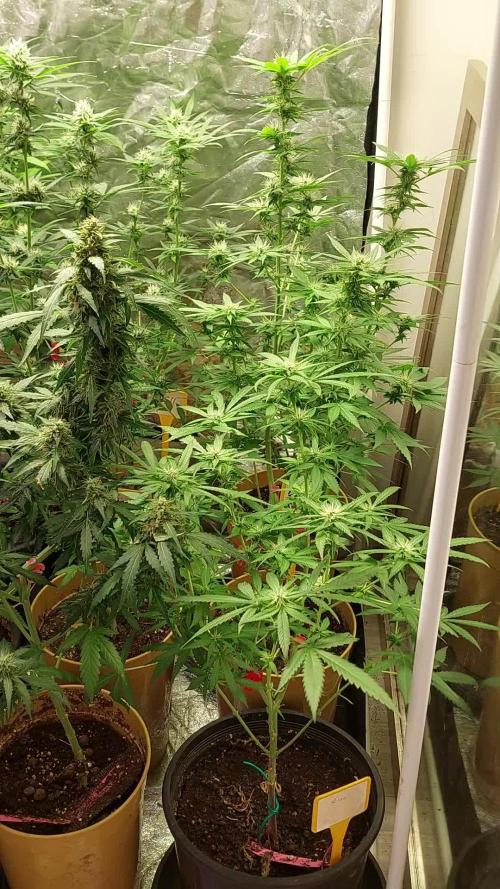
The plants are doing great overall! 💪🌿
RS11 is filling up beautifully — the structure looks amazing and the sweet smell is starting to show! 🍬✨
Amnesi-K Lemon has such juicy-looking buds 🍋💦 — that’s honestly the best way I can describe them right now.
The surprise of the run is definitely Apple and Bananas 🍎🍌 — the plants are packing on heavy trichomes, even on the sugar leaves. This one’s going to be an interesting strain for sure! ❄️🔥
Monkey Grease is growing steady and strong — zero issues so far 🙌🌱.
Cherry Dreams… well, that’s where I made a big mistake 😅. When I mixed the soil, my ppm meter turned out to be faulty — so they went into a very hot mix. I’m currently flushing to remove excess salts so the roots can breathe and work properly again 💧🌿. Lost some time there, and they’re definitely behind compared to the others. But hey, it’s all part of the learning process. This will be an interesting one to see how it finishes! 🧠✨.

Likes
3
Share


@TS_Greens23
Follow
All I’ve done this week was stretch her out as much as possible,,getting as much light to all the buds,,and kept her food levels topped up,,
This week I’m going to start giving her water only,,and just let those nuggs flush out the unneeded,,,,,lols ,she looks really good for her age,,,start winding her down now,,,these buds are so tight,,🙏💚💚💚
Likes
3
Share


@Ryno1990
Follow
Ms Grapes an Cream from Atlas seeds is comming in amazing on week 4 of veg she is still the biggest she's growing great after being topped thinking about topping her again have had no problems with her she's growing more every day under the medic grow fold 6
Ending week 4 this girl continues to amaze me with how vigorous she's been growing she's been topped a couple times now an really thinking about giving her another one she's been growing so great with these nutrients from cultured biologix
Likes
Comments
Share

@WetWillie
Follow
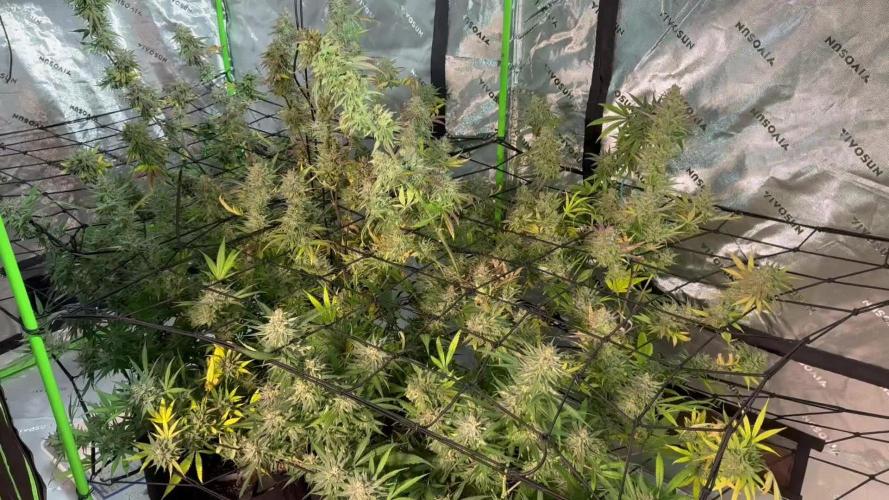
Cut and hung, only the best buds kept, beginning dry cycle. Into jars after 11 days dry, beginning cure.


Likes
141
Share


@Tropicannibis_Todd
Follow
💩Holy Crap Growmies We Are Back💩
Well growmies we are at 35 days in and everything is going great 👌
👉 Shes a short chunky little plant 👈 We got some very pretty colors😍 👌 She's got some odd colors kinda like tiger leafing,😉
Lights being readjusted and chart updated .........👍rain water to be used entire growth👈
👉I used NutriNPK for nutrients for my grows and welcome anyone to give them a try .👈
👉 www.nutrinpk.com 👈
NutriNPK Cal MAG 14-0-14
NutriNPK Grow 28-14-14
NutriNPK Bloom 8-20-30
NutriNPK Bloom Booster 0-52-34
I GOT MULTIPLE DIARIES ON THE GO 😱 please check them out 😎
👉THANKS FOR TAKING THE TIME TO GO OVER MY DIARIES 👈
Likes
13
Share


@cookingwithninja
Follow
Week 6 day 1 video
Week 6 day 4 video
I’m still pushing very hard with carbs every watering, humic acid, soluble n, soluble pk, microbial mass, b+, fishshit. Already tried testers for lowers. Very potent hits harder than a pen. Feels like 30-40% baked for 1-3h per j, different phenos. Not harsh just testers dried for 0:01:15, checked seeds and developing for 2-3 weeks
Processing
Likes
3
Share


@Mr_nugs_lover_David
Follow
She looks wonderfully beautiful and vert healthy,she just like her sisters has started flower on August 3rd let's see how she performs,I'm loving this strain Black cherry punch so far! 🔝💚

Likes
51
Share


@Bones_1986
Follow
DAY 57 :
Changed light schedule to 24/0 to control temps dropping. Problem solved sitting between 22 - 27 at all times now.
As you can see from the pics the 3 gallon pot is gonna be harvest a few weeks before the 5 gallon pot although the trichomes are still clear ATM.
Still feeding every 2/3 days around 2.5 / 3 liters. The smell of these is just delicious.
Day 58
trichomes are still clear,
Day 60
Trichomes have started to turn cloudy.
Seriously sticky and stinky covered in resin
Day 62 -
Trichomes are now over 50% cloudy. Gonna flush when the pot is next dry probably Monday ready to havest within the week.


Likes
152
Share

@GreenHobbit
Follow
The Hobbit Hole – Woche 13
? BAAAAUM FÄLLT! – Das Ende einer Outdoor-Reise
Woche 13 – und heute endet die Reise für die letzten beiden Bewohnerinnen des Hobbit Holes.
Die Gelato hat das Hobbit Hole bereits vor knapp zwei Wochen verlassen und hängt seitdem kopfüber im Schuppen. Aufgrund des sehr feuchten Wetters trocknet sie deutlich langsamer als erwartet. Nach inzwischen 12 Tagen ist sie immer noch recht feucht, aber das Wichtigste: bislang keinerlei Anzeichen von Schimmel. Einen ersten kleinen Probebud gab es trotzdem schon. 😅
Und dann gab es noch eine kleine Überraschung: In der Gelato habe ich einen einzelnen Samen gefunden – und gestern auch einen in der Cinderella. Woher die Bestäubung kam, bleibt wohl eines der kleinen Geheimnisse Mittelerdes. 😂
💜 Purple Punch
Was soll ich zu ihr noch sagen?
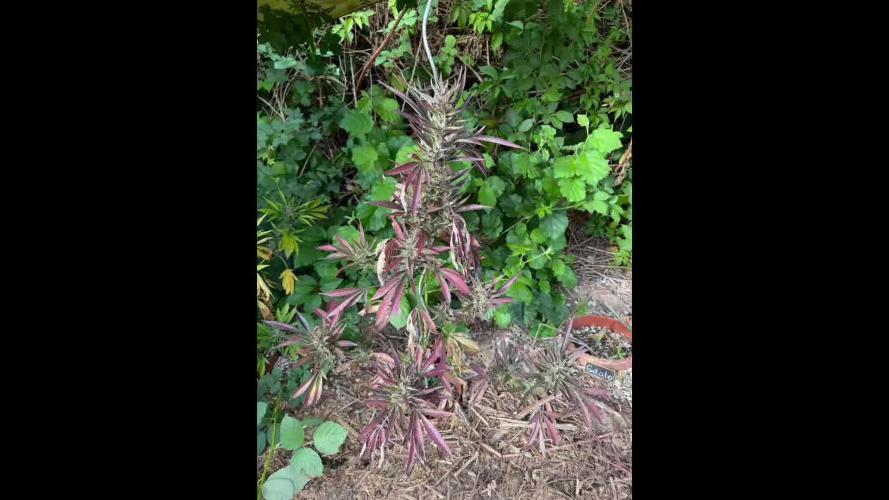
Die Purple Punch hat sich in ihren letzten Wochen optisch komplett verwandelt. Aus einer eher unscheinbaren grünen Pflanze wurde zum Ende eine tiefrote bis violette Schönheit. Besonders in der Sonne kommen die Farben zusammen mit der dicken Trichomschicht unglaublich zur Geltung.
Sie ist sicherlich nicht die Pflanze mit den größten oder kompaktesten Buds dieses Runs geworden – aber optisch ist sie für mich definitiv eines der Highlights des gesamten Projekts.
Und vor allem: Trotz der dauerhaft hohen Luftfeuchtigkeit und des schlechten Wetters sehen die Blüten bis zum Schluss sauber aus.
👠 Cinderella
Cindy sieht inzwischen aus, als hätte sie selbst beschlossen, dass es reicht. 😅
Das Laub ist massiv ausgefadet, viele der großen Blätter sind bereits gelb oder komplett abgestorben. Gleichzeitig stehen an den Trieben noch überraschend schöne, stark bereifte Buds.
Die Makroaufnahmen zeigen überwiegend milchige Trichome, daneben noch klare und vereinzelt bernsteinfarbene Köpfe. Vielleicht hätte sie unter perfekten Bedingungen noch etwas Zeit bekommen können.
Aber perfekte Bedingungen haben wir momentan definitiv nicht.
Die letzten Wochen waren kühl und vor allem viel zu feucht. Das zusätzlich gespannte Tarp hat die Pflanzen zwar vor direktem Regen geschützt, aber irgendwann überwiegt das Risiko den möglichen Gewinn durch ein paar weitere Tage Reife.
Deshalb fällt heute die Entscheidung:
Cinderella und Purple Punch werden geerntet. ?
Lieber etwas früher als Budrot
Das war wahrscheinlich die wichtigste Lektion dieses Outdoor-Runs.
Indoor kann ich Temperatur, Luftfeuchtigkeit, Licht und Bewässerung kontrollieren. Im Hobbit Hole entscheidet dagegen irgendwann Mutter Natur, was gespielt wird.
Das Wetter der vergangenen Wochen war alles andere als freundlich. Trotzdem haben die Pflanzen durchgehalten und ich konnte sie dank Regenhaube und später zusätzlichem Tarp weitgehend trocken halten.
Jetzt möchte ich mein Glück aber nicht weiter herausfordern.
Nach den letzten Fotos, Videos und Makros heißt es deshalb heute:
BAAAAUM FÄLLT! 🌳?😂
Damit ist der aktive Grow im Hobbit Hole 2026 beendet.
Aber das Diary ist noch lange nicht vorbei. 😏
Als Nächstes folgen die Ernteberichte, die finalen Trockengewichte und natürlich die Rauchberichte der drei Sorten. Die Gelato macht dabei den Anfang.
Was als kleines Outdoor-Experiment in einer überwucherten Ecke des Gartens angefangen hat, ist für mich zu einem meiner spaßigsten Projekte dieses Jahres geworden.
The Hobbit Hole will return.
Und nächstes Jahr darf dort etwas Größeres einziehen.