Likes
Comments
Share
No deficiencies thus far adding some molasses each feeding 1 tbls per gal water
Likes
18
Share
week intel: its time to harvest some of plants the ones that is mature enough. indica dominant plants will done first always so we should harvest them first because my base nutrients and one of boosters was salt based, i'll do flushing this week to get some relieve to plants in the last days stresses : flushing Drought stress via watering only one time with flushing this week feeding: day 1 : i flushed them with Advanced Nutrients Flawless finish and adjusted ph day 3 : no more feeding from now on day 5 : no more feeding from now on guide of the week : i harvest in 2 parts : first i harvest top of the branches and will let the lower buds to ripe another week then ill harvest the second wave. indica dominant plants will get done 1 or 2 weeks sooner than sativa dominant plants that will often takes more than 8 weeks so be aware to harvest them sooner. my dry and cure style is this: 3 days of hanging upside down to get water activity lower to around 0.6 in 50% humidity and 26 C temp (i know its a little high but we are in a hot summer right now and i cant get it lower even with air conditioner) and then after 3 days of drying i remove leaves and stalks, trim buds and move them to jar for the rest of their life :D . and in the first 4 days of curing i open the jar door and let hem get some fresh air in the jar for about 5 minutes and close the jar door again, after 4 days of curing like that buds are smokable but they will get better as they getting cured about 1 month. im happy as hell with this harvest :D.
Likes
34
Share
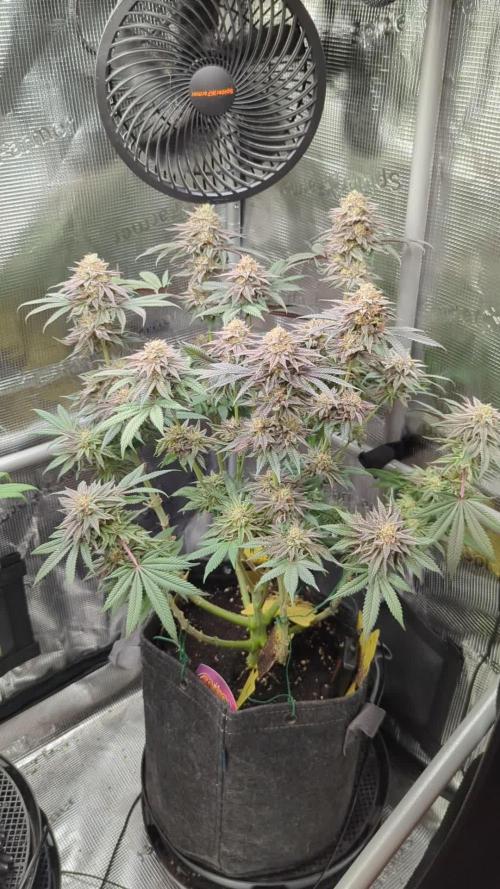
Stretched vigorously once she started to transition to flower. Developed potency early in flower! She was LST'd weekly, starting week 2. She was also gently lolipopped a few times, to maintain growth towards 5-6 nodes only.
Likes
14
Share
@Chucky324
Follow
Hello. This is the end of week 6 and the beginning of week 7 of flowering. Things are going good in here. Plant #1 has it's brown spots back. The plants had both a watering and feeding this week. I think I will grow these plants to 9 weeks of flowering. I need to have these plants finished and harvested by the time the other tent is ready to cut down at week 10. So I like to flush before harvest. This is the last week of food for these beautiful girls. More about flushing next week. Chuck.
Likes
21
Share
@Excalibur
Follow
17 July 2018 - Considerable size increase from both root and stem structure to the leaf development. Heat has and is an issue. Slight nutrient burnt tips, as nutrients was increased drastically. 20 July 2018 - Mainlined CP from 4 nodes to just her 2nd nod. Notice the stress.
Likes
2
Share
Las plantas frenaron su crecimiento bestial. El sustrato se lo comieron en 2 semanas y rapido comenzaron a mostrar inicios de carencias a partir de las 2da semana. Las pase a la cantela de 500 L, corte el fondo de las macetas. Volvi a enmendar el suelo. Queda que se recuperen para volver a despegar
Likes
2
Share
Wakíŋyaŋ, I am who I am, the salt of the earth. Thunderbird is an allegory; his conflicts with other forces in nature are then an attempt to allegorize relationships observed in the natural order, such as the changing of the weather. He is essentially an attempt to represent the patterns of activity of a powerful, mysterious force in a way that can be understood simply and easily – sort of the way in which a weather map functions today. Moving from18x60x60 = 64,800 seconds in 18 hours. 64800x860(ppfd) = 55,728,000 umol per daylight. Into Flower 12x60x60 = 43,200 seconds in 12 hours. 43200x1145(ppfd) = 49,464,000 umol per daylight. It's asking a lot of Rubisco regeneration to maintain 50 DLI in the 12 instead of 18. Raised the ambient CO2 to 1200 to 1500 ppm to achieve efficient gas exchange. Not particularly recommended, but adding sugar to an indoor growing medium is a highly effective way to stimulate microbial activity, which rapidly breaks down the sugars and releases CO2 through cellular respiration. You can safely capture this CO2 to fertilize indoor crops and boost photosynthesis. While this process works, the setup requires precise understanding and management to avoid common indoor growing hazards. The plant Carbon to Nitrogen C:N ratio defines the balance between structural carbon (sugars/cellulose) and nitrogen (proteins/enzymes). It acts as a master regulator of plant health, growth, and metabolism. Rubisco (Ribulose-1,5-bisphosphate carboxylase/oxygenase) is the engine of photosynthesis responsible for fixing atmospheric CO2 into sugars. It is intimately tied to the C:N ratio for three primary reasons. It is the Plant’s Biggest Nitrogen Sink, Drives the Carbon Side, and it is the Nitrogen Control Knob. Understanding this relationship allows you to predict how plants respond to environmental stress or fertilizer. Rubisco acts as the primary storage sink for leaf nitrogen, accounting for up to 30% to 50% of a C3 plant's soluble protein. Deep Green Leaves signal a rich abundance of both chlorophyll and Rubisco proteins. The plant possesses the heavy enzymatic machinery required to handle 1145 PPFD. Pale or yellowing leaves indicate a nitrogen deficiency. The plant is actively breaking down its own Rubisco to salvage nitrogen for newer growth, drastically reducing its light-tolerance threshold. Subtle difference, but understanding is important in order to be able to judge when to dial light intensity up and light intensity down, when to push, and when to back off. An extra dose of magnesium is vital if a plant is going to push through the growing pains of high-intensity lighting. Foliar application of magnesium is an excellent and rapid way to assist with Rubisco regeneration within a plant, so long as it is applied correctly. Spray strictly in the early morning or late evening, mixing your magnesium with a little fulvic acid or chelator, but only when she gets a little limey on top. This, for me, is the experience of growing, akin to "riding the surf" maintaining efficient Rubisco regeneration through visual identification of the shade of green. Surf a razor-thin wave when balancing light intensity, nutrient availability, and transpiration to maximize Rubisco enzyme efficiency. Keeping the Calvin cycle fully charged without tipping into nutrient toxicity, light stress, or the dreaded chlorosis requires paying close attention to the visual cues the plant provides. By monitoring these subtle shifts in color, turgor pressure, and leaf posture, you adjust your environmental controls and surf that exact razor-thin wave. Nute recycling acts as the vital execution mechanism for autophagy, which defines senescence. Natural senescence is a genetically programmed developmental stage aimed at nutrient recycling, whereas triggered autophagy is a rapid survival response activated by environmental stress. While both processes utilize the vacuole to break down cellular material, their triggers, selectivity, and overall goals are entirely different. Cannabis plant senescence is not separate from nutrient recycling protocols; rather, nutrient recycling is the primary physiological purpose of senescence, and autophagy serves as the core switch mechanism executing both processes. Takes about 24 to 48 hours to notice visible changes once the signals have initiated the autophagic response. Not too late at all. A little bit of fade from senescence 2 weeks from harvest is normal and genetically expected. Send the C:N 32:1 signal 1 week from harvest for the best effect in your organic grow. Understanding what makes leaves fade is not always senescence, but also strongly linked to Rubisco regeneration. That's a whole other subject. Vital to understand the differences if you want a correct diagnosis and to transition from hobby grower to master stoner, differentiating between a true genetic fade and a decline in photosynthetic proteins. Nitrate is nitrate, whether it oxidizes or not is not up for debate. If it's not sunk by the plant you are smoking some if not all of, it's regardless of what your feelings are on the matter. Senescence is highly critical. It is the natural end-of-life stage where the plant redirects energy to ripen flowers. Properly managed, it breaks down harsh chlorophyll, allowing the terpenes (which provide taste and aroma) to peak. Harvesting outside this window leads to an "unripe" or degraded flavor comparable to going without. To initiate the response you seek, you can trigger it multiple ways, when growing synthetically its triggered by nutrient starvation, generally when the entire medium is flushed. This is more to do with N starvation than being entirely empty. Nonetheless. PK boosters are N starvation through maximizing P and K. (Generally only works for synthetic grows) Normally, a medium only holds 10-30% of its nitrogen as ammoniacal ta part boosts this to 50% as it triggers the "ripen" signal, but you don't want to keep ammoniacal above 30% for more than 7-10 days if you can help it. Its a trigger mechanism no more. PK BOOST with 50% ammoniacal N signals floral maturation. PK BOOST with N starvation signals nutrient recycling/sinking. Because you are using organic nutes and you want to maintain the rhizosphere, what you want to do is add carbon in the form of sugars (powdered molasses). It's almost impossible to empty a medium enough when microorganisms are constantly releasing nutrients into the direct EC. Very difficult to initiate starvation responses with ammoniacal nitrogen. Manipulating the C:N ratio is the key to triggering an autophagic response and resulting nutrient recycling in the last days using organic nutes and without having to flush. Generally not recommended for new growers. So do what you want. But if you don't trigger the plant to dump its nitrates into root zones, you will smoke nitrates as NO3- does not oxidize during the dry and cure no matter what you do or how long you dry or cure. Doesn't matter what anyone "feels" about it, how many grows they had with no fade. "Clover steals valuable nutrients." Crop and drop the clover come flipping to flower, its benefit comes from creating an airy and porous rootzone. I don't need to crop and drop once the plant fills the canopy, she blotches out the light, and the clovers die. This is the nitrogen the microorganisms use to convert carbon for respiration throughout the flowering stage.
Likes
42
Share
@deFharo
Follow
Bienvenidos camaradas cultivadores, siete semanas de floración y las dos últimas con problemas de bloqueo de nutrientes que se ha reflejado en las hojas de las dos ramas principales, quemaduras en las hojas y marcas claras de deficiencia de Manganeso, el consumo de agua estaba en bajada desde hace dos semanas, y una vez más, mi falta de reflejos me ha impedido comenzar antes a tratar el problema. Ya sabía yo que esta cepa, con semejante nombre Psicopático me iba a dar problemas!! 🙄 Bien, es el momento de los fuertes!! 🤜🤛 ACTIVIDAD SEMANAL 💀 Día 84. Muevo la planta a mi carpa principal donde tengo como lámpara de dosel una magnífica MH TS1000, apoyada por otras luces que aportan espectros de luz más cercanos al rojo (2700k, 660nm, 2000k, 3000k, IR 730nm que enciendo 15 minutos cada hora.) Días 85, 86, 87, 88, 89. La planta no reacciona al último riego con agua de montaña y melaza, sigue perdiendo hojas completamente amarillas de la parte baja de la planta, en los dos últimos días, en la parte superior de las dos ramas principales han vuelto a aparecer manchas en las hojas más grandes, ahora también rizado de las puntas... muy feo!! Día 90. Acudo al cultivo dispuesto a intentar solucionar el bloqueo de nutrientes. 1º. Preparo una mezcla con agua de montaña y Ormus que aporta calcio y Magnesio y ayuda a la asimilación de nutrientes, corrijo el PH con vinagre blanco. PH: 7.0, EC: 0.55. 1000ml. Riego rápido con esta mezcla hasta conseguir un buen nivel de escorrentía, recojo 500ml con un EC: 3.1 y PH: 7.05. Preparo una mezcla de sólidos (Ca, Mg, P, Fe, Mn, Cu, K...) que añado al sustrato, para que traspasen sus nutrientes lentamente en los próximos días. 2º Preparo otra mezcla suave con Agua de montaña, melaza, 3% de mi Biol de Frutas y minerales con Microorganismos Eficientes -EM- (MMA, BAL, Vitaminas, Azúcares, Micro elementos, Húmicos...) y Ormus 1%. PH: 6.59, EC: 1.15. 1500ml. Vuelvo a regar rápido para arrastrar nutrientes del sustrato y al tiempo aportar en ese agua los nutrientes de la mezcla que potenciarán el trabajo y reproducción de la microbiología del sustrato. La escorrentía la uso para regar mis geranios!! Día 91. Se ha notado el tratamiento, la planta parece hinchada, ha recuperado en 24h la tersura, seguiré con unos riegos suaves hasta estar seguro de que el problema desaparece. Aunque me preocupa el impacto en la producción, pues justo estas semanas son cruciales para el crecimiento de las colas. SALUDOS Y SALUD A TODOS!! 😬 ================================= 🙄☮️👇🙏👌🤛👍👉👉👉❤️💜❤️👈👈👈🤜👌🙏👇☮️🤩🖐️🏻 =================================
Likes
9
Share
@BlaKX
Follow
Hallo Growmies, Von der Mitte der 6 bis 7 Woche habe ich ihr PK13/14 verabreicht. Auch eine aller letzte Entlaubung vor der Ernte habe ich vorgenommen.
Likes
3
Share
@Badbreath
Follow
13/9 hon har vuxit en hel del men hennes blad som växer ut är skadade, varför är det så? Jag har henne på 5.8/6.2 i pH, 1.55 EC, 550 ppfd. Vattenbyte var 7e dag. Inför hennes förra vattenbyte från 1.2 i EC till 1.6 EC det gillade hon inte. Hon intog bara vatten vid det tillfället men jag märkte det snabbt enig för att spä ut EC ner till 1.55 som hon trivs perfekt i.
Processing
Likes
45
Share
@AsNoriu
Follow
Day 65 . Girls love theirs shitty life ;))) Looks everything fine, they started to smell really berry , time to put air filter on. The only toped and most delayed girl is showing super results, you can check her size on week 4. Its crazy what upside down plant delivered. Good i left her and always hoped that she will be special .. Day 66. And its friday 13 ;))) I see that late FastDiesel is way behind, so i made it even worse ;)) i stripped her hard, just to know how this strain reacts. All other girls are way upfront and for some it would be second round of defoliation in flower, but they never tried it and its just to late to experiment with all of them. After two hours she still hates it. Fast Diesel really loves CalMag, on day 67 all girls will get CalMag + Molasses mix, for some girls it will be last CalMag i think. They will have a heavy feed aswell. Planing on day 69-70. Thats all action and plans for this week. All girls got striped a bit on day 66 and changed left with right . Thinking new possition will light up other buds, maybe flower will develop more evenly... Looks like thats it, hope no budrot, thats my only fear .... And i forgot to make earliest Tangie photo, but she was always in front at the entrance and she is nothing special, looks like too leafy bud phenotype, the only plus, i hope she will be choped this year. Day 67. Morning, girls still not thursty, they drink pure ph water slowest from all mixes. Defoliated girl prays like nothing happend, she should make long colas ;) just in february i quess ;))) Way too long run with autos, i was hoping to flush by now ... Wont make it with two waterings this week. Its a first week for them without nute boost. Will reduce a bit amount, was feeding almost 2 liters per pot, thinking to go back to 1.5-1.7 area and stop giving silica and cal mag mix. So feed will be in 3 steps from now 1. Heavy feed 2. Ph Water 3. Molasses and calmag mix Day 67. Late Eve. They are finally light, maybe i will make feeding on tuesday, right at the end of week, today calmag and molasses mix. Raised 3 pots, girls should love more light, now have more even canopy. Everytime i say thats it , but after pot raise i dont see what can i do more with them... Toped tangie looks having some bleaching on top cola, raised lights half inch ;)) Day 70. Heavy feed day. They look happy and fatten a bit. End of week Next run if i ever do autos i will check #FastBuds beans, from all diaries this house make it super fast.
Processing
Likes
10
Share
@GrowerGaz
Follow
This week just water from the autopots and a soil soak with some bio enhancer . Plants are really starting to smell now . Resin production on the Rado z is insane. Sadly they did not make the cut for the next drop. Happy to have been able to test them. I think they look and smell great.
Processing
Likes
14
Share
Week 12, Day 83 from seed and 3rd day of flower.....The 5 day of this week officially marked the start of the flowering season!! So I flushed both of these bad boys with ph'd water for two days and then today I switched them to 12/12. I gave them their first dose of bloom nutrients and then lollipoped them as you can see, pixs . Grateful no issues to report for the past 3 weeks have been trouble-free!! I'm going to leave the MH bulb in for an additional 2 weeks to prevent any stretching before switching to the HPS. But so far they are still loving their environment. I'm also in the process of keeping clones of fat banana and hulkberry while i try this new strain of Peanut Butter Tree.
Likes
44
Share
24 Oct 2021 Week 16 began yesterday, but the first watering of the week was today. I’m keeping up with the flush, starting the 2nd week today. Hopefully I’ll be able to harvest in a few days. My Trio is looking really lovely. Their buds are covered in trichomes that glisten under the lights. They are starting to darken in color in some areas like their mother did. They may take on some pinkish/purple hues before it’s all done. Some of their leaves are turning purple as well. The sugar leaves are somewhat dark, but still green. All three of them are very nice to look at, and their smell is super strong! It’s really nice in my grow room! Yesterday I went out and got some more of those support sticks from the local home store and provided support for all of the branches that needed it. Which was a lot! I got 7 new support sticks and used them all. All of the branches are now supported and flourishing! Today each of my girls received a gallon of properly pH’ed water, and each had a sufficient amount of runoff from which to gather measurements. The process went as follows: C1 & C2 had an initial pH of 6.9, and C3’s initial pH was 6.8. I added .2ml of pH DOWN to each gallon which adjusted the pH to 6.4 for C1, and 6.3 for C2 and C3. TDS going in was 88 ppm for C1, 86 ppm for C2, and 84 ppm for C3. Runoff measurements were a little weird. The runoff pH for C1 was 5.9. The TDS was (at first) 600 ppm. I thought that was an incredible drop from the other day, so I did it again. It was 603 ppm the second time. Ok, moving along nicely! The runoff for C2 was pH - 5.8, and TDS was 1101 ppm. 😳 That’s a lot more than C1. C3 had a pH of 5.6, and TDS of 1212 ppm. Which is even more; so I measured a little more from C1 again, and the 3rd time it measured 736 ppm. 🤔 That seems weird to me, but I’ll keep an eye on it. If it continues to be that low then I will end up harvesting it before the others which won’t be so terrible. I’ll just have to wait and see. The temperature in the tent was 81F, and humidity was 47%. My ladies are looking lovely and growing better than I could have hoped for. This grow has been awesome, but I can’t wait to be done. Happy growing everyone! 27 Oct 2021 Feeding/flushing time again! I was somewhat perplexed the other day when I got the runoff reading for the TDS in C1. It was 500-600 ppm less than C2 & C3 respectively. Since I was having some issues with the TDS meter I thought that IT may be the cause. I made a note to check on it today, and there seems to be no problem with the TDS meter at all. Keep reading for details. My plants are still looking as lovely as I could ever have hoped for! C1 has started showing more color changes than the other 2, and the only thing I can say the difference is, is that I defoliated some of C1’s larger fan leaves last week, and wasn’t able to do the same for the other 2. That is the ONLY thing I can think of that has been different between all 3 plants this entire grow. Regardless, all 3 plants are looking wonderful! Today each of my lovely ladies received a gallon of property pH’ed water with an expected amount of runoff for testing. The preparation went as follows: C1 & C2 had an initial pH of 6.9, and C3 was at 7.0. I added 0.2ml’s of pH DOWN to each gallon which adjusted the pH of all 3 gallons to 6.3. TDS going in for C1 & C2 was 85 ppm, and C3 was 84 ppm. Runoff levels were different for all three plants. C2’s runoff pH was 5.7, and TDS was 1041 ppm. C3’s pH was 5.6, and TDS was 1059 ppm. Last time C1 was significantly lower than the others, and I thought that maybe it was a TDS meter issue. Evidently it wasn’t. C1’s TDS today was 526 ppm! 😳 still much lower than the others, and pretty much ready for harvest. The temperature in the tent was 81F, and humidity was 43%. Although harvest time is much closer, I don’t believe it will be done in time for this month’s grow diary of the month contest. So sad, but that’s life. Happy growing everyone! See you again soon. 29 Oct 2021 Today is the last day of week 16. I was planning on continuing the flush today, but remembered something that I had forgotten about…. I remembered the branch that had broken off of C1 back on October 10th in week 14. She had held on for well over a week in a can of water, but finally her leaves started to droop. I hung it up all by itself in my small tent to dry. Until today that is! I took it outside and trimmed it on my deck. Even outside, in a pleasant breeze, the amazing smell of this branch was easily detected. It’s kind of windy, rainy, and chilly here today, but still …. That sweet blueberry muffin smell was there. Her buds; still covered in the dried, crystallized trichomes were super sticky! I must admit that they are the stickiest buds I have grown to date. I weighed the dry bud to add to the grand total of C1’s harvest later. Then I ground it up and smoked it. All I am going to say is that from my reaction to smoking it; I have decided that no additional flushing is needed. After all, what I smoked today broke right before I started flushing, and I could taste nothing other than what I would hope to taste. So my fellow Growmies; I am ending this week right here. The next report you will see will be the harvest report!! Stay tuned!