The Grow Awards 2026 🏆
Likes
Comments
Share
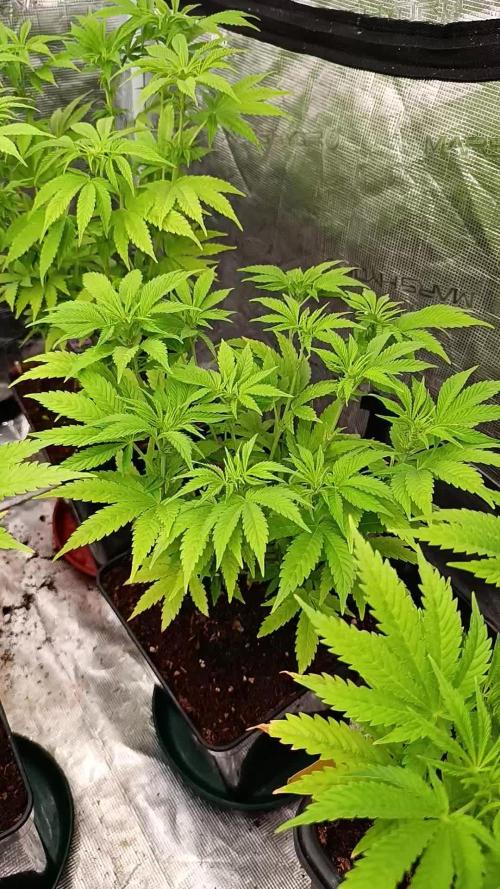
Esta semana seleccionamos las plantas más adelantadas de nuestro cultivo, para colocarlas bajo la nueva luminaria Led LazerLite Pro 720 de The Pure Factory, con la potencia ajustada al 50%. Miramos de que las cuatro variedades estén representadas bajo el led y bajo las lamparas HID, de esta forma podremos ver las diferencias entre los dos sistemas. Seguimos con nuestra rutina de fertilización para la fase vegetativa Grow Soldier + Green Mystic by JUJU Royal y CALMAG de BioBizz. Al final de la semana, cambiamos el ciclo lumínico para pasar a 12/12 Floración.

Likes
Comments
Share
Primera semana de floración de esta chocofresas, se ve completamente sana, ya que pasan del indoor al exterior cuando pasan a floración
Likes
15
Share
@Dunk_Junk
Follow
Day 77 - Her flowers are forming nicely. Trichomes are forming! Starting to get stinky.
Likes
9
Share
So far first week of flower been great, watching as the days goes by. I defoliated and top dressed a week before flip and they are super bushy already. Looking forward to stripping them again sometime end of next week. Feed them every other water with little run of, soil and water ph tested every other day. No complaints so far. Happy growing everyone. Stay bless
Likes
145
Share
@Kynareth
Follow
Day 81 update - as you can see at microscope pictures the buds are near to be ready for the harvest. I will stop watering for the next 24 hours the 2 biggest plants to be harvested at the weekend on days 82-84. The other one i will wait a bit more to madurating proccess.
Likes
4
Share
@m0use
Follow
***Sponsored Grow*** = Medic || https://medicgrow.com || Grow = ***Sponsored Grow*** Not a whole lot is happening this week, still having some PH issues in the medium, I believe this is from the microbial mass I added a while back. A microbe product, PH going into the medium is around 6.5-6.8 and coming out is between 5.5-5.8, so something is acidifying it up. Also noticed the runoff last week was a bit higher at times. So lowered the feed down quite a bit, going in at 1.4EC vs 1.8 will bump it up to 1.5 and 1.6 in the next few weeks. I also added in a bit of a PK booster. nothing to crazy only 60ppm worth on a total allowance of 700PPM Lights now running at 100% with V1 spectrum, decided to go with 100% now vs after stretch, will see how it works out. Till next week. https://medicgrow.com/ + https://seedstockers.com/ Facebook: https://www.facebook.com/medicgrowled + https://www.facebook.com/SeedstockersBarcelona/ Twitter: https://twitter.com/medicgrow + https://twitter.com/seedstockersb Instagram: https://www.instagram.com/medicgrow420/ + https://www.instagram.com/seedstockers_seeds YouTube: https://www.youtube.com/channel/UCNmiY4F9z94u-8eGj7R1CSQ + https://www.youtube.com/channel/UC4GiFYrIWeNtwtXjcivCmfw Growdiaries: https://growdiaries.com/grower/medicgrowled https://growdiaries.com/grow-lights/medic-grow + https://growdiaries.com/grower/seedstockersofficial https://growdiaries.com/seedbank/seedstockers
Likes
2
Share
Tag 53 : - 1. Entlaubung „Die Pflanze hat richtig doll angefangen zu Zwittern. Da es aber aktuell die einzige Pflanze ist die in der Blüte steht, lasse ich sie stehen und bringe sie zuende“ Tag 55: - 2. Entlaubung
Likes
10
Share
Check out this beautiful plant and the trichome production this week. Stunning! I cleaned up the bottom one more time. I will be top dressing this next week and it will be the last before harvest.
Likes
2
Share
@Hydrus
Follow
she is fine, got rid of spider mites. all the others are strongly infected, mostly mature plants. so i harvested them very early to make the best tea in the village. spidermite tea.lol p.S.: the only way you can infest your plants with spidermites is, you live near a garden or the nature.lol (ordered new equipment, to give the plants a more nature environment.lol)
Likes
2
Share
Les tête continue à sortir comme il se doit renouvellement de l eau racine en pleine forme et mise en place de deux clim pour contré les chaleur et purification de l'aire allumage du filtre a ozone pour l odeur qui as déjà commencé
Likes
1
Share
Found out the water I was using had a ph of at least 7 instead of 6.5 like I had thought. I also had a cal mag deficiency from using LEDs and reverse osmosis water. Now I have a ph tester to prevent the first issue and cal mag for the second.
Likes
12
Share
I have a lot to harvest indoor. I pulled over a pound off the plant that produced low quality buds. I put most of my effort in the one grove bag of good good
Likes
28
Share
@Brujha77
Follow
Sooo, Die beiden haben es nun auch geschafft. Punktlandung, genau 9 Wochen Blüte. Muss sagen der Run war absolut entspannt. Gerade in Verbindung mit dem Blumat... Gewogen wurde nicht... Hängen nun zum Trocknen im Zelt bei ca. 21°C und ca. 48-55% Rlf.
Likes
8
Share
@MG2009
Follow
02/01/2022 Girls looking good potting up this weekend I hope. I wish I labeled them better but I'll be surprised at harvest I think tallest one is jillybean we will see.
Likes
3
Share
Week 4 Happy New Year everyone! Got an explosion of growth between the previous week and now. She must like that top dressing I did last week... closer to 2 weeks ago actually now that I think of it. Any who... she's branching out nicely and I'm just trynna train an even-ish canopy before flipping to flower. She's already showing signs that she's ready. I wanna take a few clones from her in about 2 weeks and let her rock a while longer to recover before we flip the lights so until then, our routine is train, water, and top dress every 2 weeks. Water with recharge every other watering. Watering occurs currently about every 4-5 days. That's all for this week's report 🙌🏾 As always... Stay Highly Medicated & Highly Dedicated folks 🔥🎄😎🌬️🤙🏾
Likes
3
Share
@qoodwater
Follow
Bigger buds! Nice smell! Sweet and creamy!
Likes
52
Share
You don't become confident by shouting affirmations in the mirror, but by having a stack of undeniable proof that you are who you say you are, outwork your self-doubt. Nitrogen fixation is a chemical process by which molecular nitrogen (N2), which has a strong triple covalent bond, is converted into ammonia (NH3) or related nitrogenous compounds, typically in soil or aquatic systems but also in industry. The nitrogen in air is molecular dinitrogen, a relatively nonreactive molecule that is metabolically useless to all but a few microorganisms. Biological nitrogen fixation or diazotrophy is an important microbe-mediated process that converts dinitrogen (N2) gas to ammonia (NH3) using the nitrogenase protein complex (Nif).[2][3] Nitrogen fixation is essential to life because fixed inorganic nitrogen compounds are required for the biosynthesis of all nitrogen-containing organic compounds, such as amino acids and proteins, nucleoside triphosphates and nucleic acids. As part of the nitrogen cycle, it is essential for agriculture and the manufacture of fertilizer. It is also, indirectly, relevant to the manufacture of all nitrogen chemical compounds, which include some explosives, pharmaceuticals, and dyes. Nitrogen fixation is carried out naturally in soil by microorganisms termed diazotrophs that include bacteria, such as Azotobacter, and archaea. Some nitrogen-fixing bacteria have symbiotic relationships with plant groups, especially legumes.[4] Looser non-symbiotic relationships between diazotrophs and plants are often referred to as associative, as seen in nitrogen fixation on rice roots. Nitrogen fixation occurs between some termites and fungi.[5] It occurs naturally in the air by means of NOx production by lightning.[6][7] All biological reactions involving the process of nitrogen fixation are catalyzed by enzymes called nitrogenases.[8] These enzymes contain iron, often with a second metal, usually molybdenum but sometimes vanadium. Green clover (Fixation) White clover (Fixation) Red Clover. (Fixation) Yellow Clover. (Fixation, deeper roots) Sweet Thai Basil. (Terpenes) Italian Basil. (Terpenes) Chamomile.(Oil production) Borage.(Pest attraction taste) Lavender.(Pest attraction smell) Marigold(Pest attraction visual) Mycorrhizae are beneficial associations between mycorrhizal fungi and a plant’s root system. Mycorrhizal fungi spores germinate in the soil, creating filaments (hyphae) that penetrate the root cells, thus establishing a symbiotic relationship. This collaboration leads to the development of both intra-radical and extra-radical networks of filaments, enabling efficient exploration of the soil for enhanced access to nutrients and water. Consequently, these vital resources are transferred to the plant, resulting in numerous benefits for crop cultivation. Various mycorrhizal products are available in diverse formulations (powder, granular, and liquid), concentrations, and qualities. Ongoing advancements in products, technologies, and research are reshaping our understanding of mycorrhizae. Despite these positive developments, certain misconceptions persist. In the following discussion, we aim to clarify the truths and dispel the myths surrounding mycorrhizae products. MYTH #1 A HIGHER NUMBER OF MYCORRHIZAE SPECIES MEANS BETTER RESULTS. Contrary to common belief, having a higher number of mycorrhizae species in a product does not translate to better results; in fact, it often yields the opposite outcome. A plant can sustain only one association with a particular mycorrhizal fungi species. Introducing multiple species creates competition among them, which is not advantageous for the plant. The initial colonizer does not ensure the highest success; instead, it gains precedence. It is recommended to select a product with a concentrated presence of a single mycorrhizae species known for its effective performance, rather than opting for a product with multiple species at lower concentrations. MYTH #2 ECTOMYCORRHIZAE ARE EFFECTIVE FOR CANNABIS PLANTS. Although ectomycorrhizae can colonize five to ten percent of plant species, cannabis is not among them. Ectomycorrhizae do not penetrate the root cells; instead, they develop around the roots and on the exterior. For cannabis plants, it is essential to seek out endomycorrhizae. Endomycorrhizae are capable of colonizing 70% to 90% of plant species, including cannabis. Unlike ectomycorrhizae, endomycorrhizae penetrate the root cells, forming structures like arbuscules for the exchange of nutrients and water with the plant. MYTH #3 WHOLE INOCULANT (PROPAGULES) PERFORM BETTER THAN ONLY VIABLE SPORES. The propagule count specified on most mycorrhizae products indicates the presence of spores (viable and unviable), hyphae, and root fragments. However, it is crucial to note that only viable spores, those with the capacity to germinate, can successfully colonize a plant’s root system. Spores are to mycorrhizal fungi what seeds are to cannabis plants—a fundamental component enabling fungi reproduction. Consequently, even if a mycorrhizal product boasts millions of propagules, its effectiveness hinges on the presence of viable spores. Without viable spores, the product will not contribute to plant development. Therefore, the genuine value of a mycorrhizal inoculant lies in the quantity of viable spores it contains, as only viable spores can efficiently initiate symbiosis. MYTH #4 ALL METHODS OF APPLICATION YIELD IDENTICAL RESULTS. To establish the symbiosis, mycorrhizal fungi spores must be close to the plant roots. The optimal recommendation is to directly apply mycorrhizal inoculant to the roots, either in powder, granular or slurry form. This method ensures maximum proximity between the spores and the roots, facilitating a rapid establishment of symbiosis. Particularly with crops like cannabis, which have a short growing cycle, employing this technique is the most effective way to obtain optimal benefits. Alternatively, techniques such as blending the inoculant with the soil are effective, but there may be a delay in the establishment of symbiosis. This is because the roots need to grow and come into contact with the dispersed spores throughout the growing media. MYTH #5 MYCORRHIZAE CAN ONLY BE GROWN ON LIVING PLANTS. While the predominant method for commercially producing mycorrhizae involves growing them on the root systems of living plants (in vivo production), it is not the exclusive nor the optimal technique. In fact, this production approach has notable drawbacks that the “root organ culture” method just does not have (in vitro production). In vitro production occurs in meticulously controlled, aseptic laboratory conditions, allowing for the consistent generation of products that are viable, highly concentrated, species-specific, and free from pathogens. Achieving such precision and quality is impossible when relying on the cultivation of mycorrhizal fungi on plants exposed to external conditions. In conclusion, it is crucial to take all these factors into consideration when choosing the appropriate product for your crop to fully harness the wide array of benefits provided by a high-quality mycorrhizal product. STRONGER PLANT – Stress resistance. FASTER GROWTH – Improve plant structure and shorter veg time. INCREASE YIELD – Overall more biomass. IMPROVED QUALITY – Increase cannabinoids and terpenes content.
Likes
6
Share
@Dengued
Follow
Day 63...buds fattening up nicely...currently experiencing worst pollution on the planet with AQI of 300+ for most of the week which i fear is affecting growth..,..the buds look a lot browner in the pics, than i reality.. due to the post-apocalyptical tinge to the sky as the sun sets, though the smog
Likes
2
Share
Agua de cañeria Ph 7.2 Ec 0,660 Corte las colas centrales
Processing
Likes
96
Share
So this marks the beggning of week three veg for these fabulous lady's . One of them is still catching up to the other because she keeps deciding to do weird things haha . I'm starting my nutrient cycle this week to help them kick it into veg drive ! Thanks again for the support and love lady's and gents makes this grower feel loved haha remember to check out my diary's daily for updates !!!!! -Happy Growing