The Grow Awards 2026 🏆
Likes
55
Share
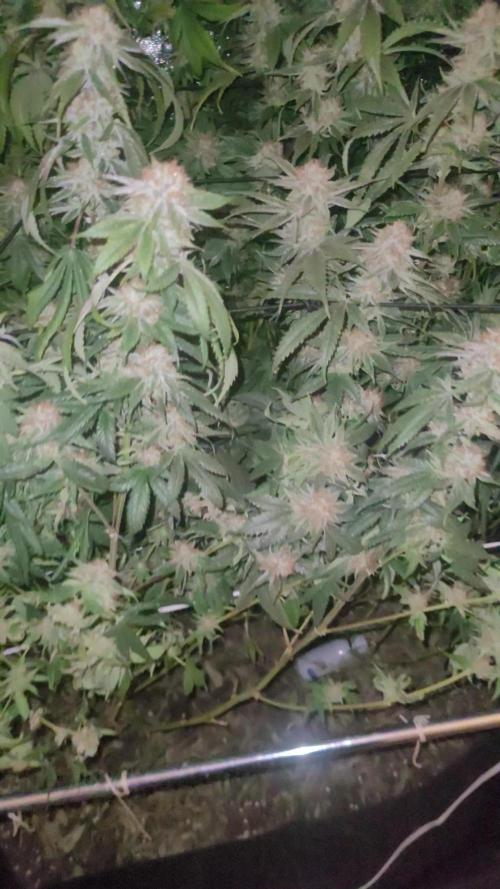
What's in the soil? What's not in the soil would be an easier question to answer. 16-18 DLI @ the minute. +++ as she grows. Probably not recommended, but to get to where it needs to be, I need to start now. Vegetative @1400ppm 0.8–1.2 kPa 80–86°F (26.7–30°C) 65–75%, LST Day 10, Fim'd Day 11 CEC (Cation Exchange Capacity): This is a measure of a soil's ability to hold and exchange positively charged nutrients, like calcium, magnesium, and potassium. Soils with high CEC (more clay and organic matter) have more negative charges that attract and hold these essential nutrients, preventing them from leaching away. Biochar is highly efficient at increasing cation exchange capacity (CEC) compared to many other amendments. Biochar's high CEC potential stems from its negatively charged functional groups, and studies show it can increase CEC by over 90%. Amendments like compost also increase CEC but are often more prone to rapid biodegradation, which can make biochar's effect more long-lasting. biochar acts as a long-lasting Cation Exchange Capacity (CEC) enhancer because its porous, carbon-rich structure provides sites for nutrients to bind to, effectively improving nutrient retention in soil without relying on the short-term benefits of fresh organic matter like compost or manure. Biochar's stability means these benefits last much longer than those from traditional organic amendments, making it a sustainable way to improve soil fertility, water retention, and structure over time. Needs to be charged first, similar to Coco, or it will immobilize cations, but at a much higher ratio. a high cation exchange capacity (CEC) results in a high buffer protection, meaning the soil can better resist changes in pH and nutrient availability. This is because a high CEC soil has more negatively charged sites to hold onto essential positively charged nutrients, like calcium and magnesium, and to buffer against acid ions, such as hydrogen. EC (Electrical Conductivity): This measures the amount of soluble salts in the soil. High EC levels indicate a high concentration of dissolved salts and can be a sign of potential salinity issues that can harm plants. The stored cations associated with a medium's cation exchange capacity (CEC) do not directly contribute to a real-time electrical conductivity (EC) reading. A real-time EC measurement reflects only the concentration of free, dissolved salt ions in the water solution within the medium. 98% of a plants nutrients comes directly from the water solution. 2% come directly from soil particles. CEC is a mediums storage capacity for cations. These stored cations do not contribute to a mediums EC directly. Electrical Conductivity (EC) does not measure salt ions adsorbed (stored) onto a Cation Exchange Capacity (CEC) site, as EC measures the conductivity of ions in solution within a soil or water sample, not those held on soil particles. A medium releases stored cations to water by ion exchange, where a new, more desirable ion from the water solution temporarily displaces the stored cation from the medium's surface, a process also seen in plants absorbing nutrients via mass flow. For example, in water softeners, sodium ions are released from resin beads to bond with the medium's surface, displacing calcium and magnesium ions which then enter the water. This same principle applies when plants take up nutrients from the soil solution: the cations are released from the soil particles into the water in response to a concentration equilibrium, and then moved to the root surface via mass flow. An example of ion exchange within the context of Cation Exchange Capacity (CEC) is a soil particle with a negative charge attracting and holding positively charged nutrient ions, like potassium (K+) or calcium (Ca2+), and then exchanging them for other positive ions present in the soil solution. For instance, a negatively charged clay particle in soil can hold a K+ ion and later release it to a plant's roots when a different cation, such as calcium (Ca2+), is abundant and replaces the potassium. This process of holding and swapping positively charged ions is fundamental to soil fertility, as it provides plants with essential nutrients. Negative charges on soil particles: Soil particles, particularly clay and organic matter, have negatively charged surfaces due to their chemical structure. Attraction of cations: These negative charges attract and hold positively charged ions, or cations, such as: Potassium (K+) Calcium (Ca2+) Magnesium (Mg2+) Sodium (Na+) Ammonium (NH4+) Plant roots excrete hydrogen ions (H+) through the action of proton pumps embedded in the root cell membranes, which use ATP (energy) to actively transport H+ ions from inside the root cell into the surrounding soil. This process lowers the pH of the soil, which helps to make certain mineral nutrients, such as iron, more available for uptake by the plant. Mechanism of H+ Excretion Proton Pumps: Root cells contain specialized proteins called proton pumps (H+-ATPases) in their cell membranes. Active Transport: These proton pumps use energy from ATP to actively move H+ ions from the cytoplasm of the root cell into the soil, against their concentration gradient. Role in pH Regulation: This active excretion of H+ is a major way plants regulate their internal cytoplasmic pH. Nutrient Availability: The resulting decrease in soil pH makes certain essential mineral nutrients, like iron, more soluble and available for the root cells to absorb. Ion Exchange: The H+ ions also displace positively charged mineral cations from the soil particles, making them available for uptake. Iron Uptake: In response to iron deficiency stress, plants enhance H+ excretion and reductant release to lower the pH and convert Fe3+ to the more available form Fe2+. The altered pH can influence the activity and composition of beneficial microbes in the soil. The H+ gradient created by the proton pumps can also be used for other vital cell functions, such as ATP synthesis and the transport of other solutes. The hydrogen ions (H+) excreted during photosynthesis come from the splitting of water molecules. This splitting, called photolysis, occurs in Photosystem II to replace the electrons used in the light-dependent reactions. The released hydrogen ions are then pumped into the thylakoid lumen, creating a proton gradient that drives ATP synthesis. Plants release hydrogen ions (H+) from their roots into the soil, a process that occurs in conjunction with nutrient uptake and photosynthesis. These H+ ions compete with mineral cations for the negatively charged sites on soil particles, a phenomenon known as cation exchange. By displacing beneficial mineral cations, the excreted H+ ions make these nutrients available for the plant to absorb, which can also lower the soil pH and indirectly affect its Cation Exchange Capacity (CEC) by altering the pool of exchangeable cations in the soil solution. Plants use proton (H+) exudation, driven by the H+-ATPase enzyme, to release H+ ions into the soil, creating a more acidic rhizosphere, which enhances nutrient availability and influences nutrient cycling processes. This acidification mobilizes insoluble nutrients like iron (Fe) by breaking them down, while also facilitating the activity of beneficial microbes involved in the nutrient cycle. Therefore, H+ exudation is a critical plant strategy for nutrient acquisition and management, allowing plants to improve their access to essential elements from the soil. A lack of water splitting during photosynthesis can affect iron uptake because the resulting energy imbalance disrupts the plant's ability to produce ATP and NADPH, which are crucial for overall photosynthetic energy conversion and can trigger a deficiency in iron homeostasis pathways. While photosynthesis uses hydrogen ions produced from water splitting for the Calvin cycle, not to create a hydrogen gas deficiency, the overall process is sensitive to nutrient availability, and iron is essential for chloroplast function. In photosynthesis, water is split to provide electrons to replace those lost in Photosystem II, which is triggered by light absorption. These electrons then travel along a transport chain to generate ATP (energy currency) and NADPH (reducing power). Carbon Fixation: The generated ATP and NADPH are then used to convert carbon dioxide into carbohydrates in the Calvin cycle. Impaired water splitting (via water in or out) breaks the chain reaction of photosynthesis. This leads to an imbalance in ATP and NADPH levels, which disrupts the Calvin cycle and overall energy production in the plant. Plants require a sufficient supply of essential mineral elements like iron for photosynthesis. Iron is vital for chlorophyll formation and plays a crucial role in electron transport within the chloroplasts. The complex relationship between nutrient status and photosynthesis is evident when iron deficiency can be reverted by depleting other micronutrients like manganese. This highlights how nutrient homeostasis influences photosynthetic function. A lack of adequate energy and reducing power from photosynthesis, which is directly linked to water splitting, can trigger complex adaptive responses in the plant's iron uptake and distribution systems. Plants possess receptors called transceptors that can directly detect specific nutrient concentrations in the soil or within the plant's tissues. These receptors trigger signaling pathways, sometimes involving calcium influx or changes in protein complex activity, that then influence nutrient uptake by the roots. Plants use this information to make long-term adjustments, such as Increasing root biomass to explore more soil for nutrients. Modifying metabolic pathways to make better use of available resources. Adjusting the rate of nutrient transport into the roots. That's why I keep a high EC. Abundance resonates Abundance.
Processing
Likes
50
Share
Hello growers and tokers! 👋 👩‍🌾 🧑‍🌾.🔥💨 Hope you had a great week because these ladies sure have! 😍 They're starting to get that sweet aroma this strain gives off, her aroma will be over powering my tent in full flower. Love it! Pictures and info were taken on day 12 of flower. I put 71cm tall because that's the average between the three girls. CC 1: 78cm CC 2: 68cm CC 3: 68cm CC 1 is killing it with the double main colas. 💪 💪 🤩 CC2 is my favorite. She's got a perfect shape, nice evenly distributed canopy. Took LST great. For me that's the goal when I do LST. CC3 doesn't fall behind in any way, she's looking great. There's a bunch of new growth everywhere so after 21 days i'll be doing some pretty heavy selective defoliation. Feeding 1,5L each, every other day. Will be increasing as they ask for more. How do they ask for more? When feeding if the soil is drier than normal I give a 150-200ml increment of water. I do that until they stop feeding so much then i just maintain that amount. I start reducing if it takes longer to dry. That works good for me. The old finger in the dirt trick. 👍 Nothing like knowing exactly what your ladies need first hand. They've got a lovely green lush color. It's a delight growing this strain. I'll have to get me some more seeds for next run because this is a strain that will always have a spot in my garden. 😍 😍 Hope you enjoyed this week's update and stay tuned for next week. If you like what you see check out the other strains in the garden. 😁 Take care and stay safe! One love!
Likes
35
Share
Health to everyone! 👋 🌿1 week has passed since the big defoliation and switching the timer to 12/12 mode. -Pre-flowering stage, stigmas have not yet appeared. We are waiting for the flowering to begin. -Very thick stems. -Appetite was restored by watering 5 liters per day (water 2 times a week). -No problems or shortages were found. -Every 3-4 days I remove several large burdocks (no more than 5), which greatly block the light. -Added Bud Ignitor and Bud Factor X to the diet. 🤙In general, a strong and large plant with good resistance, which is pleasing to the eye.
Likes
11
Share
Such an amazing flower, really great especially a phenomenal hash producer yall will be super satisfied with this one!! She’s a shorty but Make sure you top 4 to 6 times or even more to have all them gooey bud producing heads , Dirtyblonde is absolutely an amazing plant!!
Likes
2
Share
@Comfrey
Follow
Drei Eiswasser Spülungen und etwas kühlere Nachttemperaturen haben zwar etwas an der FarbeRichtung bläulich geändert, allerdings blieb das erwartete Purple vollständig aus. Die Blüten sind sehr klebrig und der Duft ist deutlich aber nicht besonders intensiv. In der letzten Woche habe ich einige männliche Blüten heraus geknipst und mir sind auch ein paar Samen aufgefallen. Das selbe Problem hatte auch meine Hindu Kush. An Tag 97 habe ich die Pflanze nach 48 Stunden Dunkelheit abgeschnitten und kopfüber aufgehängt.
Likes
18
Share
Likes
46
Share
Hey, cannabis enthusiasts and connoisseurs! 🌿🔥 The journey with our Runtz F1 has been nothing short of legendary, and now we’re at the stage that every grower eagerly awaits—the trim and smoke report. This Runtz F1 has delivered beyond expectations, and I can’t wait to share the details with you. Let’s dive in! The Trim Process 🌾✂️ The trimming process was an experience in itself, filled with care and attention to detail. Here’s how it all went down: • Breaking Down the Branches 🌿: • First, we carefully broke down the plant into manageable branches, making sure to preserve the integrity of each bud. The structure of the Runtz F1 made this easy, with its dense, compact colas ready for precision trimming. • Trim Bin Magic ✂️: • Using a Trim Bin, we meticulously trimmed away the sugar leaves, leaving behind only the most beautiful, resin-coated buds. The Trim Bin isn’t just a tool; it’s a game-changer, allowing us to catch every last bit of precious kief that falls during the process. This extra kief is like a bonus for those special moments when you want to add a little something extra to your smoke. • Preserving Terpenes with Grove Bags 🛍️: • Once trimmed, the buds were placed into Grove Bags for curing. These bags are revolutionary in the cannabis world, designed to lock in terpenes and keep your buds fresh for the long haul. Unlike traditional jars, Grove Bags use a special TerpLoc technology that creates a perfect microclimate within the bag, balancing out oxygen and moisture levels. This means your buds cure evenly without the need for burping, preserving that incredible citrus terpene profile we’ve come to love from the Runtz F1. The Legendary Smoke 🌬️🔥 Now, let’s talk about the smoke—because this is where the Runtz F1 truly shines. • Flavor Explosion 🍊🍋: • The moment you take your first inhale, you’re hit with a symphony of citrus flavors. It’s like walking through a citrus grove with the sun shining down—notes of oranges, tangerines, and lemons come through strong, each one distinct yet harmoniously blended. But the magic doesn’t stop there; an underlying hint of vanilla sneaks in on the exhale, rounding out the flavor with a creamy, smooth finish. It’s an experience that dances on your palate, leaving you craving more. • Aroma 🌿🌸: • The smell is just as captivating as the flavor. As soon as you open the Grove Bag, the room fills with that zesty citrus aroma, complemented by a subtle sweetness from the vanilla undertone. It’s the kind of smell that makes you pause and appreciate the craft that went into growing this plant. • The Effects 🌟: • The effects of the Runtz F1 are as balanced as its flavor profile. Expect an initial wave of uplifting energy—perfect for daytime use or when you need a creative boost. As the high settles in, it mellows into a relaxed, yet focused state. It’s the best of both worlds: energizing without being overwhelming, and calming without knocking you out. This makes it an ideal strain for those who want to stay productive while still enjoying a potent, flavorful smoke. Final Thoughts and Invitation 🎥✨ The Runtz F1 has proven itself to be a true connoisseur’s strain—a perfect blend of flavor, aroma, and effects that’s both complex and satisfying. This was a journey that showcased the importance of patience, precision, and care, from germination all the way to the final cure. If you want to dive deeper into the entire process, from the first week of veg to the final trim, I’ve documented it all on my YouTube channel. Join me there for a closer look at how this incredible strain came to life, and learn more about the tips and techniques I used to bring out the best in these plants. Thank you to everyone who’s been part of this journey, from the community to the amazing brands like Gro Diaries, TrolMaster, Aptus Holland, Kannabia, and more. Your support and tools have been invaluable. Remember, the magic is in the details—so never stop learning, growing, and enjoying the fruits of your labor. Stay positive, stay curious, and keep spreading the love! 🌿💚 #RuntzF1 #LegendarySmoke #CannabisConnoisseur #GroveBags #TrimMagic #StayPositive #GreenMagic #YouTubeJourney Germination method 🌱 @thecannakan Genetics Runtz F1 @zam.nesia Runtz auto @kannabiaglobal Nutrition @aptusholland 🌿 @aptus_world 🌎 @aptus_es 🌍 @aptusbrasil 🌱 @aptus_thailand 🌿 @aptus_portugal 🌳 @aptususa_official 🍀 @aptusplanttechnz 🌺 @aptusplanttechaus 🍃 Ambient controls🎮 @trolmaster.eu @trolmaster.eu.support @trolmaster.support @trolmaster.agro Soil @promix_growers_eur @promix_cannabis LED - @lumatekeu Watering- @autopot_usa @autopot_global Love and attention- @dogdoctorofficial #aptus #aptusplanttech #aptusgang #aptusfamily #aptustrueplantscience #inbalancewithnature #trolmaster #trolmastereurope #trolmastersecrets #Autopots #RuntzBattle #KannabiaVsZamnesia #GreenJoy As always thank you all for stopping by, for the love and for it all , this journey of mine wold just not be the same without you guys, the love and support is very much appreciated and i fell honored and so joyful with you all in my life 🙏 With true love comes happiness 💚🙏 Always believe in your self and always do things expecting nothing and with an open heart , be a giver and the universe will give back to you in ways you could not even imagine so 💚 More info and complete updates from all my adventures can be found ⬆️ link in the profile description ⬆️ Friendly reminder all you see here is pure research and for educational purposes only 💚Growers Love To you All 💚
Processing
Likes
150
Share
AvT oh my she just stinks and I'm not sure is a pleasant smell. She is 22 inches tall and just as wide, filling her space nicely. Defoleated her. She is bottom heavy, branches are low and wide. Hung second light so things should be happening. Increased newts to 680 ppm. All things considered this plant is doing great, and really has a strong smell.
Likes
76
Share
While I was away in Mallorca, enjoying the sun and smoking some Sativa Landrace, the girls were given a more simple feed to make things easier for my friend whilst he was taking care of the garden. The feedings came to around 700ppm (Including 150-190ppm tap water). As you can see in the video I've been bending her down for a couple of days instead of tying a string to her. It's just a lazy LST that should basically do the same thing. This girl has really impressed me with her growth and bushy structure. She's responded very well from topping and just wants to carry on. Every second feed from here on out will also contain Mammoth P for the first time in my garden! 🐺
Likes
14
Share
@Mr_Dior21
Follow
Last 2 weeks before I put her in a 3 day dark period! I’m no longer giving any nutrients and I’m letting the plant deplete all the nutrients in the soil, I’m also only using water for now own. I have her in a 11.5 hour light schedule. There’s slight nutrient burning too on some parts but it’s nothing drastic.
Likes
8
Share
Put a lot of love into this grow. She grew for 4 months from seeds to harvest. About 5 weeks and 56 days of flower. Overall great strain to grow and great site @growdiaries for giving the platform and help from other growers. I’ve learned so much about growing and especially about this strain.
Likes
14
Share
@MG2009
Follow
05/27/2021 Its been a while but all is well, the red light only seems to have encouraged lots of new growth. But I think I'm going to stick with 25-50% blue spectrum and 100% red for the finish. I'm kind of disappointed that she has no distinguishing smell, but she was bred for resistance to PM specifically. All the good stuff will come once i have stabilized consistent PM resistance. (Work in progress) Then the good stuff will be worked in..... If needed. Ps. I do believe it will likely be 12+ weeks of flowering to finish (Hope she has a racy/trippy sativa side) fingers crossed🙏
Likes
11
Share
Tied down few ecolas to all more light and took off a few big fan leaves
Likes
7
Share
Looks awesome in her 4th week since we changed the light cycle to 12-12 she's developing a big fat main cola which I think it's gonna be reeal fat in a couple of weeks, the smell of this strain it's not very strong yet however she has a really nice piney smell, let's see how this jack orange keeps developing her buds, I hope she gets to produce a lot of strong terps, not very strong smell at the moment. Stay tuned to see how this girl perfoms. See you on the next one growmies! 💚❤️💛✌️
Likes
176
Share
I started picking for forbidden fruits the day after last week’s post, checking the colas with the scope and only picking tops that were approx 10-20% amber. As I snipped colas I also removed a lot of upper fan leaves, this is to allow light to reach lower buds for a final ripening. Once picked, I placed approx 100g in each brown paper bag, folded the top and sat on a rack. I slowly rolled the bags around once or twice a day just so the buds didn’t stick together. Seems to have worked well, no dreaded hay smell to note and nicely dried. I think I’ll be taking some more colas tops off in a few days time and I’ll keep the plants alive for another week or two, depending on how fast they come along. I have 4 Mimosa EVO (no diary) about 7 weeks into veg at the moment and I think it would be nice to give them another 2 weeks as I need big plants to make clones from them, ready for the next diary coming soon... hopefully with successfully taken clones 😊
Likes
15
Share
Day 43 Watered them with feeding but a bit less than in Chart. Ppm is still high but because I got bio-fertilizer I think it should be okay 👍🏽. I also set the light from stage 7 to stage 9 so far the plants seem to like it. Will give an update on day 45. Day 50 Trying to fix the overfeeding. looked good Day 53 Still a bit overfed. Reducing the feed. I’m trying water without minerals next and will see how it is going.
Likes
4
Share
Day 57-63 Week 9 Halfway through last week, I noticed a issue with a wilting, deep water culture bucket. I realized there was a possibility I created an imbalanced solution for my plant that shuts them out, even though it was in the correct p.H range I probably encouraged mold or stagnant root growth. They are all picking up.Don't look stressed.They look happy and pointing towards the light.