


Likes
Comments
Share


@MasterKush714
Follow
07/09/2024 Week 7 Update!!!
Yooo what's good gang update!!!
What's good gang, we pushing into week 7 now and the girls are doing great, chugging along trying to get them to even out at the canopy level nutso let's see!!
07/11/2024
Yoo gang what's brackin!?!?👹
Soo they girls are coming along, gotta do the water change Sunday and gunna hit the Rez with that CropSalt drop on em!!! Stay tuned training is in full effect tonight will update lessgooo!!!


Likes
15
Share


@MrJones
Follow
MrJones Ztrawberriez Auto
🍓╰⊰🍓´🍓⊱╮🍓╰⊰🍓´🍓⊱╮🍓╰⊰🍓´🍓⊱╮🍓╰⊰🍓´🍓⊱╮🍓
💧 Feeding - Using Gaia Green Grow / Bloom and Compost Teas
🍃Training / LST-Defoliation-Topping TBA
🕷️ IPM - Will be using Green Cleaner" 1 OZ per Gallon, and CannControl from Mammoth alternating between products each month for Integrated Pest
🍓╰⊰🍓´🍓⊱╮🍓╰⊰🍓´🍓⊱╮🍓╰⊰🍓´🍓⊱╮🍓╰⊰🍓´🍓⊱╮🍓
▶️Saturday 11.18.23 - These girls are just blowing up, always like the flower stretch of FastBuds strains, the smells are nice and they are starting to drink more, the closet is filling up, did another PPM treatment with CanControl.
🍓´🍓⊱╮🍓╰⊰🍓´🍓⊱╮🍓╰⊰🍓´🍓⊱╮🍓╰⊰🍓´🍓⊱╮🍓
▶️Bud Description Ztrawberriez Auto produces long and fat buds with a beautiful light green shade with oftentimes purplish hues and a thick layer of resin that starts at the top of the flowers and continues all the way to the tip of the sugar leaves. It’s the typical bud structure you would expect from hybrid varieties topped with an explosion of fruity terps that’ll hit you in the face with a blend of creamy, fruity, and sweet aromas as soon as you break the buds open. Definitely a must for terp heads and extractors looking for exaggerated flavors and aromas
🍓╰⊰🍓´🍓⊱╮🍓╰⊰🍓´🍓⊱╮🍓╰⊰🍓´🍓⊱╮🍓╰⊰🍓´🍓⊱╮🍓
▶️SOIL MIX
40% ProMix HP
40% Coco Coir 70/30
15% Worm Castings
05% Malibu Compost
🍓╰⊰🍓´🍓⊱╮🍓╰⊰🍓´🍓⊱╮🍓╰⊰🍓´🍓⊱╮🍓╰⊰🍓´🍓⊱╮🍓
Likes
22
Share


@CrazyFlowers07
Follow
Questo è il primo giorno della piantina non perdetevi la terza settimana dove applicherò il low strees training! Temperatura 26⁰ e umidità 80 %


Likes
17
Share


@Gamfin
Follow
So I finally have time to finish this review. The buds cured now for over a month and I consumed them a lot because I simply don't want to smoke something else. The details are in the strain review but to make it short: 10/10 high, 9/10 taste, 0/10 grow (she hermed).


Likes
9
Share


@BeanCrop420
Follow
Big defoliation this week!
Being my first ever grow I was a bit worried but I have been reassured it's for the best so can't wait to see how she turns out!
I have also had a ph issue this week for some reason the ph levels in my reservoir kept changing. I have monitored the ph levels daily and have topped up with more water. I will keep an eye on thing over the next few days and hopefully things start to settle.
This girl is looking better and better every day her stickybuz420 😏 are coming along really nicely and she is starting to produce more of a smell. Can't wait to she her at harvest!
Happy growing 🌱

Processing
Likes
18
Share


@Silverback_Guerilla
Follow
11/30:
I harvested the first 6 today, flushed 5 more for the second time, and fed everybody else for the last time.
I washed all the branches using the 4-step method ascribed by Doc Bud at High Times/420magazine and many other notable cannabis connoisseurs, with slight modifications:
4 x big plastic totes/bins
8 x ounces of 12% hydrogen peroxide (or 32 ounces of 3%)
2 x cups of concentrated lemon juice
2 x cups of baking soda
10 x gallons of water in each bin
Unless your tap water stinks, you're safe to use tap water for the procedure, but I used an inline carbon hose filter to fill my buckets.
Bin #1 - 10 gallons of water mixed with the hydrogen peroxide
Bin #2 - 10 gallons of water mixed with the lemon juice and baking soda
Bin #3 - 10 gallons of water as hot tap water
Bin #4 - 10 gallons of cold tap water
I was mainly concerned about removing as much lint and cat/dog hair as possible, but also rinsing off any residue left from all the various foliar applications of humic/fulvic acid, kelp, axiom, big bloom, and tiger bloom I did. First, I put my leaf blower on low speed and blasted my plants thoroughly, one at a time, replicating 50-60mph winds for about 10 seconds and watched as a whirlwind of debris and hair flew out the back door.
Bud-washing:
Pluck any necrotic plant material and any old fan leaves off while they're still on the plant. Then, take a handful of branches and submerge them in Bin #1 for about 30 seconds, agitating it, removing from water, submerging again, agitating, etc...then remove it and let it drip out for a few seconds...then repeat the process with Bins #2-4. Let it drip dry overnight with a little bit of airflow, then dry as you normally would...baskets, boxes, etc..
I hadn't watered these plants in a few days, so they were almost in draught, but after doing this procedure, they were fully hydrated(turgid) and seemed to have brighter colors than before. Nice!😍
12/1:
The bottom part of the closet seems empty with only 9 plants in there.. 😟
I cut the harvested plants up and put them into drying baskets in the top of my closet with a small oscillating fan on. I've got the temperature fluctuating between 68f and 75f and the RH is staying between 48% and 52%.
To do that, I had to take down the small light in the top of the closet to fit the drying baskets up there. So, I moved the 3 shorter plants still up there down to the bottom and put them on top of buckets. Now the bottom of the closet looks full again!😃
I'm anxious to finish up this grow so I can get busy growing the Fastbuds Fast Flowering Photo Testers!!! When I harvest the next 5, I'll flush the remaining plants really well and that will be all the flushing they'll get..I'll let them dry back out for a few days and harvest them. I've got to make some minor improvements to the garden (adding UV, blue and red/far red booster panels and intake fans) That should put me on track to start germinating them by mid-December if all goes well.
12/3:
...early a.m...
The harvested plants are already dry!?!?? And have excellent texture??? Wow..bud washing is for real..roughly 48 hours after I hung them to drip dry, and 40 hours after I put them in baskets in 50% RH/70f conditions with moderate airflow...usually takes 4 or 5 days to get a good slow-dry in the same conditions, so I'm convinced that this must be attributed to the bud-washing procedure. I'm sold!
Here's the talley so far:
plant #1 - 115g (plus 13g larf) - Candy Cane [F2]
plant #2 - 108g (plus 18g larf) - Candy Cane [F2]
plant #3 - 119g (plus 15g larf) - C4ndycaine [Candy Cane x C4]
plant #4 - 92g (plus 6g larf) - Candy Cane [F2] - the smallest plant in the main area
plant #5 - 112g (plus 22g larf) - Candesia [Candy Cane x Amnesia]
plant #6 - 75g (no larf) - Candesia [Candy Cane x Amnesia] - grown in upper area under 200w
...afternoon:
I flushed 6 of the last 7 plants for the first time today and harvested 4 more of them. I washed them and hung them to dry.....my dripping wet bathing beauties!😍
Likes
44
Share


@Cogollo_eu
Follow
With no doubt these plants have not produced much more quantity and density of buds due to the 2 serious mistakes I've made (those who have read the weeks will know what I mean). However, I can say that I am happy with the production obtained given the mistakes made.
Between the 2 plants, the one that has produced more and generated the most dense buds has been the Gorilla with the Man-lining technique applied, it has also loosed a bit less weight drying than the non man-lining one.
In comparison with the Money Makers with which they have grown the result is the same. Both Gorillas have each produced more than any of the Moneys comparing them 1 to 1. Also buds are a bit dense than the moneys, but none of them is really desde at all.
*****ESPAÑOL*****
Sin duda estas plantas no han producido mucha mas cantidad y densidad de cogollos debido a los 2 graves errores que he cometido (quien se haya leído las semanas sabrá a que me refiero). No obstante, puedo decir que estoy contento con la producción obtenida dados los errores cometidos.
Entre las 2 plantas, la que más a producido y ha generado cogollos más densos ha sido la Gorilla con la técnica de Man-lining aplicada, y también ha perdido un poquito menos de peso en el secado que la otra.
En comparación con las Money Maker junto a las que han crecido el resultado es el mismo. Las Gorillas han producido cada una más que cualquiera de las Moneys comparándolas 1 a 1. Así mismo, los cogollos de las Gorillas presentan un pelín más densidad que el de las Moneys, aunque realmente ninguna de las 4 plantas ha generado cogollos densos del todo.

Processing
Likes
25
Share


@HH501
Follow
hello green-thumbed friends .. my seedling is running out of time .. do you still know how much is still missing to be able to reap its fruit? good cultive to all
Likes
65
Share


@Secretflower
Follow
Bonjour à tous,
👑.Le 17 Mai 2021...Jour N°107.👑
🌻.Flowering Day 32.🌻
5ème semaine de floraison pour mes trois Hulkberry Feminisées.
Les plantes vont bien, les bud commencent à libérer des odeurs très agréables, les feuilles n'ont pas encore changer de couleur.
💉..Je leurs donne que du Calgreen.
🔦..Lampe Led MarsHydro Tsw 2000 à 100% de puissance et à 20 cm de la canopé. Cette lampe c'est de la balle, regardez mes plantes comme elles sont magnifiques et tout ça en organique..😘
www.marshydro.eu
www.mars-hydro.com
Voilà c'est tout pour l'instant mes amis, merci à vous d'être passé par l hésitez pas à Sub et je vous suivrai en retour.
Prenez soin de vous et de vos proches.
Je vous souhaite que du bonheur avec vos chéries..😘
..À bientôt..💨💨

Likes
4
Share


@Ninjabuds
Follow
A really smelly and strong growing auto this plant definitely has potential for topping several times
Likes
167
Share


@PapaNugs
Follow
A great week overall. Self watering pots are doing great. Keeping things moist without having to water all the time. Buds are really swelling up at this point and starting to change colors. Exciting but I don't think next week will be harvest as advertised. I think it'll be two to three more weeks.
Lights at 100% power.
Here are the lights details:
Medic Grow Mini Sun-2 150W LED
Model: MN150-022
Spectrum mode: V1
Efficacy: 2.8 umol/J
Thanks for stopping by!
You can find the light on Grow Diaries:
https://growdiaries.com/grow-lights/medic-grow/mini-sun-2-150-watts
You can find the light on Medic Grow's website:
https://medicgrow.com/


Likes
6
Share

@TheRexxx
Follow
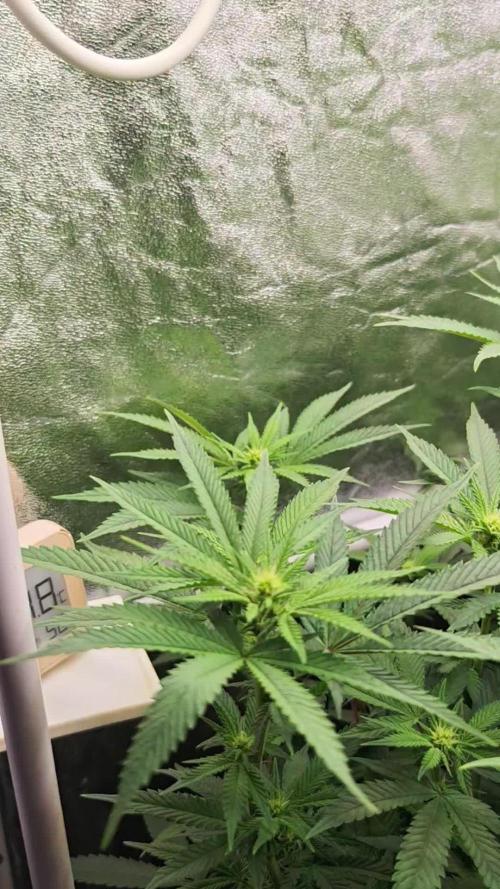
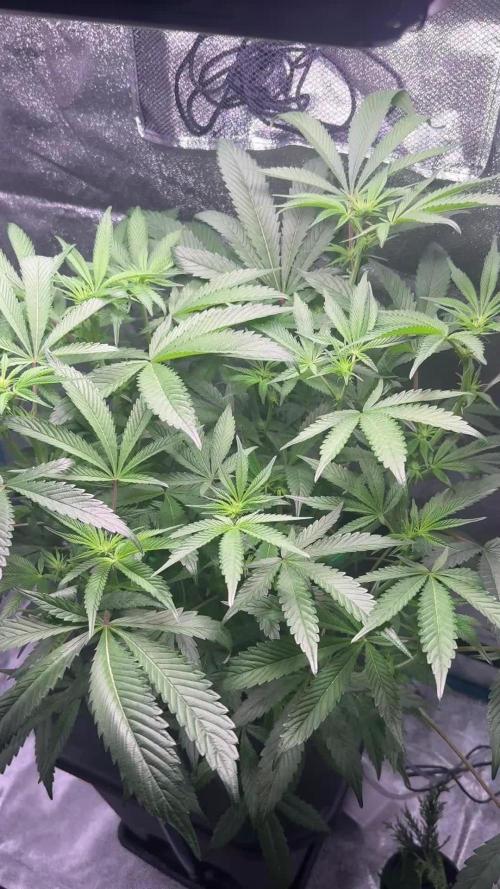
Die Mädels haben offiziell die Ein-Meter-Marke geknackt. Die Papayton führt das Feld mit stolzen 104 cm an. Trotz des massiven Lollipoppings an Tag 14 ist der Vorwärtsdrang ungebrochen. Die Blütenansätze (Puschel) werden von Tag zu Tag dichter und definierter.
Heute Morgen wurde die Intensität auf 319 Watt hochgefahren. Das Ziel ist es, die Photonen-Dichte passend zur Hauptblüte zu maximieren.
Der Luftentfeuchter ist auf 55 % RLF scharfgeschaltet, um Feuchtigkeitsspitzen in der Nacht abzufangen.
Aktuell sind die Lampen am Anschlag. Als taktischen „Joker“ habe ich noch die Bodenisolation im Zelt, die mir bei Bedarf weitere 3–4 cm Puffer liefert, sobald es oben zu eng wird.
Die gestrige Mischung war das erste Mal „Full House“ inklusive dem Turbo-Booster:
Green Sensation: Premiere an BT 17, um die Blütenmasse und den Stoffwechsel zu pushen
Sugar Royal & Power Buds: Für maximale Harzproduktion und zur finalen Stretch-Kontrolle
CalMag (10ml/5L): Als Schutzschild gegen die 319 Watt LED-Power
Nematoden-Einsatz gestern Abend erfolgreich zur Prophylaxe gegen Trauermücken ausgebracht.
Die Vitalität ist brutal die Blätter stehen steil zum Licht („Praying Plants“). Die Kombination aus hoher Wattzahl und dem Green Sensation scheint voll einzuschlagen. Die nächsten Tage wird der Fokus auf dem Lampenabstand zur Papayton liegen. Sobald der Abstand kritisch wird, fliegt die Bodenisolation raus.
Likes
4
Share


@HydroMage
Follow
Week 2 full strength feed schedule. I change water weekly, week 3 will begin 1/20/24. Hooked water chiller up to system, works great holding water temps at 66-68 deg F. Ph bounced around but has held steady at 5.9 for 4 days now. EC is 1.2. Lights are at 50% intensity. Roots really starting to show. Sorry pics and diary are a little disorganized, didn’t get diary going right away, I’ll keep up to date as week 3 begins. Humidity fluctuates and drops rapidly when the tent is opened. Put a pitcher of room temp water in with the girls to try to keep humidity up, just had a cold snap here with extreme lows! Girls are powering through no prob though 💪 As of 1/18/24 I’ll add update pics daily, also going to phase out hydroguard in favor or SoAg when it arrives in the mail. 1 8ox bottle of SoAg will make almost 50 gallons of “Hydroguard” and it’s much more effective from what I’ve been hearing from others.


Likes
20
Share


@AdamCajda
Follow
Week 10. A bit behind the schedule considering I switched to 12/12 after week 1 but I don't rush. It was just an experiment to see what;s gonna happen when I switch so early.. Not much I guess :))
The left plant was like a week behind for the first part of the grow and now doing way better then the other one. Not sure what affected the one on the right if it's just genetics or something else but she is little bit slower now. It makes me feel like a light leak so I tightened up the tent and we will see. Fingers crossed it looks very promissing. I also have to leave for 5 days so I have to setup autowatering and hope it's not gonna die till I come back :)
See you next week