


Likes
Comments
Share


@MiyaguiOkPolilla
Follow
Hola amigos! Hemos llegado al final de esta hermosa aventura, una planta perfecta desde su siembra, ni un daño por plagas, calor o exceso de nutrientes la afectó.
Tengo que ser honesto y es que realmente me costó cortar la planta al final, olía a maravilla y con toques de alegría.
Su estructura súper robusta me indica que debería cultivar una más y dejarla crecer libremente por más tiempo. Es increíble el tiempo de floración de esta genética, ya que en solo 7 semanas de floración está perfecta para cosechar 💐😍
Tricomas de gran tamaño cubren cada rincón de los cogollos y destellan bajo la luz.
No hay mucho más que decir, disfrutemos todos de la magia del auto cultivo y seamos felices!
IRIE

Likes
5
Share


@Lazuli
Follow
The best photoperiod strain ive grown, its not too stretchy and put on insane amount of weight. 10/10

Processing
Likes
23
Share


@HanzGrowz
Follow
Getting closer! Weather here is finally starting to turn warm including and after this weekend.
That means I’ll be taking Cream Caramel, Bubba’s Gift #1 & #2 and Black D.O.G. outside to be transplanted in 45 gallon pots.
Bit of a crazy week after taking my loupe to my soil and spotting a LOT of bulb mites in my soil. Nematodes surprised me with their presence too. Explains the issues I have been having with Jack Herer in my other tent. Thankfully despite them both existing in this tent the plants are doing quite well.
Just a little LST and defoliation this week. They’re doing well and I just want to leave them be until they’re outside or remain in the tent with more space. I can’t wait to tie down Bubba’s Gift #3, Chemdawg’91, The New and Black D.OG. Plan is to give them about a week more and then flip them to 12hrs.
Still just watering with dechlorinated water. Top dressed with 4-4-4, worm castings and insect Frass. Before that a Soil Drench one day with Neem oil and Dr. Bronner’s Castile soap mixed into Mosquito Dunk water for pest control.
My mycorrhizae shipment won’t be arriving until May 20th so even if the plants go up this weekend I will leave them in their existing pots until I return next weekend.

Likes
17
Share


@Bushbanker4
Follow
She is flowering more and more each day and getting bigger than I expected haha.
I have had to construct a makeshift "scaffold" around the tent so I can hang the light higher.
The leaves are now slightly to big for the tent, so I hope she dosent get much bushier.
Lots more pistels, and lots more growth, quite happy.
# new tent coming 😁

Likes
11
Share

@Borberad
Follow
Woche 8
Die Blüte ist mittlerweile deutlich in Fahrt gekommen und wir wechseln von TNT und Root zu Bloom und Boost. Aktuell hoffen wir noch, dass sich das Blümchen selbst tragen kann und versuchen das einziehen von Haltefäden (Scrognetz) solange es geht zu vermeiden. U.a. für die Stärkung der Zellwände bekommt sie daher zusätzlich Silca force. Das Blümchen wächst hervorragend und hat die 80cm (ohne Topf versteht sich) erreicht. Ohne Training (bei nicht gekrümmten Trieben) wäre sie jetzt mindestens 1m bis 1,20 je nach Trieb.

Likes
14
Share

@GERGrowDesigns
Follow
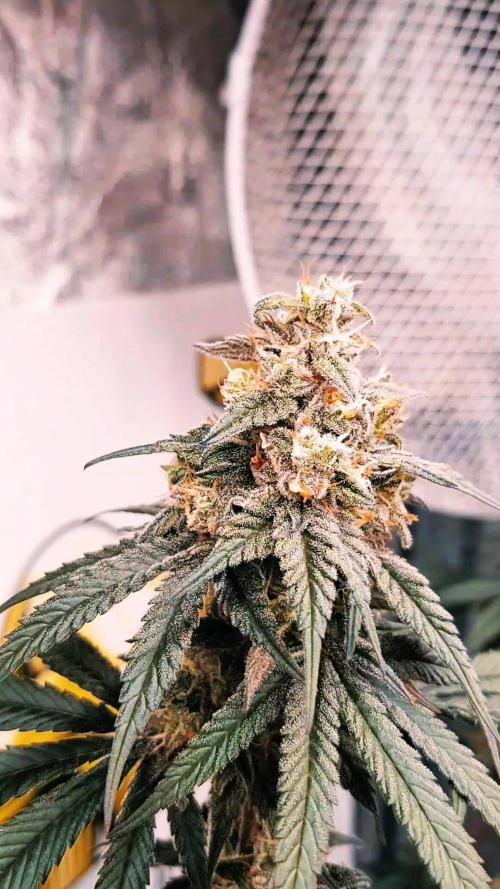
Welcome to Flower Week 7 and harvest of Sensi Seeds Purple Berry Muffinz
I'm excited to share my grow journey with you from my
Sensi Seeds Project . It's going to be an incredible ride, full of learning, growing, and connecting with fellow growers from all around the world!
For this Project , I’ve chosen the Feminized Photo Strain Purple Berry Muffinz:
Here’s what I’m working with:
• 🌱 Tent: 120x60x80
• 🧑🌾 Breeder Company: Sensi Seeds
• 💧Strain Info : 26%
• ⏳ Flowering Time: 6-7weeks
Likes
23
Share


@eldruida_lamota
Follow
Ya en la recta final familia, están apuntito, solo unos días más.
Nuestras lemon kush ya recibieron su lavado de raíces , están sin productos ya solo AGUA.
Controlamos de todas formas el Ph igual y que no baje por debajo de 6,2.
Bestiales estás flores , un olor muy característico con tonalidades cítricas que recuerdan al limón.
Todo un clásico en verdad.
Estos ejemplares carecen de brazos laterales, son óptimas para un SOG desde semilla, pudiendo llenar 16 plantas en metro cuadrado.

Likes
44
Share


@Aedaone
Follow
The temperatures, humidity, height, and watering volume(if measured) in grow conditions are all averaged for the week. The pH is soil pH. Any watering done by me is well water which is 7.6 pH and 50° F. Any listed nutrients are ml/gallon of soil spread evenly across the top of the soil.
Day 1 we had a high temperature of 84°F. We had intermittent storms and showers throughout the day that took care of the watering. The powdery mildew treatment worked well on these.
Day 2 we had a high temperature of 88°F. We had on and off rain and thunderstorms throughout the day. The rain took care of the watering. These responded well to treatment. I'll treat again tomorrow.
Day 3 we had a high temperature of 94°F with clear sunny skies. I watered about 5 gallons from the well. I treated these again with Growers Ally fungicide. The warmer nights, blazing sun, and this fungicide have really cleared up that powdery mildew. They've also decided to go all in on flowering.
Day 4 we had a high temperature of 94° with sunny skies. Heat index was over a hundred. It was super hot today. I watered twice about 8 gallons total. Everything looked good after treatment.
Day 5 we had a high temperature of 95 and partly cloudy skies. I watered twice about 4-5 gallons each time with well water.
Day 6 we had a high temperature of 91°F with partly cloudy skies. I watered twice today 4-5 gallons each pot, each time. These look great after treatment.
Day 7 we had a high temperature of 88°F with sunny skies. I watered 5-6 gallons each pot.
This week was a success. The powdery mildew issue has been cleared up. The Growers Ally fungicide worked great. These girls have rooted into the ground through the pots which is helping some of the 100+heat index days. It's hard to keep these pots moist in that kind of heat. Overall it was a great week.

Likes
110
Share


@Dennis_Bong
Follow
Die Pflanzen sind buchstäblich in der Woche explodiert. Das Volumen hat sich geschätzt verdoppelt. Die Sanlights sind auf 85 Prozent. Ich werde in 2-3 Tagen die Lampen für 2 Stunden am Tag auf 100 Prozent drehen, um nächste Woche richtig Vollgas geben zu können. Die Luft ist zum Glück sehr CO2-haltig. Die Luft liegt stundenweise bei circa 1200 ppm, im Minimum sind wir da bei circa 800, was für die Pflanzen ganz gute Werte sind. Ich habe mittlerweile einen Honeywell-Lüfter auf Stufe 2 hinzugeschaltet, um Schimmel zu vermeiden. Der Lüfter läuft jetzt auch mit AKF, den ich die Wochen davor nicht benötigt habe. Die Pflanzen bekommen weiterhin 3 Mal in der Woche CalMag (1 ml auf 5 Liter Wasser). Seitdem habe ich keine Probleme mehr mit braunen Blattspitzen. Die Pflanzen haben alle die gleiche schön dunkelgrüne Blattfarbe. Die Feuchtigkeit und Hitze, die die Box produziert, ist unerträglich. Die Stoftöpfe lassen gut verdunsten, bin aber trotzdem sehr zufrieden. Ich bin der Meinung, dass die Pflanzen in den Töpfen einfacher zu groß sind. Genaue Informationen füge ich den Bildern der einzelnen Pflanzen hinzu, um das besser erkennen zu können, was was ist
Stichpunktliste:
- Pflanzen sind explosionsartig gewachsen
- Volumen hat sich verdoppelt
- Sunlights auf 85 Prozent
- In 2-3 Tagen Lampen auf 100 Prozent für 2 Stunden täglich
- Luft ist CO2-haltig (1200 ppm, Minimum 800 ppm)
- Honeywell-Lüfter auf Stufe 2 gegen Schimmel!!!es ist kein Schimmel vorhanden es geht um Prävention!!
- Genaue Informationen zu einzelnen Pflanzen werden hinzugefügt
- Lüfter läuft nun mit AKF (vorher nicht benötigt)
- 3 Mal wöchentlich CalMag (1 ml auf 5 Liter Wasser)
- Keine Probleme mehr mit braunen Blattspitzen
- Schöne dunkelgrüne Blattfarbe
- Unerträgliche Feuchtigkeit und Hitze in der Box
- Lüfter von 40 auf 70 Prozent um Temperatur zu senken + LF
- Stoftöpfe lassen gut verdunsten

Likes
13
Share


@SkunkyDog
Follow
Hallo zusammen 🤙.
Sie wächst sehr schön und fängt langsam an zu riechen 🤤🤙.
Sie bekommen 20 % Rabatt bei Zamnesia und der Code lautet GROWITGD.
Sie erhalten 25 Prozent Rabatt in unserem Shop
Mindestbestellwert beträgt 75 Euro
https://greenbuzzliquids.com/en/shop/
Code: GD42025

Likes
16
Share


@Mrg7667
Follow
Day 53
I dont know how i skipped a whole week? But it happens
Plants are looking a little rough, i flushed 2-3 times with just greatwhite and water. Its weird because they got yellow so fast but the tips still look clawed im some spots so im scared to go back to full feed. Slowly added 1ml bioheaven and alga mic then 2ml/l bioheaven and alga mic. Tryingnto get back up to normal feeding

Likes
25
Share


@DrGanj
Follow
Some mild defoliation this week. Budding up nicely and starting to frost. This girl was having a foliar feed of algae last week but this week she's getting light foliar sprays of the Lacalva stress treatment from madame grow on top of her other feed. I'll do this every 2/3 mornings and I'll only lightly mist the top. I'll concentrate most of my foliar feed on the lower growth and undersides, away from the buds. This is the main reason I kept so many lower fan leaves this time.
Likes
8
Share


@Salokin
Follow
Week went again very uneventful. The plant does what she is supposed to be doing (gaining weight) :). Still lots of new pistils appearing overnight, I am checking the Trichomes daily, however, everything remains milky, with only very little % of amber trichomes. Once amber colours start increasing I will start flushing.
Likes
1
Share


@UDUDUDUDU
Follow
Experimenting witt a water ? log. Sit it in alluminium foil, add sugar+elderberry syrup & let it do itz thing.
Stem waz split at da point of entry hopefully she'll extend fibers from their. Oxygen ? hhhhmmm Will add mineral rox for enmulsifier oxygen to h20
Likes
10
Share


@Colectivegrow
Follow
como ya habia mencionado anteriormente estoy esperando que esten listos los cogollos para poder hacer las pruebas de rigor.
pero es una cepa, rapida, fuerte y versatil. apta para cualquier cultivador.


Likes
40
Share


@TheCannaBrit
Follow
Just time to finish these guys with a flushing agent then we HARVEST!!

Likes
19
Share


@Ultraviolet
Follow
Yellow butterfly came to see me the other day; that was nice.
Starting to show signs of stress on the odd leaf, localized isolated blips, blemishes, who said growing up was going to be easy!
Smaller leaves have less surface area for stomata to occupy, so the stomata are packed more densely to maintain adequate gas exchange. Smaller leaves might have higher stomatal density to compensate for their smaller size, potentially maximizing carbon uptake and minimizing water loss. Environmental conditions like light intensity and water availability can influence stomatal density, and these factors can affect leaf size as well. Leaf development involves cell division and expansion, and stomatal differentiation is sensitive to these processes. In essence, the smaller leaf size can lead to a higher stomatal density due to the constraints of available space and the need to optimize gas exchange for photosynthesis and transpiration. In the long term, UV-B radiation can lead to more complex changes in stomatal morphology, including effects on both stomatal density and size, potentially impacting carbon sequestration and water use. In essence, UV-B can be a double-edged sword for stomata: It can induce stomatal closure and potentially reduce stomatal size, but it may also trigger an increase in stomatal density as a compensatory mechanism. It is generally more efficient for gas exchange to have smaller leaves with a higher stomatal density, rather than large leaves with lower stomatal density. This is because smaller stomata can facilitate faster gas exchange due to shorter diffusion pathways, even though they may have the same total pore area as fewer, larger stomata. Leaf size tends to decrease in colder climates to reduce heat loss, while larger leaves are more common in warmer, humid environments. Plants in arid regions often develop smaller leaves with a thicker cuticle and/or hairs to minimize water loss through transpiration. Conversely, plants in wet environments may have larger leaves and drip tips to facilitate water runoff. Leaf size and shape can vary based on light availability. For example, leaves in shaded areas may be larger and thinner to maximize light absorption. Leaf mass per area (LMA) can be higher in stressful environments with limited nutrients, indicating a greater investment in structural components for protection and critical resource conservation. Wind speed, humidity, and soil conditions can also influence leaf morphology, leading to variations in leaf shape, size, and surface characteristics. Small leaves: Reduce water loss in arid or cold climates.
Environmental conditions significantly affect gene expression in plants. Plants are sessile organisms, meaning they cannot move to escape unfavorable conditions, so they rely on gene expression to adapt to their surroundings. Environmental factors like light, temperature, water, and nutrient availability can trigger changes in gene expression, allowing plants to respond to and survive in diverse environments.
Depending on the environment a young seedling encounters, the developmental program following seed germination could be skotomorphogenesis in the dark or photomorphogenesis in the light. Light signals are interpreted by a repertoire of photoreceptors followed by sophisticated gene expression networks, eventually resulting in developmental changes. The expression and functions of photoreceptors and key signaling molecules are highly coordinated and regulated at multiple levels of the central dogma in molecular biology. Light activates gene expression through the actions of positive transcriptional regulators and the relaxation of chromatin by histone acetylation. Small regulatory RNAs help attenuate the expression of light-responsive genes. Alternative splicing, protein phosphorylation/dephosphorylation, the formation of diverse transcriptional complexes, and selective protein degradation all contribute to proteome diversity and change the functions of individual proteins.
Photomorphogenesis, the light-driven developmental changes in plants, significantly impacts gene expression. It involves a cascade of events where light signals, perceived by photoreceptors, trigger changes in gene expression patterns, ultimately leading to the development of a plant in response to its light environment.
Genes are expressed, not dictated! While having the potential to encode proteins, genes are not automatically and constantly active. Instead, their expression (the process of turning them into proteins) is carefully regulated by the cell, responding to internal and external signals. This means that genes can be "turned on" or "turned off," and the level of expression can be adjusted, depending on the cell's needs and the surrounding environment. In plants, genes are not simply "on" or "off" but rather their expression is carefully regulated based on various factors, including the cell type, developmental stage, and environmental conditions. This means that while all cells in a plant contain the same genetic information (the same genes), different cells will express different subsets of those genes at different times. This regulation is crucial for the proper functioning and development of the plant.
When a green plant is exposed to red light, much of the red light is absorbed, but some is also reflected back. The reflected red light, along with any blue light reflected from other parts of the plant, can be perceived by our eyes as purple.
Carotenoids absorb light in blue-green region of the visible spectrum, complementing chlorophyll's absorption in the red region. They safeguard the photosynthetic machinery from excessive light by activating singlet oxygen, an oxidant formed during photosynthesis. Carotenoids also quench triplet chlorophyll, which can negatively affect photosynthesis, and scavenge reactive oxygen species (ROS) that can damage cellular proteins. Additionally, carotenoid derivatives signal plant development and responses to environmental cues. They serve as precursors for the biosynthesis of phytohormones such as abscisic acid () and strigolactones (SLs). These pigments are responsible for the orange, red, and yellow hues of fruits and vegetables, while acting as free scavengers to protect plants during photosynthesis.
Singlet oxygen (¹O₂) is an electronically excited state of molecular oxygen (O₂). Singlet oxygen is produced as a byproduct during photosynthesis, primarily within the photosystem II (PSII) reaction center and light-harvesting antenna complex. This occurs when excess energy from excited chlorophyll molecules is transferred to molecular oxygen. While singlet oxygen can cause oxidative damage, plants have mechanisms to manage its production and mitigate its harmful effects.
Singlet oxygen (¹O₂) is considered a reactive oxygen species (ROS). It's a form of oxygen with higher energy and reactivity compared to the more common triplet oxygen found in its ground state. Singlet oxygen is generated both in biological systems, such as during photosynthesis in plants, and in cellular processes, and through chemical and photochemical reactions. While singlet oxygen is a ROS, it's important to note that it differs from other ROS like superoxide (O₂⁻), hydrogen peroxide (H₂O₂), and hydroxyl radicals (OH) in its formation, reactivity, and specific biological roles. Non-photochemical quenching (NPQ) protects plants from damage caused by reactive oxygen species (ROS) by dissipating excess light energy as heat. This process reduces the overexcitation of photosynthetic pigments, which can lead to the production of ROS, thus mitigating the potential for photodamage. Zeaxanthin, a carotenoid pigment, plays a crucial role in photoprotection in plants by both enhancing non-photochemical quenching (NPQ) and scavenging reactive oxygen species (ROS). In high-light conditions, zeaxanthin is synthesized from violaxanthin through the xanthophyll cycle, and this zeaxanthin then facilitates heat dissipation of excess light energy (NPQ) and quenches harmful ROS.
The Issue of Singlet Oxygen!!
ROS Formation: Blue light, with its higher energy photons, can promote the formation of reactive oxygen species (ROS), including singlet oxygen, within the plant.
Potential Damage: High levels of ROS can damage cellular components, including proteins, lipids, and DNA, potentially impacting plant health and productivity.
Balancing Act: A balanced spectrum of light, including both blue and red light, is crucial for mitigating the harmful effects of excessive blue light and promoting optimal plant growth and stress tolerance.
The Importance of Red Light:
Red light (especially far-red) can help to mitigate the negative effects of excessive blue light by:
Balancing the Photoreceptor Response: Red light can influence the activity of photoreceptors like phytochrome, which are involved in regulating plant responses to different light wavelengths.
Enhancing Antioxidant Production: Red and blue light can stimulate the production of antioxidants, which help to neutralize ROS and protect the plant from oxidative damage.
Optimizing Photosynthesis: Red light is efficiently used in photosynthesis, and its combination with blue light can lead to increased photosynthetic efficiency and biomass production.
In controlled environments like greenhouses and vertical farms, optimizing the ratio of blue and red light is a key strategy for promoting healthy plant growth and yield.
Understanding the interplay between blue light signaling, ROS production, and antioxidant defense mechanisms can inform breeding programs and biotechnological interventions aimed at improving plant stress resistance. In summary, while blue light is essential for plant development and photosynthesis, it's crucial to balance it with other light wavelengths, particularly red light, to prevent excessive ROS formation and promote overall plant health. Oxidative damage in plants occurs when there's an imbalance between the production of reactive oxygen species (ROS) and the plant's ability to neutralize them, leading to cellular damage. This imbalance, known as oxidative stress, can result from various environmental stressors, affecting plant growth, development, and overall productivity.
Causes of Oxidative Damage: Abiotic stresses: These include extreme temperatures (heat and cold), drought, salinity, heavy metal toxicity, and excessive light. Biotic stresses: Pathogen attacks and insect infestations can also trigger oxidative stress. Metabolic processes: Normal cellular activities, particularly in chloroplasts, mitochondria, and peroxisomes, can generate ROS as byproducts. Certain chlorophyll biosynthesis intermediates can produce singlet oxygen (1O2), a potent ROS, leading to oxidative damage. ROS can damage lipids (lipid peroxidation), proteins, carbohydrates, and nucleic acids (DNA). Oxidative stress can compromise the integrity of cell membranes, affecting their function and permeability. Oxidative damage can interfere with essential cellular functions, including photosynthesis, respiration, and signal transduction. In severe cases, oxidative stress can trigger programmed cell death (apoptosis). Oxidative damage can lead to stunted growth, reduced biomass, and lower crop yields.
Plants have evolved intricate antioxidant defense systems to counteract oxidative stress. These include: Enzymes like superoxide dismutase (SOD), catalase (CAT), and various peroxidases scavenge ROS and neutralize their damaging effects. Antioxidant molecules like glutathione, ascorbic acid (vitamin C), C60 fullerene, and carotenoids directly neutralize ROS. Developing plant varieties with gene expression focused on enhanced antioxidant capacity and stress tolerance is crucial. Optimizing irrigation, fertilization, and other management practices can help minimize stress and oxidative damage. Applying antioxidant compounds or elicitors can help plants cope with oxidative stress. Introducing genes for enhanced antioxidant enzymes or stress-related proteins over generations.
Phytohormones, also known as plant hormones, are a group of naturally occurring organic compounds that regulate plant growth, development, and various physiological processes. The five major classes of phytohormones are: auxins, gibberellins, cytokinins, ethylene, and abscisic acid. In addition to these, other phytohormones like brassinosteroids, jasmonates, and salicylates also play significant roles.
Here's a breakdown of the key phytohormones:
Auxins: Primarily involved in cell elongation, root initiation, and apical dominance.
Gibberellins: Promote stem elongation, seed germination, and flowering.
Cytokinins: Stimulate cell division and differentiation, and delay leaf senescence.
Ethylene: Regulates fruit ripening, leaf abscission, and senescence.
Abscisic acid (ABA): Plays a role in seed dormancy, stomatal closure, and stress responses.
Brassinosteroids: Involved in cell elongation, division, and stress responses.
Jasmonates: Regulate plant defense against pathogens and herbivores, as well as other processes.
Salicylic acid: Plays a role in plant defense against pathogens.
1. Red and Far-Red Light (Phytochromes):
Red light:
Primarily activates the phytochrome system, converting it to its active form (Pfr), which promotes processes like stem elongation and flowering.
Far-red light:
Inhibits the phytochrome system by converting the active Pfr form back to the inactive Pr form. This can trigger shade avoidance responses and inhibit germination.
Phytohormones:
Red and far-red light regulate phytohormones like auxin and gibberellins, which are involved in stem elongation and other growth processes.
2. Blue Light (Cryptochromes and Phototropins):
Blue light:
Activates cryptochromes and phototropins, which are involved in various processes like stomatal opening, seedling de-etiolation, and phototropism (growth towards light).
Phytohormones:
Blue light affects auxin levels, influencing stem growth, and also impacts other phytohormones involved in these processes.
Example:
Blue light can promote vegetative growth and can interact with red light to promote flowering.
3. UV-B Light (UV-B Receptors):
UV-B light:
Perceived by UVR8 receptors, it can affect plant growth and development and has roles in stress responses, like UV protection.
Phytohormones:
UV-B light can influence phytohormones involved in stress responses, potentially affecting growth and development.
4. Other Colors:
Green light:
Plants are generally less sensitive to green light, as chlorophyll reflects it.
Other wavelengths:
While less studied, other wavelengths can also influence plant growth and development through interactions with different photoreceptors and phytohormones.
Key Points:
Cross-Signaling:
Plants often experience a mix of light wavelengths, leading to complex interactions between different photoreceptors and phytohormones.
Species Variability:
The precise effects of light color on phytohormones can vary between different plant species.
Hormonal Interactions:
Phytohormones don't act in isolation; their interactions and interplay with other phytohormones and environmental signals are critical for plant responses.
The spectral ratio of light (the composition of different colors of light) significantly influences a plant's hormonal balance. Different wavelengths of light are perceived by specific photoreceptors in plants, which in turn regulate the production and activity of various plant hormones (phytohormones). These hormones then control a wide range of developmental processes.


Likes
20
Share

@eldruida_lamota
Follow
Que pasa familia, última semana de floración de esta farm cheese de genofarm, y que decir, es increíble vaya aroma y vaya flores repletas de tricomas.
Lleva su limpieza de raíces ,después se controló ph temperatura y humedad todo el cultivo, de principio a fin.
Variedad de 10 para trabajar en indoor, ideal para SOG .

Likes
76
Share


@Canna96
Follow
This week went pretty well. She stretched another 8 inches and is up to 48" even though I am not feeding her any veg nutrients, and I am really hoping she is ready to chill out because I have the lights D-Ringed to the roof of the tent, I had to remove the pulleys from them because they took too much room. I also added another 100 watt Spider Farmer and a 150 watt mars hydro to the mix, so I am running 4 lights at 790 Watts total for this plant. I am between 65K and 75K lumens for the entire canopy, and i have 150 watts coming in from underneath the canopy. I am also struggling with the humidity in the tent, even though I am able to maintain 45% RH outside the tent, I am having trouble keeping the tent below 60% RH and it is due to all the transpiration from her leaves, as well as the high frequency fertigation that I deploy, although all the runoff is outside the tent within 90 seconds of feeding, so not much I can do about either one. I know it doesn't look like I am defoliating her, but I have a trash bag almost full just from this plant. I purchased a small dehumidifier for inside the tent and it will be arriving tomorrow, so hopefully that takes care of my issues, as I don't want any moldy colas. Other than that just waiting for her to start stacking on some flowers. Thanks for stopping by, hope everyone had a great weekend, Be Safe and Blaze On!
