The Grow Awards 2026 🏆
Likes
Comments
Share
@MT_Farmer
Follow
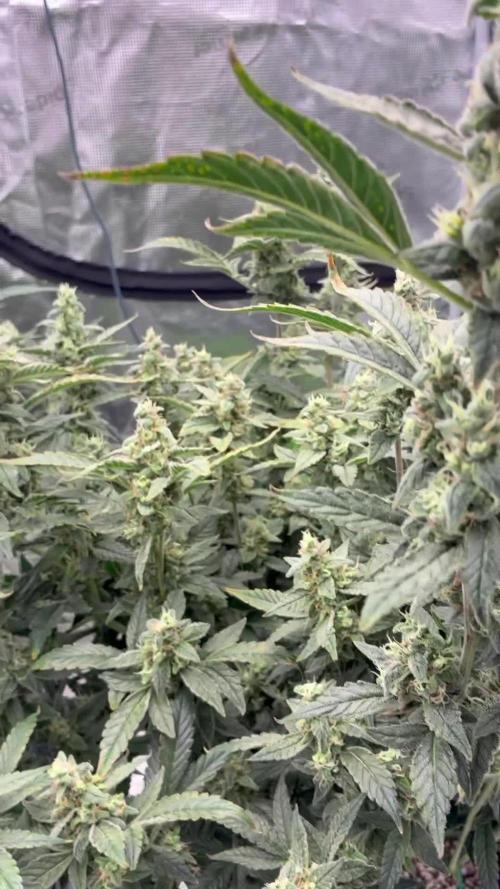
This week i defoliated a bit, as i wanted to have more light reach lower parts of the plant to increase bud sights and increase air flow through out the plants. Also I put in the net again in a nother attempt to even out the cannopy which didn't really work
Likes
24
Share
@MrPott
Follow
This is the final week of nutes for the ladies! Time to flush her for the coming week. Also read that Purple Punch needs cold temps at night to turn color. Since I can't do that where I live, an alternative is to flush her with ice water. Giving that a try and will keep you guys updated.
Likes
19
Share
So happy my gorilla glue have started showing their first signs of floweringlast night. One in the front is filmed ( non intentionally ) The back one was toped once. They are flourishing in their growtechgarden self wicking pots
Likes
5
Share
@Ninjabuds
Follow
It’s day 27 from seed for all the plants in the photo sea of green. Let’s call it the battle of the strains summer 2025. All of the plants are starting to have visible differences. I’m already starting to tell witch plants are more sensitive than others.
Likes
Comments
Share
@Bizio
Follow
So this week I defoliated a bit more, now you can clearly see that they look better and there's more light going through especially in the middle of each plant. I had a little deficiency of K with one plant of Blue widow but I started to give the right amount of BioFlores after the transition from Veg. phase. The Blue widow ones are apparently going faster than Royal medic, (Royal medic plants are in the front on the sides, only 2 out of 5 plants). Overall I experiencing the variations' genes of each seed and I can clearly see that some plants go well than others and the importance of a "Mother plant" for consistency but unfortunately I cannot afford, right now, another grow room for this scope. Happy growing fellas! and grow your own!
Likes
Comments
Share
@Fiftysou
Follow
Bientôt la fin, les têtes sont très jolie compacte est plein de trichome.
Processing
Likes
71
Share
@Witty420
Follow
Ok sorta lost track. Of acctual age. But she is huge mWveg lease ended and this photo was going onnly i did my whole grow with. Out a carbon filter. To scared to flower. So she will sit in Amy. Ideas on what kind of yeild i am looking at. Cureently this 150. At 24 hours. Likly will flower with. This and another. 150. Yeild estamites. Ideas. I am just gonna bush her and defoilate. For air flow
Likes
9
Share
@papexa
Follow
in this stage i just add my co2 own system configuration and i setup for 500 ppm CO2 and the instalation of ozone generator of 60g
Likes
12
Share
@Hanibert
Follow
Sadly had a two moldy headbuds, but i think it was my bad. I didnt take my time watering slowly and the right way. I will still wash the rest, didnt see anymore mold, i checked very cautios. From the Too much GAK #3 i also saved three headbuds to try her as flower aswell Pressed the 45-90u first at 75°C and a 2nd time at 80°C. First press was 5,65g and 2nd press was 0,5 which i dabbed right away and had some very nice candy fumez terps. Makes it a ~1,2% return on the lower quality, i am hoping for ~4g on the 90-160u which will be my premium quality.
Likes
36
Share
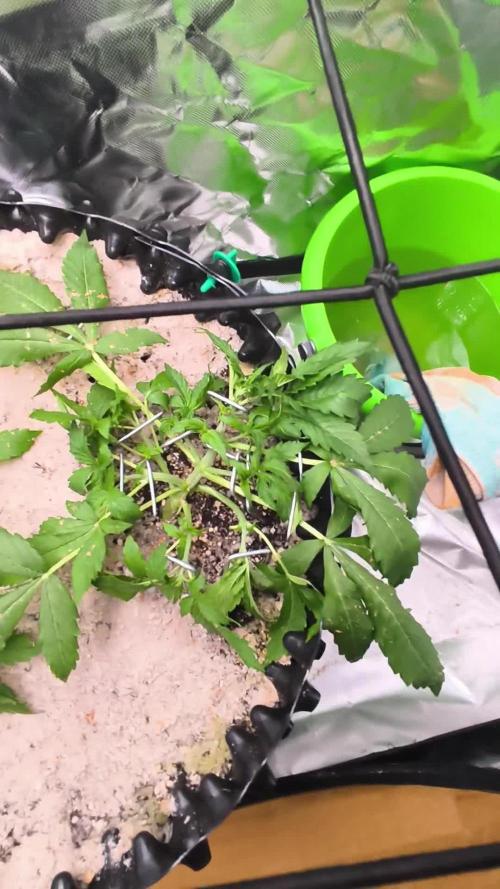
7/7: Transplanted plant to final pot! Roots showed out of tray. Accidentally pulled a root off during transplant 😢. After transplant I top feed/watered medium with a half gallon of treated water. I mixed 2ml of Rapid Start in 1 gallon water hub. Poured half in half gallon jug then poured half gallon over medium. Added 2 gallons of water into reservoir (1st white line) to promote root growth to bottom and to begin capillary reaction. 7/8: Bumped light intensity dimmer to 30%. 7/9: Left for Vacation.... Praying for my baby!🙏🏿 Going to be gone for 4 days. 😅 ***** For this Grow****** “Day Air Temperature” will be the max temp of tent for the week. “Substrate Temperature” will be the average temp of tent for the week. “Night Air Temperature” will be the lowest temp of the tent for the week.
Likes
42
Share
~Humboldt Seed Co. AMHERST SOUR DIESEL~ ???Secret origins??? The mystery of the unknown🧐 Amherst Sour Diesel is a cannabis seed whose origins are kept a secret. This wonderful vigorous marijuana plant will reward your work with large, elongated, compact buds complemented by a rich complex aroma. Indoors it performs best with a short growth and outdoors, in temperate, warm, dry and Mediterranean climates or in a greenhouse. A marijuana plant that boasts balanced properties. -Top-notch flavor and effect -Idyllic feelings to treat the senses -The aroma of this cannabis hybrid is a pleasant combination of ripe fruit and oil. The flavor is rich and complex, with hints of tropical fruit, oil and exotic wood. -The effect, typically Sativa, is euphoric, uplifting, powerful and long-lasting. A cannabis strain Sativa lovers will know how to appreciate. ________________________________________________________________________________________________________________________________________________________________________________________________________________________________________________________________________________________________________________________________________________________________________________________________________________________________________________________ Tech Specs: ~Amherst Sour Diesel~ Feminized Genotype: 20% Indica / 80% Sativa Cross: Chemdawg x Amherst Super Skunk Suitable for: Indoors and outdoors Indoor flowering: 65-70 days Indoor yield: 400-600 g/m2 Outdoor harvest time: Late October Outdoor yield: 2000-3000 g/plant Outdoor height: 2-3 m THC: 27% CBD: 0.1% ________________________________________________________________________________________________________________________________________________________________________________________________________________________________________________________________________________________________________________________________________________________________________________________________________________________________________________________ THE SETUP: ~Planted into Jiffy Peat Pellets that were hydrated with de-chlorinated water with SuperThrive added then ph'd to 6.0 @ 80℉ ~Grown 100% organic in 10g fabric pots with Mother Earth 70/30 Coco/Perlite medium amended with 2tbs/g of Down To Earth 4-4-4 / 2 cups/g of Earthworm Castings / 1tbs/g of Dr. Earth Flower Girl 3-9-4, 1tbs/g of Dr. Earth Bat Guano, 3/4 cup of Down To Earth Azomite and 1 tsp/g Down To Earth Fish Bone Meal. ~24hr light cycle during Germination / 19/5 light cycle for Vegetation and 12/12 for Flower ~Straight water ph'd @ 6.2-6.8 when needed and weekly Compost Tea's. ________________________________________________________________________________________________________________________________________________________________________________________________________________________________________________________________________________________________________________________________________________________________________________________________________________________________________________________ WEEKLY UPDATES: 9/20- 💥BOOM!💥 Week Six of flower is here and my girl's in high gear, stacking her flowers and pumping out trichomes! Today I watered her with 1.5g de-chlorinated water with 5ml/g of Botanicare CalMag+ added, then ph'd to 6.2 @ 72℉. I turned her pot and plucked a couple of yellow shade leaves...the basic daily maintenance. 9/22- I didn't water her yesterday as she looked great and was 'praying' hard. Today she was given 1.5g of de-chlorinated water which was ph'd to 6.2 @ 72℉ which I gave her through her drip pan (bottom chuggin) and I also gave her pot a turn. She continues to have a great deep green color that is beautifully contrasted by the snow white trichomes piling up on them! Her height has not really increased but she is extremely bushy with tight node spacing which will necessitate plucking some leaves to keep the light penetrating into her canopy. 9/24- We're getting close to wrapping up Week Five of flower in a couple of days and she'll be past the half-way point with the most exciting weeks yet to come! I didn't water yesterday and today I went ahead and Top Dressed her with 2 tbsp/g Dr. Earth Flower Girl 3-9-4, 1 tbsp/g Dr. Earth Gold Premium 4-4-4, 1/2 cup Down To Earth Bio-Fish, 1/3 cup Down To Earth High Phosphorus Bat Guano and 2 cups of Worm Castings. I watered in the Top Dress with 1.5g of de-chlorinated water which was ph'd to 6.2 @ 72℉ and let her enjoy her meal! 😜 9/26- After her heavy watering on the 24th I didn't water yesterday and when I checked her today at 'lights on' and she still had some weight to her pot and her leaves were praying hard so I held off on watering today and will hit her tomorrow with her usual 0.75g watering. ~Thanks for stopping in! Things should be getting a lot more interesting in the coming weeks...Stay lifted and be Blessed! 😎🙏~
Processing
Likes
1
Share
@Mr_Fuki
Follow
6th week I buy new foil to box, cos old was little dirty. Next training with some TOP ( cut down some branches ), LST, DEF. Again I so admire her for fast reactions on training. Conditions: Sub: Atami cocos Box: 80x80x100 Light: CLF 6100K 125W veg, CLF 2700K 85W flowering Airflow: 1 10W PC cooler inside box to cool CFL, 1 20W airflow fan to get air in Day time: 18h day / 6h night veg, 12h day / 12h night flowering Main nutrients: wooden ash, ATAMI, GREEN HOUSE POWER FEEDING, homemade special for flowering Feeding: first 12 days every 3rd day, next every 4th day, in flowering after switch 20 days every 4th day, next every 3 days Water: 0,3-0,6l per watering, every time it is on place = if sub is OK to water or with nutrients Training technic: harsh training for plant resistance and performance Genetics Skunk x Northern Lights x Afghani THC 17% Flowering time +/- 55 days Type Indica dominant Height indoor 60 - 90cm Height outdoor 170 - 200cm Yield indoor g/m² 550 - 600g Yield outdoor g/plant 450 - 550g
Likes
18
Share
Green light is radiation with wavelengths between 520 and 560 nm and it affects photosynthesis, plant height, and flowering. Plants reflect green light and this is why they appear green to our eyes. As a result, some growers think that plants don’t use green wavelengths, but they actually do! In fact, only around 5 – 10% of green light is reflected from leaves and the rest (90 – 95 %) is absorbed or transmitted to lower leaves [1]. Green wavelengths get used in photosynthesis. Chlorophyll pigments absorb small amounts of green wavelengths. Light that doesn’t get absorbed is transmitted to leaves that are shaded out from direct light. This means that leaves at the bottom of the canopy get more green light than leaves at the top. A high proportion of green wavelengths compared to other colors tells lower leaves that they are being shaded out, so they are able to react accordingly. Lower leaves may react by opening or closing their stomata or growing longer stems that help the leaves reach brighter light [1, 2, 3]. When it comes to growing cannabis, many cultivators are interested in the quality of light used for the flowering stage. In many plants, flowering is regulated by two main photoreceptors: cryptochrome and phytochrome. Both photoreceptors primarily respond to blue light but can also respond to green, although to a lesser extent. Green can accelerate the start of flowering in several species (although cannabis has yet to be tested) [1, 4, 5]. However, once flowering has begun, it’s important to provide plants with a “full spectrum” light that has high amounts of blue and red light, and moderate amounts of green, in order for photosynthesis to be optimized. Green light mediates seed germination in some species. Seeds use green wavelengths to decide whether the environment is good for germination. Shade environments are enriched in green relative to red and blue light, so a plant can tell if it is shady or sunny. A seed that senses a shaded environment may stay dormant to avoid poor growing conditions [1]. Some examples of plant species where researchers have documented this response are: ryegrass (a grass that grows in tufts) and Chondrilla (a plant related to dandelion) [1, 6]. Although green wavelengths generally tell plants NOT to germinate, there are some exceptions! Surprisingly, green wavelengths can stimulate seed germination in some species like Aeschynomene, Tephrosia, Solidago, Cyrtopodium, and Atriplex [1, 6, 7]. Of course, light is not the only factor affecting seed germination – it’s a combination of many factors, such as soil moisture, soil type, temperature, photoperiod, and light quality. When combined with red and blue light, green can really enhance plant growth [1, 8]. However, too much green light (more than 50% of the total light) can actually reduce plant growth [8]. Based on the most current research, the ideal ratio of green, red, and blue light is thought to be around 1:2:1 for green:blue:red [9]. When choosing a horticultural light, choose one that has high amounts of blue and red light and moderate amounts of green and other colors of light. Not many studies can be found about the effect of green light on cannabis growth or metabolism. However, if one reads carefully, there are clues and data available even from the very early papers. Mahlberg and Hemphill (1983) used colored filters in their study to alter the sunlight spectrum and study green light among others. They concluded that the green filter, which makes the environment green by cutting other wavelengths out, reduced the THC concentration significantly compared to the daylight control treatment. It has been demonstrated that green color can reduce secondary metabolite activity with other species as well. For example, the addition of green to a light spectrum decreases anthocyanin concentration in lettuce (Zhang and Folta 2012). If green light only reverses the biosynthesis of some secondary metabolites, then why put green light into a growth spectrum at all? Well, there are a couple of good reasons. One is that green penetrates leaf layers effectively. Conversely red and blue light is almost completely absorbed by the first leaf layer. Green travels through the first, second, and even third layers effectively (Figure 2). Lower leaf layers can utilize green light in photosynthesis and therefore produce yields as well. Even though a green light-specific photoreceptor has not yet been found, it is known that green light has effects independent from the cryptochrome but then again, also cryptochrome-dependent ones, just like blue light. It is known that green light in low light intensity conditions can enhance far red stimulating secondary metabolite production in microgreens and then again, counteracts the production of these compounds in high-intensity light conditions (Kim et al. 2004). In many cases, green light promoted physiological changes in plants that are opposite to the actions of blue light. In the study by Kim et al. blue light-induced anthocyanin accumulation was inhibited by green light. In another study it has been found that blue light promotes stomatal opening whereas green light promotes stomatal closure (Frechilla et al. 2000). Blue light inhibits the early stem elongation in the seedling stage whereas green light promotes it (Folta 2004). Also, blue light results in flowering induction, and green light inhibits it (Banerjee et al., 2007). As you can see, green light works very closely with blue light, and therefore not only the amount of these two wavelengths separately is important but also the ratio (Blue: Green) between these two in the designed spectrum. Furthermore, green light has been found to affect the elongation of petioles and upward leaf reorientation with the model plant Arabidopsis thaliana both of which are a sign of shade avoidance symptoms (Zhang et al. 2011) and also gene expression in the same plant (Dhingra et al. 2006). As mentioned before, green light produces shade avoidance symptoms which are quite intuitive if you consider the natural conditions where the plants grow. Not all the green light is reflected from the highest canopy leaves in nature but a lot of it (50-90%) has been estimated to penetrate the upper leaves at the plant level ((Terashima et al., 2009; Nishio, 2000). For the plant growing in the understory of the forest green light is a signal for the plant of being in the shade of a bigger plant. Then again, the plants growing under unobstructed sunlight can take advantage of the green photons that can more easily penetrate the upper leaves than the red and blue photons. From the photosynthetic pigments in higher plants, chlorophyll is crucial for plant growth. Dissolved chlorophyll and absorb maximally in the red (λ600–700 nm) and blue (λ400–500 nm) regions of the spectrum and not as easily in the green (λ500–600 nm) regions. Up to 80% of all green light is thought to be transmitted through the chloroplast (Terashima et al., 2009) and this allows more green photons to pass deeper into the leaf mesophyll layer than red and blue photons. When the green light is scattered in the vertical leaf profile its journey is lengthened and therefore photons have a higher chance of hitting and being absorbed by chloroplasts on their passage through the leaf to the lower leaves of the plant. Photons of PPFD (photosynthetic photon flux density) are captured by chlorophyll causing an excitation of an electron to enter a higher energy state in which the energy is immediately passed on to the neighboring chlorophyll molecule by resonance transfer or released to the electron transport chain (PSII and PSI). Despite the low extinction coefficient of chlorophyll in the green 500–600 nm region it needs to be noted that the absorbance can be significant if the pigment (chlorophyll) concentration in the leaf is high enough. The research available clearly shows that plants use green wavelengths to promote higher biomass and yield (photosynthetic activity), and that it is a crucial signal for long-term developmental and short-term dynamic acclimation (Blue:Green ratio) to the environment. It should not be dismissed but studied more because it brings more opportunities to control plant gene expression and physiology in plant production. REFERENCES Banerjee R., Schleicher E., Meier S. Viana R. M., Pokorny R., Ahmad M., Bittl R., Batschauer. 2007. The signaling state of Arabidopsis cryptochrome 2 contains flavin semiquinone. The Journal of Biological Chemistry 282, 14916–14922. Dhingra, A., Bies, D. H., Lehner, K. R., and Folta, K. M. 2006. Green light adjusts the plastic transcriptome during early photomorphogenic development. Plant Physiol. 142, 1256-1266. Folta, K. M. 2004. Green light stimulates early stem elongation, antagonizing light-mediated growth inhibition. Plant Physiol. 135, 1407-1416. Frechilla, S., Talbott, L. D., Bogomolmi, R. A., and Zeiger, E. 2000. Reversal of blue light -stimulated stomatal opening by green light. Plant Cell Physiol. 41, 171-176. Kim, H.H., Goins, G. D., Wheeler, R. M., and Sager, J. C. 2004.Green-light supplementation for enhanced lettuce growth under red- and blue-light emitting diodes. HortScience 39, 1617-1622. Nishio, J.N. 2000. Why are higher plants green? Evolution of the higher plant photosynthetic pigment complement. Plant Cell and Environment 23, 539–548. Terashima I., Fujita T., Inoue T., Chow W.S., Oguchi R. 2009. Green light drives leaf photosynthesis more efficiently than red light in strong white light: revisiting the enigmatic question of why leaves are green. Plant & Cell Physiology 50, 684–697. Zhang, T., Maruhnich, S. A., and Folta, K. M. 2011. Green light induces shade avoidance symptoms. Plant Physiol. 157, 1528-156. Wang, Y. & Folta, K. M. Contributions of green light to plant growth and development. Am. J. Bot. 100, 70–78 (2013). Zhang, T. & Folta, K. M. Green light signaling and adaptive response. Plant Signal. Behav. 7, 75–78 (2012). Johkan, M. et al. Blue light-emitting diode light irradiation of seedlings improves seedling quality and growth after transplanting in red leaf lettuce. HortScience 45, 1809–1814 (2010). Kasajima, S., et al. Effect of Light Quality on Developmental Rate of Wheat under Continuous Light at a Constant Temperature. Plant Prod. Sci. 10, 286–291 (2007). Banerjee, R. et al. The signaling state of Arabidopsis cryptochrome 2 contains flavin semiquinone. J. Biol. Chem. 282, 14916–14922 (2007). Goggin, D. E. & Steadman, K. J. Blue and green are frequently seen: responses of seeds to short- and mid-wavelength light. Seed Sci. Res. 22, 27–35 (2012). Mandák, B. & Pyšek, P. The effects of light quality, nitrate concentration and presence of bracteoles on germination of different fruit types in the heterocarpous Atriplex sagittata. J. Ecol. 89, 149–158 (2001). Darko, E. et al. Photosynthesis under artificial light: the shift in primary and secondary metabolism. Philos. Trans. R. Soc. B Biol. Sci. 369 (2014). Lu, N. et al. Effects of Supplemental Lighting with Light-Emitting Diodes (LEDs) on Tomato Yield and Quality of Single-Truss Tomato Plants Grown at High Planting Density. Environ. Control Biol. 50, 63–74 (2012).
Likes
36
Share
Info: Unfortunately, I had to find out that my account is used for fake pages in social media. I am only active here on growdiaries. I am not on facebook instagram twitter etc All accounts except this one are fake. Have fun with the update. Flowering day 9 since the time was changed to 12/12 h. Hey everyone 😀. The lady has started to stretch very nicely :-). She is developing very well without any problems 👍. I added 2 g of GHSC Powder Feeding per liter of coconut beforehand. In 16-22 days I will add another 1 g per l cocos. Today, like every two weeks, I added 1 g of GHSC Enhancer. I also removed the bottom shoots. As every day, the tent was cleaned, the humidifier was refilled and the entire electronics were checked for functionality. I am very curious how it will develop in the coming week and I wish you all a lot of fun with the update. Stay healthy and let it grow 🙏🏻 You can buy this Strain at : https://originalsensible.com/original-sensible-seeds-zkittlez~20503 Type: Zkittlez ☝️🏼 Genetics: Afghan Kush Indica x Grandaddy Purple x Grapefruit hybrid 👍 Vega lamp: 2 x Todogrow Led Quantum Board 100 W 💡 Bloom Lamp : 2 x Todogrow Led Cxb 3590 COB 3500 K 205W 💡💡☝️🏼 Soil : Canna Coco Professional + ☝️🏼 Fertilizer: Green House Powder Feeding ☝️🏼🌱 Water: Osmosis water mixed with normal water (24 hours stale that the chlorine evaporates) to 0.2 EC. Add Cal / Mag to 0.4 Ec Ph with Organic Ph - to 5.5 - 5.8 .
Likes
8
Share
Привет курильщики Наступила 5 неделя Растения выглядят хорошо ,видимо климат для них вполне подходящий Я решил ускорить процесс зацветания и дал им в питание bio bloom и перевел световое расписание на 12/12 Bruce Banner уже стал зацветать а Dos si Dos еще нет У kalachnikova листья широкие как у афганки Жду с нетерпением попробовать новые сорта
Processing
Likes
10
Share
@yaron
Follow
starting week 6,the wedding cheesecakes are in flower for a couple of days now and the gg are starting to flower. alot of wind and clouds and rain these past two weeks but the girls are looking good in my opinion. update:after 4 or 5 days of rain and low temperatures finally the re is sunlight so the girls have to recover a bit. but things are looking better wheatherwise. cheers!