


Likes
Comments
Share


@Kronen
Follow
Auto Flower AK Triple Haze by Super Sativa Seed Club: Day 70 From Seed, 45 days in flower. Ripening continues with a trichome ratio of Milky 65%, Clear 25%, & Amber 10%. Weekly environment: 72F, 52% RH, 725ppm CO2, & 650-1200 PPFD 12hr lighting. Only getting mineral water to allow normal processes of mobile nutrients to move from leaf to bud & flushing Ammoniums/Nitrates out of the medium.

Likes
Comments
Share



Likes
22
Share


@bypado_farm
Follow
Day 29:
Watered each plant with 0.75L with nuts
1485 ppm, 3150 us/cm, 3.1 EC
Day 32:
Watered each plant with 0.8L with nuts
Day 35:
Watered each plant with 0.8L with nuts
1616 ppm, 3438 us/cm, 3.4 EC

Likes
14
Share


@ao_grows1978
Follow
Another week of training down. Leaves are starting to smell skunky now and no signs of deficiencies or struggle. Environment has been steady and the Kush has been loving it. Starting the transition to flower (flip is in 2 weeks) so she's been fed a bloom mix and some all purpose to get her ready. Figure it'll be about a week before the slow release is available for the plant and in her system by flip. Fingers crossed, but I'm hoping for explosive growth soon. She's relatively modest in size right now, but getting nice and wide.

Likes
16
Share


@Big_Rade_SCLA
Follow
Happy to see the plants taking off. Watering has not been an issue with the hot weather. Give them as much as they will take every 2-3 days. Gave them kelp meal (1tsp/gallon of soil) and some worm castings this week--about a handful worm castings per pot--dry amendments are very gentle and forgiving in soil.
Fems: Both identified growing solo in 30 gallon fabric pots. Not pulling the 1st female much. I did gently set her under a small tomato cage slightly. 2nd female is growing regular--no pull--no pinch--nada!--just straight up.
Males--As far as the male count--currently 6 males have been removed from the grow area.

Likes
6
Share


@Flex1
Follow
Week 7 day 52: Ladies are not drinking as much it seems. Probably will continue to water 1.5gal every 3 days. Gave it some build a bloom today 6/29/22 as a final push. Just water from now on. They are just working on fattening up. Still throwing some white hairs but it is not much and trichomes are 20 % clear, 70% cloudy with the remaining 10% amber from what i can tell. I learned today, while using a microzoom hand held camera, that i am very shaky! I need to rig something up to hold the camera in place to get better pics.

Likes
19
Share


@MrWolfe
Follow
Had to support the trellises, definitely need a middle support next time. This will work for the last few weeks


Likes
32
Share


@Bud_Spencer
Follow
Hi Grower!!
Day 109 Complete
( 80 Days Flower)
Really awesome this strain, the heads are already dry and tested. Had 27% THC on the first test. I decided to build on the lower part and hope that there will be a little more
Grown under Viparspectra P4000
CHECK YOUR DISCOUNT WITH THIS LINK
‐----------------------COPY&PASTE--‐-‐----------------
https://viparspectra.eu/?ref=budspencer
Or with my Coupon Code:
Budspencer420

Likes
5
Share


Likes
Comments
Share

@ThreeLittleHerbs
Follow
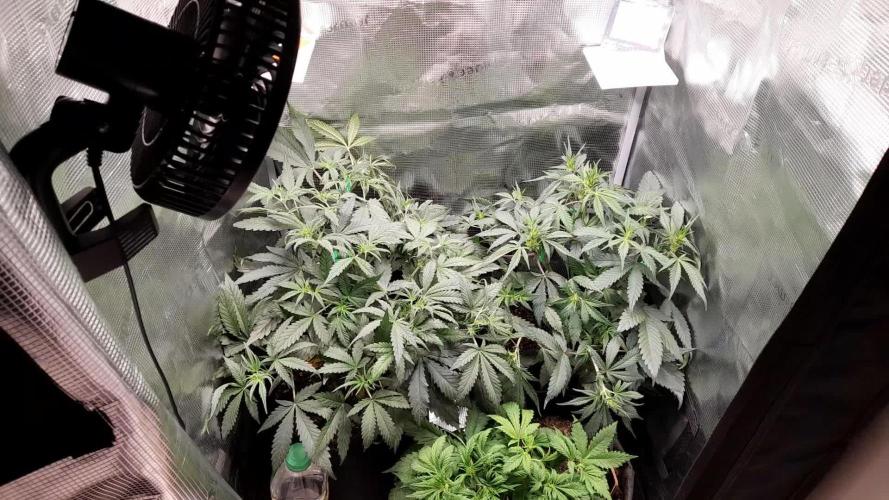
I had no pictures of week 4, s now it's 10 days later. The plants are now 1 month and week. Applestrudel (left) and Strawberry-G (right) are close to start to bloom and already stretched a bit. I tie down the outer branches to get more light inside. 😇
Lemon Cherry (in the front) is still has thin, light-green leaves and a short and compact structure. The most branches don't get enough light, but they are too small to tie down. 😑
Light is on 100% - 100W


Likes
18
Share


@Barcelona_Farmers710
Follow
Esta semana apesar de tener temp Máxima de 28... se va recuperando bien de las podas, el led de TodoGrowled funciona perfectamente para sus 55w farmers!🍁

Likes
3
Share


@Joaka
Follow
ya se comienza a sentir un olor intenso, como se tenia previsto las black jack estan evolucionando sumamente rapido, ya comienzan a explotar en resina.

Likes
27
Share


@MrJones
Follow
OSS Cheese XXL
🔹⊱╮🔹╰⊰🔹 GROW Started 03.10.24 INFORMATION 🔹╰⊰´🔹⊱╮🔹
🌞Environment - Maintaining 80F and 65%Humidity
🌾Training - These ladies are Pruned and Defoliated and ready for flower.
⚱️2-Gallon 📊6.2 PH
💧 Feeding - Using Horti Grow 8-11-21, Bloom 5-15-26, Late Bloom 0-24-26, Cal 12-0-0
🌞Medic Grow Smart 8 760 Watts
🕷️ IPM - CannControl from Mammoth and Mosquito Bits as needed
🔹⊱╮🔹╰⊰🔹 GROW Started 03.10.24 INFORMATION 🔹╰⊰´🔹⊱╮🔹
🌞Environment - Maintaining 80F and 65%Humidity
🌾Training - The girls are recovering from last week's Pruning and Defoliation,
⚱️2-Gallon 📊6.2 PH
💧 Feeding - Using Horti Bloom and Horti Cal 12-0-0
🌞Medic Grow Smart 8 760 Watts
🕷️ IPM - CannControl from Mammoth and Mosquito Bits as needed
🔹⊱╮🔹╰⊰🔹 PLANT UPDATES 🔹╰⊰´🔹⊱╮🔹
📝 Notes - On 🗓️05.11.24, This week, we are on Auto-Pilot and just Fertigating as needed; the ladies are stacking up nicely, and the leaves have grown back not sure if it is the genetics or the new nutrients; I would like to see less and will evaluate if more defoliation will be needed.
📝Fertigation injects fertilizers into an irrigation system to supply dissolved nutrients to crops.
🗓️05.11.24 Just feeding daily, sometimes twice; today, fed with Hort-Bloom @ 2.7 GRMS Per Gal and Horti-Cal @ 2.5 GRMS Per Gal.
🗓️05.12.24 Just feeding daily, sometimes twice; today, fed with Hort-Bloom @ 2.7 GRMS Per Gal and Horti-Cal @ 2.5 GRMS Per Gal.
🗓️05.13.24 Just feeding daily, sometimes twice; today, fed with Hort-Bloom @ 2.7 GRMS Per Gal and Horti-Cal @ 2.5 GRMS Per Gal.
🗓️05.14.24 Just feeding daily, sometimes twice; today, fed with Hort-Bloom @ 2.7 GRMS Per Gal and Horti-Cal @ 2.5 GRMS Per Gal.
🗓️05.15.24 Just feeding daily, sometimes twice; today, fed with Hort-Bloom @ 2.7 GRMS Per Gal and Horti-Cal @ 2.5 GRMS Per Gal.
🗓️05.16.24 Just feeding daily, sometimes twice; today, fed with Hort-Bloom @ 2.7 GRMS Per Gal and Horti-Cal @ 2.5 GRMS Per Gal.
🗓️05.17.24 Just feeding daily, sometimes twice; today, fed with Hort-Bloom @ 2.7 GRMS Per Gal and Horti-Cal @ 2.5 GRMS Per Gal.
╰⊰🔹╰⊰´🔹⊱╮🔹╰⊰🔹╰⊰🔹STRAIN INFORMATION🔹⊱╮🔹╰⊰🔹╰⊰🔹╰⊰🔹⊱╮
Cheese XXL cannabis seeds are a unique blend of Afghan Kush x Super Skunk, producing the most pungent dank weed. Cheese XXL is the third commercially available edition released by Original Sensible using and developing these Afghan and Skunk genetics. The first release of these genetics was their Skunk Afghani. The second improved version was Stinkin' Bishop, which had an enhanced and more potent THC content and was more intense in terms of smell. The third and improved release on a similar theme is this Cheese XXL, which has a similar THC content but an enhanced heavier yield. The smoke is incredible, with an outstanding flavor of pungent skunk and spicy, extra strong mature cheese created by the dominant terpene myrcene with its earthy solid scent accompanied by caryophyllene and pinene, which combine to create a peppery acrid cheesy odor. THC levels are exceptionally high in this Cheese strain, and the effect is well-balanced, developing mental and body relaxation with a remarkable alleviation of stress and depression.
The intense solid aroma starts early in the flowering period; if you're growing Cheese XXL indoors, you'll need plenty of ventilation to disperse these babies' stinky "road kill" aroma! Cheese XXL is a cheese strain suited to indoor setups and thrives outdoors well. These feminized marijuana seeds are incredibly resistant to mold and disease and produce a substantial harvest that professional and amateur growers can quickly achieve. These Cheese weed seeds are outstanding. Break open the buds ready for use, and you'll see why the stench will make your eyes water!
Cheese XXL from Original Sensible Seeds is a great choice to break into the commercial market of growing cannabis, so if you're looking to buy something special with extreme yield, potency, and flavor, Cheese XXL cannabis seeds are simply the best choice.

Processing
Likes
Comments
Share


@MG2009
Follow
08/13/2019
Another rainy day. Recovering from topping and,fimming.
Looking good for start of flower, soon.
08/18/2019
Did a little training.

Likes
10
Share


@Merchant_Lord
Follow
The Green Gelato has been a great success although i have been using this time as a bit of experiment the results are clear. While i have two plants that are ready for harvest both are looking extremely tasty, the third one in the smallest pot although it has huge top colas i would say its at least another week if not two away from being ready to harvest. I am now flushing these through ready for a great smoke. Thank you to everyone who has liked this diary fingers crossed next post will be results and review. 😌

Likes
15
Share


@maelxich
Follow
11/25 - day 67 - bushing and stretching. Will get in on day 21F for final defoliation. They will surely need it! All cultivars happy as can be, just adding water still. Getting exciting now!


Likes
241
Share


@Tropicannibis_Todd
Follow
💩Holy Crap We Are Back At It And Loving It💩
Growmies we are at DAY 49 and she's just killing💀it👌
👉We are in full on flowering , gotta say the pink to redish hairs look amazing , not to mention the frost 👈 even the stems and branches are sticky icky 👈
OMG I LOVE THE PINK PISTOLS 👈 👉 BUT THE MORE IT FLOWERS THE LESS THEY ARE SHOWING 😭
So Shit , I gave them just a tad to much nutes on the first few feeding 👈 But I have since fixed it
So I'm still doing some low stress training 🙃 and some defolation 😳
Lights being readjusted and chart updated .........👍rain water to be used entire growth👈
👉I used NutriNPK for nutrients for my grows and welcome anyone to give them a try .👈
👉 www.nutrinpk.com 👈
NutriNPK Cal MAG 14-0-14
NutriNPK Grow 28-14-14
NutriNPK Bloom 8-20-30
NutriNPK Bloom Booster 0-52-34
I GOT MULTIPLE DIARIES ON THE GO 😱 please check them out 😎
👉THANKS FOR TAKING THE TIME TO GO OVER MY DIARIES 👈
Likes
38
Share


@GODSGIFT_2005_JM
Follow
For LIQUIDS & NUTES ******GREEN BUZZ NUTRIENTS***** organic.
Also i’m using their LIVING SOIL CULTURE in powder form!
MARSHYDRO ⛺️ has large openings on the sides which is useful for mid section groom room work. 🤩
☀️ MARSHYDRO FC 3000 LED 300W
💨MARSHYDRO 6” in-line EXTRACTOR with speed-variation knob, comes complete with ducting and carbon filter.
Likes
8
Share


@Mtmtc
Follow
It harvest time for this lady, my second Jack Herer from Fastbuds. Grown under just 100w from seed to week 10, & On Her final week I’ve managed to put her in my other tent under a 300w led & instead of 48hrs of darkness I left her in 48hrs of light before I harvested. Seed to harvest in 81 days.