


Likes
Comments
Share


@Skunkiest_bender39
Follow
Shame on me… habe den taupunkt am morgen deutlich unterschätzt. Täglich steigt die LF phasenweise bis auf 95%. Solar ist praktisch, Zelt darf aber nicht draußen stehen!
Der grow hat sehr viel Spaß gemacht, trotz einiger kleiner Fehler und Unachtsamkeiten meinerseits! Die Damen sind super und werden wieder in den Stock zurückkehren, konnte sie leider nicht voll bis zum Ende bringen ca 2 Wochen zu früh. Nächste mal weniger Pflanzen oder mehr entlauben und mehr umlauft dazu. Komme vom outdoor Growen und habe enorm viel Neues kennengelernt!
Banana’s & painkiller XL sind noch im Spiel ohne jeglichen Schaden oder Betroffene stellen von Schimmel. 🐝


Processing
Likes
5
Share


@HERBBEANZ
Follow
Looking good, really deep dark green to her. Cal mag fiend. Shes already starting to smell like oranges. Pumped for this one.
Container: 4 gallon plastic nursery pots
Medium: Coco/perlite 87%, 8% perlite, 5% vermiculite
Nutrients: Gaia Green organic dry (4-4-4 All Purpose and 2-8-4 Bloom); emerald harvest full line at half strength. Foliar spray/supplemental feeding; potassium silicate AND KELP
Lights: 2×600 cob, 1200, 300 meizhi and 1 600 hps not in use yet
Light Schedule: 20/4

Likes
34
Share

@TheBloomer1
Follow
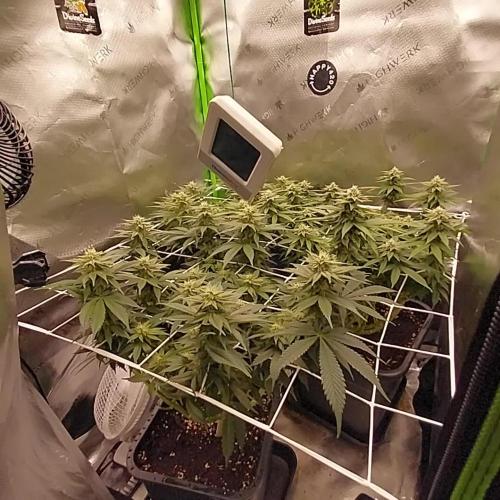
In der woche befanden sich die Pflanzen in der späten Blütephase mit klar fortschreitender Bud-Reifung. Die zuvor etablierten Trainings- und SCROG-Strukturen zeigten weiterhin ihre Wirkung, da die Haupttriebe optimal im Licht verteilt waren und eine gleichmäßige Canopy bildeten.
Die Blüten nahmen sichtbar an Dichte und Gewicht zu. Besonders die oberen Budsites entwickelten sich stark und begannen, sich deutlich zu verdichten. Die Harzproduktion nahm spürbar zu und die Pflanzen wirkten insgesamt sehr stabil in der finalen Füllphase.
Das Blätterdach blieb größtenteils vital, wobei einzelne ältere Fächerblätter begannen, ihre Nährstoffe in die Blüten umzuleiten.
👉 Eine sehr produktive Woche, in der die Buds klar an Masse und Struktur gewonnen haben.

Likes
34
Share


@BOMbolenath
Follow
Buds are getting bigger. It's developing well. This strain have a nice structure.
Likes
4
Share


@Organic473
Follow
I gave her a good trim. Fed her some bat guano juice. Now she is drying off for 2 days to use up that power…you can smell her 4 feet incoming.

Likes
15
Share


@Ultraviolet
Follow
Human Body
65% Oxygen (in all liquids and tissues, bones, and proteins)
18% Carbon (everywhere)
10% Hydrogen (in all liquids and tissues, bones, proteins
3% Nitrogen (in all liquids and tissues, proteins
1,5% Calcium (lungs, kidney, liver, thyroid, brain, muscles, heart, bones)
1% Phosphorus (urine, bones, DNA)
0,35% Potassium (enzymes)
0,25% Sulphur (proteins)
0,15% Sodium (in all liquids and tissues) (in terms of salt)
0,05% Magnesium (lungs, kidney, liver, thyroid, brain, muscles, heart)
The average adult male contains about 140 g of K(Potassium); the level varies with body weight and muscle mass. We ingest about 2.5 g per day of K from our food and excrete about the same amount. 0.0118 % of that is K40
The answer is that they were present when our earth was formed. Any radioactive material originally present at the formation of the earth would have decayed and disappeared if its half-life was short compared to the age of the earth. However, if its half-life were long, close to or greater than the age of the earth, then such materials would not have disappeared but are still with us today.
There are several radioelements in this category, such as the well-known elements uranium and thorium. Thorium (Th232) has a half-life of 14,000,000,000 years, uranium has two long-lived radioisotopes; U238 has a half-life of 4,500,000,000 years, and U235 has a half-life of 710,000,000 years. These give rise to the radium and thorium atoms found in all humans, acquired from the food we eat. That food, of course, obtained these materials from the soil in which it grew or on which it grazed.
Potassium is also in this category. There are actually three potassium isotopes: K39, a stable isotope, is the most abundant, at 93.26 % of the total; K41 is next in abundance at 6.73 % and is also a stable isotope. The potassium isotope of interest is a radioactive isotope, K40. It is present in all potassium at a very low concentration, 0.0118 %. It has a very long half-life, 1,260,000,000 years. When it decays 89 % of the events give rise to the emission of a beta ray with maximum energy of 1.33 MeV. The other 11 % of the decays produce a gamma-ray with an energy of 1.46 MeV
The forces required to forge thorium 232 can only be harnessed when traveling close to or at the speed of light, so essentially what I'm getting at is 0.0118% of every person alive is formed of the same element that was forged in the anvil of creation itself. We are all one & the same
German chemist Johann Wolfgang Dobereiner attempted to classify elements with similar properties into groups of three elements each. These groups were called ‘triads’. Dobereiner suggested that in these triads, the atomic mass of the element in the middle would be more or less equal to the mean of the atomic masses of the other two elements in the triad.
An example of such a triad would be one containing lithium, sodium, and potassium. The atomic mass of lithium 6.94 and that of potassium is 39.10. The element in the middle of this triad, sodium, has an atomic mass of 22.99 which is more or less equal to the mean of the atomic masses of lithium and potassium (which is 23.02). 9 controls the 6 and 3.
The Limitations of Dobereiner’s Triads are :
All the elements known at that time couldn’t be classified into triads.
Only four triads were mentioned – (Li,Na,K ), (Ca,Sr,Ba) , (Cl,Br,I) , (S,Se,Te).
2. Newland’s Octaves
English scientist John Newlands arranged the 56 known elements in increasing order of atomic mass in the year 1866. He observed a trend wherein every eighth element exhibited properties similar to the first.
Azomite contains 180ppm of thorium.
Your plant will thank you, you are welcome.
Most farmers do have not a proper understanding of what is Azomite and how to use it in gardening, especially if they practice organic farming. Continuous propagation and leaching effects of water deplete the essential minerals and micro-nutrients from the soils. Such soils remain weak, not able to support the production of fruits and vegetables. Azomite mineral contains micronutrients that supplement the soil. It also balances the minerals for growth and overall productivity. Constant use of this mineral rejuvenates your soil renewing its potency again. Azomite is a naturally mined mineral product that is ready to use. It’s a unique rock that comes from a mine in central Utah. Azomite requires no mixing or special preparation before use. It is derived from volcano ash that spewed out millions of years ago. It contains the widest range of minerals of all the rock dust in the world. Azomite provides plants with 70% essential elements. These elements include magnesium, calcium, potassium, and silicon for plant growth.
Facts About Azomite Fertilizer
It’s a natural mineral – 100% natural with no fillers or additives
Does not contain any harmful elements
Requires no special preparation before use
It’s odorless – very friendly to use
Does not restrict water penetration or aeration
Is easily broken down and absorbed into the soil
Does not burn plants.


Likes
5
Share


@CBTreee
Follow
These ladies are ready for flush. They are all super sticky and loaded with trichomes. I can’t wait to harvest and turn into rosin!
Likes
11
Share


@IndoorOrganix
Follow
They've started to grow their first sets of leaves and although temperature was a little higher than I'd liked they're coming along nicely. You can see the difference from just three days growth and then 3 days afer that! Adding a small amount of bio canna vega and molasses.

Likes
12
Share


@Willy_Balls
Follow
First week of flowering.
Girls are super happy. And drink a lot. I very much prefer the lower plant count with 8 plants. And I’m probably not going to go back to more than 9 plants. Perhaps will even try 6 or 7. 12 or 16 was a bit of overkill. Maybe with super short veg it has its place.
26.01 first day of flower.


Likes
1
Share

@JorgeNitales420
Follow
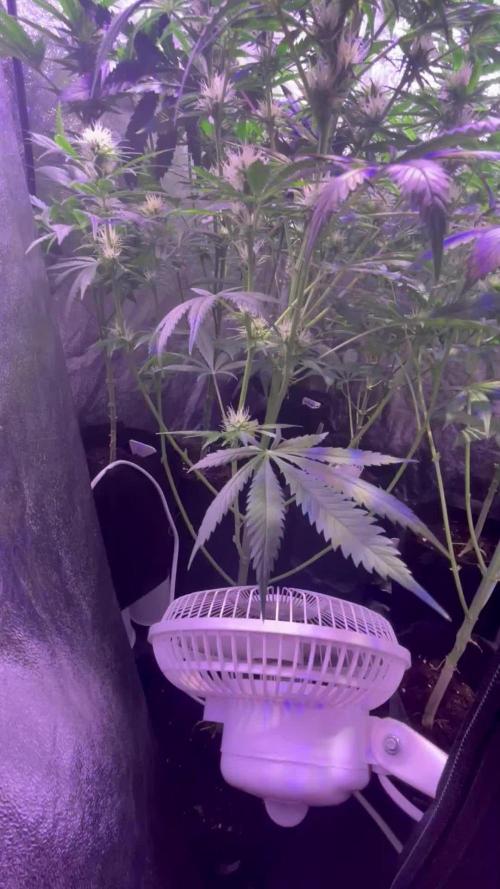
Week 5 of flower
Buds started to pack up in size, they started to smell like good shi
Tested the runoff a couple days ago and it eas around 4 EC, way to fkn much. Don't know if uptake did his job or this plants are so fkn resilient to hold 4 EC with no burned tip or another symptom
Anyways, watered with 600ppm till 20-30% of the runoff to control this, but since they dont have any symptom am not gonna do a hard flush

Likes
9
Share

@eldruida_lamota
Follow
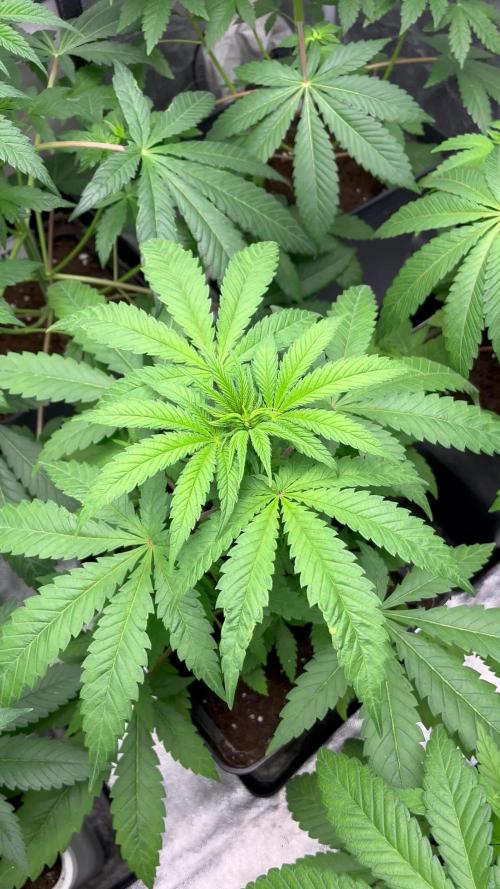
Que pasa familia, vamos con la primera semana de floración de estas Gomu Gomu Mango feminizadas de HighBreed.
Vamos al lío ,se colocaron en macetas de 7 litros definitivamente.
El ph se controla en 6.0 , la temperatura la tenemos entre 24/20 grados y la humedad ronda el 50%.
El ciclo de Floración puse 12 horas de luz, el foco está al 50% de potencia.
De momento va creciendo, tiene buen color y va progresando.
Gracias a Agrobeta por el kit para la temporada, unos jefes, siempre apoyando 💪.
- os dejo por aquí un CÓDIGO: Eldruida
Descuento para la tienda de MARS HYDRO.
https://www.mars-hydro.com
Hasta aquí todo, Buenos humos 💨💨💨
Likes
15
Share

@UnitedStrainsGermany
Follow
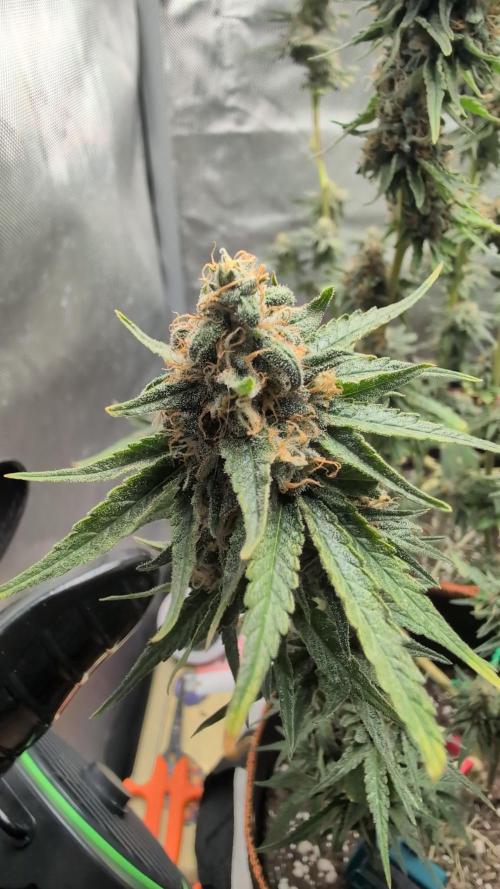
Die letzten 26h bevor die Ernte ist keine tripse mehr kein düngen nur noch flush mit 6.3 Leitungswasser sie werden in dryfembags getrocknet.

Likes
17
Share


@Brickie74
Follow
So far so good. The girls look strong, have been going well. Depending on how fast the keep growing I may have to switch to a 1 gal pot sooner than I thought.

Likes
25
Share

@GoodWeedBerlin
Follow
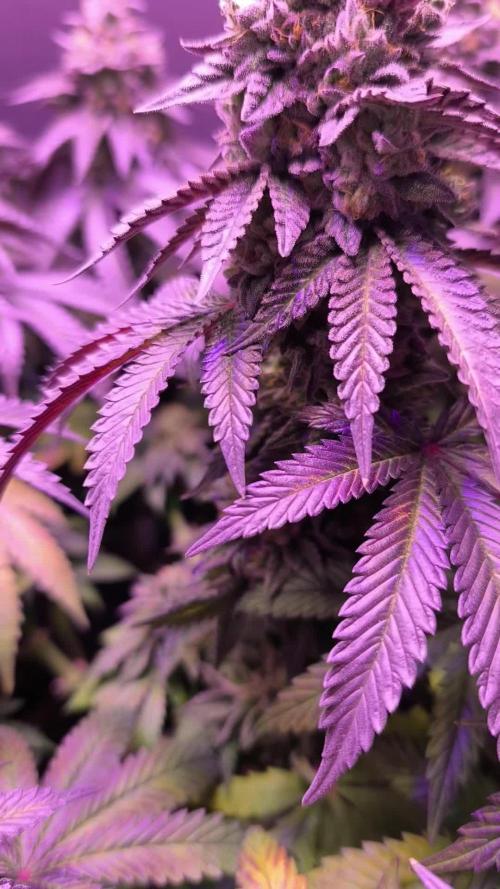
Es war zwar nicht geplant genau zur Wintersonnwende zu ernten, aber die Pflanze ist in ihrem Reifeprozess kerzengerade auf dieses Datum zugeschossen. Blütetag 64 war sie dann (nach meinem Gusto) fertig.
Die Ernte ist nassgetrimmt auf 3 Dryferm-Bags verteilt zurück im Zelt. Dort ist der Lüfter aus, so komm ich auf halbwegs konstante 60% Luftfeuchtigkeit.
1-2 mal am Tag stelle ich den Luftbefeuchter vors Zelt und schalte den Lüfter für ein paar Minuten an um die Luft auszutauschen ohne die Luftfeuchtigkeit zu verlieren.
Wenn ich das Zelt aufmache ist aus dem "light" des Geruchs ein "heavy" geworden. Heftiger Gas-Geruch, der das Clorophyl komplett überdeckt und die süße Note nur als Nuance mit sich trägt.
Edit: Erster Rauchbericht nach 9 Tagen in den Dryferm-Bags: Geschmack und Wirkung stehen dem Aussehen in nichts nach. Wenn man erstmal einen kalten Zug nimmt, schmeckt das ganze nach der Mischung die sich im Zelt breit gemacht hatte. Weichgespülter Kush mit Süße die in Richtung Kirsche geht. Wenn der Jib dann brennt, kommt beim Einatmen am Anfang ein smoother Kush Geschmack, der im Mund süßer wird und nach dem Ausatmen einen kirschsüßen Mund hinterlässt. Die Wirkung ist positiv, fast euphorisch. Kein Couchlock, aber auch kein Sativapush.
Likes
1
Share


@ganjermaster
Follow
I'm enjoying a lot this genetic, the root system is super healthy and that's giving strong plants with desire to grow and produce frosty flowers :)

Likes
2
Share


@EtnoGrow
Follow
1st photo
We did the scrog, it helped us a little more to use as support to tie the branches with threads and manipulate them as we wanted, so we tamed it. but they kept growing as my colleague affirms
Likes
25
Share


@BudHaks
Follow
As you can see, she is getting thicker as days go by! Looking to harvest her in 2 weeks! Minor light burn on the top cola, but other then that no deficiencies at all.
Likes
7
Share

@Fireproof
Follow
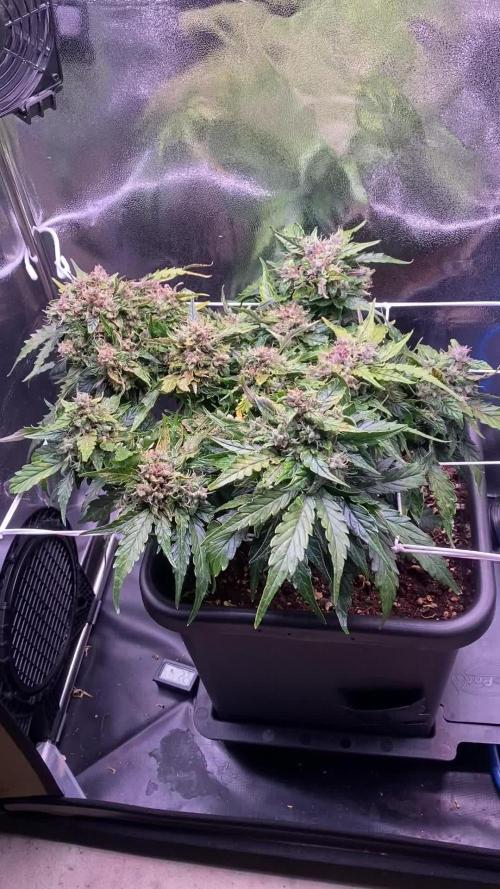
Alles gut. Die Blüten werden immer kräftiger. Riecht inzwischen sehr stark, wenn ich das Zelt das im Keller steht öffne riecht es danach gerade noch stundenlang nach Gras im Hausflur 😇


Likes
2
Share


@DrJekyll_MrKush
Follow
I'm definetely happy.
Everything is going well, acarians have destroyed bad bugs and babies are getting bigger every day, more and more.
I keep bend all side branches and plants are getting used to the lst and they are spreading and covering pretty much every square avaiable.
I hope to be capable to manage all the space avaiable.
This is my first time doing lst and honestly, it's the real deal.
No big stress,
Plants are so bigger, at the same moment, I am comparing with my previous diary with the same strain.
Changes are impressives.
I'm increasing, little by little, nutes.
For now leaves are looking healthy to me, nice green.
When lights first turn on, new leaves are light green. After couple of hours they are turning darker.
Waiting for white pistils, I'm expecting them in 4/5 days.
Have a good day folks, I'll keep you updated !
Cheers
