


@skaterblasted
Follow
Days 99 - 105 (from sprout)
8/30/24 - 9/5/24
Raised light above canopy of The Good Shit - PAR on main tops is 800-700+ while remaining lowers are seeing closer to 450-500
Loompa's Headband x TK fading to a close this week - trichome check starting to show amber on the bracts
Sweet 16 S1 now starting senescence and a little fading on some fan leaves
The Good Shit showed signs of some overwatering, so a newly made FPE was added to feed schedule to assist the microbiology
Light schedule lowered to 10 hrs this week
IPM: Applied enzymes (tweetmint) at a rate of 0.5 fl oz to 1/2 gallon and sprayed on cover crops + mulch throughout the week. Significant decrease in pest population, now needs a high quality compost top dressing for long term correction


@SupremeTimmy
Follow
Hi to everyone who watches Report. The ninth week of flowering began there. Blueberries look and smell. Deliciously. Follow the advice of the master. I decided not to radically remove the leaves and I removed only the largest ones. I prepare the plants for the log house so I stop using mineral water for a while


@PEAKYPLANTERS
Follow
Good evening and welcome back, fantastic friends of the old Weed!
Sharing my growth with you is always a pleasure! These sensual -looking beauties begin to have a really nice perfume .... I think we will begin to irrigate with only water from now!
see you around




@SamDo
Follow
Week twenty-two is officially done on the Pineapple Upside Down Cake.
This week is a turning point, marking the end of vegetative growth and the start of the flowering transition.
I decided to switch the light cycle to twelve-twelve.
Initially, the plan was to wait for a stronger recovery, but the reality is simple: it wasn’t happening.
The plant was given roughly three full weeks to acclimate after stress, and the response stayed limited.
Rather than staying stuck in an endless waiting phase, I chose to move forward.
This means accepting that flowering may not be extremely vigorous or high-energy.
That’s fine. This run is also about observation, learning, and adapting.
Flowering was initiated gently, at around three hundred PPFD, to avoid adding more stress.
At the same time, I switched the nutrient program to Athena bloom and adjusted the recipe accordingly.
The plant has now been under flowering conditions for about twenty-four to forty-eight hours.
Over the coming week, I expect to see the first signs of stretch.
It’s a bit frustrating, because structurally the plant was doing really well.
The LST work created a clean, balanced canopy, and the potential was clearly there.
Now the focus is simple.
No rushing.
No over-correction.
Just letting the plant transition naturally into flower and observing how she reacts.
Next week will officially mark the first true week of flowering.
From there, we’ll reassess posture, stretch, and overall vitality.
For now, the plant is left alone to settle into its new rhythm.
That’s it for week twenty-two.
See you next week.


@38PLAN
Follow
Siamo all'8 settimana le piante hanno sviluppato fiori ben formati,ora dobbiamo avere pazienza ed aspettare che diventino ancora più grandi,la maggior parte dei pistilli é ancora bianca e le piante ancora verdi,questo significa in grandi linee che la pianta può ancora produrre,incredibile la pianta in fondo a sinistra ha quasi toccato il soffitto,un autofiorente di eccezionali dimensioni,ancora all'inizio della fioritura


@CaliBlueDreamin
Follow
Added a second 100w LED. Everything looking healthy since catching up on nutes. Back right (red) is starting to get frosty, definitely approaching harvest with that guy. Front right (white) will be next and front left (blue) seems to be finishing it's stretch. Really hoping once I pull and chop red plant early, ol yellow In the back left will erupt with it's new found space. I definitely failed Scrogging, just too many branches and bud sites for me to keep up with. Defoliated like crazy after a feeding this week.


@Gram_Solo
Follow
Last week for these 3 remaining Runtzz
I flushed them 4 days ago with flawless finish they had 2 feeds of flawless so far 1 more and then we chop them on Tuesday. Will be doing 10-15 days drying in a 3x3.
Looking very frosty all 3 of these now orange hairs all curled and looks like they have packed out really well!
The smell when you open the tent is heaven!! Old school bud smells!
The journey is nearly fully complete!
😎😎😎😎
Will post harvest pics of these 3 on the next update!
12/05/25
Last 3 have been chopped and are now drying
21/05/25
10 days later and still small popcorns not snapping off which is great, I reckon 2-3 more days and we can get these 3 trimmed and displayed! Not long now will be just in time for contest end


@Northern_Ent
Follow
June 15: going good and will do second round of topping tomorrow. Adjusted tie downs.
June 16: adjusted tie downs and watered with soluble seaweed extract and a bit of Epsom salts.
June 17: topped this morning leaving four bud sites on each side. Leave first and third node growth tips, but remove them at the second node. This will now be 8 colas, but I’ll top once more for 16.
June 18: adjusted tie downs and did foliar spray of Extreme Blend in the evening.
June 20: released tie down in the morning.
Started the second batch of compost tea. Video shows the recipe I started using last year. Leave overnight and use within 24 hours. It should smell fresh, and if it smells ‘off’ or sulphurous it’s gone anaerobic and should be thrown out.
Use whatever you want in your compost tea recipe. Key things are blackstrap molasses (sugar and trace metals), some fresh compost, and I use coco coir to provide a substrate or matrix for the bacteria to grow on. Seems to work.


@HegauHillsFarmers_D23
Follow
In dieser Woche haben die Blüten an Größe dazu gewonnen.
Auch Trichome bilden sich jetzt um die Blütenblätter und der Geruch wird langsam stärker.😳
Vorallem süße und Zitronen Terpene sind schon heraus zu riechen 🍋🍬⛽️
Ich habe jetzt den Blühstimulator etwas reduziert und dafür Overdrive dazu gegeben, denn jetzt wird es an der Zeit die Blüten zu mästen.😏
Leider sind die braunen bis rostfarbenen Punkte auf den Blättern nicht verschwunden.. es hat sich aber zu letzter Woche verlangsamt.
Ich halte den pH-Wert weiterhin etwas höher wie zu Beginn und hoffe das es so stoppt.
Den Blüten hat es weiterhin noch nicht geschadet.🌱🍀


@Neo09
Follow
🌌🛸 hey hou,
just putting in all pics from begging till now, cos im really low with the time,.. behind this project is biggest story of my life, not only grow story, its much more behind.. i wish nobody to get such a grow in way as i do,. actually is nothing possitive there and this project i started, cos i lost everthing what in life importnt is. with this project, once, i wanted to give back just a litle bit of that what i got,.. and it still not eneough,. some things you cant buy, you cant pay,.. and you can get back... peace and stay hard, thing about what you decide, think about twice..
shorts_status_processing


@Peteg420
Follow
Week 2 and three i was really busy and didn't get good picks.. But I have 3 thorsberry regs.. I can't wait til I can see if they are male or female lol. Im slowly working toward getting my grow all set up.. Thx for any advice$!



@Stoney_Stark
Follow
Sorry I have been slacking on this diary, the plants look great. The 3WOK OG is nice and big with plenty of bud sights



@Ultraviolet
Follow
Once again she passes my expectations, late to the show with trichome production. I'm surprised there is purple on the bud, maybe Purpinator does work. I thought I could see hints under the grow lights and thought my eyes were deceiving me, I was just being hopeful. But nah 2 of the 3(under the UV) have developed a beautiful tone of purple. I was never going to bother with a deep freeze but maybe the whole bud will change given conditions, that would be something, fingers crossed. 🤔 was a little skeptical that reducing temps humidity would change density, but it does, buds are solid something I've not been able to achieve before.
Rule of thumb is never to surpass 60% RH in the flowering phase and try to progressively reduce it down to 40% in the last 2–3 weeks before harvest. The plant will react as it seeks to protect its flowers, responding by producing denser buds and a higher concentration of resin. Cannabis plants are sensitive to sudden temperature changes, especially in the flowering stage. Extreme heat or cold can impact bud density and overall yields. In nature as a defense mechanism from cold, the plant sensing sudden dips in temperature will attempt to remove the pockets of air within the bud, it achieves this by compacting itself in doing so to better protect itself from cold snaps which are normally indicators in nature that worse weather is on the way.
Terpene levels are the highest just before the sun comes out. Ideally, you want as many terpenes present in your plants as possible when you harvest. Cannabis plants soak up the sun during the day and produce resin and other goodies at night. The plant is at its emptiest from "harvest undesirables" so to speak right before the lights on. Boiling cannabis roots during harvesting slows down the drying process. When you boil cannabis roots, it shocks the plant, closing the stomata on the leaves. This prevents massive moisture loss through the leaves, leaving only the floral clusters actively losing moisture at a reduced pace. I've always run a strict 60/60 and it took almost twice as long to dry to a snap than previous grows where I didn't boil for what it's worth.
Chlorophyll is good for the plant but not for you. When you harvest the buds, even after you flush them, if you flush them, they’re still filled with chlorophyll. Freshly cut buds are greener than dried buds because they still contain loads of chlorophyll. However, when rushed through the drying process, the buds dry but retain some chlorophyll, and when you smoke it, you will taste it. Chlorophyll-filled buds are smokable, but they aren’t clean. Slow drying gives the buds enough time and favorable conditions to lose the chlorophyll and sugars, giving you a smoother smoke. How the plant disposes of the chlorophyll and sugars by a process of chemically breaking them down and attaching the decomposed matter once small enough to water molecules which then evaporate back into the ether. Time must be given to the process to break down the chlorophyll and sugars. Think of it like optimizing the environment for decay.
All the nutrients it could ever need are in abundance, it eats nutrients based on its demand for growth, which is dictated primarily by available light.
Plant growth and geographic distribution (where the plant can grow) are greatly affected by the environment. If any environmental factor is less than ideal, it limits a plant's growth and/or distribution. For example, only plants adapted to limited amounts of water can live in deserts. Either directly or indirectly, most plant problems are caused by environmental stress. In some cases, poor environmental conditions (e.g., too little water) damage a plant directly. In other cases, environmental stress weakens a plant and makes it more susceptible to disease or insect attack. Environmental factors that affect plant growth include light, temperature, water, humidity, and nutrition. It's important to understand how these factors affect plant growth and development. With a basic understanding of these factors, you may be able to manipulate plants to meet your needs, whether for increased leaf, flower, or fruit production. By recognizing the roles of these factors, you'll also be better able to diagnose plant problems caused by environmental stress.
Water and humidity
*Most growing plants contain about 90 percent water. Water plays many roles in plants. It is:*
A primary component in photosynthesis and respiration
Responsible for turgor pressure in cells (Like the air in an inflated balloon, water is responsible for the fullness and firmness of plant tissue. Turgor is needed to maintain cell shape and ensure cell growth.)
A solvent for minerals and carbohydrates moving through the plant
Responsible for cooling leaves as it evaporates from leaf tissue during transpiration
A regulator of stomatal opening and closing, thus controlling transpiration and, to some degree, photosynthesis
The source of pressure to move roots through the soil
The medium in which most biochemical reactions take place
Relative humidity is the ratio of water vapor in the air to the amount of water the air could hold at the current temperature and pressure. Warm air can hold more water vapor than cold air. Relative humidity (RH) is expressed by the following equation:
RH = water in air ÷ water air could hold (at constant temperature and pressure)
The relative humidity is given as a percent. For example, if a pound of air at 75°F could hold 4 grams of water vapor, and there are only 3 grams of water in the air, then the relative humidity (RH) is:
3 ÷ 4 = 0.75 = 75%
Water vapor moves from an area of high relative humidity to one of low relative humidity. The greater the difference in humidity, the faster water moves. This factor is important because the rate of water movement directly affects a plant's transpiration rate.
The relative humidity in the air spaces between leaf cells approaches 100 percent. When a stoma opens, water vapor inside the leaf rushes out into the surrounding air (Figure 2), and a bubble of high humidity forms around the stoma. By saturating this small area of air, the bubble reduces the difference in relative humidity between the air spaces within the leaf and the air adjacent to the leaf. As a result, transpiration slows down.
If the wind blows the humidity bubble away, however, transpiration increases. Thus, transpiration usually is at its peak on hot, dry, windy days. On the other hand, transpiration generally is quite slow when temperatures are cool, humidity is high, and there is no wind.
Hot, dry conditions generally occur during the summer, which partially explains why plants wilt quickly in the summer. If a constant supply of water is not available to be absorbed by the roots and moved to the leaves, turgor pressure is lost and leaves go limp.
Plant Nutrition
Plant nutrition often is confused with fertilization. Plant nutrition refers to a plant's need for and use of basic chemical elements. Fertilization is the term used when these materials are added to the environment around a plant. A lot must happen before a chemical element in a fertilizer can be used by a plant.
Plants need 17 elements for normal growth. Three of them--carbon, hydrogen, and oxygen--are found in air and water. The rest are found in the soil.
Six soil elements are called macronutrients because they are used in relatively large amounts by plants. They are nitrogen, potassium, magnesium, calcium, phosphorus, and sulfur.
Eight other soil elements are used in much smaller amounts and are called micronutrients or trace elements. They are iron, zinc, molybdenum, manganese, boron, copper, cobalt, and chlorine. They make up less than 1% of total but are none the less vital.
Most of the nutrients a plant needs are dissolved in water and then absorbed by its roots. In fact, 98 percent are absorbed from the soil-water solution, and only about 2 percent are actually extracted from soil particles.
Fertilizers
Fertilizers are materials containing plant nutrients that are added to the environment around a plant. Generally, they are added to the water or soil, but some can be sprayed on leaves. This method is called foliar fertilization. It should be done carefully with a dilute solution because a high fertilizer concentration can injure leaf cells. The nutrient, however, does need to pass through the thin layer of wax (cutin) on the leaf surface.
It is to be noted applying a immobile nutrient via foliar application it will remain immobile within the leaf it was absorbed through.
Fertilizers are not plant food! Plants produce their own food from water, carbon dioxide, and solar energy through photosynthesis. This food (sugars and carbohydrates) is combined with plant nutrients to produce proteins, enzymes, vitamins, and other elements essential to growth.
Nutrient absorption
Anything that reduces or stops sugar production in leaves can lower nutrient absorption. Thus, if a plant is under stress because of low light or extreme temperatures, nutrient deficiency may develop.
A plant's developmental stage or rate of growth also may affect the amount of nutrients absorbed. Many plants have a rest (dormant) period during part of the year. During this time, few nutrients are absorbed. Plants also may absorb different nutrients as flower buds begin to develop than they do during periods of rapid vegetative growth.
432 Hz is said to be mathematically consistent with the patterns of the universe. Studies reveal that 432 Hz tuning vibrates with the universe’s golden mean PHI and unifies the properties of light, time, space, matter, gravity and magnetism with biology, the DNA code and consciousness. When our atoms and DNA start to resonate in harmony with the spiraling pattern of nature, our sense of connection to nature is said to be magnified.
Another interesting factor to consider is that the A=432 Hz tuning correlates with the color spectrum while the A=440 Hz is off.
Audiophiles have also stated that A = 432 Hz music seems to be non-local and can fill an entire room, whereas A=440 Hz can be perceived as directional or linear in sound propagation.
Once you adopt the idea that sound (or vibration in general) can have an equalizing and harmonizing effect (as well as a disturbing effect), the science of harmony can be applied to bring greater harmony into ones life or a tune to specific energies. There is a form of absolute and of relative harmony. Absolute harmony can for example be determined by the tuning of an instrument. The ancients tuned their instruments at an A of 432 Hz instead of 440 Hz - and for a good reason. There are plenty of music examples on the internet that you can listen to in order to establish the difference for yourself. Attuning the instrument to 432 Hz results in a more relaxing sound, while 440 Hz slightly tenses up to body. This is because 440 Hz is out of tune with both macro and micro cosmos. On the contrary, 432 Hz is in tune. To give an example of how this is manifested micro cosmically: our breath (0,3 Hz) and our pulse (1,2 Hz) relate to the frequency of the lower octave of an A of 432 Hz (108 Hz) as 1:360 and 1:90.
It is interesting to note that 432 Hz was the standard pitch of many old instruments, and that it was only recently (19th and 20th century) the standard pitch was increased. This was done in order to be able to play for bigger audiences. Bigger audiences (more bodies) absorb more of the lower frequencies, so the higher pitch was more likely to “cut through”. One of the oldest instruments of the world is the bell ensemble of Yi Zeng (dated 423 BC), tuned to a standard F4 of 345 Hz which gives an A= 432 Hz. The frequency of 345 Hz is that of the platonic year! Similarly many old organs are tuned in an A=432 as well; for example: St. Peter’s Capella Gregoriana, St. Peter’s Capella Giulia, S. Maria Maggiore in Rome.
Maria Renold’s book “Intervals Scales Tones and the Concert Pitch C=128 Hz” claims conclusive evidence that 440 Hz and raising concert pitch above scientific “C” Prime=128 Hz (Concert A=432 Hz) disassociates the connection of consciousness to the body and creates anti-social conditions in humanity.
The difference between concert pitch A=440 Hz and Concert A=432 Hz is only 8 cycles per second, but it is a perceptible difference of awareness in the human consciousness experience of the dream we share called existence.

shorts_status_processing

@SupremeTimmy
Follow
I welcome everyone who came in for the first time or has long been following my blueberries. the girl blossoms and smells and already showers herself with trichomes.
two days ago I used iron chelate on a sheet to stimulate photosynthesis and also, due to phosphorus deficiency, introduced dry water-soluble fertilizer NPK 10/54/10


@Hempface86
Follow
Ladies and gentlemen, here we are at the start of week 3 and so far so good.. She has only gotten a light feeding Maxibloom about .1 tsp per gallon around the edges of the pot, so the roots have to go searching.. I haven't given her any liquid in 4 days in the pot still has some weight to it so i'm gonna give her another day or two before feeding..Kannabia Seeds much appreciated, these genetics are great.
All they needed was some good medium, and there isa match made in Heaven .. I hope everybody's doing well and so are their ladies.God bless and heavy growing 🙏 ✌️



@AestheticGenetix
Follow
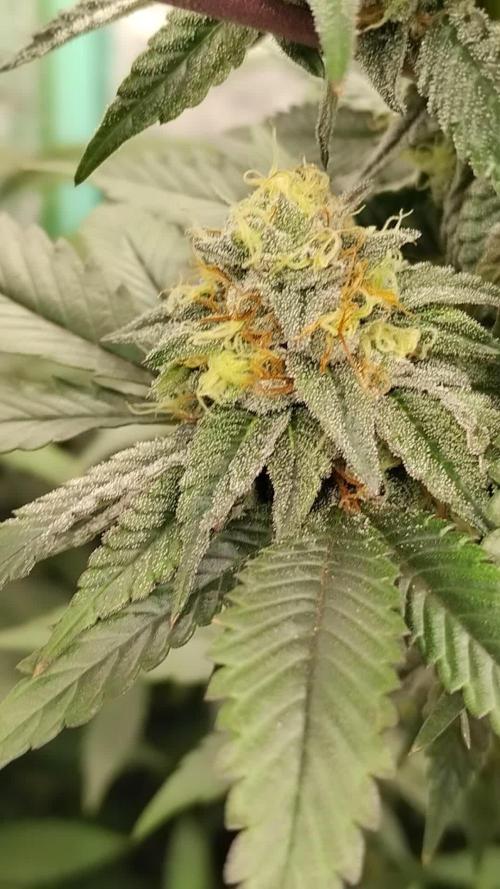
Plant is starting to fill out nicely. Bursting with pistils. I'm curious to see how she turn out with the extra light wattage and the extra pot size as well as extra week or two to flower her longer


@nonick123
Follow
Día 57 (16/12) CBD Auto 20:1 #1 ha empezado a bajar el consumo de agua... pero sigue creciendo! ¿Tendrá fin el stretch de esta planta?
CBD Auto 20:1 #2 empieza a perder hojas por senescencia. Está a punto de cosecha!?!?!?!
LSD-25 Auto está increiblemente dura y brillante. Un color morado oscuro casi negro
OG Kush Auto ha bajado un poco el consumo de agua, pero empieza a formar unos cogollos monstruosos, completamente cubiertos de resina+
Día 58 (17/12) CBD Auto 20:1 #1 empieza a tocar la lampara! Vuelvo a subir la lampara....
Además presenta una ligera coloración morada en las puntas de las hojas... ¿Coloración natural o deficiencia de P?
CBD Auto 20:1 #2 tiene un montón de hojas con senescencia acelerada de un dia para otro! Ha llegado el día de la cosecha! 😍💥
LSD-25 Auto sigue acercandose al final... todos los cogollos son duros como pelotas de golf 💥
OG Kush Auto estaba practicamente seca! Vuelvo a darle 1250 ml de H2O RO. Va a hacer unos cogollos brutales
Día 59 (18/12) CBD Auto 20:1 #1 - empieza a mostrar coloración morada en las puntas de las hojas ¿Genetica o deficiencia? Aprovecho el riego con BIO PK 5-8 10 ml/L y darle un booster!
LSD-25 Auto - se acerca la cosecha! 😍💥 Cogollos duros como piedras en todas partes y bajando el consumo de agua...
OG Kush Auto - muestra más avanzada a deficiencia de hace unos dias, de modo riego con BIO PK 5-8 10 ml/L. A ver como le sienta!
Día 60 (19/12) CBD Auto 20:1 #1 - sigue mostrando más deficiencia de P con alguna mancha en las hojas superiores. Menos mal que ayer la regué con el BIO PK 5-8!
LSD-25 Auto - Le miro los tricomas y aún no está lista. 50% trasparentes + 50% nublados. Pero solo faltan días!
OG Kush Auto - Está empezando a apilar cogollos de forma brutal, y el olor es una maravilla! Además se muestra sedienta! Eso es buena señal
Día 61 (20/12) Busy time
Día 62 (21/12) LSD-25 Auto - muy cerca de la cosecha. Apenas consume agua....
Día 63 (22/12) LSD-25 Auto - harvest day! Tricomas mayoría nublado y alguno ambar. Perfecta!
💦Nutrients by Bio Tabs - www.biotabs.nl/en/
🌱Substrate PRO-MIX HP BACILLUS + MYCORRHIZAE - www.pthorticulture.com/en-us/products/pro-mix-hp-biofungicide-plus-mycorrhizae
"GDBT420" 15% DISCOUNT code for the BIOTABS Webshop https://biotabs.nl/en/shop/


@ThatoneAKguy
Follow
3 of the 4 seeds popped. I can see the other one in the rapid rooter but I added another stardawg just to keep things moving. I started with 300 ppm and got the NFT system running and new HLG 260’s at 36” above them turned all the way down.


@Spliffing_Around
Follow
Terps on point on each pheno , 2 of them turned killers, it’s a pity I didn’t save any clone.
after almost 2 month cure and testing with Gemma cert the THC levels were around 16%. The plants were initially growing in a tent, were moved a lots. I hope that I will be able to achieve higher results with fast buds in the future. Despite the small number , the hit is really strong and has an indica side to it .